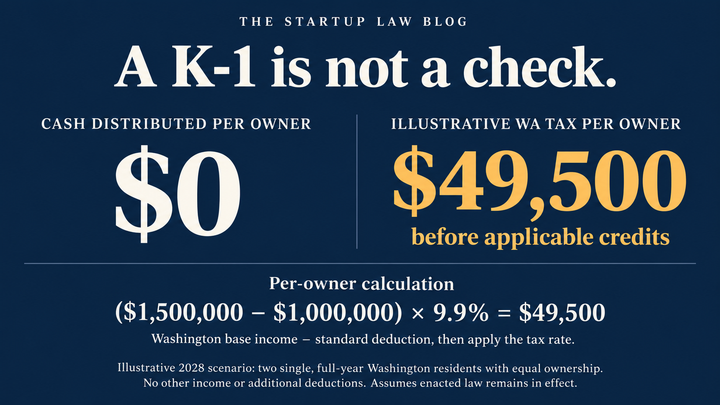

Washington’s new income tax starts at 9.9% on income above the $1 million standard deduction. If you’re reading this blog, you probably already know the details of ESSB 6346. The question I keep hearing from clients isn’t about how the tax works today — it’s about where it’s headed.
My concern is that Washington could raise its rate or broaden its income-tax base after implementation. Several states have increased income taxes, but that history does not establish an inevitable outcome for Washington. Rates have also been reduced. The useful planning question is how your decisions hold up under different future laws—not whether anyone can name the year of the next increase.
(For the mechanics of ESSB 6346, see Washington’s New Income Tax: What Founders, Investors, Athletes, and High Earners Need to Know. For the full tax landscape, see Washington State Taxes.)
This post is part of our Complete Guide to Washington's New Income Tax.
The Pattern: Rate Creep and Threshold Creep
“Rate creep” describes rising tax rates. “Threshold creep” can describe a legislated reduction in an entry point or inflation eroding a fixed dollar amount. Neither happens automatically in every state. Indexing, deductions, filing status and changes to the tax base matter alongside the headline rate.
One plausible mechanism is budget pressure: once a tax exists, lawmakers may consider changing its rate or coverage instead of creating a new revenue source. That is a political risk worth considering. Lawmakers can also cut spending, change other taxes, use reserves or reduce an existing income tax. Which choice they make depends on circumstances.
The examples below illustrate changes in both directions. They are selected histories, not a comprehensive survey proving that every state follows one path.
What Other States Show Us
New Jersey adopted its gross income tax in 1976. Its published rate history shows a 10.75% top rate on income above $5 million for 2018–2019 and above $1 million from 2020. That later threshold change is a concrete example of expanding a top bracket. It does not establish that today’s top bracket reached middle-class households for most of the tax’s history.
Connecticut adopted its broad income tax in 1991, with a transitional 1.5% rate for 1991 and 4.5% beginning in 1992. The legislature’s rate history identifies 2003 as the increase in the top rate from 4.5% to 5%, not an increase above 4.5% within two years of enactment. Later changes included both higher top rates and lower rates in bottom brackets. Adoption, subsequent increases and subsequent cuts should be distinguished.
Illinois provides an example of increases and partial reversals. Its official historical table shows 2.5% for 1969–1982, 3% for 1990–2010, 5% for 2011–2014 and 3.75% from 2015 through June 2017. The current rate is 4.95%, effective July 1, 2017. The long-run rate rose, but the path was not uniformly upward.
California voters approved Proposition 30’s temporary high-income rate increases in 2012. Proposition 55 extended those income-tax increases through 2030. An extension is not the same as making them permanent. A 2025 Legislative Analyst’s Office analysis describes a separate proposal to make them permanent; a proposal is not evidence of enactment. The lesson is to check each extension’s actual legal status and sunset.
Oregon also illustrates why selected headline rates do not prove a universal trajectory. The Legislative Revenue Office’s history records reductions in the first three personal income-tax rates from 5%, 7% and 9% to 4.75%, 6.75% and 8.75%, effective in 2020. Comparing Oregon’s brackets with Washington’s separate deduction does not, by itself, measure historical bracket creep.
These examples support concern about future changes, not a rule that rates double within 20–30 years. For a current example of reductions, Indiana’s Department of Revenue lists 2.95% for 2026 and 2.90% for 2027. A credible Washington plan should allow for increases, stability and reductions.
Washington’s Specific Fiscal Dynamics
Here are the policy risks I would consider for Washington. They are reasons to test alternative outcomes, not evidence that a particular increase will occur.
Revenue volatility. Income from capital gains, stock option exercises and business sales can vary substantially between years. Concentration in those income sources creates a risk that receipts fall below a forecast. Whether a future downturn produces a shortfall—and whether lawmakers respond with tax increases—depends on the economy, the forecast and their policy choices.
The standard deduction has an indexing provision. Section 316 directs adjustments beginning in October 2029 and each October of an odd-numbered year thereafter, with the adjusted amount effective for taxes due in the following calendar year. That is not the same wording as “beginning in tax year 2030.” The statute specifies a CPI-based calculation and rounding. Use DOR’s published amount for the applicable filing period; do not model a permanently frozen $1 million deduction or assume a fixed 10–15% erosion after indexing.
Spending commitments. New revenue can become part of an ongoing budget, which may make later reductions politically difficult. But “not earmarked” is too broad: §202 directs income-tax receipts to the general fund for specified purposes and requires a 5% transfer to the fair start for kids account beginning July 1, 2029. Budget pressure alone does not establish that tax increases are inevitable.
Political math. A tax concentrated on high earners may be easier to propose increasing than a broadly paid tax. That is a judgment about incentives, not a verified taxpayer count or a claim that other voters have no stake in the outcome. Revenue estimates, employment, investment and voter preferences can affect the politics.
What the Legislature Already Tried This Session
The chronology matters. SB 6229 and HB 2292 were introduced before ESSB 6346 was signed on March 30, 2026. They proposed adding federally excluded QSBS gain to the capital-gains tax calculation under chapter 82.87 RCW; they were not post-enactment amendments to the new income-tax statute. The proposals concerned qualified small business stock. The official bill histories checked September 9, 2026 do not record passage. Consult the bill text before describing the affected tax base.
The QSBS proposals show that some legislators have considered changing an exclusion. They do not establish what a future legislature will pass, when it will act or which effective-date and transition rules it will choose. Monitor actual proposals and enactments separately from predictions.
(For more on the QSBS add-back proposals, see Does QSBS Avoid Washington’s 9.9% Tax? and SB 6229 / HB 2292 Analysis.)
The Migration Factor
Relocation alternatives may influence Washington’s tax-policy choices, but interstate competition is not unique to Washington. Compare the full tax systems and practical costs of potential destinations; a state with no broad individual income tax may impose other substantial taxes.
Some taxpayers may respond to higher taxes by moving, changing investment plans or altering income timing. The size and revenue effect of those responses require evidence. This article does not establish a self-reinforcing cycle in which departures necessarily force a lower threshold and cause further departures.
Jobs, family ties, business relationships and amenities may make remaining in Washington attractive despite the tax. Those considerations differ by person. For founders, the corporation’s state of incorporation is not the same as the shareholder’s domicile or tax residency; incorporating elsewhere alone does not eliminate personal Washington tax.
(For a detailed comparison, see Washington vs. California: A Tax Comparison for Founders and Investors and Washington vs. Oregon vs. Nevada.)
Planning Scenarios, Not a Forecast
The following are hypothetical planning scenarios, not a forecast of legislative dates, a recession or future tax brackets:
Enacted-law scenario: Model the 9.9% tax scheduled for January 1, 2028 using the applicable deductions, allocation rules and credits. Include §316 indexing according to the published amounts. Recheck changes before implementation and before each transaction.
Higher-tax scenario: Test an illustrative higher rate or smaller deduction to see how sensitive your plan is. These inputs are assumptions for analysis, not proposed or enacted Washington brackets and not a prediction of when lawmakers will act.
Unchanged or lower-tax scenario: Also test continued application of the enacted structure and possible reductions or repeal. A plan that is attractive only if taxes rise sharply deserves scrutiny before you incur irreversible costs.
Refresh these scenarios when legislation, official guidance or your circumstances change. An assumed legislative timetable should not determine a transaction or move.
What This Means for Planning
For long-term estate planning, retirement accounts, business entity choice and domicile decisions, compare several tax scenarios. Do not assume a higher rate and lower deduction as established facts. Prefer choices that remain useful across plausible outcomes, after considering legal, financial and personal costs.
The 2026–2027 planning window may be valuable, but accelerating income is not automatically beneficial. Roth conversion decisions, option exercises and asset sales can trigger federal tax, Washington capital-gains tax, liquidity needs and loss of deferral. Compare the total cost now with the expected cost later. Some acceleration is restricted by applicable tax or contract rules; a transaction’s closing date alone may not establish when all related income is recognized.
(For specific planning strategies, see Washington’s New Tax Reality: Why 2028 Changes Everything for High Earners.)
The Bottom Line
Washington’s 9.9% income tax is a material planning issue. My concern about future expansion remains, but history supplies examples and risks—not certainty that rates will rise or a timetable for increases. Plan under enacted law, test alternatives and update the analysis as facts change.
Plan accordingly.
Concerned about where Washington’s tax rates are headed? Book a 20-minute intro call to discuss how to structure your affairs for both today’s tax and tomorrow’s. Also see: Washington State Taxes Guide | Income Tax Planning Guide for High Earners
Related Posts
- Washington vs. California: A Tax Comparison for Founders and Investors
- Stock Option Exercise Timing: Planning Before Washington's 2028 Income Tax
- Washington's New Income Tax: What Founders, Investors, Athletes, and High Earners Need to Know
- How Washington's New 9.9% Income Tax Applies to Stock Options and RSUs
- How to Change Your Washington Domicile to Avoid the Income Tax
- Washington's New Income Tax: The Complete Guide
- Washington Now Expects 25,000 Households to Pay the Income Tax, Not 21,000
This post is for educational purposes only and is not legal or tax advice. Consult a qualified attorney about your specific situation.