
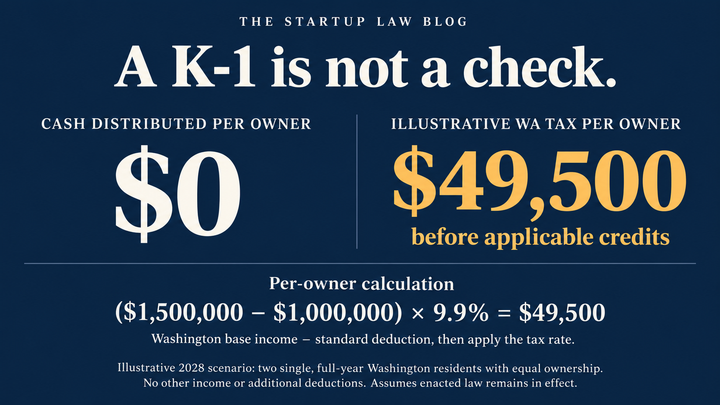
Two owners. $3 million in annual profit. No distributions.
“New equipment next year. And the bank wants the loan paid down.”
“So none of it comes home?”
“No. But $1.5 million still lands on each of our K-1s.”
“We didn’t take it.”
“The tax follows the income.”
Watch the 90-second example at the end of this article.
Washington’s new income tax creates a cash-flow problem for owners of profitable pass-through businesses: the income on a K-1 can far exceed the cash the owner actually receives.
Under the enacted law, the tax begins with 2028 income at a rate of 9.9%. The calculation starts with federal adjusted gross income, subject to Washington adjustments and deductions. Income allocated by an S corporation or partnership can be included even when the business makes no distribution.
The federal pass-through rules already work this way. S corporation shareholders and partners report their shares of income under the applicable tax rules. A cash distribution is not the event that determines whether that annual income is reportable. Washington’s new tax adds a state-level consequence.
The two-owner example
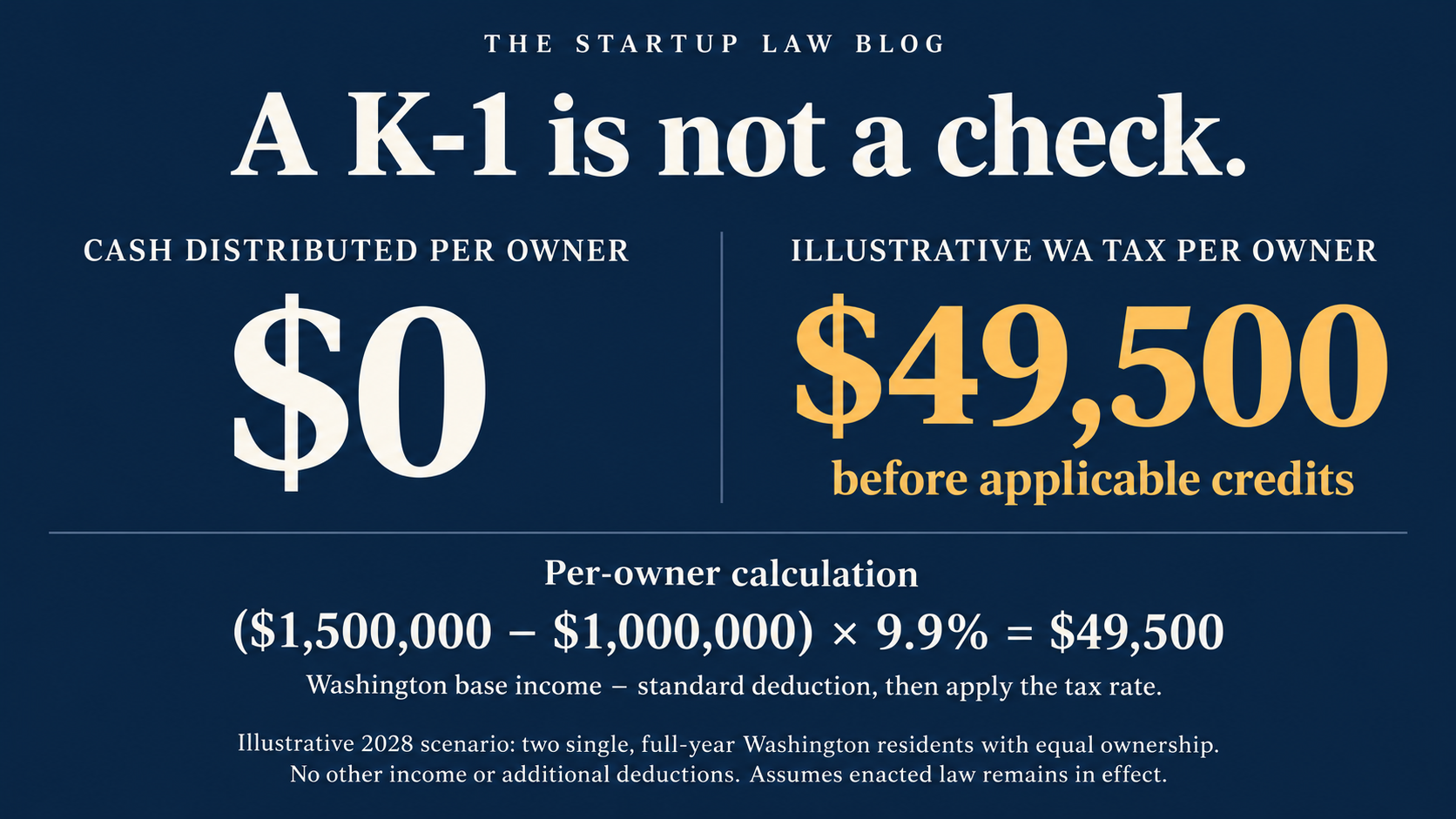
Assume two single, full-year Washington residents own equal shares of the business. After allowable business deductions and any Washington adjustments, each has $1.5 million of Washington base income. Neither has other income or additional deductions.
- Washington base income per owner: $1,500,000
- Standard deduction: $1,000,000
- Washington taxable income: $500,000
- Tax at 9.9%: $49,500 each, before applicable credits
The business has distributed nothing. Yet the owners must still account for a personal tax liability.
Why the cash may stay in the business
The business may need the money for loan principal payments, future equipment purchases, or working capital. Repaying loan principal does not reduce taxable profit. Equipment purchases may qualify for depreciation or immediate expensing, depending on the applicable rules and when the equipment is placed in service. Any allowable deductions must be reflected before calculating the income in this example.
Keeping cash for next year’s equipment does not, by itself, create a current-year deduction. This is the problem: a profitable business can have cash committed to business needs while its owners face tax on their allocated income.
The qualifications matter
Washington allows credits for qualifying B&O and public utility taxes, with related income adjustments. Those provisions can change the final bill. The $49,500 figure is an illustration before credits.
The $1 million standard deduction is also shared by spouses and registered domestic partners, even if they file separately. This example assumes two single owners. Actual liability depends on the owner’s full tax situation.
A K-1 is not a check. Profitability does not guarantee that an owner has received the cash needed to pay the tax. That is the cash-flow trap in Washington’s new income tax.
Vote YES on I-645. The initiative would repeal the new income tax and prohibit state and local taxes on individual income, as described in the Legislature’s ballot-measure summary.
This is an illustrative 2028 scenario under the enacted law, assuming it remains in effect. It concerns annual income allocated to owners, including undistributed profits.