What to Put on Your Section 351 Statement When Nobody Knows What the Company Is Worth
How not to screw up your 10x basis, which could be worth far more than the $15 million cap.



Practical legal guidance on QSBS (Section 1202), equity compensation, startup formation, financing, and Washington State tax issues for founders, investors, and startup employees.
How not to screw up your 10x basis, which could be worth far more than the $15 million cap.
In one illustration, an NBA team practicing in Seattle owes about $6.5M a year in city payroll taxes on player pay; practicing outside, about $2.2M.
The ballot says I-645 would decrease funding for schools, universities, and healthcare. It doesn't say when the money would arrive, or what the decrease is measured against.
Washington can make its tax system fairer without accepting every argument for an income tax. A falling spending-to-income ratio is not a needs assessment, and more revenue is not a substitute for budget discipline.
Washington's new income tax has no prior-year estimated-tax safe harbor for first-time filers. A founder or early employee in an exit year can pay the entire tax with a timely filed return and still face a penalty.
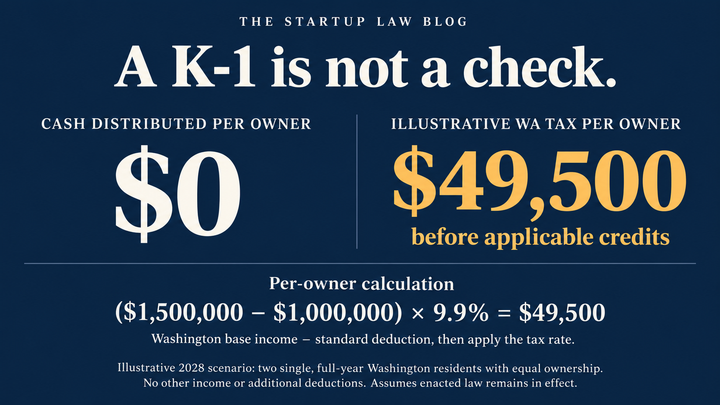
A K-1 is not a check. Starting with 2028 income, Washington’s 9.9% tax can reach profits owners never receive in cash. Here is the two-owner example.
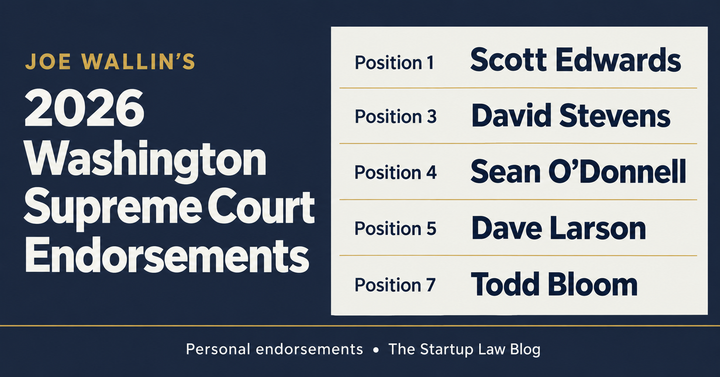
My five Washington Supreme Court endorsements, and the constitutional reasoning, votes, and judicial experience behind them.
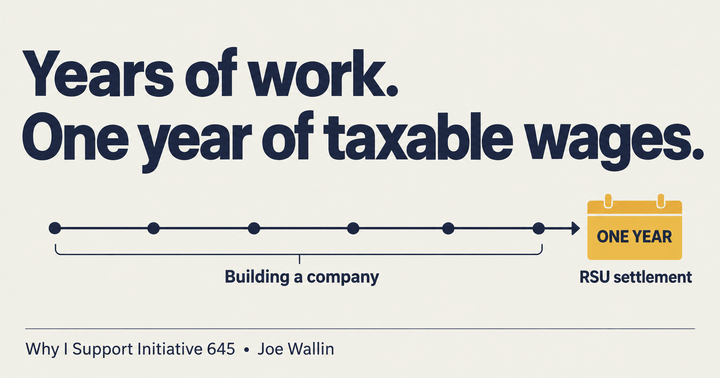
Opinion • October 3, 2026 I support Initiative 645. The way a startup employee’s restricted stock units can turn years of work into one year of taxable wages is one reason why. Imagine an employee…
S corporation stock is not QSBS. But an S corporation may hold qualifying stock in a new C-corporation subsidiary. Here is how the strategy works—and where it can fail.
A serious M&A term sheet is a tax-planning alarm clock—not a universal tax cutoff. Identify QSBS, gifts, domicile, structure, and §280G issues before the deal gets too far along.