One good year.
“The company sold. I paid the whole Washington tax in April.”
“Did you make estimated payments?”
“I’ve never owed it. I’ve never filed.”
“That’s the problem.”
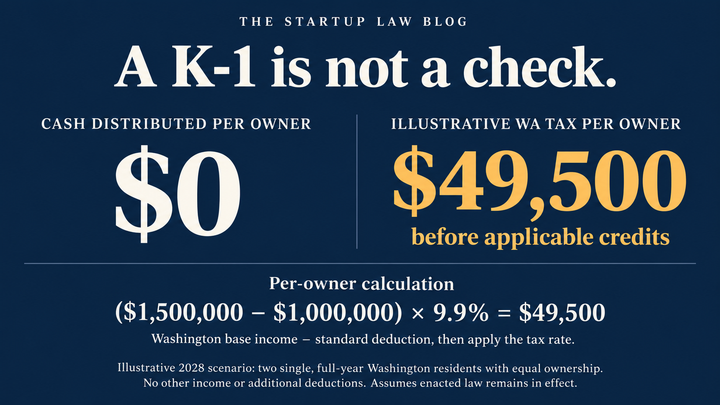
Washington’s new 9.9% income tax applies to household income over $1 million, starting with 2028 income. Most people who owe it won’t owe it every year. Founders, early employees, and investors often cross the line once: the year of an exit, a large option exercise or RSU settlement, or a big K-1. (A K-1 is not a check, but it can still put you over.)
For those people, the estimated-payment rules have a gap.
What the statute says
Section 501 of ESSB 6346 requires estimated payments from individuals whose Washington tax is expected to exceed $5,000 and who are “required by the internal revenue code to make payment of estimated taxes,” following the federal reporting periods and due dates.
Who that covers is an open question: IRC § 6654 is a penalty regime with withholding and safe-harbor rules, so it’s unclear whether someone whose federal tax is covered by withholding or a federal safe harbor is “required” to make estimates. If not, section 501 may not reach some first-time Washington payers at all.
The penalty is in RCW 82.32.090(11), as amended by section 707. If your total estimated payments for the year are less than the tax shown on your return, you owe a penalty of 5% “of the amount of the underpaid tax.” You avoid it only if your estimates are either:
- 90% of the tax shown on that year’s return; or
- 100% of the tax shown on your “most recently filed” Washington return.
Here is the catch. Under section 702(1)(a), individuals not owing the tax aren’t required to file a return. If you have never owed it, you have no “most recently filed” return. Your only safe harbor is paying 90% of a tax bill you may not be able to predict yet. (Someone who filed in an earlier year and then skipped a year may arguably still use the older return. A first-time filer can’t.)
How that compares to federal law
Federal law has a similar rule. The 100% prior-year safe harbor in IRC § 6654(d)(1)(B) doesn’t apply if the preceding year wasn’t a full 12-month year or you didn’t file a return for it. It rises to 110% if your prior-year AGI exceeded $150,000 (§ 6654(d)(1)(C)).
But almost everyone in this situation filed a federal return last year, so they have a prior-year number. And if they truly owed no federal tax for a full prior year as a U.S. citizen or resident, § 6654(e)(2) bars the penalty entirely.
RCW 82.32.090(11)’s express safe harbors have no equivalent. Section 709 does import federal rules on the “timing and amount” of section 501 prepayments “to the extent possible without being inconsistent with this chapter,” and lets DOR modify them or make exceptions by rule. How that interacts with RCW 82.32.090(11) and § 6654 is unresolved.
And because most people never file a Washington return, the “no prior return” problem, rare federally, is the normal case for first-time payers.
What legislators said
At the Department of Revenue’s income tax advisory group meeting on October 5, CPA Bea Nahon of Sweeney Conrad put it simply, according to TJ Martinell’s reporting for The Center Square: “if I didn’t have to file in 2028, I don’t have a safe harbor [for] 2029.”
Rep. Noel Frame (D-Seattle) acknowledged the gap: “we solved the problem for just the taxing and effect initially, but we didn’t think about it for somebody who’s not subject to it in a previous year, but becomes subject to it.”
House Finance Chair April Berg (D-Mill Creek) said, “with our tech community…it’s definitely gonna happen.”
The fix has its own problem
Frame also pointed out that relief cuts both ways. If first-year payers are excused from estimates, the next year they would owe estimates of 90% or 100% even if they no longer qualify. They’d get a refund later. For a one-time exit, that ties up cash in a year you owe nothing.
No fix has been proposed yet.
An example
A single founder sells her company in 2030. She has never owed Washington income tax and has never filed a Washington return. Assume she is required to make federal estimated payments, which is realistic for a founder with a large exit gain and little withholding. Her 2030 Washington taxable income is $4 million after the $1 million deduction (ignoring indexing and credits). Her tax is $396,000.
She pays all of it with her timely filed return in April 2031. She made no estimated payments.
On my reading of the statute, she faces a penalty of about $19,800 (5% of $396,000, treating the whole tax as “underpaid”), even though she paid the entire tax with her timely filed return. DOR hasn’t said how it will compute the penalty.
What to do now
Model the big year early. If an exit, tender offer, exercise, or large K-1 is coming, run the Washington number while there is still time to make estimates.
Consider paying estimates in the liquidity year. On its face, the penalty test compares total estimated payments for the year to the thresholds, not each installment. That suggests estimates made later in the year, once you know the income is coming, may cure the shortfall. But section 709 and future DOR rules could import federal installment mechanics. Pay early, from deal proceeds if possible.
Watch for K-1 timing. Partnership K-1s often arrive after the last estimated-payment date. If you invest through funds or own part of a pass-through, ask for estimates of your share early.
Watch the advisory group and DOR. The advisory group’s first report is due December 15, 2026. Section 709(2) lets DOR modify the federal prepayment rules or make exceptions by rule. A legislative fix is also possible.
Watch I-645. If voters approve Initiative 645 in November, the tax is repealed and this issue goes away. See my Initiative 645 tracker.
This is an open issue still being worked on, not settled law.
Vote YES on I-645.
Authority and status. ESSB 6346, chapter 238, Laws of 2026, sections 501, 702, 707 (amending RCW 82.32.090(11)), and 709. Federal: IRC § 6654(d)(1)(B)–(C) and (e)(2). As of October 6, 2026, the Department of Revenue had issued no rule or guidance on income tax estimated payments.