For a founder comparing Washington, Oregon, and Nevada, the tax result depends on what produces the income: salary, business profits, a stock sale, or retirement distributions. A federally excluded QSBS gain can receive very different treatment from an equally large non-QSBS gain. This comparison separates personal taxes from business taxes and identifies the assumptions that change the result.
(For an overview of ESSB 6346, see Washington's New Income Tax. For the full landscape, see Washington State Taxes. For the California comparison, see Washington vs. California.)
TL;DR
- Nevada: No personal income tax on salary or investment gains and no current state estate tax. Business, sales, property, and other states' taxes still require review.
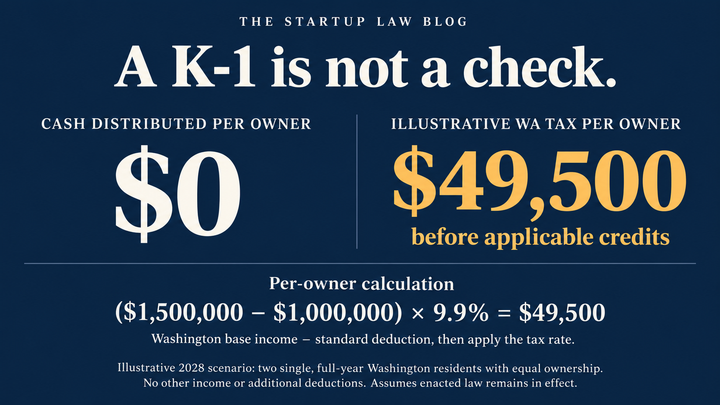
- Washington: Federally excluded QSBS gain remains outside both the existing capital-gains tax and the income tax scheduled for 2028. The broader income tax has a $1 million standard deduction for a full-year resident individual, shared by married couples; the separate capital-gains tax has its own deduction.
- Oregon: Graduated personal income tax and, from tax years beginning in 2026, an add-back for federally excluded QSBS gain. It has no general sales tax, but its estate-tax threshold is $1 million.
- Before moving: Model the particular income and transaction, the company's continuing tax obligations, and each relevant state's residency and sourcing rules.
At a Glance
| Tax category | Washington | Oregon | Nevada |
|---|---|---|---|
| Personal income tax | Broad income tax begins in 2028: 9.9% after state adjustments and deductions; $1M full-year standard deduction shared by married couples | Graduated rates up to 9.9%; applicable Metro and Multnomah County taxes are additional | No personal income tax |
| Federally excluded QSBS gain | Excluded portion outside both relevant state tax bases | Federal §1202 exclusion added back for tax years beginning in 2026 | No personal income tax on the gain |
| Capital gains | Separate tax: 7% on first $1M of taxable long-term gains, 9.9% above; annual deduction and exemptions apply | Generally taxed at ordinary income rates; applicable local taxes can add to the cost | No personal capital-gains tax |
| Estate tax | Deaths July 1–December 31, 2026: $3M exclusion; graduated 10%–20%; no portability | $1M threshold; graduated 10%–16%; no portability | No current state estate tax |
| Business taxes | B&O on taxable gross receipts; classification, sourcing, and surcharges matter | CAT plus applicable corporate excise/income tax or owner-level income tax; local business taxes may also apply | Commerce Tax on Nevada revenue above $4M; payroll-based MBT and other obligations may apply |
| General sales tax | State and local sales/use taxes; rate varies by address and date | No general sales tax | State and local sales/use taxes; rate varies by location |
Income Tax: The Headline Comparison
Washington: Under ESSB 6346, the broad personal income tax begins January 1, 2028. Its 9.9% rate applies after state adjustments and deductions. A full-year resident individual has a $1 million standard deduction; married couples share one $1 million deduction. Part-year residents and nonresidents receive a prorated deduction. Being below that income-tax threshold does not eliminate the separate capital-gains tax, B&O, or other taxes.
Oregon: Personal income is taxed at graduated rates up to 9.9%, subject to deductions, credits, and state adjustments. Oregon has no comparable $1 million standard deduction. For 2026, Metro's 1% Supportive Housing Services tax applies above $128,000 of Metro taxable income for single filers or $205,000 for joint filers. Multnomah County's Preschool for All tax is 1.5% above $125,000 single/$200,000 joint, plus another 1.5% above $250,000 single/$400,000 joint. Where both local taxes apply, the combined top marginal rate can reach 13.9% in 2026. The jurisdictions and thresholds differ; use the official local-tax guidance for the year and address.
Nevada: No personal income tax. Nevada residence does not itself eliminate tax another state may impose on income sourced there.
Washington wage illustrations for 2028: Assume a single, full-year Washington resident whose only income is wages included in federal AGI, with no state adjustments, deductions other than the $1 million standard deduction, or credits. Wages of $500,000 produce $0 of this income tax; $2 million produces $99,000; $5 million produces $396,000. These are personal income-tax illustrations, excluding federal taxes, payroll contributions, and employer taxes. They do not describe a stock sale or a business's gross revenue. An Oregon comparison requires the same year's brackets and the taxpayer's filing status, deductions, and local-tax exposure.
QSBS: The Difference That Can Cost Millions
The first question is how much gain qualifies for the federal exclusion. Sale proceeds, taxable gain, and federally excluded gain are different amounts.
Washington: Gain excluded federally under §1202 does not enter federal net long-term capital gain, the starting point for Washington's capital-gains tax, or federal AGI, the starting point for its 2028 income tax. The excluded portion therefore remains outside both bases under enacted law. A $10 million sale price alone does not establish a $10 million exclusion; basis, acquisition date, holding period, eligibility, and the per-taxpayer, per-issuer limits matter.
Oregon: SB 1507 §§5 and 10 require an add-back of federally excluded §1202 gain for tax years beginning on or after January 1, 2026. Assume an Oregon resident realizes $10 million of gain fully excluded federally, and other taxable income already puts the entire $10 million add-back in Oregon's 9.9% bracket. The incremental state income tax on that gain is $990,000, before applicable local taxes and credits. That is a marginal-tax illustration, not the exact tax on a return whose only income is the gain. See the Oregon QSBS guide for the legislative background.
Nevada: No income tax, so no tax on QSBS gain. $0.
For a fully excluded QSBS gain with no other state's tax claim, Washington and Nevada can both produce $0 of personal state tax. The comparison changes for gain beyond the available exclusion or stock eligible only for a partial exclusion. See Does QSBS Avoid Washington's 9.9% Tax? and the QSBS state conformity guide.
Capital Gains
Washington: The separate capital-gains tax applies at 7% to the first $1 million of taxable long-term gains and 9.9% above that amount, after the annual deduction and other applicable adjustments. Direct real estate sales are exempt; federally excluded QSBS gain is outside the base. Beginning in 2028, ESSB 6346 §302 adjusts the separate income-tax base for long-term gains and losses, and §205 provides a credit for the same year's Washington capital-gains tax, limited to income tax otherwise due. Compute both taxes and the credit; do not simply add their full rates.
Oregon: Capital gains are generally taxed through the personal income tax at ordinary rates, without a general preferential long-term capital-gains rate. Applicable federal exclusions and Oregon adjustments still matter. Oregon does not have Washington's broad capital-gains-tax exemption for direct real estate sales.
Nevada: None.
Historical Washington example using 2025 amounts: Assume $3 million of non-QSBS long-term stock gain, entirely allocated to Washington, no other gains or losses, and only the $278,000 standard deduction. Taxable capital gains are $2,722,000. Tax is $70,000 on the first $1 million plus $170,478 on the remainder, totaling $240,478. This is not a forecast of a later year's indexed deduction or a calculation of the separate 2028 income tax.
Moving Before a Sale: Residency and Sourcing Rules
A move can change the tax result, but neither a new address nor a particular number of days resolves every tax. Analyze investment gain, compensation for services, business income, and estate-tax exposure separately.
Washington's capital-gains tax: Under RCW 82.87.100(1)(b), long-term gain from intangible personal property is allocated to Washington if the taxpayer is domiciled here when the sale or exchange occurs. Meeting an income-tax nonresident safe harbor does not itself change domicile or remove that allocation. See the Washington stock-sale domicile guide.
Other states use their own rules. California generally sources personal stock-sale gain to residence at the time of sale, with exceptions; its residence rules and employment-related safe harbor should not be restated as Washington's domicile test. Oregon also has its own resident, part-year, and nonresident rules. Compensation attributable to services in a state can remain taxable after a move. See California FTB Publication 1031 and ORS chapter 316.
Plan before the taxable transaction, establish and document the actual move, and review the retained home, work, family connections, and income sources. For a Washington stock sale, confirm domicile at the sale or exchange; for other taxes, apply the relevant residence and sourcing rules. An installment sale or compensation component requires its own timing analysis.
Business Taxes
All three states tax business activity, but the structures differ.
Washington B&O: A gross-receipts tax with no deduction for costs — applied to revenue, not profit. Rates are set by activity-specific classification and are not bounded by the commonly cited 0.471%–2.1% range: RCW 82.04.290 alone runs from 0.275% (qualifying international investment management) to 3.1% (payment card processing), and surcharges can apply. Service and Other Activities rates are 1.5%, 1.75%, or 2.1%, with prior-year income, affiliate aggregation, and statutory exceptions determining the applicable rate.
Oregon CAT: For taxpayers above the payment threshold, the tax is $250 plus 0.57% of taxable Oregon commercial activity exceeding $1 million. The permitted subtraction is generally 35% of the greater of qualifying cost inputs or labor costs, subject to allocation, exclusions, and statutory limits. It applies across entity types. See Oregon DOR's CAT guidance.
Oregon income taxes are additional. C corporations can owe corporate excise or income tax at 6.6% on the first $1 million of Oregon taxable income and 7.6% above it; an excise-tax filer generally pays the greater of the calculated tax or its applicable minimum. Pass-through owners generally face income tax on their allocated income instead, with entity-level obligations also possible. CAT does not replace these taxes. See Oregon's corporate-tax guidance.
Nevada Commerce Tax: Industry-specific rates apply to Nevada gross revenue above $4 million for the Commerce Tax year, subject to exclusions and deductions. Total company revenue and Nevada taxable revenue are not interchangeable. See Nevada's Commerce Tax guidance.
Nevada Modified Business Tax: For general businesses, the quarterly payroll tax is 1.17% on taxable wages above $50,000 after allowed health-benefit deductions. Financial institutions and mining businesses use 1.554% after those deductions, without the $50,000 exemption. A Commerce Tax credit may reduce MBT under its separate rules. Filing can be required even when no tax is due. See Nevada's MBT guidance.
Oregon CAT illustration: Assume $10 million of Oregon commercial activity before the cost subtraction, no excluded receipts, and $6 million of qualifying labor costs, all attributable to that activity and greater than qualifying cost inputs. The 35% subtraction is $2.1 million. CAT is $250 + 0.57% × ($10 million − $2.1 million − $1 million) = $39,580. Corporate or owner-level income taxes and local taxes are additional. A comparison with Washington or Nevada also needs the applicable business classification, receipts sourcing, payroll, deductions, and credits.
Estate Tax: Where the Conventional Wisdom Is Wrong
The exclusion determines when exposure begins; the rate schedule determines how the tax grows. A lower exclusion does not mean a higher bill at every estate size.
Washington: For deaths from January 1 through June 30, 2026, the exclusion is $3,076,000 and the top rate is 35%. For deaths from July 1 through December 31, 2026, the exclusion is $3 million and graduated rates run from 10% to 20%. Washington has no spousal portability. Use the date-of-death rules and apply deductions and any allocation for out-of-state property. See RCW 83.100.020 and RCW 83.100.040.
Oregon: Its $1 million threshold and graduated 10%–16% rates can reach estates below Washington's exclusion. Oregon does not provide spousal portability. Deductions, marital planning, and property location affect the result. See ORS chapter 118.
Nevada: No estate tax.
Illustration: Assume death in the second half of 2026, a single resident, all property located in the residence state, no debts or deductions, no exclusions beyond the generally applicable state exclusion or threshold, and no credits. At a $2 million estate, Washington's estate tax is $0 and Oregon's is $101,250. At a $10 million estate, Washington's is $1.1 million and Oregon's is $1,102,500. Nevada imposes no current state estate tax. The comparison changes with estate size and planning; moving to Nevada does not necessarily eliminate estate tax on real or tangible property retained in another state. Federal estate tax is a separate question.
Sales Tax
Oregon has no general sales tax. Washington and Nevada impose state and local sales/use taxes, with the combined rate depending on location and, in Washington, the transaction date. Compare the actual address and purchases rather than treating Seattle, Reno, or Las Vegas rates as statewide ranges. Buying in Oregon does not automatically avoid use tax when an item is brought into Washington or Nevada.
The Lifestyle Tradeoff
Compare the move's actual costs: housing, travel, access to customers and employees, family commitments, and where the company will continue to operate. A founder's personal move does not automatically relocate the company or eliminate its tax obligations where it still has employees, property, or taxable business activity.
Who Should Go Where?
Founder approaching a QSBS exit: Confirm how much gain qualifies for exclusion before comparing states. A fully excluded gain can be free of personal state tax in both Washington and Nevada; Oregon's add-back changes that result. Model excess gain and any compensation component separately.
Employee with income below $1 million: A single, full-year Washington resident whose only income is wages below the standard deduction may owe no 2028 income tax. Married couples share the deduction, other income can push the household above it, and taxable capital gains have separate rules. Nevada also has no personal income tax; Oregon's result depends on the applicable brackets, deductions, and locality.
Founder with substantial non-QSBS income: Nevada's absence of personal income tax can be valuable, but estimate savings from the actual income mix and the tax another state can continue to impose. Compare those savings with the costs of a genuine relocation.
Retiree or family with a significant estate: Model estate tax separately from annual income tax. Oregon's lower threshold matters for smaller estates; larger estates require both rate schedules. Consider asset location, marital deductions and trusts, and the likely estate at death.
Small business owner: Compare company taxes and owner taxes together. A Washington owner below the income-tax deduction can still have a business that owes B&O. Oregon CAT can apply alongside income taxes, and Nevada payroll and Commerce Tax obligations can survive a $0 personal income-tax result.
The Bottom Line
Nevada's absence of personal income and current state estate taxes, Washington's treatment of federally excluded QSBS gain, and Oregon's absence of general sales tax are distinct advantages. None establishes the lowest total cost for every founder.
Start with the income or transaction you expect, confirm QSBS eligibility where relevant, calculate personal and business taxes separately, and then evaluate a move under each state's residence and sourcing rules.
Weighing a move between West Coast states? Book a 20-minute intro call to model the tax impact for your specific situation. Or get the Washington State Tax Planning Guide ($49.99) — it covers residency rules, the capital gains tax, QSBS, and the planning moves that change your effective rate.
Related
- Washington vs. California: A Tax Comparison for Founders and Investors
- Washington Capital Gains Tax: 2026 Guide for Founders
- Why Your Stock Sale Doesn't Care About the Safe Harbor
- Oregon SB 1507: QSBS Gains Now Taxable at the State Level
- How to Change Your Washington Domicile to Avoid the Income Tax
- 2026 QSBS State-by-State Conformity Guide