For years, the standard advice for Washington startup founders was simple: if you're raising venture capital, form a Delaware C corp. If you're running a services business or a bootstrapped company, consider an S corp or LLC.
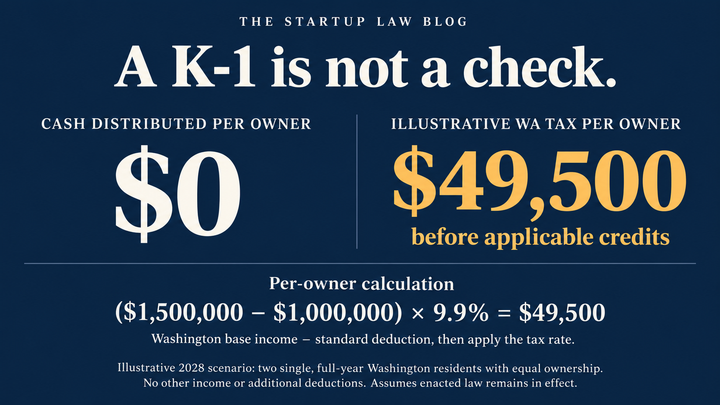
ESSB 6346, signed March 30, 2026, imposes a 9.9% tax on Washington taxable income beginning January 1, 2028. The practical question is whether that tax changes your entity choice after you account for federal taxes, how much profit you expect to distribute, financing needs, and how you expect to sell the business.
This post is part of our Complete Guide to Washington's New Income Tax.
How the Tax Hits Each Entity Type
To understand the entity choice question, you first need to understand how Washington's income tax interacts with each structure.
C Corporations
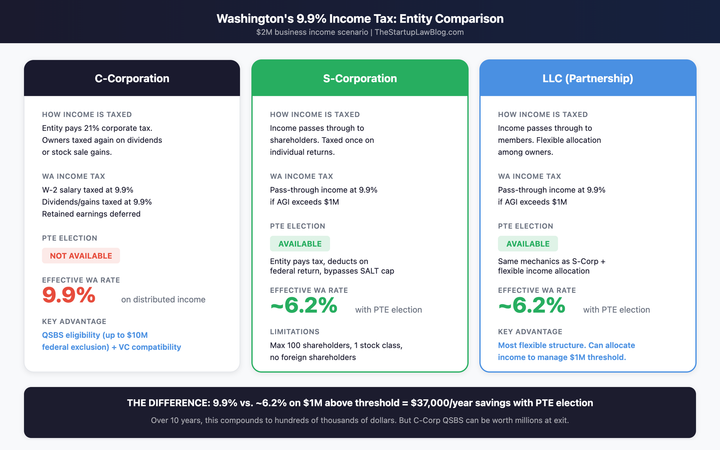
A C corporation is a separate taxpaying entity for federal purposes. It pays federal corporate income tax (currently 21%) on its profits. Shareholders are taxed again when those profits are distributed as dividends or when they sell their shares at a gain.
Under Washington's new income tax, the entity itself does not owe Washington income tax. Washington taxes individuals, not corporations. But the tax reaches C corp owners in two ways.
First, W-2 compensation. A founder’s salary generally enters federal AGI and the Washington income-tax base. Beginning in 2028, compute Washington taxable income after the state modifications and applicable deduction. The PTE election does not cover the owner’s W-2 wages.
Second, dividends generally enter the owner’s income-tax base. Stock-sale gains require a different analysis: §302 removes federal long-term gains and adds back the specified Washington capital gains amount only when capital gains tax is owed. Federal QSBS exclusions and Washington exemptions can therefore materially change the result. A stock sale does not automatically create a 9.9% Washington income-tax charge on every dollar of gain.
The key point: C corp owners have no access to the PTE election. The entity-level tax workaround under §502 of ESSB 6346 is available only to partnerships, LLCs taxed as partnerships, and S corporations. If you're in a C corp, every dollar of Washington income tax you pay is subject to the federal SALT cap on your individual return.
S Corporations
An S corporation does not pay federal corporate income tax. Instead, its income passes through to shareholders, who report it on their individual returns and pay tax at their individual rates.
S-corporation income generally flows to shareholders through federal AGI. Beginning in 2028, apply Washington’s state modifications, deductions, and credits to determine the shareholder’s income-tax liability; federal AGI above $1 million alone does not establish the result.
But here is where S corps gain an advantage: S corporations are eligible for the §502 PTE election. The entity can elect to pay the 9.9% tax at the entity level, deduct it as a business expense on its federal return (bypassing the SALT cap), and each shareholder receives a credit on their Washington return.
The election does not reduce the 9.9% state rate. It can provide a federal deduction outside the individual SALT cap when the assumptions in the example below hold.
For more on the mechanics, see our standalone piece on the PTE election.
LLCs (Taxed as Partnerships)
A multi-member LLC taxed as a partnership generally passes income through to its members. The Washington income tax applies after state modifications and the applicable deduction, with separate treatment for items such as long-term capital gains.
An eligible LLC taxed as a partnership can also consider the §502 election. Its benefit depends on the owners’ deductions, credit limits, federal tax position, and the entity-level computation. It is not an automatic reduction of Washington’s rate to 6.2%.
LLCs have some additional flexibility that S corps do not. They can allocate income and losses among members in ways that don't have to track ownership percentages (within the limits of the Section 704(b) substantial economic effect rules). This can create planning opportunities for managing which members cross the $1 million threshold and when.
Single-Member LLCs
A single-member LLC is generally disregarded for federal income-tax purposes unless it elects corporate classification. Its owner ordinarily reports the business directly rather than receiving a partnership K-1.
The statutory PTE definition includes an LLC that reports a distributive share of taxable income to its owners. A disregarded LLC generally does not report income that way, so its eligibility should not be assumed. Confirm the applicable DOR implementation before relying on an election.
If the PTE election matters to you, converting to a multi-member LLC or electing S corp status may be worth considering.
The New Math: Isolating the PTE Benefit
Illustration: an eligible owner has $2 million of Washington base income, a $1 million income-tax deduction, and no other adjustments or credits. Assumptions beside the calculation: the deduction is fully reflected in the entity-level computation; the §206 credit is fully usable; the election creates no additional state liability; individual payment produces no incremental federal deduction; and the entire entity payment produces a federal benefit at 37%.
Individual payment: $1 million of taxable income × 9.9% = $99,000 of Washington tax. Under those assumptions, there is no incremental federal tax benefit from that payment.
Entity payment: the same $99,000 Washington tax produces a $36,630 federal benefit ($99,000 × 37%). The net cost after that benefit is $62,370. Washington still receives $99,000; the $36,630 difference is federal tax savings.
This illustrates a potential PTE-election benefit. It is not a complete C-corporation-versus-pass-through comparison. A C corporation generally pays federal corporate tax on retained taxable profit, and later dividends or a stock sale have separate owner-level consequences. A valid entity comparison must include those taxes, QSBS eligibility, compensation, distributions, and timing. Do not compare retained pretax corporate profit directly with income currently allocated to a pass-through owner. If entity tax exceeds the owner’s usable nonrefundable §206 credit, additional state cost can offset or outweigh the federal deduction benefit.
When a C Corporation Still Makes Sense
Entity choice was never just about state taxes, and it still isn't. A C corporation can still be the better structure when institutional financing, potential QSBS, retained earnings, or ownership design matter more than an annual PTE benefit.
Institutional financing. Most institutional investors require a Delaware C corp. They want preferred stock, liquidation preferences, anti-dilution provisions, and a clean cap table. If you're raising a Series A, you're almost certainly forming a C corp regardless of Washington's tax.
Potential QSBS. Section 1202 can exclude qualifying gain on eligible C-corporation stock. For qualifying stock acquired after July 4, 2025, the per-issuer dollar limit is generally $15 million, with a separate 10-times-basis alternative and phased holding-period exclusions. The $15 million figure is gain potentially excluded, not tax saved. Original issuance, the active-business rules, asset limits, holding periods, and the other statutory conditions still matter.
Retained earnings. The 21% federal corporate tax rate is meaningfully lower than the top individual rate of 37%. For companies that reinvest profits rather than distributing them, the C corp structure defers individual-level tax.
Ownership flexibility. S corps restrict ownership — no more than 100 shareholders, no nonresident alien shareholders, and only one class of stock — which makes them impractical for many venture-backed companies. LLCs can often accommodate preferred-like economics and a broader owner set, so multiple stock classes or foreign owners alone do not force a C corp. Compare the LLC alternative before treating those constraints as decisive.
For many VC-backed founders, the C corp is still correct, but compensation planning (salary vs. dividends vs. deferred comp) still matters for Washington AGI.
When the Calculus Shifts Toward Pass-Through
The PTE election advantage is most powerful for:
Professional services firms: A PTE election can be valuable, but compare the total state and federal result before electing. Many professional services are excluded from QSBS eligibility under §1202 regardless of corporate form. The PTE deduction and owner-credit limits still require individual modeling.
Bootstrapped software companies: Compare the potential federal benefit of an eligible PTE election with QSBS eligibility, reinvestment plans, employment taxes, and a future exit. A recurring deduction benefit depends on taxable income and the owners’ ability to use it; it is not a fixed annual saving for every company.
Real estate holding companies: LLCs are commonly used, but model any PTE election on the actual taxable income and usable credits. Direct real estate-sale gains and recurring rental income can receive different Washington treatment; the entity form alone does not establish an election benefit.
Investment partnerships. Fund managers and investment partnerships with Washington-resident partners above the $1 million threshold should be modeling the PTE election into their fund structures.
The B&O Tax Wrinkle
B&O tax applies to gross receipts under the business’s classification and applicable rates. The income tax applies to Washington taxable income after the relevant adjustments and deductions. Section 204 provides a nonrefundable credit against income tax for qualifying B&O tax on the same income, while §304 requires the applicable add-back for B&O tax deducted in computing federal AGI. Model both steps.
The §204 credit reduces income tax; it does not reduce the B&O bill itself. At the same receipts and B&O rate, a lower profit margin can make eligible B&O tax a larger share of income-tax liability, subject to the credit limit and overlapping-income requirement. There is no general rule that service firms receive more relief than low-margin businesses.
What to Do Now
Compare your current structure with the alternatives using expected profits, distributions, federal and Washington taxes, financing needs, and exit treatment. Changing an existing entity can have tax consequences — including built-in gains tax on a C-to-S conversion — so run that analysis before January 1, 2028 rather than treating a PTE election alone as a reason to convert.
Need help running this analysis? Entity restructuring decisions ahead of January 1, 2028 have real tax stakes, and the right answer depends on your specific income mix, exit plans, and timeline. I offer a free 20-minute call to talk through your situation. Schedule a call →
For more on Washington's income tax and planning strategies, see our Washington State Taxes pillar page and our Tax Planning Guide for High Earners. For a broader look at entity selection beyond the Washington tax question — including fundraising, QSBS eligibility, and equity compensation — see LLC vs. C-Corp for Startups: How to Choose the Right Entity.
Decided on a C-Corp? My Founder Formation service is a fixed-fee ($3,500) Delaware C-Corp formation handled by a startup tax lawyer — set up to raise capital and preserve QSBS eligibility from day one.
This post is for informational purposes only and does not constitute legal or tax advice. Consult with a qualified tax professional regarding your specific circumstances.
Related Posts
- Equity Compensation Plan Design: How to Structure Your Startup's Stock Option Plan
- SAFE Agreements: What Every Startup Founder Needs to Know
- The Complete Guide to 83(b) Elections for Startup Founders and Employees
- Cap Table Management: The Founder's Guide to Getting It Right from Day One
- Convertible Notes: The Complete Guide for Startup Founders and Investors
- Washington's New Income Tax: The Complete Guide
Related Reading
For a comprehensive comparison of state taxes across 11 states — including income tax, capital gains, QSBS conformity, and estate tax — see our State Tax Comparison for Startup Founders.
Sources for the September 7, 2026 corrections
ESSB 6346 §§204, 206, 304, 502 · IRS Notice 2020-75 · Section 1202