If you work at a Washington startup — or any company that pays you in equity — ESSB 6346 just changed the math on your stock options and RSUs.
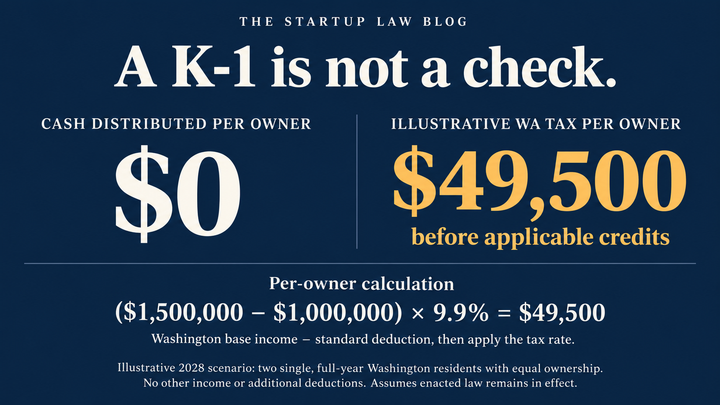
The new 9.9% income tax begins January 1, 2028. The examples below assume a full-year Washington resident, a $1 million standard deduction, and no other income, adjustments, deductions or credits unless stated. Spouses and registered domestic partners share one deduction. Equity compensation can concentrate income in a single year even when salary is well below the threshold. For the broader picture, see our Washington income tax guide.
Here's how the new tax interacts with the most common forms of equity comp.
Incentive Stock Options (ISOs)
ISOs are tricky under ESSB 6346 because they're tricky everywhere.
When you exercise an ISO, you don't recognize ordinary income for federal purposes (assuming you hold the shares). But the spread between the exercise price and fair market value does count for Alternative Minimum Tax (AMT) purposes.
The question for Washington: ESSB 6346 starts with federal adjusted gross income (AGI). If you exercise ISOs and hold, the spread typically doesn't show up in AGI — it shows up on your AMT calculation. That means a pure ISO exercise-and-hold may not push you over the $1 million threshold for Washington purposes.
A same-year exercise and sale is a disqualifying ISO disposition. It generally creates ordinary compensation income based on the exercise spread, subject to the statutory limitation for certain sales at a loss relative to exercise-date value. Additional gain can be capital gain. For example, a same-day sale producing a $2 million exercise spread, with no other income or adjustments, creates $99,000 of Washington income tax in 2028: 9.9% × ($2 million − $1 million). The stock’s total sale value is not the same as its exercise spread.
Planning implication: The hold vs. sell decision now has a state tax dimension it didn't have before. If you can hold long enough for long-term capital gains treatment and your QSBS qualifies, you may escape both federal and state tax on the gain. If you sell immediately, you're looking at federal ordinary income rates plus 9.9% to Washington on everything above $1 million.
One caution: long-term treatment alone does not eliminate Washington tax. ESSB 6346 §302 first removes federal long-term gains and losses, then adds back Washington capital gains subject to tax plus the capital-gains standard deduction, but only for taxpayers owing the capital gains tax that year; exempt transactions remain excluded. Section 205 provides a nonrefundable credit for that year’s Washington capital gains tax, limited to income tax otherwise due. Model both bases and the credit. A qualifying §1202 exclusion removes the excluded gain from federal AGI and Washington’s bases; it does not shelter ordinary compensation.
Nonqualified Stock Options (NQSOs)
NQSOs are more straightforward — and more exposed.
For a typical NQSO exercised into vested shares, the spread between exercise price and FMV is ordinary compensation, generally reported on an employee’s W-2. Early exercise into unvested shares requires a separate §83 analysis. Beginning in 2028, the compensation included in federal AGI generally enters Washington’s income-tax base.
Assume in 2028 your salary is $400,000 and an NQSO exercise into vested shares produces a $900,000 spread. Under the resident assumptions above, $1.3 million less the $1 million deduction leaves $300,000 taxable at 9.9%, or $29,700.
Planning implication: Timing your NQSO exercises matters more than ever. If you're close to the $1 million threshold, consider whether spreading exercises across two tax years keeps you below it in both years — versus one large exercise that triggers the tax.
Restricted Stock Units (RSUs)
RSUs are common at large technology companies. Their income-tax timing depends on settlement terms, which need to be distinguished from vesting.
For a typical unfunded RSU, federal ordinary income generally arises when the award settles in cash or vested shares. Settlement often coincides with vesting at public companies, but compliant arrangements can separate the two dates. The compensation included in federal AGI generally enters Washington’s income-tax calculation beginning in 2028. Payroll taxes can have different timing under the deferred-compensation rules.
For example, in 2028, $250,000 of salary plus $800,000 of taxable RSU settlements produces $1,050,000 of income. Under the resident assumptions above, the Washington income tax is 9.9% × $50,000 = $4,950. An award merely vesting this year does not by itself establish that tax result.
The planning constraint: RSU holders usually cannot choose a settlement date as an option holder chooses an exercise date. Read both the vesting and payment provisions. Deferrals and accelerations must fit an exemption from §409A or comply with its payment and election rules; a plan’s permission alone is insufficient.
The 83(b) Election Angle
If you receive actual restricted stock, a timely §83(b) election generally includes its transfer-date fair market value minus what you paid, rather than waiting for substantial vesting. The deadline is ordinarily 30 days after the stock transfer, subject to applicable weekend, holiday or specific statutory relief. It is not a year-end planning deadline and does not apply to an unfunded RSU promise.
Before 2028, this is a potential planning opportunity: if you're granted restricted stock when its value is low, filing an 83(b) election now means you recognize a small amount of income in a year when Washington has no income tax. Later vesting generally creates no additional Section 83 compensation income. A later sale is a separate event: long-term gain can still fall under Washington’s chapter 82.87 capital gains tax, and from 2028 ESSB 6346 coordinates that gain with the income tax through specified adjustments and a nonrefundable capital gains tax credit. Federally excluded QSBS gain generally falls outside those Washington bases; ordinary compensation does not become Washington-free merely because an 83(b) election was filed.
This is the kind of pre-2028 move that can save real money, but it requires acting before the tax takes effect.
For a full explanation of how 83(b) elections work, see our Complete Guide to 83(b) Elections for Startup Founders and Employees.
What About QSBS?
This is where it gets interesting for startup equity specifically.
For qualifying QSBS, §1202 applies an eligible-gain limit and an exclusion percentage. The dollar limit is generally $10 million for stock acquired on or before July 4, 2025, or $15 million for stock acquired after that date (indexed after 2026), coordinated with prior exclusions from the same issuer; the alternative is 10 times the qualifying basis of shares sold that year. Acquisition date, including applicable holding-period tacking, governs these rules. Post-July 4, 2025 acquisitions can receive 50% exclusion at three years, 75% at four and 100% at five. Earlier acquisitions require more than five years; the 100% exclusion generally applies to stock acquired after September 27, 2010, with lower percentages for older stock. Separately, the $75 million gross-assets threshold applies to stock issued after July 4, 2025; the prior threshold is $50 million. Only the excluded capital gain leaves federal AGI and Washington’s bases.
So the path looks like this:
- You receive stock in a qualifying C corporation
- You file an 83(b) election (if applicable) while the value is low
- You satisfy the applicable holding period and all other §1202 requirements
- You sell and exclude the eligible portion of capital gain, within the applicable limits; ordinary compensation remains taxable
That's the best-case scenario for startup founders and early employees. But each of those steps has requirements, and missing any of them can be expensive.
For the full QSBS analysis, see Does QSBS Avoid Washington's New 9.9% Income Tax? and our Complete Guide to QSBS & Section 1202.
Key Dates and Timing
The 9.9% tax takes effect January 1, 2028. That leaves you until December 31, 2027 to:
- Evaluate ISO exercise-and-hold for federal AMT, liquidity and holding-period consequences. The exercise spread generally does not enter federal AGI or Washington’s income-tax base, but a later disqualifying disposition or taxable long-term gain needs separate analysis.
- File any §83(b) election within the deadline measured from the stock transfer, even if that deadline falls before or after December 31, 2027.
- Accelerate NQSO exercises if you're going to exercise anyway and want to avoid the state tax
- Review RSU vesting and settlement terms, including §409A restrictions, before considering a change in income timing.
Beginning in 2028, taxable ordinary equity compensation can increase Washington income tax. The result depends on recognition timing, residency and sourcing, the shared spousal deduction, and applicable adjustments and credits; the threshold does not apply separately to each grant.
The Bottom Line
Equity compensation was already complicated. Washington's income tax adds another layer — but it's a manageable one if you plan ahead. The key variables are the type of equity (ISO vs. NQSO vs. RSU vs. restricted stock), the timing of exercises and sales, whether QSBS applies, and whether you can structure recognition events before 2028.
This is exactly the kind of situation where getting advice in 2026 or 2027 costs a fraction of what the tax will cost in 2028 and beyond.
For a complete overview of ESSB 6346, see Washington's New Income Tax: What Founders, Investors, Athletes, and High Earners Need to Know.
For more on Washington's full tax landscape, see the Complete Guide to Washington State Taxes for Startups.
Have equity compensation questions in light of Washington's new tax? Book a call to discuss your specific situation.