
By Joe Wallin | Updated September 2026
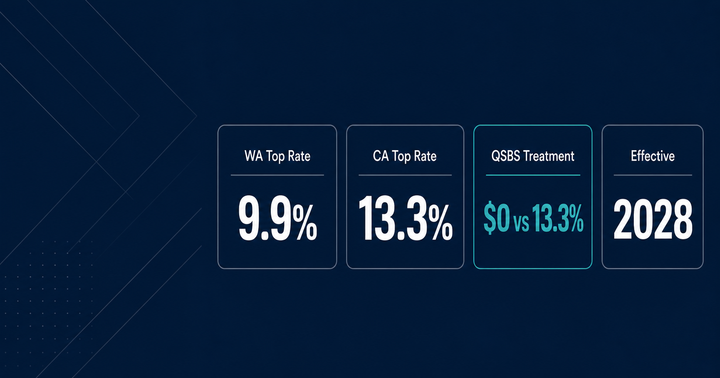
For years, the pitch was simple: move to Washington, pay no income tax. California's 13.3% top rate made it the most expensive state in the country for founders, investors, and high earners. Washington was the obvious alternative — same time zone, strong tech ecosystem, zero income tax.
That calculus changed on March 30, 2026, when Governor Ferguson signed ESSB 6346 into law. Starting January 1, 2028, Washington imposes a 9.9% income tax on income above a $1 million standard deduction ($1 million per individual; married couples share one). Washington is no longer a zero-tax state for high earners. For the full planning roadmap under the new Washington state income tax, see our action guide for high earners.
But it's not California, either. The two systems differ in fundamental ways — on rates, on QSBS, on capital gains, on pass-through treatment, and on who actually ends up paying more. Here's a detailed comparison.
(For an overview of ESSB 6346, see Washington's New Income Tax: What Founders, Investors, Athletes, and High Earners Need to Know. For the full tax landscape, see Washington State Taxes.)
TL;DR: Washington is no longer tax-free for high earners, but it's still substantially cheaper than California for most founders and investors above $1M. The biggest difference: Gain actually excluded under federal Section 1202 is excluded in Washington, while California does not allow that exclusion. Eligibility, holding period, exclusion percentage, and available per-issuer limit determine the amount. Long-term real estate gains are also largely exempt in Washington; short-term and dealer gains are not. The main area where California wins: no state estate tax.
Status as of this update: ESSB 6346 is being challenged in court and faces a possible repeal vote on November 3, 2026. No injunction has been issued, so the 2028 effective date currently stands — but this comparison could change materially depending on the outcome.
Comparison at a Glance
| Category | Washington (2028+) | California | Advantage |
|---|---|---|---|
| Top income tax rate | 9.9% (above $1M) | 13.3% (gains); 14.6% (wages, incl. SDI) | WA |
| Effective rate at $1.5M W-2 | ~3.3% | ~11% | WA |
| QSBS (Section 1202) | Excludes gain actually excluded under federal §1202 | No §1202 exclusion; regular brackets apply | WA (major) |
| Capital gains | 7%–9.9% (above ~$278K) | 13.3% (no preferential rate) | WA |
| Real estate gains | Largely exempt | Taxable gains taxed at ordinary rates; qualifying home-sale exclusion available | WA (major) |
| Pass-through income | 9.9% above $1M; entity election at 9.9% | Up to 13.3%; entity election at 9.3% | Depends on entity and owner calculations |
| Marriage penalty | Shared $1M deduction (max $99K penalty) | Doubled brackets (minimal penalty) | CA |
| Estate tax | 10%–20% above ~$3M; no portability | None | CA (major) |
| Income below $1M | $0 state income tax | 1%–12.3% | WA |
| B&O / gross receipts tax | State B&O applies to taxable gross receipts; classification, sourcing, exemptions, credits, and surcharges matter. | Local gross-receipts taxes can apply, including San Francisco’s; assess state entity taxes separately. | Depends on activity and location. |
The Headline Rates
California: Progressive brackets from 1% to 12.3%, plus an additional 1% Mental Health Services Tax on income above $1 million. Effective top rate: 13.3%. Applies to all taxable income — wages, capital gains, business income, investment income. No preferential rate for any income type.
Washington (starting 2028): A flat 9.9% on income above $1 million (after modifications). Below $1 million: 0%. The $1 million standard deduction means that a Washington resident earning $999,999 owes nothing.
The rate comparison: California allows deductions and applies progressive brackets to taxable income; it does not tax every dollar of gross income. Washington’s enacted income tax uses a different base and a $1 million standard deduction for a full-year resident individual, shared by spouses and registered domestic partners. Compare complete calculations for the same facts, rather than subtracting headline rates.
QSBS: The Biggest Single Difference
This is where the comparison gets dramatic.
California does not conform to the federal Section 1202 exclusion. For illustration, assume a founder realizes $10 million of gain, satisfies all company and shareholder requirements, qualifies for the 100% federal exclusion, and has at least $10 million of available per-issuer limit. Federal tax on that excluded gain is zero. California does not allow the exclusion; its tax depends on the applicable brackets, filing status, other income, and California adjustments. Multiplying the gain by the 13.3% top marginal rate gives $1.33 million, not an exact return calculation.
Washington protects the gain actually excluded under federal Section 1202. That excluded amount does not enter federal AGI or the starting bases for Washington’s income and capital-gains taxes. Under the $10 million-gain assumptions above, Washington tax on that excluded gain is zero. A $10 million sale price, or merely describing stock as QSBS, does not establish a $10 million exclusion. Gain outside the available exclusion requires a separate Washington calculation.
For a $15 million-gain comparison, assume all requirements for a 100% federal exclusion are satisfied and the shareholder has at least $15 million of available per-issuer limit under the applicable dollar or basis rule. Only under those assumptions is the full gain excluded federally and from Washington’s starting tax bases. California does not allow the federal exclusion. Applying its 13.3% top marginal rate to $15 million produces $1,995,000 as a rate illustration; actual California tax requires a complete calculation.
Apply Section 1202’s acquisition-date and holding-period rules, including any statutory tacking. The post-July 4, 2025 regime allows 50%, 75%, and 100% exclusions after at least three, four, and five years. Older stock generally requires more than five years; its exclusion percentage depends on acquisition date. The $10 million or newer $15 million dollar branch is coordinated with prior eligible gain and compared with the applicable 10-times-basis alternative; the branches are not independent same-issuer allowances. The gross-assets ceiling depends on issuance date: $50 million for stock issued on or before July 4, 2025 and $75 million afterward, with indexing of the newer ceiling beginning in 2027. A Section 1045 rollover is a separate deferral analysis and does not establish an eventual exclusion.
There is a caveat: the Washington legislature considered QSBS add-back bills (SB 6229 and HB 2292) during the 2026 session, and they could return in future sessions. Under current law, Washington excludes the gain actually excluded under federal Section 1202. Any remaining gain requires a separate Washington tax calculation. For a deeper analysis, see Does QSBS Avoid Washington's New 9.9% Income Tax? and our 2026 QSBS State-by-State Conformity Guide.
Does California conform to Section 1202? No. California does not allow the federal QSBS exclusion. Washington protects the amount actually excluded under federal Section 1202. A partial exclusion or exhausted per-issuer limit can leave gain taxable; QSBS status alone does not establish a zero-tax sale.
Capital Gains Treatment
California capital gains tax rate (2026): California has no separate capital gains rate — it taxes capital gains as ordinary income, from 1% up to 13.3% (including the 1% Mental Health Services Tax on income above $1 million). Washington taxes long-term gains at 7%, rising to 9.9% above $1 million, and excludes gain actually excluded under federal Section 1202 and gain from directly held real estate.
California: Generally taxes taxable capital gains at ordinary income-tax rates, without a preferential long-term rate. Specific exclusions still apply, including qualifying home-sale gain. The top rate on capital gains is 13.3%.
Washington: Two separate taxes apply to capital gains:
First, the Washington capital gains tax (already in effect under chapter 82.87 RCW) taxes long-term capital gains above the standard deduction — $250,000 base when the tax took effect in 2022, now indexed annually ($278,000 for tax year 2025) — at 7%, with gains above $1 million taxed at 9.9%. But gains from the sale of real property held directly are exempt, and gain actually excluded under federal Section 1202 is excluded.
Second, the new income tax (ESSB 6346) starts with federal AGI. Under §302, long-term capital gains are stripped out and then added back into Washington base income for any taxpayer who owes the capital gains tax — so those gains do reach the 9.9% income tax. The overlap is relieved at the credit stage: §205 allows a nonrefundable credit for the capital gains tax paid, capped at the income tax otherwise due. The practical result is that a resident pays the greater of the two regimes on a long-term gain, not their sum.
Net result for a $5 million long-term capital gain (non-QSBS, non-real estate):
- California: approximately $665,000 at the 13.3% marginal rate (the blended effective rate is modestly lower, since California's top rate applies only above ~$1 million of income)
- Washington: approximately $438,478 under the capital gains tax — 7% on the $4,722,000 of gain above the $278,000 deduction ($330,540), plus the 2.9% surtax on the $3,722,000 above $1,000,000 ($107,938). These gains also enter the ESSB 6346 income tax base, but the §205 credit for capital gains tax paid offsets it, so they are not taxed twice. (This example assumes the $5 million gain is the taxpayer's only Washington income; with other ESSB 6346 income in the same year, the shared $1 million deduction and the §205 credit cap can change the result.)
Real Estate
California: Taxes taxable gains on real property sales at ordinary income-tax rates (up to 13.3%). Qualifying principal-residence sales can receive a gain exclusion; apply the eligibility rules before comparing the state tax bills.
Washington: Gains from the direct sale of real property are exempt from the capital gains tax under RCW 82.87.050. Under §302, exempt real-estate gains are stripped from federal AGI and never added back to Washington base income, and they generate no capital gains tax. Net result: direct long-term real estate gains are largely excluded from both Washington taxes. Because §302(1) subtracts only long-term capital gain, short-term gain, dealer property, and recapture taxed as ordinary income stay in the income tax base.
This is a massive advantage for real estate investors in Washington. See Are Real Estate Gains Subject to Washington's New 9.9% Income Tax? for the full analysis, including the entity look-through rules.
W-2 Income and Compensation
Illustrative wage comparison: assume a single full-year resident, the stated amount of taxable wages before the state standard deduction, and no other income, adjustments, credits, or itemized deductions. California uses the published 2025 brackets, its $5,706 standard deduction, and the 1% tax on taxable income above $1 million. Washington uses the enacted 2028 rules and full $1 million deduction. Figures exclude payroll and other taxes and are rounded to the nearest dollar. This compares specified rules, not a forecast of California’s 2028 indexed amounts.
| Wages before state deduction | California (2025 illustration) | Washington (2028+) |
|---|---|---|
| $1.5M | $169,578 | $49,500 |
| $3M | $369,078 | $198,000 |
| $5M | $635,078 | $396,000 |
Under these assumptions, the dollar difference increases with income: approximately $120,078 at $1.5 million, $171,078 at $3 million, and $239,078 at $5 million. The difference as a percentage of total income declines. A smaller percentage-point gap does not mean smaller dollar savings. Different filing status, deductions, income sources, or residency can change the result.
These California figures are income-tax only. Because SB 951 removed California's SDI wage cap on January 1, 2024, the state's disability payroll tax now applies to every dollar of wages with no ceiling — pushing California's true top marginal rate on wage income to 14.6% for 2026 (the 13.3% income tax plus the now-uncapped 1.3% SDI). That only widens Washington's advantage on compensation.
409A valuation and RSUs
California: An ISO exercise generally does not create regular taxable income, but the exercise spread can create a separate California AMT adjustment. A same-year disposition generally eliminates that adjustment; a disqualifying disposition can create ordinary compensation income. NQSO exercise spread and taxable RSU settlement generally create compensation income subject to regular income-tax rates. Do not apply the 13.3% regular top rate to an ISO AMT adjustment.
Washington: An ISO exercise spread that is only a federal AMT adjustment does not enter federal AGI and therefore does not enter Washington’s starting income-tax base merely because of that adjustment. Taxable NQSO exercise income, RSU settlement income, and compensation from an ISO disqualifying disposition generally do enter federal AGI. Apply Washington’s modifications, deductions, and credits to determine the state tax.
For a detailed breakdown of how Washington's tax applies to equity comp, see How Washington's New 9.9% Income Tax Applies to Stock Options and RSUs.
Pass-Through Business Income
California: Taxes pass-through income (K-1) at full individual rates. California does offer a pass-through entity elective tax at 9.3% (AB 150, extended through the 2030 tax year by SB 132 (2025)), with a credit on the individual return. This partially addresses the federal SALT cap.
Washington: Qualifying entities may elect a 9.9% entity-level tax under §502. The owner credit is nonrefundable, capped at tax otherwise due, and cannot be carried forward or back. Washington also provides a §204 credit for B&O taxes paid on the same income.
Model federal deductibility, the Washington addback, the entity tax base, and each owner's usable credits together. The 9.9% and 9.3% rates alone do not establish which election produces the better after-tax result. See Washington's New Income Tax and Pass-Through Business Income for the full analysis.
The Marriage Penalty
California: Uses separate brackets for married filing jointly that are double the single-filer brackets. This eliminates much (but not all) of the marriage penalty at higher income levels.
Washington: Imposes a combined $1 million standard deduction for married couples — regardless of filing status. Two unmarried individuals each get $1 million; a married couple shares one. Maximum penalty: $99,000/year. See The Marriage Penalty Explained.
This is one area where California is actually more generous than Washington. California's doubled brackets mean that two-income couples don't face the same cliff that Washington creates.
Estate and Gift Taxes
Neither state has a gift tax, but they diverge sharply on estates. California has no state estate tax — only the federal tax applies, with its $15 million exemption in 2026. Washington taxes estates above $3 million (set by SB 6347, effective July 1, 2026) at 10%–20%, with no portability between spouses. A $10 million estate owes roughly $1 million to Washington and nothing to California.
This is easy to overlook while focused on income tax savings. A founder saving $200,000 a year in Washington income tax could still owe $1.5 million or more in estate tax on a $15 million estate — erasing seven or eight years of savings in one event. Practitioners also read SB 6347 as freezing the $3 million exclusion going forward (it ties inflation adjustments to a discontinued CPI index), so ordinary asset growth will pull more estates into the tax over time.
Other Taxes That Stack
Income tax is only part of the comparison. The following are selected additional taxes, not a complete estimate of employer, employee, or business costs. Identify who legally owes each tax before combining rates.
Washington's additional taxes:
- Capital gains tax: 7%–9.9% on long-term gains above ~$278K (2025, indexed; already law)
- B&O tax: Washington taxes business receipts under activity-specific classifications. Rates can fall outside the 0.471%–2.1% range, and surcharges may apply. Determine the relevant classification, sourcing, exemptions, deductions, and credits. City B&O taxes require a separate calculation.
- JumpStart payroll expense tax (Seattle): for 2026, the city’s threshold table tests whether total Seattle payroll was at least $9,074,409 in 2025 and whether at least one employee has annual compensation of $194,452 or more in 2026. This is an employer tax with separate employee-compensation and payroll tiers, not a flat tax only on aggregate payroll above $9,074,409. Apply the current-year schedules and applicable exemptions.
- WA Cares: 0.58% payroll tax on all wages
- No estate tax exemption portability (WA estate tax starts at ~$3M)
California's additional taxes:
- No separate capital gains tax (taxed as ordinary income)
- Local gross-receipts taxes can apply. San Francisco imposes a gross-receipts tax on taxable receipts attributable to the city, with activity-specific rates and allocation or apportionment rules. California should not be described as free of gross-receipts taxes.
- CA SDI: 1.3% on wages (2026 rate), now uncapped (employee-paid)
- No local income taxes
- Higher property tax assessment base in some cases
The stacking effect is significant. A Washington founder selling a company for $20 million in non-QSBS gains faces capital gains tax plus (potentially) income tax on other income in the same year — but the total is still substantially less than California's 13.3% on the full gain.
The California Trap That Survives Your Move: Equity Compensation Sourcing
Changing domicile does not by itself settle California nonresidency or the sourcing of a stock gain. Analyze those questions separately from the compensation element of options and RSUs, which can remain California-source after a move.
California taxes nonresidents on income from services performed in California. For equity compensation, the question isn't where you live when you exercise, vest, or sell — it's where you were working while you earned it. Under the Franchise Tax Board's allocation method (FTB Publication 1004), California sources option and RSU income by workdays:
- Nonqualified stock options: the spread at exercise is allocated over the grant-to-exercise period. The portion of that period you worked in California is California-source compensation, taxable at up to 13.3% — even if you exercise years after moving to Seattle.
- RSUs: the value at vesting is allocated from grant to vest, on the same workday ratio.
Concretely: assume you receive NQSOs while working in San Francisco, become a California nonresident in year three, and exercise in year five with a $4 million spread. If 40% of the relevant workdays were in California, the allocation produces $1.6 million of California-source compensation. The percentage applies to the entire exercise spread, including appreciation after the move; it does not isolate only appreciation before departure. The workday period ends at exercise or termination of employment, if earlier. Capital gain arising after exercise requires a separate residency and sourcing analysis.
This is why the timing of a move against your grant, vesting, and exercise calendar matters as much as the move itself. The equity that comes out cleanest is what's granted after you leave, plus the pure capital-gain portion of what you already hold. The compensation element in between gets allocated, and California pursues it.
Model equity compensation separately from subsequent stock gain. Identify the relevant service period, recognition date, residency, and sourcing rules. Moving does not automatically eliminate California tax on future receipts.
The Relocation Decision
For founders and investors weighing a move, the comparison comes down to a few key questions:
Do you hold QSBS? First determine the gain actually eligible for exclusion, the applicable percentage, and the remaining per-issuer limit. Then compare state treatment and residency. The potential saving may be substantial, but neither the QSBS label nor a move alone establishes a particular tax benefit.
Is your income primarily wages above $1 million? Compare dollar costs and effective rates separately. In the illustration above, Washington’s dollar advantage grows as wages rise, while the percentage-point gap shrinks. Include payroll taxes, benefits, and relocation costs before drawing a personal conclusion.
Do you have significant real estate gains? Washington's exemption for direct real property sales is a major advantage. California taxes the taxable portion at ordinary rates, subject to applicable exclusions such as qualifying home-sale gain.
Are you considering other no-tax states? Texas, Florida, Nevada, and Wyoming still have no income tax at all. If the goal is pure tax minimization, those states remain cheaper than Washington for high earners. Washington's advantage is the combination of lower taxes and proximity to the Pacific Northwest tech ecosystem.
Can you establish California nonresidency? Residency depends on the full facts, including the purpose and duration of presence or absence and where personal and economic ties are centered. Selling a California home is not a universal requirement, and retaining one does not alone decide the issue. Domicile and residency are related but distinct; apply California’s rules to the relevant period rather than treating a home sale or new driver’s license as decisive.
Analyze each state separately before relying on a move. Washington’s capital-gains allocation rule for intangible property looks to domicile when the sale or exchange occurs; its 30-day residency safe harbor does not itself change domicile. California applies its own residency and income-sourcing rules, including any applicable safe harbor. Do not assume a contractual closing label determines the legally relevant sale date or that the same domicile rule resolves both states’ taxes.
Caveats and Forward-Looking Risks
Before making any relocation decision based on this comparison, consider three risks that could narrow or eliminate Washington's advantage:
QSBS treatment can change through legislation. Treat a future Washington addback as a scenario to model, not an enacted rule or a certain outcome. Its effect would depend on the actual text and effective-date provisions.
Future tax changes are a planning risk, not a certainty. Model changes in rates, deductions, and exclusions as alternative scenarios. This comparison does not establish that every state has increased an income tax or predict when Washington will change its law.
The estate tax can offset years of income tax savings. Washington's estate tax starts at ~$3 million with rates up to 20% and no spousal portability. A founder who moves to Washington and saves $200,000 per year in income taxes but dies with a $15 million estate could face a Washington estate tax bill exceeding $1.5 million — effectively erasing seven or eight years of income tax savings. California has no estate tax. Any serious WA-vs-CA analysis must model both income taxes and estate taxes over the expected time horizon.
One uncertainty cuts the other way. ESSB 6346 is in active constitutional litigation — a challenge backed by the Citizen Action Defense Fund, with former Attorney General Rob McKenna and former Supreme Court Justice Phil Talmadge on the briefs, is pending in Klickitat County. In May 2026 the Washington Supreme Court rejected the referendum path but did not decide whether the tax is constitutional — and the repeal initiative is now on the ballot: Let's Go Washington submitted 511,408 signatures on July 2, 2026 (308,911 valid required), and the Secretary of State certified Initiative 645 on July 15. Voters decide November 3, 2026. Litigation over the initiative's ballot disclosure language is ongoing. The Thurston County Superior Court upheld the disclosure and denied an injunction on August 7, 2026; West appealed directly to the Washington Supreme Court on August 10, and a commissioner denied his emergency motion on August 20. The commissioner held the superior court's order affirming the disclosure final under RCW 29A.72.028; West's separate constitutional challenge to the disclosure statute survives and is unresolved on the merits. On September 3, 2026, the Supreme Court denied West's motion to modify the commissioner's ruling by an equally divided vote, so the disclosure stays on the ballot as drafted. None of it has disturbed the ballot or the 2028 effective date — so plan as if the tax survives. But note the direction: if the income tax is struck down, Washington's advantage over California widens rather than narrows — the capital gains and estate taxes would remain, but the 9.9% income tax would not. Why the challenge has real teeth.
The Bottom Line
The comparison depends on income type, residency, deductions, payroll and business taxes, and estate exposure. Washington protects the gain actually excluded under federal Section 1202. Do not treat that protection as a blanket exemption for every QSBS sale or assume one state is cheaper for every founder.
The decision isn't just about taxes, of course. California has a deeper venture capital ecosystem, better weather (for most people), and a larger talent pool in many sectors. Washington has no income tax below $1 million, protected QSBS, exempt long-term real estate gains, and a strong tech corridor.
Use the applicable tax year and a complete set of personal and transaction facts. Recheck enacted law before relying on this comparison for a move or sale.
Frequently asked questions
What is California's capital gains tax rate in 2026?
California has no separate capital gains rate. It taxes capital gains — short-term and long-term — as ordinary income, at brackets running from 1% up to 13.3%. The 13.3% top rate includes the 1% Mental Health Services Tax on income above $1 million. A top-bracket Californian pays up to 13.3% in state tax on a gain, on top of federal capital gains tax.
Does Washington tax capital gains?
Yes. Washington’s capital-gains excise tax applies to taxable long-term gains, subject to its indexed deduction, exemptions, and rate tiers. Directly held real-estate gains are exempt from that excise tax, and gain actually excluded under federal Section 1202 is outside its starting base. Beginning in 2028, nonexempt gains may also enter the income-tax calculation under Section 302; Section 205 provides a limited credit for capital-gains tax paid. Do not read the income-tax addback as including federally excluded QSBS gain.
Is Washington cheaper than California for taxes?
The answer depends on income type, residency, deductions, and the full set of applicable taxes. Washington protects gain actually excluded under federal Section 1202, while California does not allow that exclusion. QSBS status alone does not make every dollar of gain tax-free. California has no state estate tax, which can materially change a lifetime comparison.
Does moving to Washington avoid California tax on my equity?
Only partly. Becoming a California nonresident does not erase California-source compensation. For NQSOs, the workday allocation generally runs from grant to exercise or employment termination, if earlier, and applies to the entire exercise spread, including appreciation after the move. Later capital gain requires a separate residency and sourcing analysis.
Does Washington tax QSBS?
Washington protects the amount of gain actually excluded under federal Section 1202. QSBS status alone does not establish a full exclusion: holding period, exclusion percentage, available per-issuer limit, and the other statutory requirements matter. Gain outside that exclusion requires a separate Washington tax calculation.
What does it take to establish Washington domicile?
Domicile turns on facts, not paperwork. California's Franchise Tax Board looks at where you spend your time, where your home, family, and physician are, and whether your ties to California actually ended — not just whether you got a Washington driver's license. Founders with a liquidity event on the horizon should establish domicile well before the sale closes; a move that looks timed to the transaction invites an FTB residency audit.
Related Reading
- Will Washington's Income Tax Rate Go Up? (History Says Yes)
- State Tax Comparison for Startup Founders
- Washington's Capital Gains Tax and QSBS: A Founder's Guide
- How to Convert Your Delaware C-Corp to a Public Benefit Corporation
- How to Change Your Washington Domicile to Avoid the Income Tax
- Roth Conversions Before 2028: The Window Is Closing
- The Washington Founder Exit Map
- Moving from California to Washington: What a Founder Actually Saves — and What Follows You
Also see: Washington State Taxes Guide | Income Tax Planning Guide for High Earners
Have questions about your specific situation?
Joe Wallin is a startup and tax attorney with 25+ years of experience advising founders and investors. Book a 20-minute call to discuss your situation.
Book a Free 20-Minute Call →This post is for educational purposes only and is not legal or tax advice. Consult a qualified attorney about your specific situation.