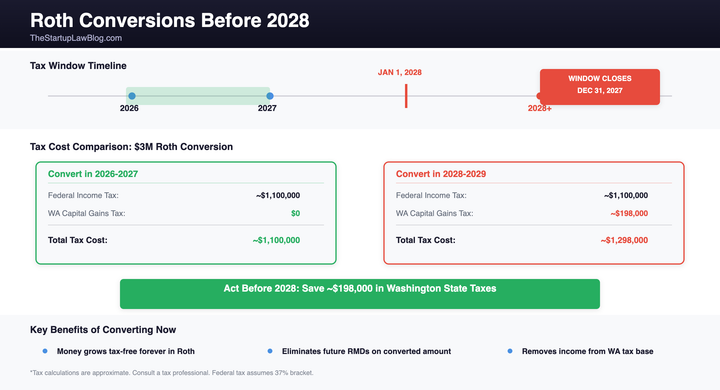
The Roth conversion window does not close in 2028 under current law. What changes is Washington’s tax treatment: beginning January 1, 2028, the taxable portion of a conversion can increase your Washington income-tax bill. The key is the conversion plus your other income, after Washington’s statutory adjustments and deductions.
The starting standard deduction is $1,000,000 per individual; married couples and registered domestic partners share one deduction. It is not a separate allowance for each conversion. A multi-year conversion plan can avoid Washington income tax if your combined income, after the applicable adjustments and deductions, leaves no Washington taxable income in each year.
The pre-2028 window matters when conversions would create Washington taxable income after the tax begins. A large IRA balance can produce that result, but so can salary, business income, or other income that already uses the deduction. Account size alone does not settle the question.
This post is part of our Complete Guide to Washington’s New Income Tax.
How a conversion enters the Washington base
A Roth conversion moves money from a traditional IRA or another eligible retirement account into a Roth. Federal income tax applies to the taxable portion in the conversion year. Nondeductible basis can make part of an IRA conversion nontaxable, subject to the IRA aggregation and pro-rata rules; you generally cannot select only the after-tax dollars. Qualified Roth distributions are excluded from income.
The taxable portion enters federal adjusted gross income. Washington starts with federal AGI, applies its statutory modifications, and subtracts the applicable deductions to determine Washington taxable income. For a full-year Washington resident, a taxable conversion therefore uses the same deduction as other income; there is no separate Roth-conversion exemption.
Washington’s existing capital gains tax does not apply to conversions, because the taxable portion is ordinary income rather than long-term capital gain. A conversion completed in 2026 or 2027 is outside Washington’s new income tax; federal tax and any applicable tax in another state must still be considered.
Sources: IRS Publication 590-A and Form 8606 instructions for conversion income and basis; ESSB 6346, §§201, 301, and 314–316 for Washington’s calculation and deduction rules.
The threshold is annual, which means it can be laddered
The $1,000,000 standard deduction applies per year, not per conversion. To avoid Washington income tax, the taxable conversion plus other income, after Washington adjustments and deductions, must leave no taxable income. The following illustration assumes a full-year Washington resident, a fully pre-tax $3 million IRA, $500,000 of other annual income included in Washington’s base, and the full $1 million deduction. It compares conversions in years when the income tax applies.
| Convert all at once | $500,000/year for six years | |
|---|---|---|
| AGI in a conversion year | $3,500,000 | $1,000,000 |
| Less Washington standard deduction | $1,000,000 | $1,000,000 |
| Washington taxable income | $2,500,000 | $0 |
| Washington tax at 9.9% | $247,500 | $0 |
On these assumptions, converting $500,000 annually for six years leaves no Washington taxable income in each year. The illustration holds other income and the deduction constant and ignores investment growth and intervening withdrawals. If other income rises, the available conversion room shrinks. The $247,500 lump-sum tax shown would not apply to a conversion completed before 2028.
Spreading conversions can keep more income in lower federal brackets. But the result depends on your income in each year, future rates, investment growth, and the time available before withdrawals. The table isolates Washington income tax; it does not establish that one schedule minimizes your total lifetime tax.
Inputs for your year-by-year conversion model
Use the same assumptions across scenarios so that the comparison is meaningful.
| Input to document | Your estimate | Source or assumption |
|---|---|---|
| Planned conversion amount and taxable portion | ______ | ______ |
| Other household income for the year | ______ | ______ |
| IRA basis and relevant account balances | ______ | ______ |
| Residence and any planned move | ______ | ______ |
| Federal and state calculation assumptions | ______ | ______ |
| Cash available to pay the resulting tax | ______ | ______ |
| Medicare or other income-sensitive effects to review | ______ | ______ |
| Investment-return and withdrawal assumptions | ______ | ______ |
Record which assumptions would change the decision. Review the schedule when income, residence, account values, or the law changes.
When the 2028 date actually binds
Consider a full-year Washington resident with $1.2 million of other income included in Washington’s base and a $100,000 fully taxable conversion. With a $1 million deduction and no other adjustments, deductions, or credits, the conversion adds $9,900 of Washington income tax in 2028. That result does not require a multimillion-dollar IRA.
A very large pre-tax balance presents another reason to evaluate early conversion. Model the following factors together:
A large balance can produce substantial required minimum distributions and leave little room in lower federal brackets. Whether that happens depends on age, withdrawals, investment returns, and other income. Compare projected future marginal rates with the federal cost of converting now.
Large taxable distributions can also increase Medicare income-related surcharges (IRMAA). A conversion can raise the surcharge in the relevant lookback year, while future qualified Roth distributions are excluded from gross income. A large account does not by itself establish that someone will remain in the highest tier permanently. Roth IRAs have no required minimum distributions during the owner’s lifetime.
The available annual conversion room depends on other income as well as account size. A schedule that works for a retiree with little other income may fail for a founder with continuing salary or pass-through business income.
Converting before 2028 may avoid an additional Washington tax cost, but accelerating income can increase federal tax and other costs.
For IRMAA, use tax years and Medicare coverage years rather than a blanket age cutoff. Social Security generally uses the tax return from two years before the premium year. A conversion in that lookback year can increase premiums. Medicare coverage before age 65 and the use of an older return can change the analysis, so “age 62 or earlier” is not an absolute safe harbor.
Two things that could change the answer
The tax could be repealed or struck down. Initiative 645 is certified for the November 3, 2026 ballot and would repeal the tax before it takes effect, and a constitutional challenge is pending. But the tax remains law, effective January 1, 2028, unless voters repeal it or the courts strike it down — plan as though it arrives on schedule.
You cannot undo a conversion. The ability to recharacterize was eliminated by the Tax Cuts and Jobs Act in 2018. Model the federal cost before you convert, and plan to pay that tax from non-retirement assets.
What to do
Compare a pre-2028 conversion, a later conversion, a smaller multi-year schedule, and no conversion using your actual circumstances: taxable conversion portion, other income, Washington modifications, deductions, and credits, federal rates, Medicare effects, cash to pay the tax, and residency if you may move.
For more on retirement income and Washington’s tax, see our Washington State Taxes guide. If you have nonqualified deferred compensation, see Deferred Compensation and Washington’s 9.9% Income Tax. Restrictions on changing distribution schedules can make early review important; the urgency depends on your payment terms, expected income, and planning deadlines.
Frequently asked questions
Can I avoid Washington’s tax by converting over several years?
Potentially. Spreading conversions helps only to the extent each year has unused deduction room after accounting for other income and Washington’s adjustments. If other income already uses the deduction, even a small taxable conversion can increase Washington income tax.
Can I undo a Roth conversion?
No. Recharacterization was eliminated by the Tax Cuts and Jobs Act in 2018.
This post is for informational purposes only and does not constitute legal or tax advice. Consult a qualified tax professional regarding your specific circumstances.
Thinking about converting before 2028?
Washington’s income tax changes the timing analysis for some conversions and not others. Book a free 20-minute call with Joe Wallin to talk through where yours falls.
Book a Free 20-Minute Call →Related Posts
- Stock Option Exercise Timing: Planning Before Washington's 2028 Income Tax
- Washington vs. California: A Tax Comparison for Founders and Investors
- QSBS Stacking: How to Multiply the $15M Exclusion with Trusts and Family Gifts
- How to Change Your Washington Domicile to Avoid the Income Tax
- Washington's New Income Tax: The Complete Guide
- Washington Capital Gains Tax: The Complete Guide
- The Washington Founder Exit Map
- The ESSB 6346 Marriage Penalty Explained