By Joe Wallin | April 2026 | ~7 min read
A taxable sale of a business or private stock can put years of appreciation into one tax year. From 2028, Washington’s income tax adds a planning question: would receiving eligible sale proceeds over time reduce the combined state tax? The answer depends on the asset and the interaction with Washington’s existing capital-gains tax. Long-term gains from directly held real estate are exempt from that excise tax and are removed from the income-tax base under §302; interest and ordinary-income components need separate treatment.
But there is a well-established technique that can help: the installment sale. By spreading the recognition of gain over multiple years, you may be able to stay below Washington's $1 million threshold in some years — or at least reduce the amount of income exposed to the 9.9% rate in any single year.
This post is part of our Complete Guide to Washington's New Income Tax.
How Installment Sales Work
Under IRC Section 453, if you sell property and receive at least one payment after the tax year of the sale, you can generally report the gain using the installment method. Instead of recognizing the entire gain in the year of sale, you recognize a proportionate share of the gain as each payment is received.
Separate stated or imputed interest from the sale-price payments. Under the installment method, gross profit divided by contract price gives the gross-profit percentage; apply that percentage to eligible principal payments to determine gain. The balance generally recovers basis. Debt and other special rules can change the contract-price calculation; interest is analyzed separately as ordinary income.
Federal recognition is the starting point, but it is not the whole Washington calculation. Section 302 removes long-term gains and losses from federal AGI, then adds back Washington capital gains plus the capital-gains standard deduction only in years the taxpayer owes capital-gains tax. Model that computation before applying the income-tax deduction and credits.
The Washington Income Tax Angle
The $1 million income-tax deduction and the separate capital-gains deduction do different jobs. An installment sale may spread taxable gains across annual deductions, but income below $1 million can still produce capital-gains tax.
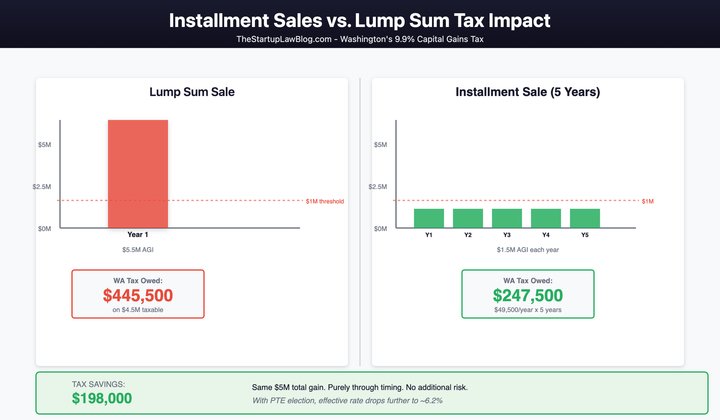
Illustration, not a forecast: assume a full-year Washington resident sells personally held, non-QSBS private stock eligible for installment reporting, with $5 million of long-term gain. Compare recognizing all gain in 2028 with $1 million per year in 2028–2032. Assume $500,000 of other ordinary income in each year, including any installment interest; no other gains, losses, exclusions, deductions, or credits except the deductions and §205 credit shown; and no PTE election. Hold the $1 million income-tax deduction and the 2025 capital-gains deduction of $278,000 constant solely to isolate timing. Actual indexed deductions and law in each year must be substituted before planning.
| Calculation | All gain in 2028 | Each installment year |
|---|---|---|
| Long-term gain | $5,000,000 | $1,000,000 |
| Capital-gains tax | $438,478 | $50,540 |
| Income tax before §205 credit | $445,500 | $49,500 |
| Usable §205 credit | $438,478 | $49,500 |
| Income tax after credit | $7,022 | $0 |
| Combined Washington tax | $445,500 | $50,540 |
Over the five-year comparison, the lump-sum route totals $445,500; the installment route totals $252,700. The nominal difference is $192,800 under these frozen-deduction assumptions. With the lump-sum route, the assumed $500,000 of ordinary income in each later year produces no income tax. This comparison excludes federal tax, financing costs, and the time value of money.
The installment route’s $49,500 tentative income tax is fully offset by §205, but the $50,540 capital-gains tax remains due. That is why staying below an income-tax threshold—or calculating income tax alone—does not establish that the total Washington bill is zero.
When Installment Sales Work
The installment method is available for most sales of property where at least one payment is received after the close of the tax year. This includes sales of businesses (asset sales), sales of real estate, sales of partnership interests, and private stock sales in certain circumstances.
The installment method is not available for sales of publicly traded stock or securities, sales of inventory, and sales of depreciable property to related parties (special rules apply).
For founders, the most common use case is an asset sale of a business or a sale of a partnership/LLC interest where the buyer pays over time — either through a seller note, an earnout, or a structured installment arrangement.
Structured Installment Sales: Changing the Credit Risk
A seller note exposes you to the buyer’s ability to pay. Some arrangements assign payment obligations to a third party or use insurance-related funding. That may change the source of credit support, but it does not eliminate counterparty risk. Identify who legally owes the payments, what assets support them, and what happens on insolvency.
Tax treatment depends on the actual documents, control over proceeds, guarantees, and applicable installment-sale rules. An arrangement marketed as a structured installment sale is not automatically eligible for deferral. Have tax counsel review the structure before signing. IRS Publication 537 explains the general installment rules; it is not approval of a particular product.
The Capital Gains Tax Interaction
Remember that Washington also has a separate capital gains tax (enacted in 2021, upheld by the state Supreme Court in 2023). The capital gains tax is tiered: 7% on the first $1 million of taxable long-term gain above the standard deduction ($250,000 base, indexed; $278,000 for tax year 2025), and 9.9% on taxable gain above $1 million.
Eligible installment sales may spread gain recognition, but Washington allocation of intangible gain depends on domicile at the sale, not merely residence when later payments arrive. WAC 458-20-301(3)(a)(i)(B) generally follows federal timing for post-2021 sales and excludes gain from pre-2022 installment sales. Apply deductions and the separate 2028 income-tax rules in the recognition year; a move after sale does not automatically remove the Washington-allocated gain.
The two taxes have different bases and deductions. Section 205 provides a nonrefundable credit for Washington capital gains tax, limited to the income-tax liability. Calculate the capital gains tax, the income tax after that credit, and then the combined amount payable, as shown above.
For more on the capital gains tax, see Washington's Capital-Gains Tax and QSBS: A Founder's Guide.
Installment Sales and the PTE Election
If an eligible pass-through entity sells the asset, model its §502 election separately from installment timing. The example above assumes a direct individual sale and cannot simply be multiplied by 63% to obtain the result for an electing entity. Capital-gains tax, the income-tax and entity-credit limits, and the treatment of owner deductions can change that comparison.
A separate federal-benefit illustration: if the election produces a $99,000 Washington income-tax payment that is fully deductible at a 37% federal marginal rate, the federal benefit is $36,630 and the payment after that benefit is $62,370. The Washington payment remains $99,000. This assumes no increase in state liability, full owner-credit use, and no other federal limitation or offset. It does not reduce every Washington tax payment by 37%. See the PTE election guide.
QSBS and Installment Sales
QSBS qualification does not by itself establish a full exclusion. Under Section 1202, qualifying stock acquired after July 4, 2025, is eligible for a 50% exclusion after at least three years, 75% after at least four years, and 100% after at least five years. Qualifying stock acquired after September 27, 2010, and on or before July 4, 2025, requires more than five years for the 100% exclusion. Earlier acquisitions have different exclusion percentages.
The exclusion percentage and the per-issuer eligible-gain limit are separate calculations. Apply the percentage to gain within the available limit, accounting for prior use and the applicable dollar-limit or 10-times-basis rules. See §1202(a)–(b). Only the federally excluded portion stays outside federal AGI and Washington’s income-tax base.
If the full gain qualifies for the Section 1202 exclusion, an installment sale provides no additional Washington tax benefit — the gain is already excluded.
A taxable remainder can result from a partial exclusion percentage or gain exceeding the available per-issuer eligible-gain limit. Eligible installment reporting may spread that taxable remainder across years, but the resulting Washington tax depends on each year’s income, deductions, and capital-gains credit.
For more on QSBS planning, see our Complete Guide to QSBS & Section 1202.
Key Considerations and Risks
Interest and original issue discount. Sections 1274 and 483 can treat part of a deferred payment as interest or original issue discount when stated interest is inadequate. The applicable test rate, compounding, payment terms and statutory exceptions matter; there is no single rule requiring every installment sale to charge the same AFR. See IRS Publication 537.
Depreciation recapture. If the property being sold has depreciation recapture under Section 1245 or 1250, the recapture income must be recognized in the year of sale, regardless of the installment method. Only the gain above recapture qualifies for installment treatment.
The pledge rule. Borrowing against certain installment obligations can be treated as receipt of payment and accelerate gain under §453A. The rule has scope limits and exceptions; review whether the particular obligation and borrowing are covered before pledging the note.
State tax changes. Spreading gain over multiple years exposes the plan to changes in rates, indexed deductions, and other rules. Use the law applicable to each year and model alternative outcomes.
Time value of money. Deferring gain is generally beneficial (a dollar of tax paid later is worth less than a dollar paid today), but the benefit must be weighed against the credit risk, opportunity cost, and complexity of the installment structure.
What to Do Now
If you are contemplating a sale of a business, real estate, or a significant asset position in the next few years, model the installment sale option now. The key inputs are your expected AGI in each year (including the installment payments), the $1 million Washington threshold, the capital gains tax threshold, and whether the PTE election or QSBS exclusion applies.
The planning window is before you sign the purchase agreement. Once the deal terms are set, the installment structure needs to be baked in. Retrofitting installment treatment after closing is generally not possible.
For a comprehensive look at Washington tax planning strategies, see our Washington State Taxes guide and Tax Planning Guide for High Earners. If you also have deferred compensation hitting in the same years as installment payments, see Deferred Compensation and Washington's 9.9% Income Tax for how to coordinate the timing.
This post is for informational purposes only and does not constitute legal or tax advice. Consult with a qualified tax professional regarding your specific circumstances.
Related Posts
- Stock Option Exercise Timing: Planning Before Washington's 2028 Income Tax
- Equity Compensation Plan Design: How to Structure Your Startup's Stock Option Plan
- ISO vs. NSO: The Complete Guide to Incentive Stock Options and Nonqualified Stock Options
- SAFE Agreements: What Every Startup Founder Needs to Know
- Washington vs. California: A Tax Comparison for Founders and Investors
- Washington's New Income Tax: The Complete Guide