Quick answer: §502 of ESSB 6346 allows eligible pass-through entities to elect to pay the Washington income tax at the entity level. A qualifying entity payment can produce a federal deduction outside the individual SALT cap. The election is annual and irrevocable, owners may opt out, and DOR sets the filing date no later than June 15 of the taxable year. Participating owners receive a §206 credit, but that credit is nonrefundable and cannot be carried forward or back. Savings depend on the entity computation, the owner’s available credit, and the incremental federal deduction; the state result is not guaranteed to be identical.
Below: how the §502 election works in practice, the worked math, when to elect, the B&O overlap, and how nonresident apportionment changes the analysis.
The Entity-Level Tax Election (§502): The SALT Cap Workaround
This is probably the most consequential planning provision in ESSB 6346 for pass-through business owners.
The Federal Problem It Solves
An individual’s federal deduction for state and local taxes is subject to a cap and, under the temporary increased-cap rules, an income-based phase-down. Many high-income owners have already exhausted the available individual deduction. Washington base income includes state modifications, so crossing Washington’s $1 million threshold does not by itself establish the owner’s federal SALT limit or the incremental benefit of a PTE deduction.
But if the entity pays the tax instead of the individual, the tax is a business expense — not a state income tax paid by the individual. The IRS confirmed in Notice 2020-75 that entity-level state taxes imposed on pass-through entities are not subject to the SALT cap. They're deductible as ordinary business expenses, reducing the entity's taxable income before it flows to the K-1.
Washington's §502 creates exactly this mechanism.
How the Election Works
Who can elect: Eligible partnerships and S corporations, including LLCs taxed as either, may elect. LLC status alone does not establish eligibility; do not assume a disregarded single-member LLC qualifies. (§§101(7), 502(2)(a).)
How to elect: File an election with the Department of Revenue on or before a date prescribed by the department, but no later than June 15 of the taxable year. (§502(2)(a).)
Irrevocable: The election is irrevocable for the taxable year once filed. (§502(2)(b).)
Opt-out for individual owners: An election may exclude owners who choose not to participate. The entity must identify participating and nonparticipating owners at the time of election. (§502(2)(d).)
Tax rate: 9.90% — the same rate as the individual income tax. (§502(1)(a).)
What Income the Entity Pays Tax On
The taxable income of an electing entity consists of:
- The entire distributive share of income, gain, loss, and deduction attributable to participating resident owners, regardless of source. (§502(3)(a)(i).)
- The state source distributive share attributable to participating nonresident owners. (§502(3)(a)(ii).)
Taxable income is determined by applying all state-specific additions, subtractions, and modifications that would apply to the owners individually. (§502(3)(b).) Guaranteed payments, separately stated items, and investment income are included to the same extent they would be for an individual. (§502(3)(c).)
The Credit on the Owner's Return
Each participating owner receives a §206 credit for the owner’s proportionate share of entity tax paid, subject to the statutory limits and the reduction for a §203 credit on the same income. The credit is nonrefundable and cannot be carried forward or back. Entity tax exceeding the usable credit can create an additional state cost.
Here's the mechanical flow:
- The entity pays 9.9% on the participating owners' share of taxable income.
- The entity deducts that tax payment as a business expense on its federal return, reducing the K-1 income flowing to each owner.
- Each participating owner adds back their share of the entity tax expense to their Washington base income (§310 — this prevents a double benefit at the state level).
- Each participating owner claims a credit under §206 for their share of entity tax paid.
The election can leave total Washington tax unchanged when the entity computation and the owner’s usable credit align. A qualifying federal deduction can then lower the net cost. A 37% federal benefit is an illustration for an owner who can fully use the incremental deduction at that rate; it is not a guaranteed saving on every entity payment.
Example: The Math in Practice
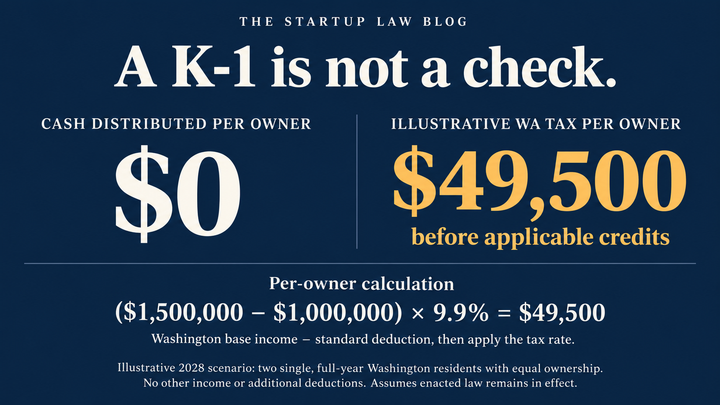
Illustration: Dr. Smith and Dr. Jones are equal, unrelated Washington-resident partners in a medical-practice LLC with $3 million of net income before PTE tax. Each has $1.5 million of Washington base income, no other adjustments or credits, and an individual $1 million deduction. Assume that deduction is fully reflected in the entity computation, each owner fully uses the §206 credit, and the entity payment produces a full incremental federal deduction at 37%. Assume their individual SALT deductions are already exhausted.
Without the entity election:
- Each partner has $1.5 million of Washington base income.
- Each claims the $1 million standard deduction (§314 — $1M per individual; the combined deduction only applies to spouses and domestic partners, so unrelated business partners each get their own $1M).
- Each partner has $500,000 of Washington taxable income.
- Each pays 9.9% × $500,000 = $49,500.
- Total Washington tax: $99,000.
- Federal SALT deduction: limited to $10,000 each.
With the entity election:
Under those assumptions, the entity pays $99,000. Each partner’s federal K-1 income is reduced by $49,500, then each adds back that share of entity tax for Washington purposes under §310 and uses a $49,500 §206 credit. The total Washington payment remains $99,000. The incremental federal benefit is $18,315 per partner, or $36,630 combined. Net cost after that federal benefit is $62,370.
One assumption runs underneath this entire example: that the $1 million standard deduction under §314 is available at the entity level when the electing entity computes its taxable income. The statute points that way — §502(3)(b) directs the entity to apply the additions, subtractions, and modifications that would apply to the owners individually — but §314 and the nonresident proration in §315 are written as individual-level mechanics, and the Department of Revenue has not yet issued guidance. This matters more than it looks. The §206 credit is capped at the owner's own tax and is not refundable. If the standard deduction is unavailable in the entity computation, entity tax may exceed the owner’s usable credit. Compare that additional state cost with the incremental federal tax benefit; the election could produce either a net saving or a net cost. The advisory group created in §712 is specifically charged with the election's implementation, so expect a rule on this point. Until then, model both readings before electing.
The $36,630 benefit follows from these assumptions. Recompute it each year and confirm the standard-deduction and credit treatment before electing.
A note before you book: please share only the names of the parties and a brief, non-confidential description of your issue. Confidential details should wait until we’ve completed a conflicts check and signed a written engagement agreement.
Important Limitations
The credit for other-state taxes (§203) reduces the §206 credit. If a resident owner also claims a credit under §203 for income taxes paid to another state on the same income, the §206 entity-level credit must be reduced accordingly. (§206.) You can't double-dip.
Estimated payments: The same schedule as individuals is required by §502(4)(a); subsection (4)(c) makes entity estimates substitute for owner estimates on the covered income. Subsection (4)(d) says no entity estimates are required before July 1, 2029. See the enacted PTE payment rules.
Election timing: File by the date DOR prescribes, which cannot be later than June 15 of the taxable year. June 15 is the statutory latest permissible deadline, not a promise that DOR will choose that date.
How Pass-Through Income Gets Taxed
The individual income tax applies to owners, while §502 separately permits an eligible entity to elect to pay tax. Partnerships, LLCs taxed as partnerships, and S corporations report their owners’ shares of income and other tax items on Schedule K-1.
Section 402 establishes how this works:
For Washington residents: Your distributive share of income, gains, losses, and deductions from a pass-through entity is included in your Washington base income — regardless of where the entity operates. If you're a Washington resident who owns 30% of a Texas-based partnership, your 30% share of that entity's income is Washington income. (§402(1), §401(1).)
For nonresidents: Only the Washington-source portion of your distributive share is taxable. "Sources within this state" means income from pass-through entities that operate in Washington, as determined under the allocation and apportionment rules in §405. (§402(1), §401(2).)
Modifications and credits flow through proportionally. If the entity has income that triggers a modification under §§302–308 (like capital gains or state/local tax deductions), your share of those modifications is computed based on your pro rata share — as reflected on the K-1. (§402(2).)
Guaranteed payments are treated the same as any other item of income that would be included in a participating owner's Washington base income. (§502(3)(c).) For residents, taxable guaranteed payments enter the Washington calculation subject to state modifications. For nonresidents, determine the Washington-source portion under the applicable allocation and apportionment rules; the firm's Washington location alone does not make the entire payment Washington-source income.
The B&O Tax Overlap
Washington already imposes its Business & Occupation (B&O) tax on gross receipts from business activity in the state. Unlike the income tax, B&O is levied on revenue — not profit. If all $5 million of revenue is taxable under the applicable Washington B&O classification, with no applicable exemptions or deductions, B&O is measured on that $5 million even if profit is only $500,000.
Beginning in 2028, business receipts may generate both B&O tax and income-tax exposure for an owner or electing entity. The taxes use different bases. Calculate the applicable B&O expense addback and credit before determining the combined burden.
The §204 Credit: Partial Relief
Section 204 provides a nonrefundable credit against the income tax for B&O taxes and public utility taxes paid on income that is also subject to the income tax. The credit equals the amount of B&O tax (or public utility tax under chapters 82.04 or 82.16 RCW) paid on income that is included in both the B&O tax base and the income tax base.
The §204 credit reduces income tax, not B&O tax. Its amount depends on tax paid on income included in both tax bases and on the available income-tax liability. With the same receipts and B&O rate, a lower margin can make eligible B&O tax a larger proportion of income tax, although the nonrefundable limit can leave B&O tax unrelieved. Model the §304 add-back for applicable B&O tax deducted in federal AGI as well as the §204 credit.
Practical Impact by Business Type
Professional services: High profits can create substantial income-tax exposure. Model the §204 credit, the §304 add-back, the §502 entity computation, and the owner’s §206 credit before electing. The business category alone does not establish that an election is beneficial.
Tech companies (S-corps): Model each shareholder’s household income, deductions, credits, and residency. Washington receipts affect B&O and nonresident business-income apportionment, but a resident shareholder can have income-tax exposure from business income earned elsewhere. Compare the PTE election with individual payment after accounting for usable credits and the incremental federal deduction.
Real estate (rental LLCs): Rental income flows through to owners on K-1. However, if the gains qualify for exclusion under the capital gains tax exemptions (RCW 82.87.050), the §302 modification may remove them from Washington base income. See Are Real Estate Gains Subject to Washington's New 9.9% Income Tax? for the details.
Retail and low-margin businesses: A low margin can make B&O substantial relative to profit, but does not establish which tax is larger. Calculate the owner’s Washington base income, available household deduction, other deductions, and credits. Nonresident and part-year deduction adjustments can produce liability with less than $1 million of Washington-source income.
Nonresident Owners: Apportionment Under §405
If you're a nonresident who owns a share of a Washington pass-through entity, your income from that entity is taxed only to the extent it's derived from Washington sources.
Section 405 uses a receipts factor for apportionable business income. Service receipts are assigned to Washington if and to the extent the service is delivered to a location in Washington; where the work is performed does not by itself determine that assignment. Nonapportionable income follows separate allocation rules.
The receipts factor uses Washington receipts over receipts everywhere, subject to the statutory assignment and exclusion rules. Section 405(3) has separate rules for tangible goods, services, real property, and intangible property, including reasonable approximation and exclusions from the factor. Apply those rules before calculating the percentage.
For nonresident owners of multi-state businesses, this can significantly reduce Washington exposure — but it does not eliminate it the way many owners assume. A nonresident who owns 50% of a firm with $4 million in income but only 20% of receipts in Washington has $400,000 of Washington-source K-1 income. The catch is §315: nonresidents do not get the full $1 million standard deduction against Washington-source income. The deduction is prorated by the ratio of Washington base income to total federal AGI — the same mechanism that applies to part-year residents.
With $2 million of total federal AGI and $400,000 of Washington base income, §315 prorates the assumed $1 million deduction to $200,000. That leaves $200,000 taxable and $19,800 of tentative income tax before credits, assuming no other adjustments. This example does not mean every nonresident with total income above $1 million and a Washington K-1 will owe tax: modifications, deductions, and available credits still matter.
Entity Structure Considerations
ESSB 6346 doesn't change the fundamental analysis of S-corp vs. LLC vs. partnership for most businesses. But it does add new factors:
S-corp reasonable compensation: An S-corporation shareholder may receive W-2 wages and separately report pass-through taxable income on Schedule K-1. That income can be taxable whether or not distributed. Cash distributions require a separate basis and distribution analysis. The §502 election covers qualifying entity income attributable to participating owners; it does not cover their W-2 wages.
Multi-member LLCs and partnerships: The election can cover participating partners’ distributive shares and guaranteed payments, subject to the statutory tax-base and sourcing rules. Partnership status alone does not establish a larger benefit than an S corporation election; compare the entity payment, each owner’s usable credit, and the incremental federal tax effect.
Single-member LLCs: A single-member LLC is generally disregarded unless it elects corporate tax classification. A disregarded LLC does not ordinarily file a partnership return or issue a K-1. Because §101(7) ties the PTE definition to reporting a distributive share of taxable income, do not assume a disregarded entity can elect; confirm DOR’s applicable implementation.
C-corps: Not eligible for the §502 election (they're not pass-through entities). C-corp owners who take salary are taxed at the individual level on their W-2 income. Dividends are also included in AGI. C corporations generally pay federal corporate income tax, and their earnings do not pass through to shareholders. Shareholder distributions require a separate analysis: they may be taxable dividends, a return of stock basis, or capital gain, with applicable Washington modifications.
Who Should Consider the Entity-Level Election?
Owners of eligible operating businesses and investment entities should compare the election with individual payment using their actual tax positions. An exhausted individual SALT deduction can make an entity deduction valuable, but the net result also depends on federal deduction limits and interactions, entity-level deduction treatment, state addbacks, usable owner credits, and compliance costs. Evaluate each participating owner separately; profession, entity form, or income above $1 million does not by itself establish a net saving.
Planning Takeaways
Model the §502 election against individual payment using the same income and deductions. Confirm the entity-level standard-deduction treatment, the owner’s usable nonrefundable credit, other-state credits, and the incremental federal deduction. Any additional state cost can reduce or outweigh the federal benefit.
Calendar DOR’s prescribed election date. Section 502 permits a deadline no later than June 15 of the taxable year; the election is irrevocable for that year.
Model the B&O interaction. Calculate the §304 add-back and the §204 credit against income tax on qualifying overlapping income. Do not assume relief is greater simply because a business has a higher margin.
Consider the owner mix. If your entity has both resident and nonresident owners, the election can be structured to include or exclude specific owners. Nonresident owners should model the opt-out decision under §315's prorated deduction — the relevant comparison is the entity-level tax on their Washington-source share versus their individual liability after the prorated (not full) $1 million deduction.
Track guaranteed payments separately. Guaranteed payments to partners are included in the entity-level tax computation under §502(3)(c). Make sure your entity's tax modeling captures these.
Do not forget estimated payments. No entity estimates are required before July 1, 2029. That date ends the moratorium; it is not itself a quarterly installment deadline. The entity follows the individual schedule for covered income. Confirm the transition instructions and actual due dates.
Frequently Asked Questions
What is the Washington PTE election?
The Washington PTE election under §502 allows an eligible pass-through entity to pay the income tax at the entity level. A qualifying payment can generate a federal deduction outside the individual SALT cap. Owners receive a §206 credit, but it is nonrefundable and cannot be carried forward or back. Model the entity tax and each owner’s usable credit; the state result is not automatically unchanged.
When is the deadline to file the Washington PTE election?
Pass-through entities must file the §502 election with the Washington Department of Revenue on or before the due date the department prescribes, but no later than June 15 of the taxable year. The election is annual — it must be made each year — and once filed it is irrevocable for that taxable year. Estimated tax payments are not required at the entity level before July 1, 2029.
How much does the Washington PTE election actually save?
In the stated example, a $99,000 entity payment produces a $36,630 incremental federal benefit at 37%, for a $62,370 net cost. This assumes the election creates no additional state liability, owners fully use their credits, and the entire entity deduction is incremental and usable at that rate. Different deductions, credit limits, federal tax positions, or entity computations change the result.
Can individual owners opt out of the Washington PTE election?
Yes. Under §502(2)(d), the entity-level election may exclude owners who choose not to participate. The entity identifies participating and non-participating owners at the time of the election. Owners who opt out continue to be taxed individually on their distributive share. Non-resident owners with minimal Washington-source income, or owners who claim §203 credits against other-state income taxes that would interact poorly with the §206 entity credit, may prefer to opt out.
Does the Washington PTE election help if my business pays B&O tax?
B&O tax continues to apply to gross receipts. Section 204 provides a nonrefundable credit against income tax for qualifying B&O tax on the same income; §304 also requires the applicable add-back for B&O tax deducted in federal AGI. Calculate those rules together with the PTE tax and owner-credit limits. The credit does not reduce B&O tax itself, and business margin alone does not determine the benefit.
Need help evaluating the entity-level tax election or modeling the B&O overlap for your business? Book a 20-minute intro call to discuss your situation. Also see: Washington State Taxes Guide | Income Tax Planning Guide for High Earners
This post is for educational purposes only and is not legal or tax advice. Consult a qualified attorney about your specific situation.