By Joe Wallin | Updated September 17, 2026
Here’s the practical issue: compensation you earned before 2028 under a nonqualified deferred compensation (NQDC) plan may enter Washington’s 9.9% income-tax calculation when it is included in federal adjusted gross income (AGI) in 2028 or later. Whether tax is due then depends on residency, Washington sourcing, any federal retirement-income protection under 4 U.S.C. §114, and the state’s modifications, deductions, and credits.
If you have an NQDC balance and expect payments around or after 2028, start with these questions:
- What payments are already scheduled, and for which years?
- What future deferral elections (if any) remain open under the plan and §409A?
- Where will the recipient reside — and be domiciled — when the amounts are paid?
- Does 4 U.S.C. §114 protect the payment as qualifying retirement income?
This post is part of our Complete Guide to Washington's New Income Tax.
How Deferred Compensation Works (Quick Refresher)
A nonqualified deferred compensation plan under Section 409A of the Internal Revenue Code allows you to defer a portion of your compensation — salary, bonuses, or other earnings — to a future date, typically retirement or separation from service.
A compliant, unfunded NQDC arrangement generally defers federal income inclusion until payment or constructive receipt. A §409A failure can instead require earlier inclusion of vested amounts not previously taxed. Payroll-tax timing is separate; do not assume it has already been handled merely because income-tax inclusion was deferred.
NQDC can move income into a year with a lower marginal tax rate, but the plan fixes payment timing under federal rules. Deferral is not indefinite at the participant’s discretion, and the state-tax result depends on the payment year, residency, and sourcing.
The Washington Tax Trap
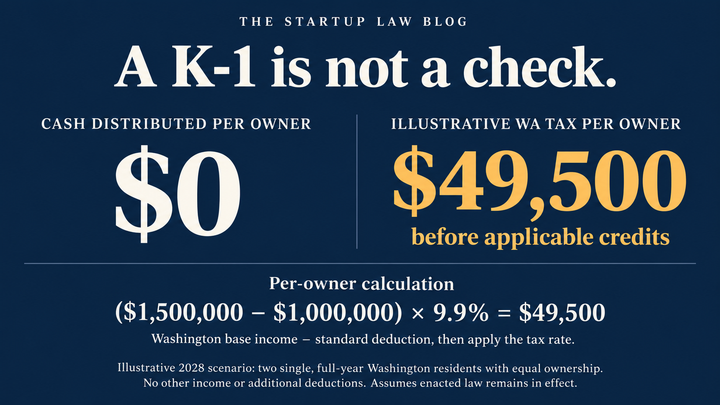
Washington's income tax, enacted under ESSB 6346, applies a 9.9% tax on "Washington taxable income" — income above a $1 million standard deduction ($1 million per individual; spouses and registered domestic partners share a single deduction). The tax base starts with federal AGI.
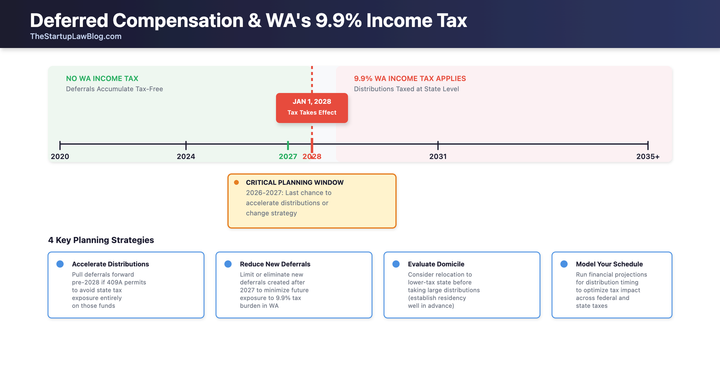
Income deferred before 2028 may be subject to Washington’s income tax when included federally in 2028 or later. Apply residency, sourcing, federal protection, and Washington’s modifications and deductions — including the shared standard deduction for spouses — before calculating the tax.
Consider a tech executive who deferred $500,000 per year from 2020 through 2027, accumulating $4 million in deferred compensation (plus investment returns). If that executive takes taxable distributions of $800,000 per year starting in 2029 and has other income of $400,000, federal AGI is $1.2 million. For illustration, assume Washington residency, a fixed $1 million standard deduction, and no other state modifications, deductions or credits: the resulting $200,000 of Washington taxable income produces $19,800 of tax at 9.9%. This is an illustration, not a forecast of the actual indexed deduction for 2029.
Can You Accelerate Distributions Before 2028?
This is the first question every executive with an NQDC plan asks: can I take my money out before January 1, 2028, when the tax takes effect?
Generally, no — and plan permission alone is not enough.Section 409A prohibits accelerating the time or schedule of payment except as the statute and regulations allow. A new state tax does not create a general right to accelerate. For an affected participant, a failure can cause inclusion in the year of failure of current and prior covered deferrals that are vested and not previously included, plus the 20% additional tax and premium interest. See §409A(a)(1) and §409A(a)(3).
Section 409A also sets strict initial-election and payment rules. Generally, an initial deferral election must be made by the end of the taxable year before the services are performed. A qualifying first-year eligibility election must be made within 30 days after eligibility begins and applies only to compensation for services performed after the election; other exceptions have their own requirements. Payment timing and form must comply with the plan and §409A. Permissible payment events include separation from service, a specified time or fixed schedule, a qualifying change in control, disability, death, or an unforeseeable emergency, subject to the applicable statutory and regulatory conditions. See §409A(a)(2) and (4).
Distinguish prohibited acceleration from a permissible subsequent election that further defers payment. Under §409A(a)(4)(C) and Treas. Reg. §1.409A-2(b), if the plan permits a subsequent election to delay a payment or change its form, that election generally must:
- not take effect until at least 12 months after it is made;
- defer the payment at least five years from the originally scheduled payment date (the five-year rule does not apply to elections related to payments on account of disability, death, or unforeseeable emergency); and
- for a payment at a specified time or fixed schedule, be made at least 12 months before the first scheduled payment.
Those rules authorize further deferral when they are met — not acceleration to beat the state tax. The plan must allow the change and the change must satisfy §409A; plan language without the statutory conditions is not enough.
If your plan allows "in-service distributions" on a fixed date, and you still have flexibility for future deferral elections, you may be able to schedule those future elections so distributions fall before January 1, 2028. That does not let you retroactively accelerate amounts already deferred.
A separation from service before 2028 does not guarantee payment before 2028. Check the plan’s payment terms, installment schedule and any applicable six-month delay for specified employees of publicly traded companies. Model the year of actual federal inclusion.
The practical constraint: existing payment schedules generally cannot be accelerated just to avoid a new state tax. Where a further deferral is lawfully available, model residency, sourcing, and federal-protection rules instead of assuming every distribution will be taxed — or that every election the plan form offers is §409A-compliant.
The Residency Question
For a former resident, analyze both residency and the source of the NQDC payment. Becoming a nonresident does not automatically remove compensation attributable to Washington work from the income-tax base. Federal protection for qualifying retirement income is a separate question.
A genuine domicile change, the full-year 30-day safe harbor and statutory residency are separate inquiries. Moving before distributions may change the residence-based result, but Washington-source compensation can remain taxable. Evaluate the plan, service history and federal retirement-income protection before treating a payout as exempt.
Some income types are sourced to the state where the services were performed, not where the taxpayer lives when paid. For NQDC, many states that tax nonresidents use an allocation approach, taxing the portion attributable to services performed in that state regardless of where the recipient lives at distribution.
Under 4 U.S.C. §114, the recipient must be neither a resident nor a domiciliary of the taxing state. For covered NQDC, the periodic-payment route requires substantially equal payments at least annually over life or life expectancy, or at least ten years. A separate route covers qualifying excess-benefit payments after termination. A ten-year label alone is insufficient; a lump sum is not automatically disqualified if another statutory route applies.
This is an area to watch closely as DOR issues implementing rules.
For a broader look at the residency and domicile question, see How to Change Your Washington Domicile to Avoid the Income Tax and What Happens If You Move Mid-Year?.
What About Qualified Plans (401(k), Pension)?
Washington’s income tax starts with federal AGI. Pre-tax salary deferrals to a 401(k) or 403(b) generally reduce current federal taxable wages; Roth and other after-tax contributions do not. Traditional IRA contributions reduce AGI only to the extent deductible, and the deduction can be limited by income and workplace retirement-plan coverage. Retirement distributions enter AGI only to the extent taxable: recovery of after-tax basis and qualified Roth distributions are excluded. See the IRS guidance on IRA deduction limits and Roth accounts in retirement plans.
The taxable portion of retirement distributions can therefore increase the federal AGI used to compute Washington’s tax. Apply the state’s modifications and deductions before calculating the 9.9% tax on Washington taxable income, and then apply available credits. Large taxable 401(k), pension and NQDC payments in the same year can produce a tax liability; spouses and registered domestic partners share one standard deduction. Do not treat every retirement distribution as fully taxable.
For more on this, see Is Retirement Income Subject to Washington's 9.9% Income Tax?.
Planning Strategies
Given the constraints of Section 409A, the planning options are limited but real:
Model your distribution schedule now. Project federal AGI for each year from 2028 forward, including taxable NQDC distributions, other compensation, investment income and expected liquidity events. Then apply Washington’s modifications, the applicable annual standard deduction and other deductions and credits. Compare total federal and state tax across the full distribution period.
Review lawful pre-2028 payment opportunities. A payout included federally before the income tax begins can avoid that tax, but a departure date or new election does not guarantee the payout date. Follow the plan and §409A. Do not accelerate payment solely to beat the state tax, and do not treat a subsequent election as valid unless it meets the further-deferral rules above.
Consider reducing or eliminating new deferrals. If you are currently making deferral elections for future years, run the numbers on whether continued deferral still makes sense once state tax is in the model. The federal deferral benefit may still outweigh the state cost if you expect a lower federal bracket at distribution.
Evaluate a domicile change. Changing domicile can eliminate Washington residence-based taxation, but it does not necessarily eliminate Washington-source taxation: compensation attributable to services performed in Washington requires a separate sourcing analysis, subject to applicable federal limitations including 4 U.S.C. §114. Moving does not automatically wipe out Washington tax on the NQDC. The break-even analysis depends on your total deferred balance, distribution timeline, and personal circumstances.
Coordinate with other income. If you can lawfully control the timing of taxable income — including capital gains, taxable business income and Roth conversions — coordinate it with your NQDC schedule. Minimizing the number of years above the standard deduction is not the goal: bunching income can waste deductions available in other years and increase total tax. A cash business distribution does not necessarily equal taxable income. Account for federal brackets, Washington’s capital-gains tax coordination and §409A restrictions before changing timing. For a related strategy, see Installment Sales and Structured Exits.
Review sourcing and federal protection together.Washington’s enacted allocation rules already reach specified nonresident compensation. Apply those rules, the service history and 4 U.S.C. §114, and check DOR implementation guidance.
What to Do Before 2028
Section 409A limits acceleration of existing schedules, and establishing a new domicile takes time and documentation. If you have a significant NQDC balance, talk to your tax advisor while lawful election and residency options are still available — not after the tax takes effect.
This post is for informational purposes only and does not constitute legal or tax advice. Consult with a qualified tax professional regarding your specific circumstances.
If ESSB 6346 will reach your deferred compensation, the planning conversation belongs in 2026–2027, not 2028. Book a 20-minute call with Joe Wallin or email wallin@carneylaw.com.
Related Posts
- Stock Option Exercise Timing: Planning Before Washington's 2028 Income Tax
- Equity Compensation Plan Design: How to Structure Your Startup's Stock Option Plan
- ISO vs. NSO: The Complete Guide to Incentive Stock Options and Nonqualified Stock Options
- Washington vs. California: A Tax Comparison for Founders and Investors
- QSBS Stacking: How to Multiply the $15M Exclusion with Trusts and Family Gifts
- Washington's New Income Tax: The Complete Guide