
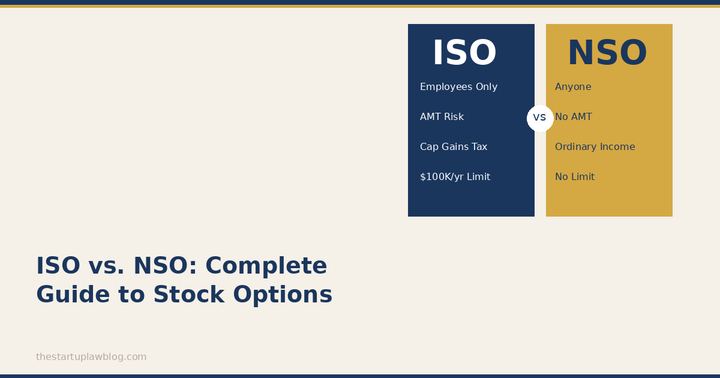
ISO and NSO treatment can materially change an option grant’s after-tax value. Grant terms, exercise timing, and sale timing all matter. This guide to equity compensation explains the rules and tradeoffs to check before acting.
For NSOs specifically, employers must also handle tax withholding on NSO exercises.
In This Guide
- → What ISOs and NSOs Actually Are
- → The Tax Difference: Why Timing Changes Everything
- → The Alternative Minimum Tax Trap
- → The $100,000 ISO Annual First-Exercisable Limit
- → Who Can Receive ISOs and NSOs
- → Capital Gains and the Qualifying Disposition Test
- → The Three-Month Post-Termination Exercise Window
- → Section 83(b) Elections and Early Exercise
- → QSBS and Both ISO and NSO Implications
- → Washington State Income Tax: How ESSB 6346 Changes the Calculus
- → When Founders Should Grant ISOs Versus NSOs
- → The Company Tax Deduction: An Often-Overlooked Advantage of NSOs
- → Common Mistakes and How to Avoid Them
- → Strategic Considerations for Growing Companies
- → The Bottom Line
The important dates are grant, exercise, vesting and sale. Each can affect tax treatment, and the option agreement may impose a deadline that differs from the tax-law deadline.
Start by identifying whether the award is an ISO or NSO, whether the shares will be vested at exercise, and whether cash will be available for the exercise price and any tax.
This guide explains the principal federal tax differences and the planning issues to check before granting or exercising options.
What ISOs and NSOs Actually Are
Let's start with the fundamentals. A stock option is simply a contractual right to purchase shares of your company at a predetermined price—what we call the strike price or exercise price. You don't own the stock yet. You own the right to buy the stock at that fixed price, whenever you decide to exercise that right (within the terms of your grant).
That's where ISOs and NSOs are the same. That's also where the similarities end.
An ISO—Incentive Stock Option—is a creature of federal tax law, specifically IRC Section 422. Congress created ISOs in 1981 as a way to align employee interests with company performance while providing favorable tax treatment. When you exercise an ISO, you don't immediately owe ordinary income tax on the difference between what you paid for the stock and what it's worth. That ordinary-income deferral is the core ISO advantage at exercise — subject to the AMT, holding-period, and other limits discussed below.
An NSO—Nonqualified Stock Option—does not receive the special tax treatment available to ISOs. For a typical compensatory NSO that was not taxable at grant, exercise into vested shares generally produces ordinary compensation income equal to the exercise-date value minus the exercise price. If the purchased shares remain nontransferable and subject to a substantial risk of forfeiture, income generally arises when those restrictions lapse, unless a timely Section 83(b) election applies. Employment or self-employment taxes and state taxes depend on the recipient and applicable rules. See §83(a)–(b) and Treas. Reg. §1.83-7.
The naming is a bit unfortunate because "nonqualified" makes NSOs sound like second-class options. In reality, NSOs are incredibly useful and often the right choice for a company. More on that in a moment.
But first, why this distinction matters so much in the real world.
The Tax Difference: Why Timing Changes Everything
Imagine I grant you 10,000 shares as an NSO with a $1.00 strike price. You hold the option and exercise later, once the stock's fair market value has climbed to $1.50 per share. You pay $10,000 (10,000 shares × $1.00 strike price). But the stock is worth $15,000 on the day you exercise ($1.50 × 10,000 shares).
Assume the NSO was not taxable at grant and the shares are vested at exercise. The $5,000 spread is then ordinary compensation income in the exercise year, even without a sale. Applicable withholding and employment taxes must also be considered. An early exercise into unvested shares requires the separate Section 83 analysis described below.
With the same grant and exercise prices, exercising a qualifying ISO to acquire vested shares generally creates no regular federal income-tax inclusion and no federal employment tax on the exercise spread. The $5,000 spread may nevertheless enter the AMT calculation. State treatment must be checked separately. See IRS Topic 427.
That's the core benefit of an ISO, and it's substantial.
A qualifying ISO disposition generally produces long-term capital gain measured from the exercise price. Applicable exclusions, including Section 1202 for eligible QSBS, may reduce taxable gain. Favorable sale treatment does not remove exercise-year AMT exposure or investment risk.
For a typical NSO exercised into vested shares, the spread is compensation income at exercise. That amount is included in the stock’s tax basis; a later sale generally produces capital gain or loss measured from that basis. For unvested shares, recognition and basis depend on Section 83 and any timely 83(b) election.
The Alternative Minimum Tax Trap
An ISO exercise can create alternative minimum tax before the shares provide any cash.
The AMT is a parallel tax system that exists to prevent high-income people from using certain deductions and exclusions to avoid federal income tax entirely. For most people, the AMT doesn't apply. But for ISO holders, it can be devastating.
Here's why: when you exercise an ISO, there's no ordinary income tax. But the exercise creates an "alternative minimum taxable income" adjustment equal to the spread. So even though you didn't owe regular federal income tax on the spread, the spread counts toward your AMT calculation.
If your AMT ends up being higher than your regular federal income tax, you pay the AMT instead.
For example, exercising 100,000 ISO shares at $1 when each vested share is worth $10 produces a $900,000 spread. If the shares remain held at year-end, that spread generally enters the AMT calculation. The resulting additional tax depends on the taxpayer’s other income, deductions, exemption phaseout and regular tax; the spread alone does not establish a tax bill.
ISO-related AMT may generate a minimum-tax credit for later years. How quickly the credit can be used depends on the applicable credit limitation and future tax circumstances. A stock sale or decline in value does not itself guarantee recovery.
A sale in the same calendar year as ISO exercise generally avoids a separate ISO AMT adjustment under the Form 6251 instructions, but is a disqualifying disposition. Compensation income generally reflects the exercise spread, subject to the section 422(c)(2) limitation for qualifying sales at a lower price. A sale in a later year does not erase the exercise-year adjustment.
This is not theoretical. During the dot-com boom, thousands of employees exercised ISOs in companies that eventually failed or stayed private for decades. They owed AMT on the spread immediately but never made any money from the stock.
That liquidity and credit problem is real: ISO-related AMT can leave you paying tax before the shares can be sold, and recovery through the AMT credit depends on later-year limitations that may delay or prevent full recovery. An NSO does not solve every risk either: you generally know the ordinary-income liability at exercise into vested shares, but that tax stays paid even if the stock later loses value, and a later loss on the shares is a capital loss, deductible against ordinary income at only $3,000 a year (§1211(b)). Neither option type is universally preferable.
The $100,000 ISO Annual First-Exercisable Limit
Here's another rule that trips up founders: Section 422(d) of the IRC limits the aggregate fair market value of stock with respect to which ISOs first become exercisable in a calendar year.
Specifically, the aggregate fair market value of the stock with respect to which ISOs are exercisable for the first time in any calendar year (determined at the time of grant) cannot exceed $100,000. The “for the first time” language matters: the limit applies to shares as they first become exercisable each year, not to your cumulative exercisable balance.
First exercisable means the first calendar year in which the option permits the employee to purchase the shares. This may track vesting, but an early-exercise provision can make unvested shares immediately exercisable and count them in the grant year. Use actual calendar-year dates and grant-date fair market value; a four-year service schedule does not automatically divide the limit into four equal calendar-year amounts.
The $100,000 limit uses the stock’s fair market value when each option was granted, not the exercise spread or later appreciation. If grant-date value is $1 per share, 100,000 shares first becoming exercisable in a calendar year use the limit; at $5 per share, 20,000 shares use it. Aggregate the relevant grants under the statutory rules. Separately, an ISO generally must have an exercise price at least equal to grant-date fair market value; the special rule for more-than-10% owners requires at least 110%. See §422(b)(4), (c)(5), and (d).
Anything over this limit automatically becomes an NSO, regardless of what your option agreement says.
This is relevant for companies that have had multiple funding rounds. For each employee, combine the grant-date fair market value of shares that first become exercisable in the same calendar year under all plans of the employer and its parent and subsidiary corporations. If that total exceeds $100,000, the excess is treated as NSOs (§422(d)). The test does not aggregate all options granted during the year.
A company can retain ISO treatment for the portion within the $100,000 first-exercisable limit and treat the excess as NSOs. A higher valuation does not itself require the company to stop granting ISOs.
Who Can Receive ISOs and NSOs
ISOs must be granted in connection with employment by the employer corporation or a qualifying parent or subsidiary. A nonemployee consultant, advisor, or director cannot receive an ISO for that role. A director who is also an employee can receive an employment-related ISO if the other requirements are met. See §422(b).
The IRS is strict about this. If you grant an ISO to a consultant or contractor, it loses its ISO status and becomes an NSO, regardless of what the agreement says.
Compensatory NSOs can be granted to employees and nonemployee service providers, including consultants, advisors, and directors, subject to the plan, tax rules, and securities-law requirements. Investor warrants and family transfers require separate analysis; the NSO label does not establish a securities exemption.
Options granted for services as a nonemployee advisor, consultant, or director generally use NSO treatment. An individual’s additional title as a director or advisor does not disqualify an otherwise eligible employment-related ISO.
The Formal ISO Plan Requirements Founders Miss
Three formalities deserve attention. First, the ISO plan needs shareholder approval within 12 months before or after adoption (§422(b)(1)); obtaining approval before grants avoids missing the deadline, although the statute permits later approval within that window. Second, ISO grants must occur within 10 years of plan adoption or shareholder approval, whichever is earlier (§422(b)(2)). Third, lifetime transferability is restricted. A transfer incident to divorce loses statutory-option status, but a trust transfer can preserve it if the employee remains the sole beneficial owner under section 671 and applicable state law (Treas. Reg. §1.421-1(b)(2)). Review the actual plan and transfer before acting.
Capital Gains and the Qualifying Disposition Test
Remember when I said ISOs have special tax treatment? I didn't tell you the full story. There are conditions.
A qualifying ISO exercise generally does not create regular federal compensation income at exercise. Preserving capital-gain treatment on a later sale requires the statutory holding periods and other requirements. A disqualifying disposition generally creates compensation income in the disposition year, rather than retroactively changing the exercise year.
A qualifying disposition means: (1) you hold the stock for at least two years from the date the option was granted, and (2) you hold the stock for at least one year from the date you exercised the option.
A qualifying disposition generally produces long-term capital gain. Applicable exclusions, including Section 1202 for eligible QSBS, can reduce the taxable amount.
If you don't meet these conditions, it's called a "disqualifying disposition." And here's what happens: the spread between the strike price and the fair market value on the date of exercise is taxed as ordinary income, just as if you'd exercised an NSO in the first place. Any additional gain after the exercise date is still capital gain. But you've lost the ISO benefit on the spread. One relief rule worth knowing (§422(c)(2)): if you sell in an arm's-length disqualifying disposition for less than the exercise-date fair market value, your ordinary income is generally limited to your actual gain on the sale — you aren't taxed on paper spread you never realized. In a down market, that cap matters.
The most common reason for a disqualifying disposition? You leave the company, exercise the options, and sell the stock all within a year. You exercised the option and held the stock for less than one year, so the disposition doesn't qualify.
This is important enough that I'm going to say it again: if you exercise an ISO, you need to hold the stock for at least one year before selling to avoid ordinary income tax on the spread. Some employees don't realize this. They exercise their options, their company has a successful exit, and they're suddenly forced to pay ordinary income tax instead of capital gains tax because they didn't hold long enough.
The Three-Month Post-Termination Exercise Window
Most stock option plans, whether they're for ISOs or NSOs, include a vesting schedule. Typically, 25% of your shares vest after one year (the "cliff"), and the remaining 75% vest monthly or quarterly over the next three years. If you leave the company, you can only exercise the shares that have vested.
But here's where ISOs have a special rule: if you leave the company, you have only three months to exercise your vested ISOs and keep ISO tax treatment (§422(a)(2)). Two different things can happen at the three-month mark, and it pays to know which applies to you. Under most standard plans, the option simply expires — the plan is written to terminate options at three months precisely because ISO treatment ends there. But the three-month cutoff itself is a tax rule, not an expiration rule: if your plan provides a longer post-termination window (extended windows have become common), the option survives — it just converts to NSO treatment when exercised after three months, meaning ordinary income tax on the spread. Read your plan; don't assume.
For both ISOs and NSOs, the plan and option agreement set the post-termination expiration date. A 10-year original option term does not mean you have 10 years after leaving to exercise. Separately, the ISO employment requirement generally looks back three months from exercise; disability extends that period to one year (§422(c)(6)), and special rules apply to exercise by an estate or heirs after death.
Why does this matter? If your agreement gives you a short post-termination window, you need the exercise cash before that contractual deadline or the options expire. If it allows a longer window, exercising within three months generally preserves ISO treatment; exercising later generally receives NSO treatment. If you have 10,000 options at a $1 strike price, exercise requires $10,000, plus any applicable tax. Model the AMT consequences before exercising ISOs with a spread.
Do not wait for an IPO or acquisition without checking your documents. Ask the company to confirm both your contractual expiration date and the deadline for preserving ISO tax treatment.
NSOs have no ISO three-month tax deadline, but they can expire under the same contractual post-termination provisions. Their flexibility depends on what the plan and option agreement actually allow.
What to check before leaving a startup with vested options
Before your last day, download your plan, grant agreements, and amendments. Vested options are a right to buy shares; they are not shares you already own. Work through this checklist for each grant:
- Confirm what you can exercise. Ask the company to confirm your vested, unexercised balance, strike price, and ISO or NSO classification. Check the termination date used for vesting and the date your employment ends. Continuing as a consultant does not, by itself, preserve employee status for ISO purposes.
- Get both deadlines in writing. Identify the contractual post-termination expiration date, any earlier maximum expiration date, and the separate deadline for ISO tax treatment. The ordinary ISO rule uses three calendar months, not necessarily 90 days; death and disability have special rules. Request any extension before the option expires and have its tax consequences reviewed. A longer contractual window does not itself extend the statutory ISO employment period.
- Price the whole exercise. Multiply the shares you want to exercise by the strike price, then model taxes separately. For vested NSOs, the exercise-date spread generally produces compensation income, with applicable withholding. For ISOs, exercise can trigger AMT. Confirm the common-stock fair market value the company will use, rather than assuming the latest preferred-stock financing price applies. Withholding is not necessarily your final tax liability. The IRS stock-option overview explains the basic distinction.
- Check what you can do with the shares. Read transfer restrictions, company approval requirements, rights of first refusal, and repurchase provisions. Ask whether any cashless exercise or liquidity program is actually available to you. Do not assume a tender offer, IPO, or acquisition will fund the exercise. Consider whether you can afford to lose the exercise cash and taxes if the shares become worthless.
- Finish the exercise and keep proof. Confirm the required notice, payment method, signed documents, withholding, and receipt deadline. Submit everything early enough to cure errors, and obtain written confirmation of completion. Keep the exercise confirmation, valuation information, and tax records outside your work account, and update your contact details for later tax forms.
If you are considering exercising only part of a grant, ask how the company will allocate the exercise between any ISO and NSO portions.
Section 83(b) Elections and Early Exercise
Early exercise and Section 83(b) interact with both ISOs and NSOs in important ways.
Early exercise means exercising an option before the purchased shares are vested, if the plan and award permit it. The company may retain a repurchase right over the unvested shares. The option can have economic value even when no tax is imposed at grant; the tax question is separate from valuation.
Here's where Section 83(b) comes in. A timely election generally includes the transfer-date fair market value minus the amount paid when substantially nonvested shares are transferred, instead of waiting until they become substantially vested. That changes when compensation is measured under §83; it does not itself convert all later share-price appreciation into capital gain. Character on a later sale still depends on basis, capital-asset status, holding period, any ISO disqualifying-disposition rules, and separate state taxes such as Washington’s capital-gains tax.
For a typical NSO early-exercised into nontransferable shares subject to a substantial risk of forfeiture, a timely Section 83(b) election generally includes the transfer-date spread in compensation income rather than waiting for vesting. If the stock’s value equals the exercise price, that spread is zero. Subsequent vesting generally does not create additional compensation income on the elected shares; a later sale ordinarily receives capital-gain or loss treatment if the shares are a capital asset.
With an ISO? It's different — and widely misunderstood. For regular tax purposes there is no Section 83(b) election to make on an ISO, because exercising an ISO creates no ordinary income in the first place (§421(a)). The election you file on an early-exercised ISO operates only for AMT purposes: it fixes the AMT adjustment at the exercise-date spread rather than the (likely larger) spread when the shares later vest. See Treas. Reg. §1.422-1(b)(3) and §56(b)(3).
What the election does not do is move the qualifying-disposition clock. The §422 one-year holding period runs from the transfer of the shares at exercise whether or not you file — and the two-year-from-grant period is unaffected by anything you do. File the protective 83(b) within 30 days of an early exercise anyway (Form 15620; the IRS now has an e-filing portal). If the spread at exercise is zero, the election costs nothing. If there is a spread, the election fixes the exercise-year AMT adjustment at that spread. An adjustment does not automatically mean AMT is payable; that depends on your overall tax calculation (§55(a)). If AMT is payable, a later decline or forfeiture does not by itself entitle you to a refund of that tax (§83(b)(1); Reg. §1.83-2(a)); recovery through an AMT credit depends on future tax circumstances and may never be possible.
For an early-exercised NSO, a timely §83(b) election generally prevents subsequent vesting from creating additional compensation income on the elected shares. ISO stock follows the separate regular-tax and AMT rules described above. An election does not guarantee capital-gain treatment on every later disposition.
But it requires careful planning. You need to understand the AMT implications. You need to make sure you actually want to lock in the basis. And you need to make sure your option plan actually permits early exercise.
QSBS and Both ISO and NSO Implications
I've written extensively about Qualified Small Business Stock—QSBS—because the Section 1202 capital gains exclusion is one of the most valuable tax benefits available to startup employees and founders. Here's how it interacts with both ISOs and NSOs.
Section 1202 first limits eligible gain and then applies the exclusion percentage. The limit is generally the greater of the remaining per-issuer dollar limit or 10 times qualifying basis in that issuer’s QSBS disposed of during the year, disregarding basis additions after original issuance. The starting dollar limit is $10 million for acquisitions on or before July 4, 2025 and $15 million for later acquisitions, subject to prior-use and coordination rules; the latter is indexed after 2026. Determine acquisition dates after applicable §1223 holding-period tacking. Qualifying stock acquired after September 27, 2010 and on or before July 4, 2025 requires more than five years for a 100% exclusion; earlier acquisitions have historical percentage rules. Qualifying post-July 4, 2025 acquisitions receive 50%, 75% or 100% exclusions after at least three, four or five years. The nonexcluded part of eligible gain in the partial-exclusion tiers can face a maximum 28% federal rate, plus NIIT when applicable. Gain above the eligible-gain limit generally follows the usual long-term capital-gain rates, rather than becoming 28%-rate gain solely because the stock is QSBS. The separate $50 million/$75 million corporate gross-asset threshold turns on issuance. See the QSBS guide and §1(h).
Shares acquired by exercising either ISOs or NSOs can qualify as QSBS. The options themselves are not QSBS.
With an ISO, your basis is the strike price you paid to exercise the option. If you exercise at $1 per share, your basis is $1 per share. Then you hold it past the five-year mark, the company is acquired for $100 per share, and you have a $99 per share gain. If it qualifies as QSBS, you exclude up to $10 million (or $15 million for post-July 4, 2025 stock) of that gain.
With an NSO, your basis is the fair market value at exercise—the strike price you paid plus the spread you already recognized as ordinary income. That's the key point: because you were taxed on the spread at exercise, it's baked into your basis, so you're not "double taxed" on it. The QSBS exclusion then applies to your gain from that exercise-date basis up to the sale price.
For vested shares purchased on exercise, the QSBS holding period generally begins with the stock acquisition rather than the option grant. An early exercise into unvested shares requires separate §83 and ISO/AMT analysis. The issuing company must satisfy the applicable gross-asset ceiling both before and immediately after issuance, and the C-corporation and active-business requirements during substantially all of the relevant holding period.
Do not infer QSBS eligibility from the company’s success, industry label or option type. Obtain the issuance records and company-level evidence needed to test the requirements for the particular shares.
Washington State Income Tax: How ESSB 6346 Changes the Calculus
Washington tax consequences belong in the exercise and sale analysis alongside federal tax, liquidity and the award’s contractual deadlines.
In 2026, Washington passed Engrossed Substitute Senate Bill 6346 (ESSB 6346), which imposes a 9.9% income tax on income above $1 million, effective January 1, 2028. (Washington's capital gains tax — a separate excise tax on long-term gains above the annual standard deduction — was enacted earlier, in 2021, as ESSB 5096, and has been in effect since 2022. Beginning with tax year 2025, the rate is 7% on the first $1 million of taxable Washington capital gains and 9.9% on amounts above that, after applicable deductions and adjustments.)
Washington’s capital gains excise tax and the income tax scheduled for 2028 use different bases, deductions, and exemptions. Section 205 provides a nonrefundable income-tax credit for Washington capital gains tax imposed for the same taxable year, with no carryforward. The result is not a universal 9.9% effective rate. Calculate each tax, the section 302 addback, and the available credit using the taxpayer’s full facts.
Using the 2025 capital gains standard deduction of $278,000 as a historical illustration, a $5 million gain subject to the excise tax with no other adjustments leaves $4.722 million taxable: $70,000 on the first $1 million and $368,478 on the remainder, totaling $438,478. This is not a 2028 projection; use the applicable year’s indexed deduction and rules.
For NSOs, the situation is different. The spread at exercise is ordinary income, which will fall under Washington's new income tax once it takes effect in 2028. The capital gain portion is subject to the capital gains tax, which applies to long-term gains only.
Washington residents should compare federal and state consequences together. Neither option type is universally better: AMT, compensation income, sale timing, liquidity, investment risk, and potential QSBS eligibility can change the result.
Exercising an ISO before 2028 does not itself exclude a later sale from Washington tax. Review sale-year rules, residency and sourcing, and the credit interaction. Gain validly excluded from federal income under Section 1202 generally remains outside both Washington tax bases, but the shares must satisfy the QSBS requirements.
When Founders Should Grant ISOs Versus NSOs
Now let's talk about what matters to founders: when should you grant ISOs versus NSOs to your team?
Here's my practical framework:
Grant ISOs when:The recipient is an eligible employee, the award meets the statutory requirements, and the expected exercise and sale strategy makes potential deferral and capital-gain treatment useful. Model AMT and cash needs even with a low strike price; an expected exit does not guarantee liquidity or favorable tax treatment.
Grant NSOs when: The recipient is a nonemployee consultant, advisor, or director; part of an employee’s award exceeds the $100,000 ISO first-exercisable limit; or the company and recipient prefer terms that do not meet the ISO requirements. Consider the expected compensation deduction and the recipient’s tax and liquidity circumstances. A high valuation alone does not require abandoning ISOs, and an NSO deduction does not necessarily arise at exercise if the shares remain unvested.
A company may grant both ISOs and NSOs. Employee eligibility, the first-exercisable limit, expected tax treatment and the plan’s terms determine the mix; employee number and financing round are not statutory dividing lines.
An employee who owns more than 10% of the company’s voting power, applying the statutory attribution rules, can receive an ISO only with an exercise price of at least 110% of grant-date fair market value and a term no longer than five years. Compare those terms with an NSO using the actual economics; the restriction does not establish that NSOs are almost always better for founders. See §422(b)(6) and (c)(5).
The Company Tax Deduction: An Often-Overlooked Advantage of NSOs
A qualifying ISO exercise does not produce an employer compensation deduction, and no such deduction arises if the employee later makes a qualifying disposition. But a disqualifying disposition can generate compensation income for the employee and a corresponding employer deduction in the disposition year, subject to Section 162, Section 83(h), and the applicable requirements. The deduction is therefore not an advantage exclusive to NSOs. See Treas. Reg. §1.421-2(a)–(b).
For an NSO, Section 83(h) generally permits a corresponding compensation deduction under Section 162 when the recipient recognizes compensation income, subject to the applicable requirements and deduction limits. If an employee recognizes $100,000 on exercise into vested shares, that can support a $100,000 deduction. Early exercise into unvested shares can change the timing, depending on Section 83 and any timely 83(b) election. See §83(h).
For a venture-backed company, this might not matter much until the company is profitable. But for bootstrap companies or companies with other sources of profit, the NSO deduction can be valuable. It's a benefit of granting NSOs that employees often don't understand.
Common Mistakes and How to Avoid Them
The mistakes below are the ones that most often cost people money — usually smart people who simply didn't know the rules.
Mistake #1: Not understanding AMT. An employee exercises a bunch of ISOs with a large spread, doesn't understand they'll owe AMT, and gets a tax bill for hundreds of thousands of dollars. Then their company never goes public and the stock becomes illiquid. The fix: understand the math before exercising. If you're exercising a substantial amount of ISOs, talk to a tax professional about your AMT exposure.
Mistake #2: Missing the $100,000 annual limit. A founder grants options to employees without tracking the annual limit, and options that should have been ISOs become NSOs due to the limit. The fix: if you're granting significant equity, use an option tracking spreadsheet that monitors, for each employee and calendar year, the grant-date fair market value of the ISO shares that first become exercisable that year (§422(d)).
Mistake #3: Forgetting about the three-month post-termination rule for ISOs. An employee leaves the company, thinks they have time to decide, and then finds two clocks running. The plan's post-termination expiration date decides whether the option can still be exercised at all; under most plans that is 90 days, and a missed date means the options are gone. The §422(a)(2) three-month rule decides whether an exercise still gets ISO treatment; where a plan allows a longer window, an exercise after three months is taxed as an NSO. The fix: tell departing employees both dates, in writing, and put them in your option plan and your employee handbook.
Mistake #4: Not holding ISOs long enough for a qualifying disposition. An employee exercises ISOs, the company is acquired or goes public, and they sell immediately. They pay ordinary income tax on the spread instead of capital gains tax because they didn't hold for one year post-exercise. The fix: understand the one-year holding period and plan your exercise and sale timing around it.
Mistake #5: Ignoring Section 83(b) when early exercising. An employee early exercises options without filing an 83(b) election, and the tax treatment is less efficient than it could have been. The fix: if you're early exercising, definitely talk to a tax professional about whether an 83(b) election makes sense.
Strategic Considerations for Growing Companies
The grant framework above already covers when ISOs or NSOs fit; revisit that mix as valuations and hiring needs change. A Series B financing does not require abandoning ISOs within the statutory limits.
Exit planning adds a separate layer. Many acquisition agreements accelerate vesting, which creates a compressed decision for employees holding ISOs with a large spread: employees who are terminated in the post-closing restructuring face the three-month exercise clock and the AMT exposure at the same time. Cash-outs, option assumption, and termination timing all change the tax outcome — plan for them in the deal documents, not after closing.
The Bottom Line
ISOs and NSOs are both useful tools, with different tax consequences and no universal winner. Use the grant framework, AMT and liquidity analysis, holding-period rules, and the departure checklist above against the actual award — exercise cost, tax exposure, liquidity, and risk of loss — rather than a generic preference for either label.
Related Posts
- The Complete 83(b) Election Guide
- Stock Option Exercise Timing and Washington Income Tax
- Qualified Small Business Stock (QSBS): What Founders, Investors, Contractors, and Employees Need to Know
- 409A Valuations: What Every Startup Needs to Know
- SAFE Agreements: What Every Startup Founder Needs to Know
For help reviewing an option grant or exercise, schedule an introductory call.
Related Reading
This post is for educational purposes only and is not legal or tax advice. Consult a qualified attorney about your specific situation.