Equity plan design involves choices about dilution, award eligibility, vesting, exercise rights and administration. Set those terms deliberately and document grants before making commitments to employees.
In This Guide
- → Why Startups Need an Equity Compensation Plan
- → The Stock Option Plan Document: What It Contains and Why It Matters
- → Setting the Option Pool Size
- → ISOs vs NSOs: When to Use Each
- → Vesting Schedules: The Standard and Why It Exists
- → Exercise Prices and the 409A Valuation
- → Early Exercise: A Powerful Tool with Tradeoffs
- → Restricted Stock vs Stock Options vs RSUs: Which to Use When
- → Plan Administration: The Mechanics That Matter
- → Evergreen Provisions and Annual Pool Refreshers
- → Post-Termination Exercise Windows: The 90-Day Standard Is Changing
- → Change of Control: Single-Trigger vs Double-Trigger Acceleration
- → Tax Considerations for the Company and Employees
- → Common Mistakes: How to Avoid Them
- → How to Communicate Equity Grants to Employees
- → Putting It All Together: Your Equity Plan Framework
- → Ready to Build on a Solid Legal Foundation?
An equity compensation plan sets the framework for awards. The plan, individual agreements and corporate approvals should work together to define recipients’ rights and the company’s obligations.
Why Startups Need an Equity Compensation Plan
At Series A, assess cash compensation and equity together against the company’s hiring needs and budget. Explain the award’s potential upside alongside dilution, exercise costs and liquidity risks.
Equity is your lever for attracting and retaining talent. It lets you offer total compensation packages that make sense for your stage—but only if your plan is structured thoughtfully and communicated clearly.
Equity can give employees a financial interest in the company’s growth. Its value as an incentive depends on the award terms, dilution, business performance and opportunities for liquidity.
Document equity grants and obtain the required approvals. A formal plan provides a consistent framework and is required for ISO treatment; Rule 701 can also cover grants under a written compensation contract if its other conditions are met. Either way, accurate approvals, agreements, pricing support and issuance records are still needed to establish each recipient’s rights.
The Stock Option Plan Document: What It Contains and Why It Matters
When I say "equity compensation plan," I'm usually talking about what the law calls an "equity incentive plan"—a master plan document that governs how options, restricted stock, and other equity awards are issued. This document is your constitution for equity grants.
The plan document does several things. First, it authorizes the board of directors to grant equity awards to employees, consultants, and advisors. It specifies which types of equity awards can be issued (options, restricted stock, restricted stock units, or a combination). It sets out the rules that all grants must follow—things like vesting schedules, exercise procedures, and what happens if someone is terminated or the company is sold.
Second, the plan document addresses critical compliance requirements. If you want to issue Incentive Stock Options (ISOs) to your employees—which is usually desirable for tax reasons—your plan needs specific language to comply with Section 422 of the Internal Revenue Code. If you want to take advantage of Section 423 ESPP tax treatment, you need additional provisions. These aren't just legal niceties; they determine whether your employees get favorable long-term capital gains treatment on their equity or ordinary income treatment.
One acquisition-stage pitfall worth flagging: Rule 701 compliance in an acquisition.
For the full exemption rules — eligible recipients, the rolling 12-month cap math, and the SEC’s March 2026 guidance — see the complete Rule 701 guide.
Third, the plan document establishes the pool of authorized shares available for issuance. This is crucial because it limits how much equity you can grant before you have to go back to shareholders and amend the plan to add more shares. I'll talk more about pool sizing in the next section, but the key point here is that your plan needs to specify: "We're authorizing 10 million shares under this plan, and we can issue options or stock grants up to that number."
Fourth, the plan document sets out the governance framework. Who administers the plan? Usually the board of directors, though they often delegate to a compensation committee. What are the plan administrator's powers and limitations? Can they modify grants after they're issued? Under what circumstances can they terminate the plan?
Setting the Option Pool Size
This is one of the most important decisions you'll make, and it's where founders make serious mistakes in both directions.
A 10–20% option pool is a planning range, not a legal requirement. Size the unallocated reserve against your hiring and retention budget. Define “fully diluted” consistently: it commonly includes issued stock on an as-converted basis, outstanding options and warrants, and the unallocated reserve, plus other convertible securities as agreed. Avoid double-counting shares already issued from a plan. With only 8 million issued shares and a 10 million unissued reserve, the reserve is 10/18, or 55.6%, of that capitalization.
The 10-20 percent range is based on what's typical in venture-backed companies at Series A. Investors expect to see a reasonable pool because it gives the company room to hire and retain people for the next 18-24 months. A pool that's too small means you'll have to go back and ask shareholders to increase it, which dilutes everyone and triggers another round of conversations. A pool that's too large concerns investors because it suggests the company will massively dilute equity holders to pay employees.
For example, with 5 million issued shares and no other securities, a 1 million-share unissued pool is 1/(5 + 1), or 16.7%, of fully diluted capitalization. A 20% pool requires 1.25 million shares: 1.25/(5 + 1.25) = 20%. Ensure the charter has enough authorized shares. A financing changes the denominator; specify whether the target pool is measured before or after closing.
But here's where founders often go wrong: they set the pool size and never adjust it. Three years later, they've granted 80 percent of the pool and they're about to raise Series B, but they haven't refreshed. Now they're in an awkward conversation with new investors about whether to increase the pool again, and existing employees feel like no one's getting meaningful grants anymore.
Review the pool against hiring needs at each financing and regularly between rounds. Refresh the reserve when justified by the budget, obtaining board, stockholder and investor approvals as applicable. Increasing a plan reserve does not itself increase the charter’s authorized shares.
Founders often purchase their initial shares directly at formation. They may also receive awards under the equity incentive plan, subject to eligibility, required approvals and applicable tax rules. Include any planned founder grants when budgeting the pool.
ISOs vs NSOs: When to Use Each
This is one of the most important tax decisions you'll make, and it affects your employees directly.
An Incentive Stock Option (ISO) can defer regular federal income tax until sale and produce long-term capital gain if the statutory conditions are met. Exercise-and-hold can trigger AMT. A qualifying disposition must satisfy both the two-year period from grant and the one-year period from share transfer. Federal long-term rates are generally 0%, 15% or 20%, with possible net investment income tax; there is no universal lowest-tax instrument.
A nonstatutory stock option (NSO) is outside the statutory ISO and Section 423 employee stock purchase plan regimes. For a typical private-company NSO, exercise into vested stock generally creates ordinary compensation equal to stock fair market value minus the exercise price. Exercise into substantially nonvested stock requires a separate Section 83 analysis, including any timely 83(b) election. See IRS Topic 427.
ISOs have specific §422 requirements. They are for qualifying employees, including directors who also qualify as employees, not service providers acting solely as contractors, consultants or outside directors. The usual strike-price minimum is FMV at grant. For a holder owning more than 10% of voting power under the attribution rules, it is 110% of FMV with a five-year maximum term. The $100,000 limit uses grant-date FMV of stock first exercisable in a calendar year across relevant plans, not annual grant value or sale proceeds. Excess options are treated as NSOs. A disqualifying disposition generally creates ordinary compensation, with possible additional capital gain or loss; the entire gain is not invariably ordinary.
A plan can offer ISOs to eligible employees within statutory limits and NSOs to employees or other eligible service providers. U.S. citizenship is not an ISO eligibility requirement. For employees outside the United States, analyze local tax and securities rules and whether U.S. ISO treatment provides a benefit.
A plan can authorize both ISOs and NSOs, with the choice depending on eligibility and the employee’s circumstances. For an early hire, a direct restricted-stock purchase may also be worth considering. The purchase price must be compared with supportable fair market value: calling it nominal does not establish a zero spread. A valid 83(b) election measures transfer-date fair market value minus the amount paid. Paying full fair market value can produce zero compensation income. See Treas. Reg. §1.83-2.
Authorizing ISOs in the plan does not make every option an ISO. The grant must satisfy §422’s eligibility, price, term and other requirements. Clearly state the intended tax treatment in the agreement, but do not assume an ISO label cures noncompliant terms; options expressly designated as nonstatutory are not ISOs.
Vesting Schedules: The Standard and Why It Exists
Vesting is the process by which an employee earns a nonforfeitable interest in an award. It often controls when options can be exercised, but an early-exercise provision can allow exercise before vesting, with the resulting shares subject to repurchase.
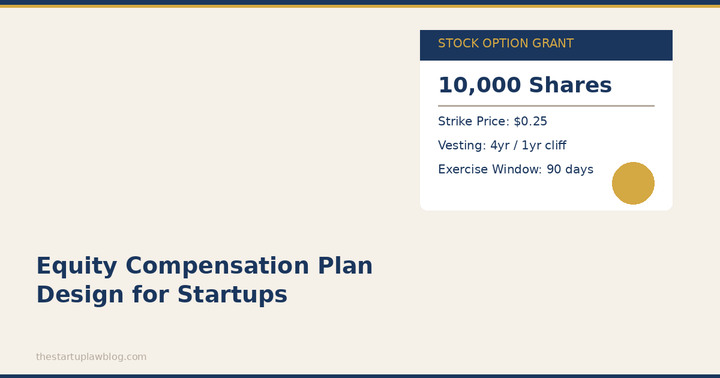
A common startup schedule is four years with a one-year cliff. On a 100,000-share grant, leaving after six months ordinarily means no vesting and no vested options to exercise. At the first anniversary, 25,000 shares vest; over the next 36 months, the remaining 75,000 vest monthly, subject to the agreement’s rounding and service rules. Early-exercised shares and acceleration provisions require separate treatment.
A one-year cliff delays initial vesting until the first anniversary. Continued vesting generally depends on continued service under the award agreement. A longer vesting schedule does not itself allow vesting after departure; acceleration and any continued-vesting exceptions depend on the applicable terms.
That said, this isn't the only vesting schedule that makes sense, and successful startups use alternatives. Some companies do three years with a one-year cliff, which is more aggressive but makes sense if you're in a fast-moving industry where people are more mobile. Some companies do four years with no cliff, which vests 1/48th every month from day one—this is less common but makes sense if you want to retain flexibility early on or if you're in an industry with very high turnover.
Immediate full vesting removes an important retention mechanism. Founder stock is not inherently fully vested: founder agreements often give the company a right to repurchase unvested shares if service ends. Set founder and employee terms deliberately, including any credit for prior work, rather than treating the founder label as an exemption from vesting.
Default vesting schedules should usually stay consistent across comparable roles so administration stays manageable and employees see a fair process. Individualized schedules can be justified for senior or specialized hires, credit for prior service, or other negotiated retention terms—for example, when hiring a VP of Sales in year three, or vesting 25 percent immediately with the rest over 36 months for a mid-level or senior hire taking on significant risk. Document exceptions deliberately rather than treating customization as the default.
There's also the question of acceleration. What happens to unvested shares if the company is sold? Who keeps the ownership of already-vested shares if someone is fired versus resigns versus retires? These are documented in the option agreement and your plan, and they matter a lot in any exit scenario.
Exercise Prices and the 409A Valuation
Here's a mistake founders make all the time: they grant options at whatever share price they feel like, without getting a formal valuation. This can create serious tax consequences for employees.
The exercise price is what the holder pays for a share. Granting a $1-strike option when common-stock FMV is $2 creates a discounted option; it does not automatically create $1 of taxable income at grant. A typical private-company NSO without a readily ascertainable option value is generally taxed at exercise, but a discounted option may fail the §409A stock-right exemption and trigger adverse deferred-compensation treatment.
To avoid this problem and to take advantage of ISO treatment, you need to set the exercise price at or above the fair market value of your stock at the time of grant. But who determines FMV? You do, initially, but you need to have a reasonable basis for your valuation. This is where Section 409A of the Internal Revenue Code comes in.
An independent common-stock appraisal is one commonly used valuation safe harbor for options. Treas. Reg. §1.409A-1(b)(5)(iv)(B) also recognizes other methods and safe harbors when their conditions are met. The legal standard is a reasonable valuation method applied reasonably; a paid outside appraisal is not universally mandatory. It remains a practical way to document supportable grant-date FMV.
An option on qualifying service-recipient stock with a strike at least FMV at grant, no additional deferral feature and the other required terms can be exempt from §409A. An appraisal alone does not establish every condition. If a covered option fails §409A, vested affected amounts can be included in income with a 20% additional federal tax and an interest-based additional tax; this is not automatic grant-date taxation of all unvested options.
Establish and document supportable common-stock FMV before granting options. Do not wait until Series A to address pricing. Before a new grant, consider whether financing, litigation, commercial developments or other information has materially changed value.
For option pricing, a valuation older than 12 months is not reasonable under the regulation. A younger valuation can also be unusable if it omits intervening material information. A previously granted option does not need to be repriced merely because the stock appreciates, but new grants need supportable current FMV.
Early Exercise: A Powerful Tool with Tradeoffs
Some startups include an "early exercise" provision in their plan and option agreements. This lets employees exercise options before they're vested, paying cash for shares that technically haven't earned yet. This is unusual and worth understanding.
For an early-exercised NSO into substantially nonvested shares, a timely §83(b) election generally includes exercise-date FMV minus the exercise price, often zero for an early hire. Later appreciation can be capital gain when the shares are sold. Early-exercised ISOs require separate analysis: §83(b) can affect AMT treatment and does not erase the ISO holding-period or disqualifying-disposition rules. The election does not remove contractual vesting or repurchase restrictions.
Early exercise requires funding the purchase and any tax due. Tax is not inevitable: a zero-spread NSO exercise with a valid 83(b) election can produce no compensation income. A positive spread can create tax before liquidity. The purchase price remains at risk even when the current tax is zero.
If the documents provide a company repurchase right, an employee’s departure before vesting can leave early-exercised shares subject to that right. Check the price, notice, payment and exercise deadline in the agreement and applicable corporate-law limits. Early exercise alone does not create a repurchase right.
Early exercise adds cash, forfeiture and tax risks. The §83(b) deadline is ordinarily 30 days after the stock transfer, subject to applicable weekend, holiday and specific statutory relief. Do not assume there is a routine discretionary extension. If the stock is later forfeited, tax paid on the elected compensation generally is not refunded merely because of that forfeiture.
My view: early exercise is a useful tool if you're hiring very early employees who want to optimize their taxes and are sophisticated enough to understand the mechanics. But it's not required and shouldn't be standard for all employees. Keep it optional and let people opt in if they want it.
Restricted Stock vs Stock Options vs RSUs: Which to Use When
You don't have to use options. There are other ways to give employees equity stakes. Let me break down the main types.
Stock options give the holder a right to buy stock at an exercise price. A typical NSO exercised into vested shares generates ordinary income on the spread; a qualifying ISO exercise generally does not create regular federal income, although AMT may apply. Options do not themselves confer stockholder voting rights.
Restricted stock consists of shares transferred now, often subject to a repurchase or forfeiture condition. Voting and dividend rights depend on the share class and agreements. Under §83, compensation is generally FMV minus the amount paid when the shares become substantially vested, unless a timely §83(b) election includes the transfer-date spread. The election deadline runs from transfer, not merely approval of a future grant. Founder and very early employee stock purchases are common uses.
Restricted stock units (RSUs) promise future cash or shares. They generally create ordinary income on settlement in cash or vested shares, which may coincide with or follow vesting. An RSU has no stockholder voting rights before share issuance, although an award can provide dividend equivalents. Private-company awards need careful liquidity and §409A design; they do not invariably require share delivery at service vesting.
For most early-stage startups, stock options are the right tool. They defer tax consequences, they don't create voting rights or dividend complications, and investors understand them. Restricted stock might make sense if you want to give early employees a deeper sense of ownership and voting power. RSUs make sense if you're a mature company and you want to issue equity without worrying about exercise mechanics.
Plan Administration: The Mechanics That Matter
Having a great plan document is only half the battle. You also need processes in place to actually administer the plan.
First, valid grant authorization. Use the board, a committee or another properly authorized delegate, within the plan and applicable corporate law. For example, Delaware §157 permits delegation subject to statutory conditions. Retain the authorization, grant terms and pricing record; an informal promise by an unauthorized founder is insufficient.
Second, individual option agreements. Each employee granted options gets an agreement specifying how many shares, at what exercise price, with what vesting schedule. This agreement is the binding contract between the employee and the company. It should be clear and consistent with your plan. Option agreements sometimes contradict the equity plan, which creates confusion about what's actually granted.
Third, Section 83(b) notices. If an employee makes a Section 83(b) election, they file a notice with the IRS and provide a copy to the company. The company should track these because it affects how the employee's grants are taxed and affects the company's withholding obligations.
Fourth, option tracking and records. This can be as simple as a spreadsheet or as complex as specialized software. You need to know, at any given time: every option grant outstanding, the grant date, exercise price, vesting schedule, and how many shares have vested. This becomes crucial when you're raising money or preparing for an exit.
Fifth, securities-law compliance. Employee or consultant status does not by itself establish an exemption. Check the federal exemption, eligible recipients, offering limits, disclosures, state exemptions and any required notices or filings for each jurisdiction involved.
Many founders try to handle this themselves, and in the first year or two of the company, it's manageable. But as you grow and issue more grants, it becomes easier to make mistakes if you don't have systems in place. Some companies use equity management software to manage this. Others keep it simple with spreadsheets and attorney assistance. Either way, you need a system.
Evergreen Provisions and Annual Pool Refreshers
As I mentioned earlier, you'll eventually issue most of your initial option pool. At that point, you need to refresh.
An evergreen provision can increase a plan reserve under a preapproved formula, subject to its limits and governing approvals. For ISOs, Treas. Reg. §1.422-2(b) requires a designated maximum aggregate number of shares issuable through ISOs; an evergreen formula does not eliminate that requirement. Also confirm sufficient authorized shares and investor consent requirements.
But here's the key: evergreen provisions are only useful if shareholders have approved them. And most Series A investors won't allow unlimited evergreen provisions because it means you could theoretically increase the pool without their approval. One negotiated arrangement is an evergreen provision capped at a stated percentage of outstanding shares per year—sometimes around 3 percent—up to a maximum total cap. Whether that figure fits depends on the company’s hiring plan and investor consent, not on a market rule.
Without an evergreen provision, companies generally amend the plan to increase the reserve as needed. Board approval alone is not always enough: ISO plan increases can require stockholder approval, and charter amendments or investor consent may also be necessary.
The important thing is to think about pool refresh as a regular process. You should be asking: "Are we about to run low on option pool? Do we have a plan to expand it?" If you let the pool deplete without planning for expansion, you'll suddenly find yourself unable to make competitive equity offers to new hires, which is a real problem.
Post-Termination Exercise Windows: The 90-Day Standard Is Changing
When an employee leaves your company—whether they resign, get terminated, or retire—they usually stop vesting immediately. But what happens to the options they've already vested?
Many awards provide a 90-day exercise window after an ordinary departure, but there is no universal contractual period. Some termination categories have shorter or longer deadlines. Read the plan and award together and calendar the actual expiration date; a vested option can expire without being exercised.
A longer post-termination window may run for a stated period or until the option’s original expiration date, depending on the documents. A ten-year total option term is not ten additional years after departure. Check any special cause, death or disability terms and review the tax consequences of an extension.
Document the contractual exercise window clearly and distinguish it from ISO tax eligibility. Under §422(a)(2), a former employee generally must exercise within three calendar months to retain ISO treatment; this is not invariably 90 days. Disability and death have special rules. A longer contractual window can preserve the right to exercise while losing ISO treatment. Review extensions before granting them because option-modification and §409A rules can also apply.
Separate exercise cost from tax cost. For an unchanged option, cash exercise cost is the number of options exercised multiplied by the fixed exercise price; stock appreciation does not itself raise that price. Appreciation can increase NSO compensation tax or an ISO AMT adjustment. A same-day sale requires an available, permitted transaction. Net exercise, payment with other shares and third-party financing have different requirements and tax consequences. Confirm the permitted method, funding, withholding and effect on ISO treatment before the contractual deadline.
Change of Control: Single-Trigger vs Double-Trigger Acceleration
What happens to options when the company is acquired?
There are two main approaches: single-trigger and double-trigger acceleration.
Single-trigger acceleration makes some or all unvested awards vest upon a defined change of control, as the agreement provides. Accelerated option vesting does not itself issue shares: exercise, assumption, cashout or cancellation depends on the option and transaction terms.
Double-trigger acceleration requires a defined change of control plus a qualifying employment event within the specified protection period, often termination without cause or resignation for defined good reason. A role change or termination does not automatically qualify. Read the definitions, notice and cure provisions, acceleration percentage, and treatment of awards not assumed in the transaction.
Acceleration terms allocate protection between recipients and the company in a sale. Negotiate the triggering events, acceleration amount and treatment of awards that are assumed, replaced or cashed out.
Parties sometimes negotiate a partial single-trigger acceleration—for instance, vesting of 25 percent of all unvested options upon change of control, with the rest subject to double-trigger. That structure is one way to split protection between recipients and the company; it is not a universal market default.
The key point is to decide this in advance and document it clearly. Don't try to negotiate it at acquisition time when there's information asymmetry and pressure. Make your policy clear upfront.
Tax Considerations for the Company and Employees
I've touched on this throughout, but let me summarize the key tax issues.
For typical private-company options, grant ordinarily creates no federal income tax. A discounted option can create §409A risk, but not an automatic grant-date spread inclusion. Exercising an NSO into vested shares generally creates ordinary compensation; later sale produces gain or loss measured from adjusted basis. ISO exercise-and-hold can trigger AMT, and a sale can be qualifying or disqualifying. Compare cash needs, holding risk and total taxes rather than assuming an ISO always minimizes tax. See IRS Topic 427.
For the company, a compensation deduction generally tracks the amount and timing of the recipient’s ordinary-income inclusion, subject to applicable deduction and reporting rules. A qualifying ISO disposition ordinarily produces no employer compensation deduction; a disqualifying disposition can produce one for the ordinary-income component. Contractors cannot receive ISOs solely for contractor services, so the deduction is not the reason to choose NSOs for that category.
ISO exercise-and-hold can produce a federal AMT adjustment. A sale in the same calendar year generally eliminates the separate exercise adjustment and creates a disqualifying disposition; a sale in a later year does not undo the exercise-year adjustment. Employees need a realistic liquidity plan before exercising.
For the company, there's also the question of accounting. Under ASC 718 (formerly SFAS 123R), any company preparing GAAP financial statements — public or private — must expense equity compensation through its income statement. Early-stage companies that don't yet produce GAAP financials won't feel this immediately, but it arrives with your first audited financials, typically at institutional fundraising. This means your option grants reduce reported earnings, even though they're not cash expenses. This matters if you're tracking profitability or showing metrics to investors.
Common Mistakes: How to Avoid Them
Here are the big mistakes founders make with equity plans.
Pool too small. Founders set a pool they think is generous and then run out of it after hiring 20 people. They then face a difficult choice: ask the board to increase the pool (which dilutes everyone) or make new hires small grants (which sends a signal that equity isn't valuable). Plan for regular refresh cycles and increase your pool proactively.
Unsupported grant-date valuation. Document a reasonable FMV method before issuing options. An independent appraisal is a useful safe harbor, not the only permitted approach. Refresh valuations when material information changes and do not use a value more than 12 months old for a new grant.
Inconsistent grant practices. Founder A approved this option grant, Founder B approved that one, and there's no consistency in terms of grant size, vesting schedule, or exercise price. This creates friction and makes it harder to manage the plan. Document your grant practices: "Level 1 employees get X shares with Y vesting," etc.
Missing 83(b) filings or records. Track the actual stock-transfer date and applicable filing deadline—generally 30 days after transfer. Retain proof of timely IRS filing and provide the company a copy. Keeping a signed election in the company’s files does not establish that it was filed with the IRS.
Vesting terms that don’t fit the grant. Choose the schedule based on the recipient’s role, prior service and retention goals. Four-year vesting with a one-year cliff is one approach; other schedules can be appropriate. Document the terms clearly.
No documentation of grants. Someone verbally told an employee they'd get options, but there's no signed option agreement. When the employee leaves, they claim they should have gotten options and it becomes a legal dispute. Require signed option agreements for every grant, no exceptions.
Discounted options without a §409A analysis. A low nominal strike price is appropriate only if supported by value and the award’s tax structure. An ordinary option priced below FMV generally loses the stock-right exemption and can create adverse tax consequences. A $0.01 price is not inherently wrong when supportable common-stock FMV is $0.01.
Forgetting about change of control provisions. You get acquired and suddenly there are disputes about who keeps what and whether it was supposed to accelerate. Make your change of control provisions clear in the plan and agreements upfront.
How to Communicate Equity Grants to Employees
Here's something that matters more than founders realize: how you communicate equity to your team.
Many founders hand out option agreements and expect employees to understand them. But most employees don't understand options, ISOs, vesting, or exercise prices. They might think the options are immediately valuable, or they might think they're worthless because they can't exercise them today. This lack of understanding undercuts the motivational value of equity.
When communicating a grant, explain the share count, exercise price, vesting, expiration and post-termination window. Distinguish vested options from owned shares. Explain the cash needed to exercise and that NSO compensation tax, ISO AMT and sale taxes differ. Discuss possible outcomes, including loss of the investment, without promising a future stock value or tax result.
Clear explanations help employees assess the grant’s potential value, costs and risks. Distinguish an option to buy shares from shares already owned.
I also recommend creating a simple document explaining your company's equity compensation approach. Something like: "Here's how we think about equity. We grant options to most employees. Here's the typical grant size at each level. Here's our standard vesting schedule. Here's what happens if you leave. Here's what we expect you to know before you exercise." This removes mystery and shows employees you've thought about fairness and transparency.
One more thing: as the company grows and grant values increase, consider offering equity compensation workshops or bringing in an outside advisor to explain options to your team. By the time you're raising Series A or Series B, equity compensation can be a material portion of employees' net worth. It deserves proper explanation.
Putting It All Together: Your Equity Plan Framework
Let me summarize the framework I'd recommend for an early-stage startup:
Adopt a written plan and obtain required approvals before grants. Size the reserve against hiring needs and define the fully diluted denominator. Document current supportable common-stock FMV. Offer ISOs only to eligible employees under §422 and use NSOs where appropriate, including for employees. Set vesting and exercise windows deliberately; distinguish contractual deadlines from ISO tax deadlines. Keep grant agreements, approvals and election copies together. Review pool capacity, award liquidity, securities-law compliance and tax reporting as the company grows.
A documented plan and consistent administration help identify approval, tax and ownership problems before they grow. They do not guarantee investor acceptance, employee retention or freedom from disputes. Revisit the structure as the company and its awards change.
Related Posts
- ISO vs NSO Stock Options: The Complete Guide for Startups
- 409A Valuations: What Every Startup Needs to Know
- Section 83(b) Elections: What Startup Founders and Employees Need to Know
- Stock Option Exercise Timing and Washington Income Tax
- Founder Vesting Schedules: A Practical Guide
- SAFE Agreements: What Every Startup Founder Needs to Know
- Anti-Dilution Provisions: What Every Startup Founder Needs to Know
Designing Equity Plans With Washington State Taxes in Mind
If your startup is based in Washington or your employees live here, the state's new tax regime should influence how you design your equity compensation plan.
ISOs vs. NSOs: model both Washington taxes. A qualifying ISO exercise-and-hold generally avoids ordinary income in federal AGI, but later long-term gain is not categorically outside the 2028 income tax. ESSB 6346 §302 removes federal long-term gains and losses and conditionally adds back Washington capital gains plus the capital-gains standard deduction when capital gains tax is owed. Section 205 allows a limited nonrefundable credit for that year’s Washington capital gains tax. NSO compensation generally enters the income-tax base at taxable exercise. Neither instrument is invariably more efficient at the state level. The $100,000 ISO limit measures stock first exercisable during the year using grant-date FMV, not merely stock vesting during the year.
RSUs create state tax exposure at taxable settlement. Public-company vesting and settlement often coincide, but a private-company award may separate them. Settlement in illiquid vested shares can create tax without sale proceeds. See RSUs and Washington State’s taxes for settlement timing, §409A and liquidity planning.
Early exercise and §83(b). A timely election for actual unvested shares can fix compensation at the transfer-date spread and start relevant holding periods. It does not apply to an unfunded RSU or unexercised option, does not remove ISO or AMT requirements, and does not guarantee Washington savings on later capital gain.
QSBS qualification. Qualifying original-issue stock obtained through option exercise, restricted-stock transfer or RSU settlement can satisfy §1202. Test the issuer when shares are issued and apply the holder’s acquisition and holding-period rules. RSU settlement can occur too late for the required holding period or gross-assets test, but RSU-settled shares are not categorically disqualified. Eligible excluded gain also leaves Washington’s capital-gains and income-tax bases; ordinary compensation is not excluded.
Grant timing and size. Model when income will actually be recognized. Granting options usually creates no current income; NSO exercise and RSU settlement can. Merely spreading grant dates does not ensure that taxable income falls into different years. For 2028 examples, spouses and registered domestic partners share one $1 million deduction, and residency, sourcing, adjustments and credits must be considered.
For comprehensive Washington tax planning strategies, see the Washington Founder Exit Map.
This post is for educational purposes only and is not legal or tax advice. Consult a qualified attorney about your specific situation.
Frequently Asked Questions
How large should a startup’s option pool be?
Use the hiring and retention budget to size the unallocated reserve. A 10–20% range is a starting point, not a requirement. With 5 million issued shares and no other securities, a 1 million-share reserve is 16.7% of fully diluted capitalization; a 20% reserve requires 1.25 million shares. Specify whether the target is measured before or after financing.
What is a common stock-option vesting schedule?
Four years with a one-year cliff is common: 25% vests at the first anniversary, and the remaining 75% usually vests monthly over the next 36 months, subject to continued service and the agreement. Other schedules and acceleration provisions may apply.
What is double-trigger acceleration?
It requires a defined change of control plus a qualifying employment event during a stated protection period, often termination without cause or resignation for defined good reason. The agreement controls the definitions, deadlines and acceleration amount; any termination or role change does not automatically qualify.
Ready to Build on a Solid Legal Foundation?
Need help reviewing your equity plan, grant documents or administration? Schedule an introductory call.
Related: QSBS pillar