
In This Guide
- → What Is a SAFE, Really?
- → A SAFE Is Itself a Security
- → Post-Money vs. Pre-Money: Understanding the Shift That Changed Everything
- → The Valuation Cap: Your Most Important Negotiation
- → The Discount: The Secondary Lever
- → The Hidden Complexity: MFN Clauses and the Uncapped SAFE
- → Side Letters, Pro Rata Rights, and Cap Table Complexity
- → The Dilution Problem: Why You Need to Model Your Cap Table Before Signing
- → SAFE vs. Convertible Note: Which Should You Use?
- → The Common Mistakes Founders Make—And How to Avoid Them
- → When You Absolutely Need a Lawyer
- → The Bottom Line
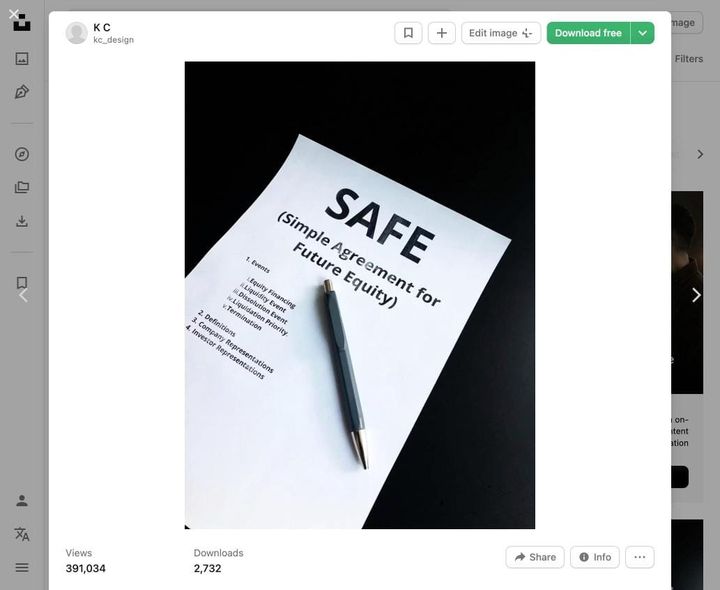
If you're raising capital as an early-stage startup, you've probably heard the term "SAFE" thrown around. Maybe an investor sent you a SAFE agreement, or your co-founders asked whether you should use one instead of a convertible note. The name suggests simplicity—Simple Agreement for Future Equity—but SAFEs are deceptively simple on the surface and surprisingly complex when you actually live with the consequences.
The practical risks are in the terms and the arithmetic: conversion prices, payment priorities, side letters, and dilution. A standard form can simplify documentation, but founders still need to understand the commitments made in each financing.
This post is meant to give you the lawyer's perspective on SAFEs—not just what they are, but how they actually work, what can go wrong, and what you need to know before you sign one.
What Is a SAFE, Really?
Y Combinator created the SAFE in 2013 to address a problem: early investors wanted to put money into startups, but the startups weren't ready for a priced Series A round. A priced round requires agreeing on a company valuation, which is complex when the company has minimal revenue and lots of uncertainty. So Y Combinator designed an instrument that would let investors put money in now and convert that investment into equity later, when the company either raised a priced round or hit some other triggering event.
A SAFE is a security and a contractual right to receive stock or a payment upon specified future events. It generally is not conventional debt: the standard YC form has no stated interest rate or maturity date. But a SAFE holder does not yet hold the shares that may later be issued on conversion, and the instrument’s characterization can vary depending on the legal, tax, accounting, and contractual question being analyzed. The SEC has described a SAFE as giving an investor rights to a future ownership interest upon a triggering event — not as present stock ownership.
Here is how a standard YC SAFE differs from other instruments you might consider:
A standard YC SAFE is not a loan and has no interest or maturity date. Merely failing to raise a Series A does not create a maturity repayment obligation. However, liquidity and dissolution events can create payment rights, subject to the contract’s priorities and available proceeds. “Not debt” does not mean “the company can never owe the holder money.” YC cap SAFE, Section 1
A SAFE holder does not receive shares or ordinary stockholder voting rights merely by signing. But the standard YC form requires a contractual Dividend Amount payment when the company pays a dividend on common stock other than in common shares. Board, observer, information, and other rights may also be separately negotiated. YC cap SAFE, Section 5(c)
Under the YC cap form, a defined Equity Financing triggers conversion into Standard Preferred or Safe Preferred, whichever calculation gives more shares. Safe Preferred is a separate series with specified price-based preferences tied to the SAFE price. An acquisition or other Liquidity Event instead invokes proceeds provisions; it is not invariably an issuance of common stock. Read the relevant event definition and payout formula. YC cap SAFE, Sections 1–2
Keep contractual rights, accounting classification, and federal tax classification separate. There is no definitive IRS authority establishing a universal federal income-tax classification for every SAFE. Contractual labels — including the YC form’s stated intent to treat the instrument as stock for specified tax purposes such as Section 1202 — do not by themselves determine tax treatment, and they do not bind the IRS. Possible analyses may include equity or other contractual/forward-type treatment; the terms of the particular SAFE matter, and accounting classification does not itself decide federal tax classification.
Because the federal tax characterization of a SAFE and the application of §1202 to the instrument before conversion remain uncertain, investors should not assume the QSBS holding period begins when the SAFE is signed. For conservative planning, analyze the stock issued on conversion — including original issuance, acquisition date after applicable §1223 tacking, and the gross-assets test at issuance — and do not count on a pre-conversion holding period without transaction-specific authority. For qualifying stock acquired after July 4, 2025, Section 1202 permits 50%, 75%, and 100% exclusions at holding periods of at least three, four, and five years, subject to eligible-gain limits; the earlier acquisition regime generally requires more than five years. See Section 1202 and the SAFE QSBS discussion.
A SAFE Is Itself a Security
A SAFE is itself a security. Issuing a SAFE therefore requires Securities Act and applicable state-securities-law compliance even though the investor has not yet received stock. Private SAFE rounds commonly rely on an exemption such as Section 4(a)(2) and/or Regulation D, depending on the offering — but not every SAFE financing must use Regulation D or file a Form D. Another valid exemption may apply.
If Regulation D is used, Rule 506(b) and Rule 506(c) differ on general solicitation and investor verification. Rule 506(b) can permit a limited number of sophisticated non-accredited purchasers subject to additional requirements; it does not follow that SAFEs may be sold only to accredited investors, nor that anyone may invest without an exemption analysis. Form D and state notice or fee filings may be required when those exemptions are claimed. See the Regulation D guide, 506(b) vs. 506(c), and accredited-investor rules.
Post-Money vs. Pre-Money: Understanding the Shift That Changed Everything
If you're researching SAFEs, you'll see references to "post-money" and "pre-money" SAFEs. This distinction matters far more than most founders realize, and it's worth getting clear.
In a simplified pre-money example, assume each SAFE converts at a $5 million cap, all use the same capitalization definition, and there are no other converting securities or option-pool changes. A single $500,000 SAFE represents $500,000 ÷ $5.5 million, or about 9.09%, immediately after conversion and before new cash. With two identical $500,000 SAFEs, each represents $500,000 ÷ $6 million, or about 8.33%. Identical terms do not produce different ownership merely because one SAFE was signed first.
For post-money cap SAFEs, $500,000 ÷ $5 million = 10%, and $500,000 ÷ $8 million = 6.25%. If both caps control, these are the interests before the priced round’s new-money and option-pool dilution. They are not guaranteed final ownership percentages. YC SAFE User Guide
The post-money formula makes ownership easier to estimate when the caps control. It does not lock the investor’s percentage through every later transaction. Additional post-money SAFEs, new-money shares, and an option-pool increase must be modeled under their respective capitalization rules. A financing price low enough to displace the cap can also produce more shares than the investment-to-cap estimate.
Compare the actual pre-money and post-money definitions and negotiated caps. The same numerical cap is not the same economic offer under both forms. A form’s age or label does not tell you whether its overall terms are favorable.
The Valuation Cap: Your Most Important Negotiation
A valuation cap is an input to the conversion-price formula. Its effect depends on the capitalization definition and the other conversion terms; it is not a guarantee of company value or investor recovery.
A worked post-money example: assume a $500,000 SAFE with a $10 million cap, 9.5 million existing fully diluted shares, no other converting instruments, and no option-pool increase. If the cap controls, the SAFE receives 500,000 shares at $1.00, bringing the pre-new-money total to 10 million shares and its interest to 5%. Suppose new investors then pay $5.00 per share, using a $50 million pre-money valuation that includes those conversion shares. A $10 million cash investment buys 2 million shares. The SAFE holder finishes with 500,000 of 12 million shares, or about 4.17%. The cap benefit survives; the 5% ownership percentage does not.
A lower controlling cap generally produces more shares for the same investment. Evaluate that trade together with the amount raised, side letters, later financing assumptions, and other outstanding instruments.
There is no universal correct cap for a funding stage. The dollar figures in this guide are worked examples, not a current market survey. Compare a proposed cap with the ownership sold under plausible financing scenarios and the other terms the investor requests.
Another example: $250,000 on a $6 million post-money cap implies about 4.17% before new-money dilution if the cap controls. Assume a $5 million priced investment at $15 million pre-money, expressly including SAFE conversion shares, and no pool increase, other converting instruments, or SAFE-holder participation. New investors receive 25% of the $20 million post-money capitalization. The SAFE interest falls to 4.17% × 75% = 3.125%.
At a controlling $3 million post-money cap, a $200,000 investment implies about 6.67% before new-money and option-pool dilution. That arithmetic does not establish whether the deal was attractive when negotiated, or what either party ultimately receives at exit.
The Discount: The Secondary Lever
A discount reduces the financing price per share. The agreement determines whether a discount, cap, or other provision applies; do not infer a discount from the SAFE label.
Let's say you have a SAFE with a 20 percent discount and no cap (or a very high cap). At your Series A, Series A investors are buying shares at $1.00. Your SAFE holders get to buy at $0.80—a 20 percent discount. If you've raised $500,000 on this SAFE, they get $500,000 divided by $0.80 per share, which is 625,000 shares. Series A investors at $1.00 per share would only get 500,000 shares for the same $500,000.
If the signed SAFE includes both a cap and a discount, read how they interact. A lower-price formula selects the calculation producing more shares; it does not necessarily stack the two benefits. YC publishes distinct cap-only, discount-only, and uncapped MFN forms. YC forms
The 20% discount example above is illustrative. Confirm the signed percentage and how the document expresses it: a Discount Rate of 80% can mean a 20% reduction from the new-investor price. Do not assume that every SAFE includes a discount.
The Hidden Complexity: MFN Clauses and the Uncapped SAFE
An uncapped MFN SAFE postpones certain pricing terms while providing a mechanism to adopt specified later terms. Read the actual clause; the downloadable form and YC’s own investment arrangement need not operate identically.
The downloadable YC MFN-only form starts with neither a valuation cap nor a discount. Unless amended, its Equity Financing conversion uses the lowest Standard Preferred price. Section 3 requires company notice of qualifying later securities and gives the investor 10 days after receiving the MFN Notice to elect in writing. The resulting amendment makes the SAFE identical to the later instrument; it is not a right to combine selected terms from unrelated deals. Check the definition’s exclusions. YC MFN-only SAFE
YC’s published standard deal, checked September 10, 2026, invests $125,000 for 7% before the priced round’s dilution and $375,000 through an uncapped MFN SAFE. Its deal page describes automatic adoption of qualifying favorable terms during a specified window. The new-money financing and an option-pool creation or increase dilute YC’s ownership. Use the actual YC agreements when evaluating that deal. YC standard deal
Before issuing a later instrument, review every outstanding MFN clause. Identify which investors must receive notice, what securities and terms are covered, whether an election is required, and how an amendment changes the capitalization model. Do not assume every MFN updates automatically or continues after its contractual termination.
Maintain a schedule of MFN notice and election deadlines alongside the capitalization model. Reflect an effective amendment in both the signed-document file and the share calculations.
Side Letters, Pro Rata Rights, and Cap Table Complexity
The SAFE agreement itself is usually only a few pages, but negotiated side letters can add complexity. Pro rata rights are not inherent in every SAFE; when granted, they often appear in a separate pro rata side letter or other negotiated arrangement rather than in the YC SAFE form itself. Information rights, board observer rights, and similar provisions are likewise negotiated and are not categorically harmless or automatically appropriate.
Side letters typically cover things like pro rata rights (the right to invest in your Series A to maintain their current ownership percentage), information rights (the right to get financial updates), board observer rights, and other protective provisions. These start out seeming reasonable, but they accumulate.
Founders who raise capital from five or six different SAFE investors can end up with five or six different side letters, each with slightly different provisions. Now your Series A is coming, and you're managing a complex web of pro rata obligations, information rights requests, and board observer appointments. Your Series A investor wants to clean this up, so you're negotiating to eliminate or consolidate side letters at the same time you're closing the Series A. It's a mess.
Review side letters as part of the financing package. Specify participation scope, information access, confidentiality, duration, and termination. Observer access can raise conflicts and privilege concerns as well as administrative work. Do not treat all investor requests as either harmless or unacceptable; identify the rights actually being granted.
The Dilution Problem: Why You Need to Model Your Cap Table Before Signing
This is the most common mistake, and the most expensive one. Founders raise a SAFE, then another SAFE, then maybe a third one, without actually calculating what their cap table will look like when all of these SAFEs convert at the Series A.
Assume two post-money cap SAFEs: $250,000 at a $5 million cap and $250,000 at an $8 million cap. If both caps control, their interests immediately before new money are 5% and 3.125%, respectively, totaling 8.125%.
Now assume a $5 million Series A at $30 million pre-money, expressly including both SAFE conversion positions, with no pool increase, other converting securities, or SAFE-holder participation. The new investors own $5 million ÷ $35 million = 14.2857%. Each existing position retains 30/35 of its pre-round percentage. The SAFE holders therefore finish with approximately 4.2857% and 2.6786%, not 5% and 3.125%. The other pre-round holders finish with 78.75%; the four interests sum to 100%.
SAFEs avoid issuing shares immediately, but they do not make dilution disappear. They belong in the company’s capitalization model from the day they are issued. The amount raised and the conversion terms determine dilution, not the number of SAFE documents alone. A large investment on one low cap can sell more ownership than several smaller investments on higher caps.
Before signing, model higher-valuation, lower-valuation, and delayed-financing scenarios, plus a sale or dissolution before conversion. Include new-money shares, pool changes, promised options, and participation rights where the documents require them.
SAFE vs. Convertible Note: Which Should You Use?
If you're considering a SAFE, you might also have the option of taking a convertible note instead. What's the difference, and which is better?
A convertible note documents debt with negotiated interest, maturity, and conversion provisions. Read its qualified-financing threshold and optional conversion rights. At maturity, payment may depend on a demand or election, or conversion may apply; an extension requires the specified approvals. See the convertible-note guide.
A standard SAFE avoids loan interest and maturity extensions, but still carries contractual conversion and proceeds obligations. Its financial-statement classification is a separate accounting analysis; the absence of loan terms does not make it off-balance-sheet.
A SAFE can fit when its payment rights and conversion economics match the parties’ objectives. Compare the documents and financing timeline instead of assuming that avoiding a maturity date settles the choice.
A noteholder may have creditor remedies unavailable to a SAFE holder, depending on payment, default, security, and subordination terms. Those rights do not guarantee repayment or a forced sale. A SAFE’s specified liquidity and dissolution rights also do not guarantee recovery.
Compare both instruments using the same funding and exit assumptions. See the SAFE-versus-note comparison for a practical framework.
In a startup securities offering, assess registration or an available exemption for either instrument, together with applicable state and cross-border requirements. A familiar SAFE or note form is not itself a securities-law exemption. See the Regulation D discussion.
The Common Mistakes Founders Make—And How to Avoid Them
The mistakes founders make with SAFEs tend to cluster around a few themes.
First, stacking too many SAFEs without modeling. I've mentioned this, but it bears repeating. Run the numbers. Model multiple scenarios. See what your cap table looks like in a successful outcome and a mediocre outcome. If you don't like what you see, renegotiate before you sign.
Second, agreeing to side letters without modeling the rights granted. Not every investor needs a side letter, and not every requested provision should be granted. Review participation scope, information access, confidentiality, duration, and termination before signing.
Third, treating post-money percentages as final ownership. Label every percentage with the point in the financing at which it is measured. The investment-to-cap estimate, when applicable, precedes the priced round’s new-money and option-pool dilution.
Fourth, choosing a cap without comparing alternatives. Evaluate the cash needed, ownership sold, financing runway, and other available terms. There is no assurance that another financing will be available if you decline this one.
Fifth, ignoring new valuation information before option grants. Give the valuation adviser the SAFE terms and financing facts, but do not equate the cap with common-stock fair market value. Section 409A requires a reasonable valuation that considers material information; the SAFE is one financing fact to assess. Treas. Reg. §1.409A-1(b)(5)
When You Absolutely Need a Lawyer
Legal review should address the actual questions: authority to issue the instrument, securities-law compliance, conversion and payout terms, tax treatment, and side-letter obligations. A short document can still make consequential commitments.
Before closing, reconcile the signed terms with the capitalization model and the company’s approval records. Identify who will track later issuances, notices, elections, and conversion calculations.
A good startup lawyer will also help you think about the tax and securities implications of your specific structure, which varies depending on your jurisdiction, entity type, and other factors. YC SAFE forms are designed around corporate equity; using SAFE-like instruments with an LLC or S corporation can create different tax and capital-structure issues and requires tailored documents.
The Bottom Line
SAFEs are often attractive when the parties want a fast financing without interest or a maturity date. Convertible notes may fit better when investors want debt rights, accrued interest, or a maturity backstop. The better instrument depends on the financing and the parties’ objectives. Understand the payment rights as well as the conversion formula before committing.
Book a free introductory call with me.
Related Posts
- Section 83(b) Elections: What Startup Founders and Employees Need to Know
- Qualified Small Business Stock (QSBS): What Founders, Investors, Contractors, and Employees Need to Know
- Term Sheets & Negotiation
- Where Should I Incorporate My Business?
- C-Corp vs. S-Corp vs. LLC: Washington Income Tax Considerations
- 409A Valuations: What Every Startup Needs to Know
- Convertible Notes: Complete Guide
- Cap Table Management Guide
- Equity Compensation Plan Design
- Anti-Dilution Provisions: What Every Startup Founder Needs to Know
Related Reading
For more on startup fundraising and securities law, see our Complete Guide to Regulation D, Rule 506(b) vs. 506(c) Comparison, and Accredited Investor Rules.
Related: QSBS pillar