
Washington and California each provide a safe harbor that can make a domiciliary a nonresident for specified tax purposes. The requirements differ. Neither safe harbor establishes a new domicile, and neither eliminates tax on every kind of income. Start by identifying the tax, income or asset, and relevant dates.
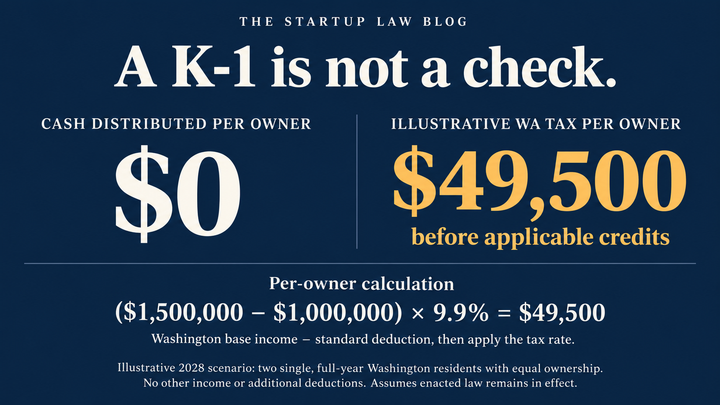
Washington’s capital-gains excise tax has a 7% base rate, plus 2.9% on Washington capital gains exceeding $1 million beginning in 2025. The separate 9.9% income tax begins January 1, 2028. Their tax bases and credits must be calculated separately.
The Comparison
| Washington | California | |
|---|---|---|
| Authority | RCW 82.87.020(11)(a); mirrored in ESSB 6346 §101(8) for the 2028 income tax | RTC §17014(d); FTB Publication 1031 |
| Who it helps | Domiciliaries who have left | Qualifying domiciliaries absent under an employment-related contract; qualifying accompanying spouses/RDPs |
| Presence limit | 30 days or fewer in Washington, in the aggregate | 546 consecutive days outside California; up to 45 days back per year disregarded |
| Employment requirement | None | Employment-related contract required for the principal qualifying individual; accompanying-spouse exception applies |
| Income cap | None | Fails if intangible income exceeds $200,000 in any covered year; apply separately to each spouse |
| Home in the state | Any permanent place of abode kept in Washington fails it | Retaining a home does not automatically defeat this safe harbor; ties matter under the ordinary residency analysis |
| Home outside the state | Required for the entire year | No parallel full-year abode requirement |
| Anti-abuse | No express principal-purpose exclusion in this safe harbor | Fails if the principal purpose of the absence is tax avoidance (§17014(d)(4)) |
| If you miss it | Apply domicile, statutory residency and the part-year rule; failure alone does not establish full-year residency | Facts-and-circumstances "temporary or transitory" analysis |
Two things follow from the table.
Washington’s safe harbor has no employment requirement or income cap, but requires both full-year abode conditions and no more than 30 Washington days. Failing it does not automatically establish full-year residency: domicile, the separate statutory-residency test and the part-year provision still matter. California uses a different set of conditions; neither safe harbor is easier on every dimension.
California’s safe harbor requires a qualifying extended absence and limits intangible income. Owning a portfolio does not itself disqualify someone; the test concerns income from intangible property, not portfolio value. Someone who does not qualify may still be a nonresident under California’s ordinary residency rules.
The Trap: Clearing the Safe Harbor Is Not Changing Your Domicile
This is what catches sophisticated people. Washington's 30-day rule governs resident status. A sale of stock — or any intangible — is allocated to Washington under RCW 82.87.100 based on your domicile at the time the sale or exchange occurs. The safe harbor does not change your domicile. You can satisfy all three conditions, be a nonresident for the year, and still have a stock gain allocated to Washington because you were domiciled here when the sale or exchange occurred.
For a stock sale, an actual domicile change before the sale can remove Washington allocation under RCW 82.87.100(1)(b). That allocation rule is distinct from the part-year resident definition. A gain allocated to Washington is not necessarily taxable in full: exclusions, deductions, and credits may change the liability. Determine the legally relevant sale or exchange date rather than assuming a document’s closing label decides it.
Reviewed September 9, 2026. Primary sources: WAC 458-20-301; ESSB 6346, §§101, 203, 205 and 302; California Schedule S instructions. Related reading: Washington's 30-Day Rule Won't Save You.
Washington's 30-Day Safe Harbor
Washington’s capital-gains residency definition is in RCW 82.87.020(11); the income-tax definition appears in ESSB 6346 §101(8). Both include a full-year domiciliary safe harbor and a separate part-year provision. To obtain nonresident treatment under this safe harbor, meet all three conditions:
- They maintained no permanent place of abode in Washington during the entire taxable year.
- They maintained a permanent place of abode outside of Washington during the entire taxable year.
- They spent 30 days or fewer in Washington in the aggregate during the taxable year.
A "day" is any portion of a calendar day (RCW 82.87.020(11)(b)); an early flight out of SeaTac counts. "In the aggregate" means the cap is annual, not per trip.
Who it protects. The exception concerns people treated as Washington domiciliaries. It does not replace an actual domicile-change analysis. For a non-domiciliary, apply the separate Washington-abode-plus-more-than-183-day test. If residency changes during the year, apply the statutory part-year provision.
A permanent place of abode is not limited to owned property. Under WAC 458-20-301(2)(l), ownership, occupancy, characteristics, and use are relevant but not individually conclusive. A home suitable and actually used only for vacations is not indicative of a permanent abode. Review each dwelling’s facts. The safe harbor requires no permanent Washington abode and a permanent outside abode for the entire year, plus no more than 30 Washington days.
California's Safe Harbor
California defines a resident as anyone in the state for other than a temporary or transitory purpose, or domiciled in California but absent for a temporary or transitory purpose (RTC §17014(a)). More than nine months in California raises a rebuttable presumption of residency (RTC §17016).
California’s employment-related safe harbor is in RTC §17014(d), summarized in FTB Publication 1031. Subject to the anti-avoidance limitation and accompanying-spouse rules below, a California domiciliary can qualify by meeting these conditions:
- The individual is outside California under an employment-related contract for an uninterrupted period of at least 546 consecutive days.
- The individual does not have intangible income exceeding $200,000 in any taxable year in which the employment-related contract is in effect.
- Return visits to California during the qualifying absence must total no more than 45 days in a taxable year to be disregarded under RTC §17014(d)(1). This return-visit rule does not count the days before the qualifying absence begins or after it ends; those periods require their own residency analysis.
The principal purpose of the absence cannot be avoiding California personal income tax. The statute also covers a spouse who accompanies a qualifying spouse outside California for at least 546 consecutive days; an accompanying spouse does not need a separate employment contract. Apply the $200,000 intangible-income limit to each spouse separately. FTB Publication 1031 also addresses registered domestic partners.
The employment-related contract and continuity of the absence require careful review. Do not assume every consulting arrangement qualifies. FTB Publication 1031, Example 1, rejects combining two overseas assignments separated by a three-month return to California. That example does not establish a blanket prohibition on successive contracts during an otherwise qualifying uninterrupted absence. Return visits totaling no more than 45 days in a taxable year are disregarded under RTC §17014(d)(1).
What California uses instead. For founders, investors, and executives who can't fit the safe harbor, residency is a totality-of-circumstances analysis: where the home is, where the family is, where the doctors are, where you vote, where your social and professional life is centered. A paper move is not enough.
Dual Residency and the Credit That Actually Exists
Dual residency can arise when Washington treats an individual as a resident under its rules and California independently treats the same individual as a resident. Identify the resident periods and income taxed by each state, then apply the relevant credits. A retained home or a particular number of visits alone does not settle both states’ analyses.
Washington capital-gains credit. RCW 82.87.100(2) allows a nonrefundable credit for qualifying income or excise tax paid to another jurisdiction on gains from capital assets within that jurisdiction that are included in Washington capital gains. The credit is limited to the smaller of the relevant Washington liability or the tax paid elsewhere; unused credit cannot be carried forward or back.
WAC 458-20-301(6)(d) requires payment of the other jurisdiction’s tax before filing the Washington return claiming the credit. For intangible property, DOR presumes the asset is within the other jurisdiction when that jurisdiction legally taxes its gain. Example 27 illustrates the credit for a Washington domiciliary who is also a New York statutory resident. The same framework can support a credit for legally imposed California tax paid on the same stock gain.
California credit. Analyze Schedule S separately. Its net-income-tax and sourcing requirements must be satisfied; do not assume Washington’s excise-tax classification alone settles the California credit result. Check California authority for the particular tax and year before claiming a credit.
Washington’s income tax beginning in 2028 already has statutory credits. ESSB 6346 §203 provides a limited credit for qualifying income tax paid to another jurisdiction on income sourced there and included in Washington base income. Section 205 provides a limited credit for Washington capital-gains tax for the same year. Both are nonrefundable, and unused amounts cannot be carried forward or back. Section 302 separately adjusts long-term gains and losses. Calculate the tax bases and credits together rather than adding the headline rates.
Four Scenarios
Scenario 1: Washington domiciliary living in California for the year. Assume Washington domicile continues, no permanent Washington abode is maintained at any time during the year, a permanent San Francisco abode is maintained all year, and Washington visits total 20 days. The Washington safe harbor is satisfied. That nonresident status does not remove a stock gain from Washington allocation if Washington domicile continues at sale. Living and working in California on an indefinite assignment generally establishes California residency under its separate rules. California can therefore tax the gain too, with the Washington credit analyzed as described above.
Scenario 2: Same founder, with a permanent Seattle abode retained. Assume Washington domicile continues throughout the year and the Seattle condo remains available and maintained as a permanent home. The safe harbor fails, and the continuing full-year domicile establishes full-year Washington residency. Ownership alone would not establish the abode condition; actual use, availability, and the dwelling’s characteristics matter. A person who actually changes domicile during the year needs a separate part-year analysis. California residency is determined independently.
Scenario 3: An executive moving from California to Washington. A license and voter registration are evidence, not a conclusive domicile change. If Washington becomes the actual domicile, residency can begin without waiting for 184 Washington days. If California domicile continues, examine Washington’s abode-and-day-count test. California separately applies its own residency rules, so dual residency remains possible.
Scenario 4: CA-domiciled investor, Washington vacation cabin, 100 days per year. California domicile, no intent to change it. Owns a cabin on Hood Canal and visits about 100 days per year. Result: Not a Washington resident — they have a place of abode (the cabin), but they haven't crossed the 183-day threshold. The 30-day rule doesn't apply (they're not WA-domiciled). If visits grew to 200+ days, they would become a WA resident under the 183-day test regardless of their California domicile.
Bottom Line
Analyze each state separately. Washington’s 30-day safe harbor concerns resident status; Washington capital-gains allocation for stock depends on domicile at sale. California taxes residents on worldwide income and nonresidents on California-source income, with special rules for intangibles. Do not substitute Washington’s stock-sale rule for California’s rules. See FTB Publication 1031.
For a move, document when the new location becomes your permanent home and examine every retained dwelling’s actual use and availability. Selling the old home can strengthen the record, but it is not a universal legal requirement. Track visits and work locations, apply each state’s residency and sourcing rules, and calculate available credits before relying on a projected tax saving.
If you are planning a move in either direction around a liquidity event, the residency analysis is the first thing to get right. → Book a 20-minute call, or start with the Washington State Tax Planning Guide.
Related Reading
Washington's 30-Day Rule Won't Save You (Unless You Do All 3 Things)
Washington vs. California: A Tax Comparison for Founders and Investors
How to Change Your Washington Domicile to Avoid the Income Tax
Washington State Income Tax Planning Guide for High Earners
This post is for educational purposes only and is not legal or tax advice. Consult a qualified attorney about your specific situation.