When you're building a startup, state tax planning rarely feels like the most urgent problem. Your product isn't launched. Fundraising is consuming your calendar. The last thing on your mind is whether Delaware's franchise tax or California's capital gains treatment will affect your eventual exit.
In This Guide
- → The Two Critical Decisions (That Are Completely Different)
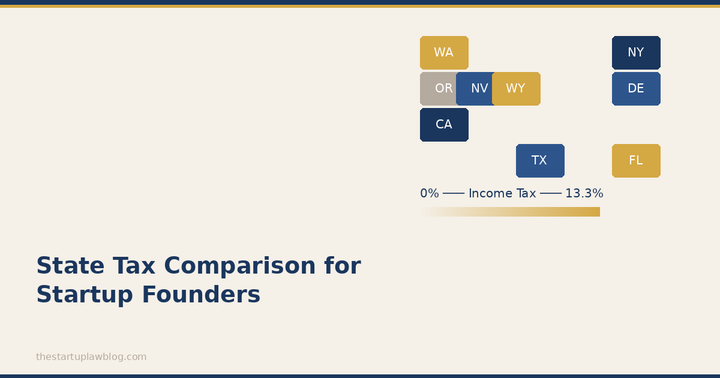
- → State-by-State Tax Comparison
- → Quick Comparison Table
- → Incorporation State vs. Residence State: Why They Matter Differently
- → The Deep Dive: QSBS State Conformity and Section 1202 Exclusions
- → Scenario Analysis: Four Founder Stories
- → The Remote Work Wrinkle: Multi-State Taxation and Nexus
- → Tax Planning Strategies for Founders
- → Conclusion: Key Takeaways for Founders
State tax decisions can materially affect a founder’s exit proceeds. The examples below distinguish corporate incorporation from the founder’s personal residence, and separate marginal-rate illustrations from an actual tax-return calculation.
State tax rules are changing. Washington enacted a 9.9% income tax starting in 2028, and Oregon has eliminated its state §1202 exclusion for tax years beginning in 2026. California’s 13.3% top state rate is high, but state and local taxes must be compared together: the combined top rate for a New York City resident is about 14.78%. Texas, Florida, Nevada and Wyoming impose no personal income tax, although business taxes and another state’s taxing jurisdiction can still matter.
This guide walks you through the state tax landscape for startup founders and investors. We'll cover where to incorporate, where to live, how QSBS exclusions work across state lines, and what your options look like in the most important startup jurisdictions.
The Two Critical Decisions (That Are Completely Different)
Before we go state-by-state, let's clarify the most common founder mistake: confusing incorporation state with residence state.
Where you incorporate determines your choice-of-law for corporate governance and exposes you to franchise taxes in that state. It's primarily a legal and Delaware-specific governance question. Most VC-backed startups incorporate in Delaware, regardless of where the founder lives, because Delaware has predictable corporate law, specialized courts, and investor expectations.
Residence, domicile and income sourcing affect a founder’s personal tax exposure at exit. Incorporation alone does not settle those questions. Estate tax is a separate tax associated with death; domicile, property location, deductions and state-specific estate rules can matter. The stock sale itself does not trigger estate tax.
The second decision matters more for your after-tax proceeds. We'll explain why throughout this guide.
State-by-State Tax Comparison
Delaware
Incorporation Favorite: Delaware is the de facto standard for VC-backed companies. It has:
- Predictable corporate law developed over 130+ years
- Delaware Court of Chancery (specialized, sophisticated)
- Pro-management case law preferred by investors
- Flexibility in corporate governance
Personal Taxes (if you live there):
- Income Tax: Graduated rates up to 6.6% on income over ~$60,000
- Capital Gains Tax: Taxed as ordinary income (up to 6.6%)
- Franchise Tax: $175 up to $200,000 a year for Delaware corporations ($250,000 for Large Corporate Filers) (you pay this regardless of where you live, if incorporated in Delaware)
- Sales Tax: No sales tax
- Estate Tax: No state estate tax
QSBS Conformity: Delaware conforms to federal Section 1202 QSBS exclusion for state tax purposes.
For Founders: Delaware incorporation is common for VC-backed companies, but it does not make the founder’s income tax-free. Delaware residents face graduated rates on taxable gains, up to 6.6%; qualifying §1202 exclusions can reduce taxable gain. The 6.6% figure is a top marginal rate, not a flat tax on every resident’s entire gain. See Delaware’s income-tax guidance.
California
Income Tax: California’s graduated brackets reach 12.3%, with a separate 1% Behavioral Health Services Tax on taxable income over $1 million, producing a 13.3% top state marginal rate. FTB’s 2026 instructions use the new name for the former Mental Health Services Tax. The federal 3.8% net investment income tax is separate and applies only when its income and taxpayer requirements are met.
Capital Gains Tax: California taxes capital gains as ordinary income at regular rates. No preferential treatment.
QSBS conformity: California does not conform to federal §1202. Federally excluded gain is taxable in California at its graduated rates, with a 13.3% top marginal rate. Sale proceeds are not the same as taxable gain. Federal exclusion limits generally apply per taxpayer and issuer, with the applicable dollar cap or 10-times-basis alternative, and eligibility and holding-period conditions.
Example assumptions throughout this guide: the founder has $10 million of gain, negligible basis, and stock eligible for the full federal §1202 exclusion. The simplified California calculations assume other taxable income already places all of this additional gain in the 13.3% marginal bracket. Thus $1.33 million is an incremental-tax illustration, not an exact total-return calculation for a founder whose only income is the $10 million gain. Actual tax depends on filing status, deductions, other income, and the year’s brackets.
This is arguably the single largest tax cost of being a California startup founder.
Corporate Tax: The general C-corporation rate is 8.84%. For corporations subject to franchise tax, the regular calculation generally compares tax on California net income with the $800 minimum; the minimum is not an additional flat tax. Newly incorporated or qualified corporations are exempt from the minimum for their first taxable year, but still owe applicable tax on net income. Banks and financial corporations have different rates. See FTB Publication 1060. California’s separate graduated LLC fee is not a C-corporation tax.
Sales Tax: The statewide rate is 7.25%, plus applicable district taxes. Combined rates can exceed 10.75%; the July 2026 schedule lists Lancaster and Palmdale at 11.25%. Use CDTFA’s current address and rate information for the transaction’s location and date.
Estate Tax: No state estate tax, but federal estate tax applies to large estates.
For Founders: California’s QSBS nonconformity can materially reduce exit proceeds. Under this guide’s stated assumptions, a $10 million gain creates $1.33 million of incremental California tax. A $10 million sale price is not necessarily a $10 million gain. A genuine move can change the result, but residence, sourcing and transaction facts must support the treatment. See FTB Publication 1031.
Washington
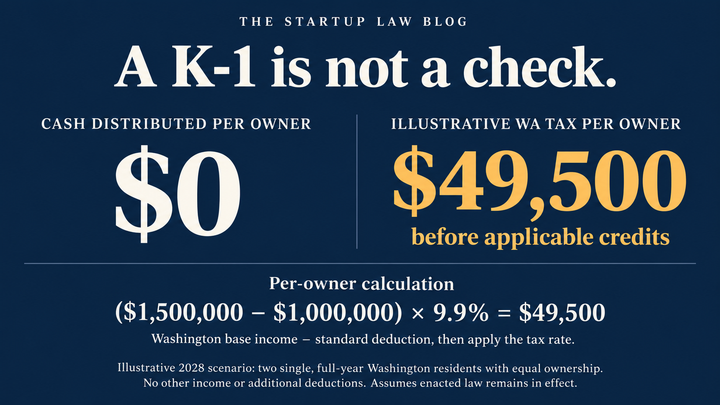
Income Tax: Under ESSB 6346, Washington’s broad personal income tax begins January 1, 2028. The rate is 9.9% on Washington taxable income after applicable state adjustments and deductions. The standard deduction is $1 million for a full-year resident individual, with one $1 million deduction shared by a married couple; part-year and nonresident deductions are prorated. The existing capital-gains tax is separate, with a credit coordinating the two taxes as explained below.
Capital Gains Tax: Washington has had a capital gains excise tax since 2022 — not starting in 2028. It is 7% on long-term gains above the annual standard deduction (~$278,000 for 2025, indexed) and 9.9% on the taxable portion above $1 million (the second tier took effect in 2025). Gains from direct real estate sales are exempt, and federally excluded QSBS gain is not subject to the tax.
QSBS Conformity: Federally excluded §1202 gain does not enter federal net long-term capital gain, the starting point for Washington’s capital-gains tax. It also does not enter federal AGI, the starting point for the income tax scheduled for 2028. The excluded portion therefore falls outside both tax bases.
Corporate Tax: Washington generally taxes business gross receipts through B&O tax rather than a corporate net-income tax. Rates depend on classification: retailing is generally 0.471% in 2026, while Service and Other Activities generally uses 1.5%, 1.75% or 2.1%, based on the prior year’s taxable service income and statutory exceptions. Other classifications and surcharges can exceed those rates; 2.1% is not a universal ceiling. See DOR’s service-rate guidance and the separate payment-card-processing classification.
Sales Tax: The state rate is 6.5%, plus local sales tax. The combined rate varies by address and transaction date and can exceed 10.25%. Use Washington DOR’s rate lookup for the applicable rate.
Estate Tax: The date of death determines Washington’s exclusion and rate schedule. For deaths July 1–December 31, 2025, the exclusion was $3 million and the top rate was 35%. For deaths January 1–June 30, 2026, the exclusion was $3.076 million and the top rate remained 35%. From July 1, 2026, the exclusion is $3 million and graduated rates run from 10% to 20%. Apply the rates to Washington taxable estate after the applicable exclusion and other statutory adjustments; Washington has no spousal portability. See RCW 83.100.020 and ESB 6347, signed March 24, 2026.
For Founders: Washington already taxes covered non-QSBS long-term gains. From 2028, the separate income tax broadens the tax base, subject to deductions, exclusions and credits. Federally excluded QSBS gain stays outside both bases under enacted law, so the change does not end Washington’s advantage for fully excluded QSBS. See our Washington vs. California comparison and guide to changing your Washington domicile.
Texas
Income Tax: No state income tax.
Capital Gains Tax: No capital gains tax.
QSBS Conformity: Texas imposes no personal income tax on an individual’s stock-sale gain, whether or not it qualifies as QSBS. This does not eliminate federal tax, business-level franchise tax or tax that another state can impose.
Corporate Tax: Texas imposes a franchise tax on taxable entities. The regular rates are 0.375% for qualifying retail or wholesale businesses and 0.75% for other businesses, applied to apportioned taxable margin. For 2026 and 2027 reports, the no-tax-due threshold is $2.65 million in annualized total revenue. Eligible entities with no more than $20 million in total revenue may use the E-Z computation at 0.331%, subject to its separate rules. Rate selection is not simply a function of entity type, and owing no tax does not necessarily eliminate information-report obligations. See Texas Comptroller rates and thresholds.
Sales Tax: 6.25% state base + local sales tax (effective 6.25%-8.25% depending on county).
Estate Tax: No estate tax.
For Founders: Texas is one of the two or three best jurisdictions for founders, especially post-exit. No state income tax, no capital gains tax, no estate tax. The Franchise Tax on corporations is a modest cost. Austin has become a major startup hub, and many founders who initially built companies elsewhere have relocated to Texas as exits approached.
Florida
Income Tax: No state income tax.
Capital Gains Tax: No capital gains tax.
QSBS Conformity: Not applicable (no state income tax).
Corporate Tax: 5.5% corporate income tax on net income over $50,000. This applies to C-corps doing business in Florida, but many startups pay little or no Florida corporate tax due to losses and deductions in early years.
Sales Tax: Florida’s general state rate is 6%, plus the applicable county discretionary surtax. The 2026 county schedule includes a 2% surtax in Hamilton County, making 8% combined for transactions subject to both full rates. Exemptions and transaction-specific limits can change the result; use DOR’s address lookup.
Estate Tax: No estate tax.
For Founders: Florida's zero personal income tax and zero capital gains tax make it one of the most attractive states for founders at exit. South Florida (Miami, Fort Lauderdale) and Tampa Bay are growing startup hubs with significant venture capital activity. The 5.5% corporate tax is modest and often irrelevant for early-stage companies. Like Texas, Florida is exceptionally friendly for founders at exit.
Nevada
Income Tax: No state income tax.
Capital Gains Tax: No capital gains tax.
QSBS Conformity: Not applicable.
Corporate Tax: Nevada has no general corporate income tax. For a domestic corporation, the annual-list fee starts at $150 and can reach $11,125 based on the statutory stock-capitalization schedule in NRS 78.150; $150 is not a flat fee for every corporation. The separate annual state business-license fee is generally $500. Commerce Tax can apply above $4 million of Nevada gross revenue, with industry rates from 0.051% to 0.331%.
Sales Tax: 6.85% state base + local sales tax (effective 6.85%-8.375% depending on district).
Estate Tax: No estate tax.
For Founders: Nevada’s lack of personal income tax can be valuable at exit. It does not mean businesses operate tax-free: Commerce Tax and other business obligations can apply. Delaware incorporation and Nevada residence are separate choices, and establishing Nevada residence does not by itself end another state’s jurisdiction over income.
Wyoming
Income Tax: No state income tax.
Capital Gains Tax: No capital gains tax.
QSBS Conformity: Not applicable.
Corporate Tax: No corporate income tax. Corporations pay an initial filing fee of $100 and an annual report license tax — $60 minimum, or two-tenths of a mill on Wyoming assets, whichever is greater.
Sales Tax: Wyoming’s state rate is 4%, with applicable local sales taxes added. Check the Wyoming Excise Tax Division’s current rate charts for the transaction’s location and date.
Estate Tax: No estate tax.
For Founders: Wyoming offers the friendliest tax environment in the nation for founders: no income, capital gains, or corporate tax. It's gaining popularity with tech founders as a residency state, particularly for those seeking tax optimization and privacy. However, Wyoming doesn't have the venture capital infrastructure or startup culture of Texas, Florida, or California. Many founders maintain Wyoming residency while operating remotely.
New York
Income Tax: In 2026, New York’s 9.65% bracket begins above $1,077,550 for single filers and $2,155,350 for married joint filers. The 10.3% bracket begins above $5 million and the 10.9% bracket above $25 million. A New York City resident can also face the city’s 3.876% top rate, for about 14.78% combined. Filing status and the state’s tax-benefit recapture rules matter to an actual calculation. See New York’s estimated-tax instructions.
Capital Gains Tax: Capital gains taxed as ordinary income at regular rates (up to ~14.78% combined for top earners in NYC). No preferential treatment.
QSBS Conformity: New York conforms to federal Section 1202 QSBS exclusion at the state level.
Corporate Tax: For general Article 9-A corporations in 2026, the business-income-base rate is 6.5%, or 7.25% on the entire apportioned business income base when that base exceeds $5 million. The general franchise tax is the highest applicable business-income-base, capital-base, or fixed-dollar-minimum amount—not the income tax plus the minimum. The general fixed-dollar minimum depends on New York receipts and ranges from $25 to $200,000; special taxpayer categories have different rules. New York S corporations use a separate fixed-dollar-minimum schedule topping out at $4,500. See New York Tax Law §210.
Sales Tax: New York’s state rate is 4%, plus applicable local taxes. An additional 0.375% applies within the Metropolitan Commuter Transportation District. New York City’s combined general rate is 8.875%. Use the state’s jurisdiction and rate lookup to identify the applicable local rate.
Estate Tax: New York’s 2026 basic exclusion amount is $7.35 million. Under Tax Law §952, the credit phases out as the New York taxable estate rises from that amount to 105% of it ($7,717,500). Above that range, no exclusion credit remains and the graduated schedule, with a 16% top rate, applies to the New York taxable estate. The measure is taxable estate after applicable adjustments—not simply gross asset value.
For Founders: New York and NYC can impose high rates on taxable income, but qualifying federally excluded QSBS gain generally remains excluded for both state and city resident personal-income-tax purposes. NYC resident taxable income generally follows New York taxable income under Tax Law §1303. Distinguish excluded gain from taxable gain, equity compensation and business-level taxes.
Oregon
Income Tax: Oregon’s graduated rates reach 9.9% above $125,000 of taxable income for single filers or $250,000 for joint filers. Deductions and other adjustments apply; this is not a tax on every dollar of gross income. Local taxes depend on jurisdiction: in 2026, Metro SHS adds 1% above $128,000/$205,000 of taxable income for its single/joint categories, and Multnomah County PFA has two 1.5% tiers. A taxpayer subject to both can face 4 additional percentage points at the top. See the local rates and thresholds.
Capital Gains Tax: Oregon generally taxes taxable capital gains at ordinary income rates, up to 9.9%, without a separate capital-gains tax. It has no blanket exclusion for all real-estate sales, but qualifying principal-residence gain can receive the §121 home-sale exclusion. Do not confuse the absence of a general real-estate exemption with the absence of any home-sale exclusion. See Portland Revenue’s explanation of the federal and Oregon home-sale exclusion.
QSBS Conformity: No longer conforms. Oregon historically followed the federal §1202 exclusion, but Senate Bill 1507 — signed April 9, 2026 and applicable to tax years beginning on or after January 1, 2026 — decoupled the state from §1202. Oregon now taxes federally excluded QSBS gain as ordinary income, up to 9.9%. A $10 million QSBS exit that is fully excluded federally can generate roughly $990,000 in Oregon tax, making Oregon one of the most expensive states for a QSBS exit.
Corporate Tax: Oregon’s corporate excise rates are 6.6% on the first $1 million of Oregon taxable income and 7.6% above that amount (ORS 317.061). The minimum tax is keyed to Oregon sales, from $150 to $100,000 (ORS 317.090). The separate Corporate Activity Tax uses taxable Oregon commercial activity, after applicable exclusions and the allowed business-expense subtraction, rather than simply gross receipts. Where that taxable amount exceeds $1 million, CAT is $250 plus 0.57% of the excess. Registration and filing thresholds are separate from the payment threshold. See Oregon DOR’s CAT guidance.
Sales Tax: No state sales tax (Oregon is one of only five states without sales tax).
Estate Tax: Estate tax on estates over $1 million — the lowest threshold in the country — graduated 10%–16%, not indexed for inflation, with no spousal portability.
For Founders: Oregon’s lack of a general sales tax does not make it a low-tax state for every founder. SB 1507 adds federally excluded QSBS gain back for the applicable 2026-and-later tax years, and Oregon’s estate-tax threshold is $1 million. Include applicable Metro and Multnomah County income taxes when modeling an exit.
Colorado
Income Tax: Colorado’s 2026 estimated-tax instructions use 4.4% of Colorado taxable income, after applicable deductions and state modifications. It is not 4.4% of every dollar received. See Colorado’s 2026 instructions.
Capital Gains Tax: Taxed as ordinary income at 4.4% rate.
QSBS Conformity: Colorado conforms to federal Section 1202 QSBS exclusion.
Corporate Tax: 4.4% on corporate income (same rate as individual income tax).
Sales Tax: Colorado’s state rate is 2.9%, with county, municipal and special-district taxes where applicable. Home-rule jurisdictions may administer their own sales taxes. Use the official rate lookup for the transaction’s address and date.
Estate Tax: No state estate tax.
For Founders: Colorado is an emerging startup hub (Denver and Boulder) with a favorable tax climate. The flat 4.4% income tax is significantly lower than California, New York, or Oregon. Colorado conforms to federal QSBS, making capital gains from qualifying stock sales eligible for the exclusion. For founders willing to build in Colorado, the tax treatment at exit is reasonable, and the lifestyle benefits are well-known.
Massachusetts
Income Tax: Most taxable income is subject to 5%, with an additional 4% surtax on taxable income above $1,107,750 for tax year 2026. The threshold is indexed annually.
Capital Gains Tax: Most short-term gains are taxed at 8.5%, and most long-term gains at 5%. For tax year 2026, the additional 4% surtax applies to taxable income above $1,107,750, not a fixed $1 million threshold. Where the surtax applies, the corresponding marginal rates are 12.5% and 9%; crossing the threshold does not apply those rates to all income. Special rules apply to certain gains, including qualifying small-business stock. See Massachusetts tax rates.
QSBS Conformity: Massachusetts uses §1202 as of January 1, 2022 and has not adopted the 2025 federal expansion. Qualifying stock can still receive a 100% exclusion under the older rules. The separate 3% rate applies only to certain qualifying small-business stock meeting Massachusetts requirements; it is not a general rate for all federally excluded gain that Massachusetts taxes.
Corporate Tax: Massachusetts’ general corporate excise combines an 8% income measure with a non-income measure of $2.60 per $1,000 of taxable Massachusetts tangible property or allocable net worth, depending on the corporation’s classification. The general minimum excise is $456. The non-income measure is not always net worth. See DOR’s explanation of the property and net-worth measures.
Sales Tax: Massachusetts’ general sales and use tax is 6.25%. Local options apply to specific categories, rather than a general local sales tax on all purchases; for example, a participating municipality adds 0.75% to the 6.25% meals tax. See the sales-tax guide and meals-tax guidance.
Estate Tax: Massachusetts has a state estate tax with a $2 million threshold — one of the lowest in the nation. The 2023 reform eliminated the old cliff: a $99,600 credit means only value above $2 million is effectively taxed, at rates up to 16%.
For Founders: Boston offers a substantial startup ecosystem. Model the state QSBS exclusion before applying tax rates to an exit: qualifying gain can be fully excluded under Massachusetts’ adopted rules, while taxable gain may face the applicable capital-gains rate and the 4% surtax above the indexed threshold.
Quick Comparison Table
| State | Personal income tax: selected rates | Taxable long-term investment gains | Personal QSBS treatment | Estate Tax |
|---|---|---|---|---|
| Delaware | Up to 6.6% | Up to 6.6% | Generally follows federal exclusion | None |
| California | Up to 13.3% | Up to 13.3% | No federal §1202 exclusion | None |
| Washington | 9.9% from 2028 after state adjustments and deductions | 7% on first $1M of taxable gains; 9.9% above (2025+) | Federally excluded gain outside both bases | 10–20%; $3M exclusion for deaths July 1, 2026 onward |
| Texas | None | None | N/A | None |
| Florida | None | None | N/A | None |
| Nevada | None | None | N/A | None |
| Wyoming | None | None | N/A | None |
| New York | 10.9% state; about 14.78% with NYC | Same rates on taxable gains | Generally follows federal exclusion, including NYC residents | Up to 16%; $7.35M 2026 exclusion with phaseout |
| Oregon | 9.9% state; up to 4 additional local percentage points in 2026 | 9.9% state; applicable local income taxes also apply | §1202 add-back for tax years beginning in 2026 | 10–16%; $1M threshold |
| Colorado | 4.4% | 4.4% | Yes | None |
| Massachusetts | 5% on most income + 4% above $1,107,750 (2026) | Generally 5%; 4% surtax and special rates may apply | Earlier federal rules; full exclusion possible | Up to 16%; $2M threshold and up to $99,600 credit |
How to read the table: Rates summarize personal taxes under enacted law as of September 9, 2026; special rates, deductions, credits and sourcing rules can change the result. “None” refers to the named state’s tax, not federal tax, business taxes or another state’s claim. QSBS entries concern excluded gain, not all sale proceeds. Washington’s capital-gains brackets apply after the applicable capital-gains deductions; its 2028 income tax uses a separate calculation and credit. Estate tax applies at death, and the thresholds do not replace the applicable taxable-estate calculation.
Incorporation State vs. Residence State: Why They Matter Differently
Let's walk through a concrete example to illustrate why this distinction matters.
Scenario: You start a SaaS company and incorporate in Delaware (standard for VC funding). You live in California. You bootstrap and bootstrap, and seven years later you raise a Series A. The Series A term sheet requires a Delaware corporation—you're already there, great. You pay Delaware's annual franchise tax ($175-$250K) every year, which is built into the cost of doing business with VCs.
Fast forward to Year 10: You sell the company for $100 million. Your equity stake is worth $10 million pre-tax.
Federal tax: Assume the $10 million gain qualifies for the 100% QSBS exclusion. Federal tax on the excluded gain is $0 — §1202(a)(4)(C) eliminated the AMT preference for 100%-exclusion stock, and excluded gain is outside the 3.8% net investment income tax. Federal treatment is the same regardless of which state you live in.
State tax: Because you're a California resident at the time of the sale, California taxes your entire $10 million gain at 13.3% = $1.33 million. (California does NOT conform to federal QSBS exclusion, so you get zero state benefit from the federal 100% exclusion).
Total tax cost: $0 (federal) + $1.33M (state) = ~$1.33 million. You take home about $8.67 million after state and federal taxes.
Now, the same scenario after a genuine move to Texas: Assume the founder became a Texas resident before the sale and the personal stock gain is not taxable in another state under its residency or sourcing rules. Delaware incorporation remains unchanged. The timing and substance of the move require a facts-based review.
Federal tax: Identical: $0 on the excluded gain (federal treatment doesn’t change with your state).
State tax: Texas imposes no personal income tax on the $10 million gain. Under the stated assumption that no other state taxes this gain, the state income-tax cost is $0.
Total tax cost: $0 federal + $0 state. You keep the full $10 million (before deal costs).
Difference: Under these assumptions, $1.33 million of incremental state income tax. The move must actually change the applicable tax treatment; a new address alone does not produce the saving.
This is why residence state is more important than incorporation state for personal wealth outcomes. Delaware incorporation is table-stakes for VC funding, but where you live for tax purposes is a choice that can save you millions.
The Deep Dive: QSBS State Conformity and Section 1202 Exclusions
Section 1202 can exclude eligible QSBS gain, subject to per-taxpayer, per-issuer limits. Stock acquired after July 4, 2025 can qualify for 50%, 75%, or 100% exclusion after three, four, or five years. The applicable dollar limit is generally $15 million for that stock and $10 million for earlier stock, coordinated with prior exclusions and the alternative 10-times-basis limit. Earlier stock has different holding-period and exclusion-percentage rules.
A fully qualifying 100%-excluded QSBS gain is excluded from regular federal income tax and NIIT and has no AMT preference add-back. Older stock eligible only for a partial exclusion has different treatment; verify the acquisition date and applicable rules.
States differ in how they adopt §1202. Conformity preserves the exclusion only to the extent the stock and gain qualify under that state’s adopted rules; it does not make every dollar from a QSBS sale tax-free.
States that conform to QSBS Section 1202 exclusion:
- Delaware
- Colorado
- New York, including NYC resident personal-income-tax treatment; business-level taxes require separate analysis.
- Washington (structural — excluded gain never enters the capital gains or income tax base; monitor legislative attempts to change that)
States that DO NOT conform (and thus tax QSBS gains as ordinary income):
- California – This is the biggest one. Non-conformity. QSBS gains are taxed at California's ordinary income rates (up to 13.3%).
- Oregon: SB 1507 requires a §1202 add-back for tax years beginning on or after January 1, 2026. District of Columbia: current D.C. Code §47-1803.02(a)(1C) requires individuals, estates, and trusts to add back federal §1202(a) exclusions for tax years beginning after December 31, 2024; the rule is not limited to the 2025 federal expansion. Other jurisdictions require a separate, current-law review.
State using an earlier version of the federal exclusion:
- Massachusetts: Applies the January 1, 2022 version of §1202, which can provide a 100% exclusion for qualifying stock. It has not adopted the 2025 expansion. Its separate 3% small-business-stock rate has additional state requirements and does not apply to every taxable QSBS gain.
States with no income tax (QSBS doesn't apply because there's no tax to exclude):
- Texas, Florida, Nevada, Wyoming
Why this matters: For a founder in California with a $10 million QSBS gain, the federal exclusion saves roughly $2.38 million in federal tax (20% long-term rate plus 3.8% NIIT on $10M). But California's lack of conformity means you still owe $1.33 million to California (13.3% of $10M). A founder in Texas pays zero state tax on the same gain.
This is perhaps the single most important tax planning point for startup founders: if you're planning a significant exit and you're in California, understand that California will tax your QSBS gains as ordinary income despite the federal exclusion.
Scenario Analysis: Four Founder Stories
Scenario 1: Founder in California, $10M QSBS Exit
Setup: Started a software company in San Francisco, incorporated in Delaware, been there for 8 years. Exit at $100M valuation. Your stake: $10M.
Federal tax: QSBS exclusion applies. The full $10M is excluded — and for 100%-exclusion stock there is no AMT add-back (§1202(a)(4)(C)) and no NIIT on excluded gain. Federal tax: $0.
California tax: California does not conform to QSBS. The full $10M is taxed as ordinary income. $10M x 13.3% = $1.33M.
Total tax: $1.33M. After-tax proceeds: $8.67M.
Scenario 2: Washington Founder, $10M QSBS Exit (2027)
Setup: A Seattle founder sells qualifying QSBS in 2027. Washington’s capital gains tax already applies in 2027; the new income tax begins in 2028. The excluded QSBS gain remains outside both tax bases.
Federal tax: $0 (same as Scenario 1).
Washington state tax: $0 — and not just because of timing. QSBS-excluded gain never enters federal AGI or federal net long-term capital gain, so it sits outside Washington's capital gains tax (in force since 2022) and outside the 2028 income tax alike.
Total tax: $0. After-tax proceeds: the full $10M.
Important note: Under enacted law, federally excluded QSBS gain remains outside both Washington tax bases. For a separate historical comparison, assume a $10 million non-QSBS long-term stock gain entirely allocated to Washington in 2025, no other gains or losses, and only the $278,000 standard deduction. Washington taxable capital gains would be $9,722,000. Tax would be $70,000 on the first $1 million plus $863,478 on the remaining $8,722,000, totaling $933,478. This uses 2025 amounts, not a forecast of the 2027 deduction. See DOR’s 2025 deduction and the rate statute. Beginning in 2028, calculate the separate income-tax base and apply the §205 capital-gains-tax credit; do not simply add both taxes in full.
Scenario 3: Texas Founder, $10M QSBS Exit
Setup: Started a company in Austin, incorporated in Delaware, living in Texas. Exit at $100M.
Federal tax: $0 (QSBS exclusion; no AMT preference for 100%-exclusion stock, no NIIT on excluded gain).
Texas state tax: No income tax, no capital gains tax, no estate tax. Zero state tax.
Total tax: $0. After-tax proceeds: the full $10M.
Analysis: A fully excluded QSBS gain can produce $0 of personal state tax in both Texas and Washington under the stated facts. Texas also has no personal income tax on an individual’s non-QSBS investment gain. Washington taxes covered long-term gains now and begins its broader income tax in 2028, with exclusions, deductions and coordinating credits. Business-level taxes and other states’ jurisdiction remain separate questions.
Scenario 4: California Founder Who Relocates, $10M QSBS Exit
Setup: Started a company in San Francisco, incorporated in Delaware. Lived in California for 6 years building the company. Two years before anticipated exit, you smell success and move to Texas, establishing legitimate residency (new home, business operations, family). Exit happens with you as a Texas resident.
Federal tax: $0 (QSBS exclusion; no AMT preference for 100%-exclusion stock, no NIIT on excluded gain).
Texas state tax: Zero.
Total tax: $0. After-tax proceeds: the full $10M.
The difference from Scenario 1 (staying in California): $1.33M in additional after-tax proceeds by relocating.
Important caveats:
Relocation is a facts-and-circumstances question, not an 18–24-month safe harbor. Establish a genuine new domicile and document where your home, family, work, and closest connections are. California-source compensation can remain taxable after a move; a personal stock sale generally follows residence, subject to sourcing exceptions.
The bottom line: relocating before an exit can save massive amounts of money, but it must be done carefully and early enough to withstand FTB scrutiny.
The Remote Work Wrinkle: Multi-State Taxation and Nexus
The last five years have complicated state tax planning dramatically. With remote work normalized, founders and employees live in different states from where the company operates.
The basic rule: A state that imposes personal income tax generally taxes residents on income from all sources and can tax nonresidents on income sourced there, subject to its own rules and exclusions. States without a personal income tax do not follow that first pattern. Credits may reduce overlapping state taxes. Separate compensation for services from personal investment gains.
But it gets complicated:
New York’s convenience-of-the-employer rule can treat a nonresident’s out-of-state workdays as New York workdays when the employee’s assigned or primary office is in New York and the out-of-state work is for convenience rather than employer necessity. Employer headquarters alone does not answer the question; the bona fide employer-office rules and the employee’s facts matter.
Multi-state activity: Separate company business income, employee compensation, and the founder’s personal stock-sale gain. They follow different allocation and sourcing rules. A company’s operations in a state do not automatically apportion a nonresident shareholder’s personal stock-sale proceeds to that state.
Sales tax nexus: If your company has sales tax obligations in multiple states, this adds operational complexity but doesn't directly affect your personal tax rate. It does affect your company's after-tax profitability.
For founders: Remote work does not eliminate physical business activity. A founder or employee working from home can create state tax or filing obligations for the company. Delaware incorporation does not override the states where people work, property is located or sales are sourced. See California’s doing-business rules for one example.
Tax Planning Strategies for Founders
1. Plan Your Incorporation State Strategically (But Delaware Usually Wins)
For a VC-backed company, Delaware incorporation is nearly mandatory. VCs expect it, the courts are predictable, and the ecosystem is built around it. The franchise tax is a cost of doing business.
For a bootstrapped or self-funded company, you have more flexibility. Some founders incorporate in their home state (California, Texas, etc.) to avoid Delaware franchise taxes. This works fine if you're not raising VC. But if you think you might raise institutional funding later, Delaware incorporation usually becomes necessary anyway, so you may as well do it from the start and avoid the re-incorporation costs.
2. Plan Your Residency State Well Before Exit
This is the biggest lever you have. If you're in California and expecting an exit in 3-5 years, start thinking now about whether relocation is feasible.
The move must be real: new home, new employment base, family relocation, etc. Don't rely on the tax savings alone; if relocation makes sense for other reasons (lifestyle, business opportunities, cost of living), the tax benefit is a bonus.
Plan before a transaction becomes imminent and document the actual move. California has no general minimum period of 18–24 months that validates residency or guarantees the tax result.
3. Understand QSBS Qualification and State Conformity
Make sure your stock qualifies for federal Section 1202 QSBS treatment. Generally, this requires:
QSBS generally requires stock of a domestic C corporation for federal tax purposes, acquired at original issuance for money, eligible property, or services; an LLC validly classified as a C corporation can potentially qualify. The corporation must satisfy the applicable gross-asset limit and qualified-active-business rules. Eligible post–July 4, 2025 stock can receive 50%, 75%, and 100% exclusions at holding periods of at least three, four, and five years, respectively; earlier eligible stock generally requires more than five years. Additional statutory limits and exceptions apply.
Assuming you meet federal requirements, check which state(s) you'll be in at exit and whether they conform to QSBS. If California is your home state, assume zero conformity and plan accordingly.
4. Monitor Changing State Tax Laws
Washington's new income tax (2028), Oregon's SB 1507 (2026), and other recent changes show that state tax law is in flux. What's true today may change by the time you exit.
For Washington-based founders: the capital gains tax already applies to non-QSBS long-term gains, and from 2028 the income tax reaches income above the $1 million standard deduction. QSBS-excluded gain escapes both. Budget accordingly.
For Oregon-based founders: model the enacted §1202 add-back for tax years beginning on or after January 1, 2026. Oregon DOR’s legislative summary confirms the law and its April 9, 2026 signing. Evaluate any future amendment against enacted text before relying on a restored exclusion.
For California-based founders: No near-term changes to QSBS non-conformity, but keep an eye on political developments. Prop 30 (a proposed 1.75% surtax on income over $2 million to fund electric-vehicle and wildfire programs) was defeated in 2022, roughly 58% to 42%; similar proposals could return.
5. Consider Entity Structure for Tax Optimization
For bootstrapped companies, consider:
S-corporation stock does not qualify for §1202. An LLC taxed as a partnership also does not issue QSBS, but an LLC validly classified as a C corporation for federal tax purposes can potentially qualify. A conversion or corporate-classification election generally begins the relevant stock holding period at that point, and original issuance, gross assets, active business, and the remaining §1202 conditions must be satisfied. Corporate tax classification does not itself guarantee the exclusion.
Work with a startup tax CPA on this—the optimization depends on your specific situation and timeline.
6. Coordinate with Equity and Compensation Planning
For founder shares, acquire and document the shares properly and consider any required §83(b) election. Starting the applicable holding period early can help. Acquiring shares while fair market value is low can reduce the purchase cost. With a valid §83(b) election, compensation equals transfer-date fair market value minus the amount paid; paying full value produces zero spread. Low basis does not maximize the separate 10-times-basis QSBS limitation.
For employee equity (if you have employees): Equity compensation (options and RSUs) can be optimized for tax efficiency, but this is separate from QSBS planning. Work with counsel and a tax CPA.
Conclusion: Key Takeaways for Founders
1. Incorporate in Delaware (likely). For VC-backed companies, it's table-stakes. The annual franchise tax is a manageable cost.
2. Model residence and sourcing before a move. A genuine relocation can materially reduce tax on an exit, but savings depend on the type of income, transaction facts and each relevant state’s rules. Estate-tax exposure is a separate planning question.
3. Match the exclusion to the state’s adopted rules. California does not allow the federal §1202 exclusion; Oregon adds excluded gain back for tax years beginning in 2026. Colorado and New York generally follow it. Washington keeps federally excluded gain outside both relevant bases under enacted law. Massachusetts uses earlier federal rules that can still allow a full exclusion for qualifying stock.
4. Plan early. A genuine change of domicile depends on the facts and supporting records, not a fixed number of months before an exit.
5. Monitor new state taxes. Washington's income tax and Oregon's SB 1507 are major changes. Other states may follow. Stay informed.
6. Hire professionals. A startup tax CPA and securities attorney should be part of your team before you're in serious exit discussions. The tax planning pays for the professional fees many times over.
7. Balance tax planning with where you can build. Business, family and lifestyle considerations matter alongside taxes. Review a possible move before the taxable transaction, rather than assuming a move after closing will erase tax on gain already realized.
Frequently Asked Questions
Q: I'm a California founder considering a move to Texas before my exit. How long do I need to live in Texas to establish residency?
A: There is no general minimum period or 18–24-month safe harbor. California examines domicile, whether absences are temporary or transitory, and the taxpayer’s closest connections. Establish and document a genuine move; elapsed time alone does not settle residency.
Q: Does Delaware incorporation shield my personal income tax liability?
A: No. Incorporating in Delaware does not shield a founder’s personal income from state tax. Personal liability depends on applicable residency and income-sourcing rules, not simply the company’s incorporation state or the founder’s domicile. California generally taxes residents on income from all sources and nonresidents on California-source income, subject to applicable exclusions and other rules. Moving away therefore does not necessarily end California tax on compensation attributable to California services. See FTB residency and sourcing guidance.
Q: My company is currently a Delaware LLC. Can I still get QSBS treatment?
A: Potentially. An LLC with valid C-corporation tax classification can meet §1202; an LLC taxed as a partnership cannot issue QSBS. Conversion or a corporate-classification election generally starts the relevant stock holding period then. Pre-conversion appreciation is limited by §1202(i), and original issuance, asset limits, active business, and all other conditions still apply. For eligible post–July 4, 2025 stock, partial exclusions begin at three and four years and the full exclusion at five years; earlier eligible stock generally requires more than five years.
Q: What happens if I'm a Washington founder and I sell QSBS in 2028?
A: Washington’s income tax begins January 1, 2028; its capital-gains tax has applied since 2022. Under enacted law, gain excluded federally under §1202 stays outside both bases. For gain not excluded, ESSB 6346 §§302 and 205 require separate calculations. Section 302 removes federal long-term gains and losses, then, for taxpayers owing Washington capital-gains tax, adds Washington capital gains subject to that tax plus the capital-gains standard deduction; exempt sales remain excluded. Section 205 credits the same year’s Washington capital-gains tax against income tax, limited to income tax otherwise due, with no carryover or refund of unused credit. Budget the capital-gains tax plus income tax remaining after the credit, rather than stacking both full amounts.
Q: I live in New York and my company is headquartered in New York. Does the convenience-of-employer rule affect my equity at exit?
A: For a New York resident, New York generally taxes income from all sources, subject to applicable exclusions. The convenience rule principally concerns wage sourcing for nonresidents, including compensation elements of equity awards. A nonresident’s gain from personally held investment stock is generally excluded from New York-source income unless a statutory exception applies. Distinguish that gain from compensation, business assets, and special entity transactions.
Q: I'm in Oregon and planning an exit. How does SB 1507 affect me?
A: SB 1507 requires Oregon taxpayers to add federally excluded §1202 gain back for tax years beginning on or after January 1, 2026. Governor Kotek signed it April 9, 2026. Oregon taxes that gain through its income tax, with a 9.9% top state rate; applicable Metro and Multnomah County personal income taxes can add to the total. Federal QSBS eligibility therefore does not by itself eliminate Oregon or applicable local tax. See Oregon DOR’s summary.
Related: WA income tax guide
Ready to incorporate? My Founder Formation service is a fixed-fee ($3,500) Delaware C-Corp formation handled by a startup tax lawyer with QSBS and state-tax planning experience.
This post is for educational purposes only and is not legal or tax advice. Consult a qualified attorney about your specific situation.
Sources for the September 7, 2026 corrections
California residency guidance · IRS LLC classification · Section 1202 · New York nonresident income instructions · New York convenience rule