By Joe Wallin | April 2026 | ~6 min read
Updated August 10, 2026, to reflect the long-term gain and loss mechanics of ESSB 6346 §302 as enacted. This discussion specifically addresses long-term capital losses. The bottom line — long-term loss harvesting is a powerful Washington planning tool — stands, but the mechanism runs through the capital gains tax and §302 modifications, not through federal AGI alone, and that changes what harvesting can and cannot do.
Washington's new 9.9% income tax has a hard threshold: a $1 million standard deduction against Washington base income. Below that line, you owe nothing; above it, 9.9% on every dollar. But "Washington taxable income" is not simply federal AGI — §302 of ESSB 6346 strips out long-term capital gains and losses, then adds back the gains Washington taxes under its capital gains tax (chapter 82.87 RCW). That pipeline, traced in full here, determines exactly how loss harvesting works against this tax.
Harvesting — strategically realizing investment losses to offset gains — remains one of the most valuable tools for Washington residents. This discussion focuses on long-term capital losses under §302 and chapter 82.87 RCW: knowing how those long-term loss mechanics work is the difference between a plan that works and one that doesn't.
This post is part of our Complete Guide to Washington's New Income Tax.
Why the Threshold Changes Everything
Federal loss-harvesting savings depend on which income the loss offsets and the applicable tax rate. A $100,000 loss offsetting income taxed at 37% can save $37,000; a loss offsetting long-term gains generally saves tax at the applicable capital-gains rate.
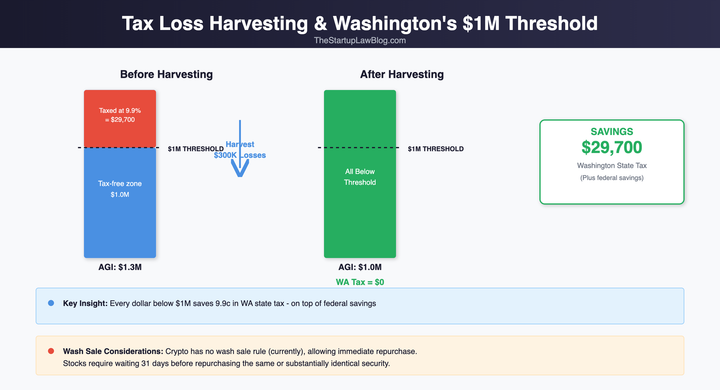
Washington adds a distinct interaction between its capital gains tax and its income tax. When long-term gains drive income above the threshold, harvesting enough losses can eliminate both Washington taxes in the example below. This depends on the statutory adjustments and credits, not simply on reducing federal AGI.
Under §302, long-term gains and losses are neutralized out of federal AGI; what enters your Washington base is the add-back of your chapter 82.87 taxable gain. Harvested long-term losses reduce your federal net long-term gain, which reduces the gain Washington taxes under chapter 82.87, which shrinks the add-back — effectively dollar-for-dollar for gains above the capital gains standard deduction. And §302(3) contains a cliff: the add-back applies only in years you actually owe capital gains tax. Harvest enough to owe none, and the add-back — including the standard deduction component — disappears entirely.
Illustration, not a forecast of indexed deductions: assume a Washington resident in 2028 has $800,000 of wages and a $500,000 Washington-allocated long-term gain, no other income, adjustments, or credits, and a $1 million income-tax deduction. Hold the capital gains deduction at its 2025 value of $278,000 solely to illustrate the mechanics. Without harvesting, capital gains tax is $15,540 (7% of $222,000); tentative income tax is $29,700, reduced by the §205 credit to $14,160. Combined Washington tax is $29,700. Harvest $250,000 of qualifying long-term losses and net gain falls to $250,000, below the assumed capital gains deduction. No capital gains tax is owed, §302(3) adds nothing back, and the $800,000 income-tax base is below the income-tax deduction. Both taxes become zero. Substitute the actual indexed deductions for the year being modeled.
The contrast case defines the limit: the same resident with $1.3 million of pure wages gets nothing from harvesting $300,000 of long-term losses. §302(2) adds long-term losses back — they cannot shelter ordinary income in Washington, not even the $3,000 the federal system allows.
That is a powerful incentive to actively manage your realized gains and losses each year.
How Tax Loss Harvesting Works
The concept is simple: sell investments that are currently trading below your cost basis, realize the loss, and use that loss to offset gains or reduce your taxable income.
Under federal tax rules, capital losses first offset capital gains (short-term losses against short-term gains, then long-term losses against long-term gains, then any remaining net losses cross over). If your net capital losses exceed your capital gains, you can deduct up to $3,000 per year against ordinary income. Unused losses carry forward to future years indefinitely.
Washington starts with federal AGI, then §302 removes long-term gains and losses and adds back the specified Washington capital gains amount. Short-term losses can affect the base through federal AGI, subject to federal netting and loss limits. Long-term losses must also be tested under chapter 82.87: RCW 82.87.040(3) allows a long-term loss carryforward only to the extent included in federal net long-term capital gain and directly attributable to losses allocated to Washington. Federal deductibility alone does not establish a Washington benefit.
The Wash Sale Rule
The federal wash sale rule (IRC Section 1091) prohibits you from claiming a loss if you purchase a "substantially identical" security within 30 days before or after the sale. The consequence depends on where the replacement purchase occurs.
If you replace the position in an ordinary taxable account, the disallowed loss generally increases the basis of the replacement securities under §1091(d). If instead you sell in a taxable account and cause your IRA or Roth IRA to purchase substantially identical securities within that 30-day window before or after the sale, the loss is disallowed without increasing the IRA’s basis — effectively permanently lost, not merely deferred. See Rev. Rul. 2008-5.
Check purchases across taxable accounts and IRAs, including automatic purchases and dividend reinvestments. Waiting 31 days after selling does not cure a triggering purchase during the preceding 30 days; the wash-sale window runs 30 days before and after the sale. To keep market exposure without triggering the rule, purchase a similar but not "substantially identical" investment during the waiting period.
For publicly traded stocks, "substantially identical" is generally interpreted narrowly — shares of the same company are substantially identical, but shares of a different company in the same industry (or a broad index fund versus individual stocks) are generally not.
Strategies for Washington Residents
Year-End Threshold Management
At year end, project Washington base income after the statutory modifications, then calculate both taxes and their credits. Federal AGI alone does not tell you whether harvesting will bring Washington taxable income below the $1 million deduction.
Review unrealized losses, expected bonuses, K-1 income, and capital-gain distributions before year end. Model the resulting federal netting, Washington allocation, capital gains tax, income-tax adjustments, and credits before deciding how much loss to realize.
A qualifying loss can reduce the capital gains tax and the income-tax add-back. The combined savings depend on the §205 credit and both tax computations; do not add a 9.9% income-tax saving to a capital-gains-tax saving without recalculating the credit. Eliminating capital gains tax can also eliminate the §302(3) add-back.
Gain-Loss Matching Throughout the Year
If you realize a significant capital gain from selling stock or a business interest, review available offsetting losses promptly. An option exercise can instead produce compensation income or an ISO AMT adjustment; do not treat the exercise itself as a capital gain. Investment conditions may change before year end.
This is particularly relevant for founders and executives who have concentrated stock positions. If you are selling company stock (after an IPO, for example) and generating large gains, simultaneously harvesting losses in other parts of your portfolio offsets those gains dollar-for-dollar federally — and, for long-term gains Washington taxes, effectively dollar-for-dollar against the Washington base as well, through the reduced chapter 82.87 add-back.
Building a Loss Harvesting Portfolio
Some advisors construct portfolios specifically designed to generate harvestable losses. The approach typically involves holding diversified, tax-efficient investments as a core portfolio, investing a portion of the portfolio in individual securities or sector funds where volatility creates periodic loss-harvesting opportunities, and systematically harvesting losses and replacing sold positions with similar (but not substantially identical) investments.
Over time, this approach can generate a steady supply of losses to offset gains and manage AGI — essentially creating a "tax alpha" that complements investment returns.
Coordinating with Other Income
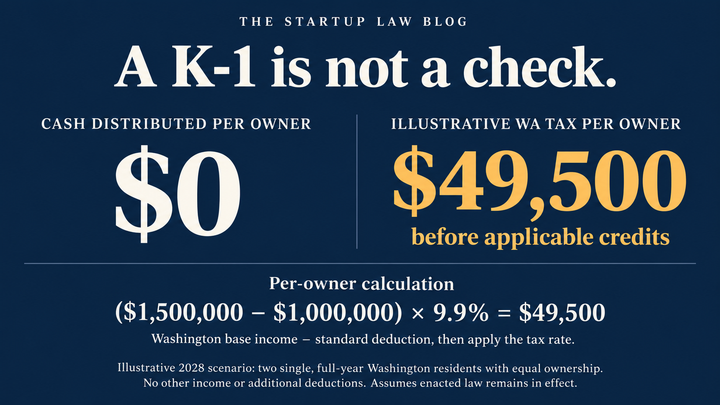
Coordinate capital-gain realizations with available losses and separately model ordinary-income events such as Roth conversions and NSO exercises. A pass-through owner generally owes tax on allocated income whether or not cash is distributed, so delaying a distribution alone usually does not defer that income.
Separate NSOs from ISOs. An NSO exercise generally produces ordinary compensation income. Exercising an ISO and holding the shares generally produces no regular federal income, although an AMT adjustment may apply; a later disqualifying disposition can produce ordinary income. Long-term capital losses cannot shelter ordinary income in Washington because §302 reverses those losses out of the base. Model the exercise and any later sale separately. See IRS Topic 427 and the stock options and RSUs guide.
The Carry-Forward Advantage
Capital losses that exceed your current-year gains (beyond the $3,000 ordinary income offset) carry forward indefinitely under federal law. This carry-forward is valuable in its own right — but it is especially valuable for Washington residents because it gives you a bank of losses to deploy in future high-income years.
For an illustration using the same assumed $278,000 capital gains deduction, suppose a future year brings a $700,000 Washington-allocated long-term gain and $1.3 million of other income. A $500,000 long-term loss carryforward that qualifies federally and under RCW 82.87.040(3) reduces net gain to $200,000. Under these assumptions no capital gains tax is owed and §302(3) adds no gain back. The remaining ordinary income is still subject to the income tax after its deduction. Use actual indexed deductions and verify the carryforward’s Washington allocation.
Building and maintaining a loss carry-forward balance is an underappreciated component of long-term Washington tax planning.
Limitations and Considerations
You need losses to harvest. In a sustained bull market, your portfolio may not have significant unrealized losses. Loss harvesting is opportunistic — it works best when markets are volatile or declining.
Long-term losses cannot shelter ordinary income. If your Washington base income is driven by salary, bonuses, option exercises, or pass-through income rather than capital gains, long-term loss harvesting does nothing against this tax: §302(2) adds long-term losses back, and even the federal $3,000 allowance against ordinary income is reversed out when the losses are long-term. Harvesting is a gains tool in Washington. If ordinary income is your problem, the levers are timing, the PTE election, and the strategies in the Before 2028 guide.
Basis erosion. When you harvest a loss and reinvest in a similar (but not identical) asset, your new basis is lower. If the replacement investment appreciates, you will have a larger gain when you eventually sell it. Loss harvesting doesn't eliminate tax — it defers it. But deferral has real value — compare the combined federal and Washington result in the eventual realization year.
Model the PTE election separately. For eligible pass-through income, an entity-level Washington income-tax payment may produce a federal deduction outside the individual SALT cap. A fully deductible $99,000 payment saves $36,630 at a 37% federal marginal rate, leaving $62,370 after that benefit. The Washington payment remains $99,000. This illustration assumes the election does not increase state liability, the owner can use the full credit, and the deduction produces its full assumed benefit. The treatment of owner deductions at entity level and other federal interactions can change the result. Compare total tax with and without the PTE election; do not prioritize it automatically.
Consult your advisor. Loss harvesting interacts with federal tax rules, state tax rules, portfolio strategy, and your overall financial plan. It should be implemented as part of a coordinated approach, not in isolation.
What to Do Now
If you are a Washington resident with a taxable investment portfolio and Washington taxable income near or above the $1 million standard deduction (per individual; spouses share one), loss harvesting should become a routine part of your annual tax planning. Start by reviewing your portfolio for unrealized losses today. Not because the tax takes effect today — but because building the habit and infrastructure now means you will be ready to execute when January 1, 2028 arrives.
For more on managing Washington's income tax, see our Washington State Taxes guide and Tax Planning Guide for High Earners.
This post is for informational purposes only and does not constitute legal or tax advice. Consult with a qualified tax professional regarding your specific circumstances.
Related Posts
- Stock Option Exercise Timing: Planning Before Washington's 2028 Income Tax
- Equity Compensation Plan Design: How to Structure Your Startup's Stock Option Plan
- Washington vs. California: A Tax Comparison for Founders and Investors
- Washington's New Income Tax: What Founders, Investors, Athletes, and High Earners Need to Know
- Cap Table Management: The Founder's Guide to Getting It Right from Day One
- Washington's New Income Tax: The Complete Guide
Sources for the September 7, 2026 corrections
ESSB 6346 §§302, 205, 502 · Washington capital gains calculation · IRS stock options guidance