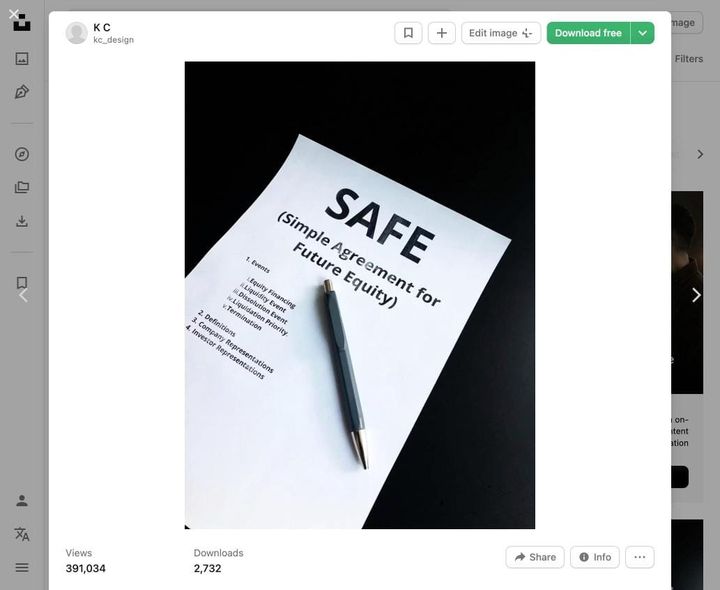

A SAFE (Simple Agreement for Future Equity) and a convertible note let a startup raise capital before a priced equity round. A note documents debt with negotiated interest, maturity, and conversion terms. A standard YC SAFE has no interest or maturity date, but does provide payment rights in specified exit and dissolution events.
For a seed financing where the parties accept equity-style economics without repayment or maturity rights, a standard post-money SAFE is a sensible starting point. A convertible note fits when negotiated creditor rights and a defined maturity outcome are important. Compare the conversion prices, payment priorities, and side letters before choosing.
What Is a Convertible Note?
A convertible note documents a loan and the circumstances in which it converts to stock. Review principal, interest, maturity, conversion triggers, pricing, amendments, and payment priority together.
- Principal: The amount advanced.
- Interest: The contract determines rate, accrual, compounding, payment, and conversion.
- Discount: A negotiated reduction in the new-investor share price. A 20% discount on $2.00 produces $1.60.
- Cap: An input to the conversion-price formula, using the defined capitalization denominator.
- Maturity: Read payment, demand, election, and extension provisions; do not assume one universal outcome.
How Does a Convertible Note Work?
Assume $500,000 principal, 6% annual simple interest for exactly 18 months, a $5 million pre-money cap, and a 20% discount. Assume a qualifying financing at $1.00 per share and that both pricing calculations use 10 million pre-financing fully diluted shares, excluding the note, with no pool change or other converting instruments.
- Cap price: $5 million ÷ 10 million shares = $0.50.
- Discount price: $1.00 × 80% = $0.80.
Assume the agreement uses the lower price and converts principal and interest at that price. Interest is $45,000; $545,000 ÷ $0.50 produces 1,090,000 shares. Different capitalization definitions or interest treatment can change this result. Calculate final ownership only after including all financing shares.
What Is a SAFE?
A standard YC SAFE is not a loan and has no interest or maturity date. It provides equity-financing conversion rights and specified liquidity and dissolution payment rights. Cash-out rights rank behind outstanding debt; recovery depends on available proceeds. See the YC forms and User Guide.
Head-to-Head Comparison
| Feature | Standard YC SAFE | Convertible Note |
|---|---|---|
| Legal structure | Contract for future equity and specified proceeds | Debt with conversion provisions |
| Interest | None in standard YC form | Negotiated rate and payment terms |
| Maturity | None in standard YC form | Contractual payment or conversion provisions |
| Issuer accounting | Apply relevant classification rules | Apply relevant convertible-debt accounting rules |
| Conversion trigger | Defined preferred-stock Equity Financing | Defined financing and any other contractual triggers |
| Investor protections | Contractual conversion and proceeds rights | Creditor rights; security only if actually granted |
A note on interest rates: a zero stated rate is not automatically prohibited, but tax consequences require analysis of the instrument and the parties. Section 7872 applies to specified below-market loan categories. OID is measured against the stated redemption price at maturity, not simply face principal. On a multiyear note, interest deferred until maturity generally is not qualified stated interest and can create OID even when the investor pays face value. A conversion-price discount alone does not establish OID. IRC §7872 Treas. Reg. §1.1273-1
When SAFEs Win
A SAFE avoids interest accrual and the need to extend a maturity date while the company works toward a priced round. This can suit a seed raise whose timing is uncertain.
Investors can close on separate SAFEs as funds arrive. Each issuance still requires appropriate authorization and securities-law compliance; existing consent and side-letter obligations may affect later closings.
A SAFE can remain outstanding indefinitely if no conversion, liquidity, or dissolution event occurs. The company must continue to track its obligations.
A note’s qualified-financing definition can require minimum proceeds. Below that threshold, check for optional conversion rights rather than assuming the note must remain outstanding. The standard YC SAFE has no minimum dollar threshold, but its defined Equity Financing requires a qualifying preferred-stock financing; not every equity issuance triggers conversion. YC forms
When Convertible Notes Win
A convertible note gives the investor a debt claim before conversion. It can fit the financing when the parties want the following rights or arrangements:
A bridge with a negotiated deadline. Align maturity with the expected financing date and available cash. Specify whether maturity requires repayment, a demand, or conversion, and who controls any election or extension.
An investor's requirement for debt. Confirm that the proposed note satisfies the investor's actual investment restrictions.
Cross-border requirements. Local corporate, securities, or tax treatment may favor a note in a particular transaction; confirm that treatment with local counsel.
The Traps Founders Miss
Maturity provisions. Check notice and cure periods, default consequences, and the approvals needed for an extension. A company that cannot pay cannot assume its investors will extend the note.
SAFE stacking. Track each purchase amount, cap, discount, and side letter separately. For illustration, $500,000 ÷ $5 million + $300,000 ÷ $7 million + $200,000 ÷ $10 million equals about 16.29%. For standard post-money cap SAFEs, this estimates ownership before new-money and option-pool dilution only if each cap controls. It is not the final post-financing percentage.
Pre-money versus post-money. The same numerical cap can produce different shares under different capitalization definitions. Run both versions through the actual proposed financing instead of comparing cap labels alone.
Pro rata rights. YC documents these in an optional side letter. Track which investors actually have participation rights and the scope of each commitment. YC SAFE documents
Tax Considerations Most Guides Ignore
A financing also supplies valuation evidence: before subsequent option grants, reassess whether the common-stock valuation reflects all material information. Section 409A valuation rules
Contractual interest accrual and taxable income recognition are different questions. The holder’s accounting method, payment terms, and applicable OID rules determine when interest is included in income; some notes require inclusion before cash is received. Conversion of accrued interest into shares also depends on the documents, including whether interest converts at the same price as principal or is paid in cash. OID rules
Analyze a SAFE’s federal tax classification separately from its financial-statement presentation. Calling the instrument a SAFE, equity, or a prepaid forward contract does not by itself establish an income-recognition event. Identify the tax treatment supported by the actual terms and applicable authorities, then analyze funding, conversion, payments, and a later sale under that treatment. Do not assume that avoiding contractual debt also avoids every tax issue.
Stock issued on conversion of a debt note may qualify as QSBS, but the note itself is not QSBS and time holding the debt does not count toward the Section 1202 holding period. A SAFE requires separate federal tax-classification analysis; signing one does not by itself establish QSBS status or start the clock. Check original issuance, the applicable gross-assets test, and the C-corporation and active-business requirements during substantially all of the stock holding period. See the QSBS eligibility checklist and Section 1202 guide.
If substantially nonvested stock is transferred in connection with services, consider an 83(b) election within 30 days after the tax transfer. A financing conversion does not automatically trigger that requirement merely because the recipient is a founder or employee. Determine whether Section 83 applies and when the property is transferred.
Washington State Angle
Analyze the company, investor, and founder separately: signing a financing instrument or converting it is not automatically a personal taxable-income event. Interest or OID may be taxable to a noteholder before conversion or exit. A later stock sale can produce Washington capital gains tax if the gain is recognized and allocated to Washington, after exemptions and deductions. Since 2025, the tax is 7% of Washington capital gains plus 2.9% of the amount exceeding $1 million; use the standard deduction for the sale year. Beginning in 2028, ESSB 6346 requires separate income-tax calculations. RCW 82A.04.210 removes federal long-term capital gains and losses, then, for taxpayers owing Washington capital gains tax, adds Washington capital gains subject to that tax plus its standard deduction, excluding statutorily exempt sales. RCW 82A.04.130 provides a same-year capital gains tax credit limited to the income tax otherwise due, with no refund or carryover. Do not assume a universal combined rate. Gain actually excluded under Section 1202 is excluded from the Washington capital gains tax base, but qualifying stock does not guarantee exclusion of every dollar of gain. See the Complete Guide to QSBS & Section 1202 for the holding-period and eligible-gain limits.
The Bottom Line
Start with the rights the parties need: a SAFE avoids interest and maturity obligations; a note provides negotiated creditor rights before conversion.
Before signing, calculate conversion shares and resulting ownership, including other outstanding instruments and option-pool changes. Confirm payment priorities, participation rights, and any repayment obligations.
Frequently Asked Questions
What is the main difference between a SAFE and a convertible note?
A note documents debt; its terms govern interest, maturity, repayment, and conversion. A standard YC SAFE has no interest or maturity date, but can entitle its holder to proceeds in a liquidity or dissolution event. Compare both payment rights and dilution.
Can a SAFE convert to common stock instead of preferred stock?
In a qualifying equity financing, a YC cap SAFE can issue Standard Preferred or a separate series of Safe Preferred. A liquidity event instead invokes proceeds provisions: generally the greater of the purchase amount or the as-converted amount, subject to priorities and available proceeds. An acquisition does not invariably require an actual issuance of common stock. YC SAFE User Guide
What happens if a convertible note matures before the company raises a priced round?
The note's terms control: repayment, a demand, an optional conversion, or automatic conversion may apply. An extension requires the specified approvals. Address the deadline before the company reaches it without financing or repayment funds.
Does a SAFE or convertible note affect QSBS eligibility under Section 1202?
Yes. Stock issued on conversion of a debt note can qualify, but holding the debt does not start the QSBS clock. A SAFE requires separate tax-classification analysis. Eligibility includes original issuance, the applicable gross-assets test, and continuing C-corporation and active-business requirements. For stock acquired after July 4, 2025, the exclusion percentages are 50%, 75%, and 100% for stock held at least three, four, and five years, respectively, subject to the eligible-gain limits. Earlier stock has different rules; identify the applicable acquisition date before calculating an exclusion.
What is a post-money SAFE and how is it different from a pre-money SAFE?
YC’s post-money cap includes converting securities in its capitalization definition. The investment-to-cap ratio can estimate ownership if the cap controls, before new-money and option-pool dilution. A lower financing price can produce more shares. Pre-money forms use a different denominator. YC SAFE User Guide
Is a SAFE considered a security?
Yes. A SAFE is a security. Rule 506(b) prohibits general solicitation and limits counted purchasers to 35 in any 90-calendar-day period, applying Rule 501(e), which excludes accredited investors from the count. Each non-accredited purchaser must satisfy the sophistication standard alone or with a qualified purchaser representative, subject to the rule’s reasonable-belief provision. Rule 502(b) also requires specified disclosures a reasonable time before sale to non-accredited purchasers. Rule 506(c) permits general solicitation, but all purchasers must be accredited and the issuer must take reasonable verification steps. These are selected conditions, not a complete compliance checklist.
Want founder-focused legal and tax insights in your inbox? Subscribe to the newsletter — it’s free.
For more on protecting your exit from tax, see the Complete Guide to QSBS & Section 1202.
Related Reading
From the Author
Angel Investing: Start to Finish
If you're a founder navigating your first raise — or an investor trying to understand deal terms and exemptions — this is the book. Co-authored by Joe Wallin, it covers SAFEs, convertible notes, term sheets, and how angels actually evaluate deals.
Have questions about your specific situation?
Joe Wallin is a startup and tax attorney with 25+ years of experience advising founders and investors. Book a 20-minute call to discuss your situation.
Book a Free 20-Minute Call →