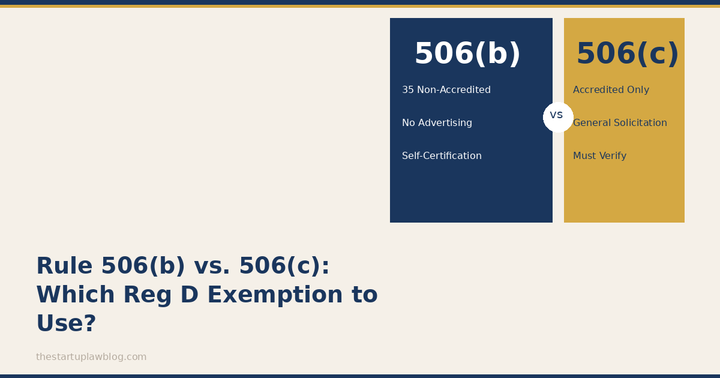
Use Rule 506(b) for a raise conducted without general solicitation. Use Rule 506(c) when you want to advertise and can limit sales to accredited investors whose status you take reasonable steps to verify. Both allow an unlimited offering amount. The choice turns on how you find investors, who may buy, and the compliance process you can support.
A familiar investor, a signed questionnaire, or a fundraising platform does not by itself determine which exemption works.
Rule 506(b) and Rule 506(c), compared
| Question | Rule 506(b) | Rule 506(c) |
|---|---|---|
| General solicitation | Prohibited | Permitted |
| Offering amount | No dollar ceiling | No dollar ceiling |
| Accredited purchasers | No numerical cap; establish qualification or reasonable belief at sale | All purchasers must be accredited; reasonable verification steps also required |
| Non-accredited purchasers | Up to 35 counted non-accredited purchasers in any 90-calendar-day period, applying Rule 501(e) counting; sophistication and disclosure conditions apply | Not permitted |
| Pre-existing substantive relationship | One way to establish the absence of general solicitation, not a universal standalone requirement | Not required as a condition of avoiding general solicitation |
| Prescribed disclosure | Rule 502(b) information owed to non-accredited purchasers | Rule 502(b) does not apply; antifraud obligations remain |
| Filings and state law | Form D; applicable state notices and fees | Form D; applicable state notices and fees |
These distinctions come from Rule 506. Neither exemption removes the need for accurate disclosure, valid corporate approvals, or compliance with other applicable securities laws.
Rule 506(b): a private offering with a reasonable investor assessment
The issuer and anyone acting on its behalf must comply with Rule 502(c)’s prohibition on general solicitation. An unrestricted website offering securities or a public fundraising advertisement can create a problem. A company announcement is not automatically a securities offer; review the actual communication, audience and context.
What a substantive relationship does—and does not—establish
A pre-existing substantive relationship is one means of showing that an offering does not involve general solicitation. It is not the only means. SEC staff Questions 256.26–256.33 address relationships, investor networks and demo days.
A substantive relationship involves enough information to evaluate the prospective offeree’s financial circumstances and sophistication—and an actual evaluation. Friendship, a business card, a referral or an accreditation checkbox alone does not establish it. When relying on a pre-existing relationship, confirm when it arose and whether it was established by the issuer or an eligible intermediary.
A qualifying Rule 148 demo day does not involve general solicitation. An event outside Rule 148 is not automatically general solicitation either; the facts still matter. Do not treat the sponsor’s label as the legal analysis.
Reasonable belief is not blind reliance
Rule 506(b) does not impose Rule 506(c)’s separate verification requirement. The purchaser must be an accredited investor, or the issuer must reasonably believe that status at the time of sale. A questionnaire or representation can be evidence supporting that belief; it is not an automatic safe harbor. Inconsistent answers or contrary facts require follow-up. A signature saying “I’m accredited” does not by itself mean the exemption is satisfied.
For the qualification routes, including the two historical income years, current-year expectation, net worth and credentials, see the accredited-investor guide.
Non-accredited investors require more than a place on the cap table
Apply the limit of up to 35 counted non-accredited purchasers in any 90-calendar-day period with Rule 501(e)’s counting rules. Each non-accredited purchaser must have the required sophistication, alone or with a purchaser representative, or the issuer must reasonably believe that immediately before sale.
Provide the information required by Rule 502(b) a reasonable time before sale. Financial-statement requirements depend on the applicable provisions, issuer and offering amount; do not assume every such offering requires exactly the same audit package. Friendship and family status waive none of these conditions. There is no standalone federal “friends and family” exemption—calling a round that does not change Rule 506(b)’s solicitation, counting, sophistication or disclosure requirements.
Rule 506(c): advertising with verified accredited purchasers
Rule 506(c) permits general solicitation. All purchasers must be accredited, and the issuer must take reasonable steps to verify their status. The verification requirement is separate from whether the investor actually qualifies.
The rule’s natural-person methods are nonexclusive and nonmandatory:
- Income: IRS forms reporting income for the two most recent years plus a written current-year expectation.
- Net worth: qualifying asset records and a nationwide consumer credit report dated within the prior three months, plus the representation concerning all necessary liabilities.
- Professional confirmation: a registered broker-dealer, SEC-registered investment adviser, licensed attorney in good standing or CPA in good standing confirms that reasonable verification steps were taken within the prior three months and that the purchaser is accredited.
- Grandfathered investors: the narrow pre-September 23, 2013 same-issuer Rule 506(b) route, for investors who still hold those securities.
- Previously verified investors: the same issuer’s prior reasonable verification can support the five-year representation route, absent contrary information.
A generic “financial adviser” or “accountant” is not enough to identify an eligible professional. A service provider can administer verification, but the issuer should understand and retain evidence of the method used. Using one of the enumerated methods can support the verification analysis when its conditions are met; it does not categorically mean the issuer is “protected,” and contrary knowledge still matters. Reasonable steps remain a principles-based inquiry—the listed methods are examples, not mandatory exclusive procedures.
A high minimum investment can support a facts-and-circumstances verification analysis. The SEC staff’s Latham & Watkins response addresses specified qualification categories, written representations, financing restrictions and absence of contrary actual knowledge. Review all those conditions. Neither a large check nor a checkbox is a universal substitute for analysis. Conversely, tax returns are not mandatory in every Rule 506(c) raise.
Choose based on the actual offering
Rule 506(b) often fits a private financing where the issuer can document how offerees were approached and evaluate purchasers without public marketing. Rule 506(c) can fit an advertised raise with a workable accredited-investor verification process.
The platform does not choose the law for you. Online offerings may use different exemptions and communication restrictions. Confirm the specific offering’s exemption, the platform’s role, verification responsibilities and any broker-dealer issues before launch. Neither route promises a particular fee or closing speed.
Sequence offerings under Rule 152
Rule 152 supplies the current integration framework. Different terms, share classes, or a six-month gap are not the governing general test.
- Completed 506(b), then 506(c): Rule 152(b)(4) provides a safe harbor for a subsequent offering that permits general solicitation after any terminated or completed offering. It does not impose a 30-day wait. Each offering must still satisfy its own exemption conditions.
- 506(c), then 506(b): Sequence carefully. The more-than-30-calendar-day safe harbor for a later private offering has an additional purchaser condition. Under Rule 152(a)(1), the issuer must reasonably believe each purchaser in the later 506(b) offering either was not solicited through general solicitation or had a substantive relationship established before that private offering began. SEC staff C&DI 148.01 addresses sales to people contacted through the earlier 506(c) general solicitation: because those investors were generally solicited, Rule 152(a)(1)(i) is unavailable for them; the issuer must instead establish a substantive relationship before the 506(b) offering begins (Rule 152(a)(1)(ii)). “Substantive” turns on the quality of the relationship—the issuer (or someone acting on its behalf) must have sufficient information to evaluate, and must actually evaluate, the person’s sophistication, financial circumstances, and ability to understand the investment’s risks. Passage of time or a short accreditation questionnaire alone is not enough. Without a prior business relationship or similar foundation, that showing is often harder, especially for internet-sourced contacts.
- Concurrent offerings: where no safe harbor applies, analyze whether each offering independently satisfies an exemption under Rule 152(a), including its purchaser and communication conditions.
Completion means more than declaring the round closed. Apply Rule 152(d), including cessation of further selling efforts. Document the offerings and their boundaries; different labels alone do not separate them. Switching labels after an accidental general solicitation does not automatically cure a defect—analyze Rule 152, Rule 508, possible Section 4(a)(2) availability, and the actual facts.
Before the first sale
- Choose and document the exemption before circulating offering materials.
- Review solicitation, purchaser eligibility and any Rule 152 sequencing conditions.
- Prepare required disclosure and the qualification or verification file.
- Check Rule 506(d) covered persons and disqualifying events, applicable exceptions and required historical disclosures.
- File Form D within 15 days after the first sale, and address state notices, fees and amendments. The first sale is the investor’s irrevocable contractual commitment, which can precede receipt of cash.
If a completed sale has a defect, analyze the exemption and possible alternatives before promising a cure. Deleting an advertisement, collecting a late letter or changing a purchaser’s later financial status does not automatically repair the earlier sale.
Frequently asked questions
Does every Rule 506(b) investor need a pre-existing relationship?
No. A pre-existing substantive relationship is one way to establish the absence of general solicitation. The offering must still satisfy the solicitation restriction and purchaser conditions.
Can I switch from Rule 506(b) to Rule 506(c)?
Potentially, but assess completed sales, how investors were solicited, the start and end of each offering, and Rule 152—including C&DI 148.01 if the later private offering would include people contacted through earlier general solicitation. The safe harbor for a subsequent general-solicitation offering does not automatically cure a defect in an earlier offering, and accidental general solicitation does not by itself end every possible exemption analysis.
Does a platform make an offering Rule 506(c)?
No. Confirm the exemption and procedures for the specific offering. A platform’s brand or online access does not determine its legal structure.
Do friends and family qualify under Rule 506(c)?
Only if they satisfy the accredited-investor requirement and the issuer takes reasonable verification steps. Their relationship to the founder does not create an exception under Rule 506(c)—and friendship or family status likewise creates no standalone federal exemption under Rule 506(b).
Related reading
Regulation D: Rules 504, 506(b) and 506(c) · Accredited-investor requirements and verification
For help choosing the exemption and building the investor process, book a 20-minute call.
This article provides general information, not legal advice.