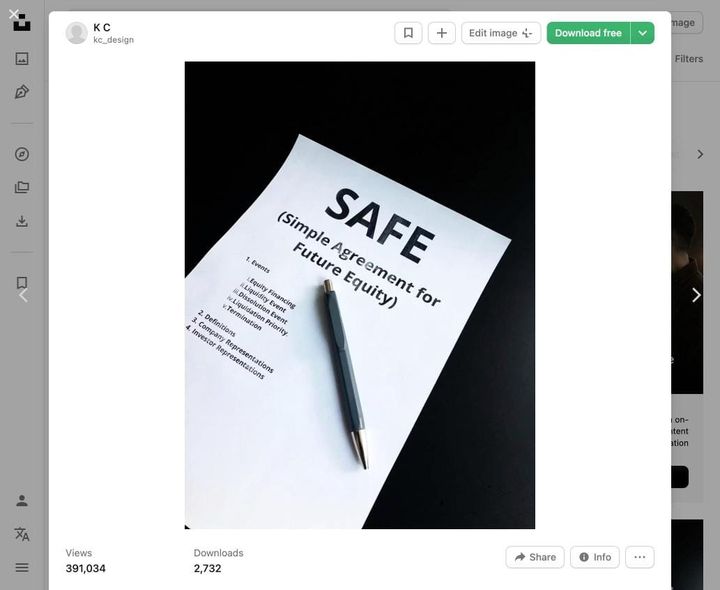
You wrote a check into an early-stage company on a SAFE. Part of what you are underwriting — maybe a large part — is the hope that when this thing works, your gain comes out tax-free under Section 1202. So here is an uncomfortable question: if that exit arrives in seven years and the IRS asks you to substantiate the issuance-time requirements and the separate requirements that apply during your holding period, what exactly are you holding?
Review your actual SAFE and any side letters for information rights, QSBS covenants and notice provisions. Do not assume the investment documents require the company to provide the records needed to substantiate a Section 1202 position. A contractual information gap is distinct from the tax classification of the SAFE itself.
The SAFE has two QSBS problems, not one
The first problem is whether your SAFE is even stock. Section 1202 excludes gain from the sale of qualified small business stock. The holding period depends on when the investor is treated as acquiring stock for federal tax purposes, subject to applicable holding-period rules. A SAFE’s treatment as stock for Section 1202 remains uncertain. Under a conventional SAFE, the investor generally holds a contractual right to future equity or other treatment upon specified events — not present shares. The IRS has not published definitive guidance classifying every SAFE as stock, debt, an option, a forward contract, or another instrument for federal income-tax purposes. Possible analyses may include equity or other contractual treatment; the particular SAFE’s terms matter, and the absence of stated interest or maturity does not by itself resolve the classification. Y Combinator’s form recites an intent to treat the instrument as stock for specified tax purposes such as Section 1202, but that recital does not bind the IRS and does not settle the question.
Why does that matter so much to you specifically? Because of timing. Do not assume the §1202 holding period begins when you fund the SAFE, or that pre-conversion SAFE time automatically tacks onto later-issued stock. Even if a particular SAFE were treated as stock, whether funding starts the §1202 period and whether a later conversion continues that period remain instrument-specific questions; §1223 and related rules do not supply a universal SAFE-to-preferred tacking answer. For conservative planning, analyze the stock issued on conversion — including original issuance, acquisition date after any applicable tacking, and the gross-assets test at that issuance — and do not count on a pre-conversion holding period without transaction-specific authority. On a hot company, conversion may be years after funding. With the post-OBBBA tiers now running 50% at three years, 75% at four, and 100% at five, where the clock starts can be the difference between a full exclusion and a partial one, or none at all. And it gets sharper if you are rolling QSBS proceeds into a SAFE under Section 1045: there, the replacement interest has to be QSBS on the date it is issued, and if the SAFE is not stock, the rollover can fail outright. That is a bet-the-farm version of the same uncertainty.
The second problem is the one I wrote about for founders last week, and it applies to you with equal force: even once you clearly hold stock, the company has to keep qualifying under the ongoing rules. The C-corporation and active-business requirements must be satisfied during substantially all of your holding period. The gross-assets ceiling works differently: Section 1202(d) tests the issuer and any predecessor before issuance and tests the issuer immediately afterward, including the issuance proceeds and applicable group aggregation. Later growth above that ceiling does not, by itself, disqualify stock that already qualified. For a SAFE, that distinction matters: if the SAFE is not stock for tax purposes, the later stock issuance on conversion must satisfy the applicable gross-assets test at that issuance, not merely at SAFE funding. Section 1202(f) preserves QSBS status and holding period only for stock acquired solely through conversion of other QSBS stock in the same corporation; it does not itself classify a SAFE as stock or automatically cover every SAFE-to-preferred conversion. A pivot into an excluded business, excessive nonbusiness real estate or portfolio holdings under the applicable rules, or a redemption within a disqualifying window can raise separate problems. The investor needs information about those facts, not a promise that the company will stay below the gross-assets ceiling forever. See Section 1202(c)(2), (d), (e) and (f).
What a side letter can address
A negotiated side letter can give the investor information and notice rights alongside a SAFE. It cannot determine whether the SAFE is stock for tax purposes, cure a failed statutory requirement, or guarantee the exclusion. The scope, cost and company’s willingness to agree depend on the requested obligations and available records.
The side letter should seek commercially reasonable efforts to support QSBS qualification; notice of proposed redemptions, restructurings and business changes that could affect it; the factual information needed to evaluate qualification; and an annual certification, signed by the company's principal financial officer, of the facts that underlie the Section 1202 qualification, for as long as you hold the SAFE or the stock it becomes. Request gross-assets information for the relevant issuance analysis, including any expected conversion if the SAFE is not tax stock. Growth above the ceiling after a qualifying issuance is not itself a disqualifying event. A covenant or certification provides information and contractual rights; it does not establish tax qualification by itself.
An annual factual certification can help build a contemporaneous record. Its usefulness depends on the underlying evidence, the period covered and the limits stated. The work required varies with the company’s history and records; a signature alone does not establish qualification.
When the exclusion is finally on the table, that signed annual record is what an attorney builds into a QSBS attestation letter — the contemporaneous document that has to survive IRS examination and buyer diligence when the money is actually moving.
A market response worth watching: the Series SAFE Preferred
In late 2025, one law firm — Mintz — published a form instrument aimed at this exact problem. The Series SAFE Preferred keeps a post-money SAFE’s economics (investment amount and valuation cap drive the conversion math) but is issued as actual preferred stock under a filed charter amendment. Because the investor holds stock at issuance rather than a contractual right to future stock, the Section 1202 holding period has a clear start date: the day the money goes in. Holders also pick up statutory stockholder rights a SAFE holder lacks — books-and-records inspection and a class vote if a charter amendment adversely affects their series.
What it doesn’t do is eliminate the tax question — issuing one series of thinly featured preferred still leaves the other Section 1202 requirements to satisfy, and the gross assets test now runs at issuance rather than conversion. If you’re an investor being offered one, the analysis in this post still applies — the instrument changes the form of the answer, not the questions you should ask. If you’re being asked to convert an existing SAFE into one, get tax advice first: the conversion itself has consequences the marketing materials don’t dwell on.
Why this is a rational ask, not a nuisance
The potential exclusion can justify asking for records before investing and maintaining them afterward. The available eligible-gain limit and exclusion percentage depend on the acquisition regime, holding period, basis and prior exclusions. A side letter supports the information-gathering process; it is not insurance against a failed tax position.
Request a defined reporting process, responsible company contact and reasonable delivery timetable. If a company cannot provide a certification, ask which facts or records are missing. Evaluate those gaps on their merits rather than treating agreement or refusal as proof of qualification.
This is commentary on investment documentation and Section 1202, not legal or tax advice, and whether any particular SAFE is "stock" for Section 1202 turns on specific facts that deserve a real analysis. If you want help building a QSBS side letter into your angel investing process — or an annual certification process on the company side — that is something we do.