Founder vesting determines what happens to equity when a founder leaves. The documents should distinguish ownership from vesting, specify any company repurchase right, and coordinate the stock transfer with the Section 83(b) decision.
In This Guide
- → The Dead Equity Problem: Why Vesting Matters
- → How Standard Vesting Works: The 4-Year / 1-Year Cliff Model
- → Reverse Vesting vs. Forward Vesting for Founders
- → Section 83(b) Elections: The Tax Consequence You Must Not Ignore
- → Acceleration: Single-Trigger and Double-Trigger
- → Co-Founder Splits: The Hardest Conversation
- → What Happens to Unvested Shares When a Founder Leaves
- → How Investors View Founder Vesting
- → Vesting for Advisors and Key Employees
- → Common Mistakes Founders Make
- → Real-World Scenarios: How This Actually Plays Out
- → Practical Steps: How to Actually Set This Up
- → The Hard Truth About Vesting
- → Ready to Build on a Solid Legal Foundation?
Three co-founders launch a startup on day one. They each get 33% of the company. One founder starts pulling away after eight months. Another stays through the Series A but then decides to take a different job. The third builds the company for five years. Under a vesting schedule, the founder who left after eight months keeps far less equity than the one who stuck around. Without one, you've got a real mess on your hands—and a very uncomfortable conversation with an investor down the road.
This is what we call the "dead equity" problem, and it's the reason vesting schedules exist.
The Dead Equity Problem: Why Vesting Matters
Before vesting was standard practice in Silicon Valley, here's what used to happen: founders would incorporate, each receive their equity grant, and that was it. You owned it outright, fully vested from day one. On the surface, this seems fair—you all started together, so you should all get an equal stake.
From the other side of the table, see how employees can negotiate their equity.
But life happens. A co-founder might leave after six months for a job with better benefits. Another might get divorced and split their shares with a spouse who has no involvement in the company. A third might simply lose interest or find it's not what they thought. And now your company has thousands or millions of shares outstanding, held by people who aren't actually contributing anymore—people the investors will absolutely want answers about during diligence.
“Dead equity” describes shares held by someone who is no longer contributing to the company. Those shares still represent a real economic interest and may carry voting rights. Investors reviewing the cap table will want to understand the ownership and any enforceable repurchase rights.
With typical founder restricted stock, the founder owns the issued shares from the start, subject to a company repurchase right that lapses as the shares vest. A departure before the one-year cliff generally leaves all shares subject to that right, assuming no prior-service credit or acceleration. Repurchase requires the agreement’s price, notice and payment terms and compliance with applicable law. Repurchased founder shares do not automatically enter an option pool.
This isn't punishment. It's protection for everyone involved—including the founders who stay.
How Standard Vesting Works: The 4-Year / 1-Year Cliff Model
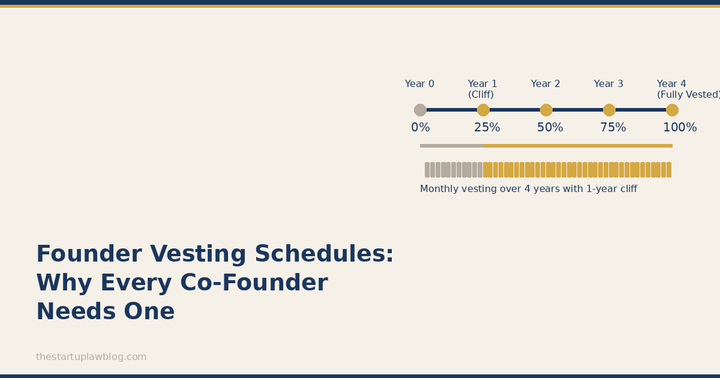
A common schedule is four years of vesting with a one-year cliff. It is a negotiated arrangement, not a statutory requirement.
For a 1 million-share award on that schedule, no shares vest before the first anniversary. At that anniversary, 250,000 shares vest; the remaining 750,000 vest over the next 36 months. Before vesting, issued restricted shares are already owned but remain subject to the agreed repurchase right. Leaving after 11 months ordinarily means no vested shares, assuming no acceleration or prior-service credit.
A one-year cliff lets the team assess a working relationship before the first portion vests. Whether that period fits depends on the founders’ prior contributions and negotiated terms.
Four years is a common total period. Different schedules, immediate vesting for prior work, and different terms for different founders can be appropriate if clearly approved and documented.
For the 1 million-share example, 250,000 shares are vested after 12 months, approximately 270,833 after 13 months, 500,000 after 24 months, and 750,000 after 36 months. All 1 million are vested after 48 months. Apply the agreement’s rounding rule. These are vested-share counts, not new stock issuances each month.
Reverse Vesting vs. Forward Vesting for Founders
The terminology here gets confusing. There are two ways to structure founder vesting, and they're actually opposites.
Reverse vesting means the founder receives and owns shares at issuance, with the unvested portion subject to a company repurchase right. The agreement specifies the price, often the original purchase price or the lesser of that price and current fair market value. Vesting releases that restriction; it does not create ownership for the first time.
An arrangement that promises delivery of shares later works differently. For example, an RSU generally is a contractual right before settlement, while an option is a right to buy shares. Vesting, exercise, settlement and stock transfer are separate events, and their timing depends on the award.
For founders, reverse vesting is standard and is what I almost always recommend. Why? Because of Section 83(b) of the tax code. Reverse vesting lets you make an 83(b) election and avoid a tax trap that can be incredibly expensive.
Section 83(b) Elections: The Tax Consequence You Must Not Ignore
This is where founders make their most expensive mistakes.
Under Section 83(a), compensation from service-related restricted stock generally is recognized when the stock first becomes transferable or is no longer subject to a substantial risk of forfeiture, whichever occurs earlier. For typical founder stock, that is vesting. The taxable amount is the excess of fair market value over the amount paid for those shares, ignoring lapse restrictions when measuring value. If you paid $0.10 per share and a tranche vests at $1 per share, the ordinary-income amount is generally $0.90 per share, not $1.
A valid Section 83(b) election instead measures compensation at transfer: fair market value minus the amount paid. Paying full fair market value can produce a zero-income election. Later vesting generally creates no additional compensation income; a later sale is analyzed under the applicable gain rules. The election does not guarantee a favorable outcome: if the stock is forfeited, the compensation previously included is not deductible merely because of the forfeiture.
The filing deadline generally is 30 days after the property is transferred, not automatically 30 days after incorporation, board approval or an option grant. Section 7503 moves a deadline falling on a Saturday, Sunday or legal holiday to the next applicable business day. Any disaster-related postponement must actually cover the taxpayer and act. Do not assume ordinary discretionary relief is available for a missed statutory deadline.
An unfunded promise to deliver shares later, such as an unsettled RSU, is not stock on which to make this election. A typical private-company option grant also does not itself support an 83(b) election. If an option permits early exercise and exercise transfers substantially nonvested shares, consider an election on those shares. ISO early exercise requires a separate AMT and regular-tax analysis.
At the stock transfer, confirm the value, purchase price, restrictions and filing deadline. Decide promptly whether to elect, file using an available IRS method, provide the required copies, and retain proof. See the 83(b) election guide for filing steps and limits.
Acceleration: Single-Trigger and Double-Trigger
One more wrinkle in vesting schedules is what happens if your company gets acquired or has some other liquidity event. Do your shares continue vesting on the normal four-year schedule, or do they accelerate?
Single-trigger acceleration means your shares automatically vest in full (or vest in part) upon a change of control—an acquisition, merger, or similar event—regardless of whether you stay with the acquiring company. If your company is acquired at year two and you had single-trigger acceleration of 50%, you'd suddenly have 50% of your unvested shares become vested. This is valuable for founders because it protects you in case the acquirer decides they don't want to keep you around after the deal closes.
Double-trigger acceleration requires both a defined change in control and a qualifying termination within the agreement’s protection period. That may include termination without cause or resignation for defined good reason; some agreements also cover specified pre-closing terminations. Closing alone does not satisfy both triggers. Check whether the award will be assumed, continued, substituted or terminated in the transaction.
Negotiate acceleration around specific acquisition and departure scenarios. A management change or reduced role does not automatically trigger vesting. Check the definitions of termination without cause and resignation for good reason, the protection period, and any notice and cure requirements.
The amount of acceleration also varies. Some schedules provide full acceleration (all unvested shares vest). Others provide partial acceleration (perhaps 50% of remaining unvested shares). You'll negotiate this in your stock plan or in your actual equity grant documents, and it's absolutely something you should understand before you sign.
Co-Founder Splits: The Hardest Conversation
Co-founder splits are the hardest conversation in this area.
You've got three co-founders who started together. Eighteen months in, one of them wants out. He's been there the whole time, he's fully committed, he's not doing this lightly. But it's just not working. He wants to move on.
Without an applicable repurchase right, a departing founder generally retains issued shares. A buyback would require an agreed transaction or another enforceable contractual mechanism; departure alone does not create a right to force a sale or a statutory entitlement to a fair-market-value payout.
With a four-year schedule and one-year cliff, a founder leaving after 18 completed months generally has vested in 37.5% of the award. The remaining shares are subject to the agreed repurchase terms. The price may be the original purchase price; do not confuse that with current fair market value. Any buyback of vested shares is a separate question.
A written schedule makes the departure discussion more concrete, but it does not remove all disputes. The parties still need to establish the service end date, vested amount, applicable acceleration and repurchase procedure.
Before you even get to this conversation, have it as a theoretical. When you're all three founding partners and everything is rosy, talk about what happens if someone wants to leave. Would you have the right to buy back their shares? At what price? What vesting schedule would be fair? Getting this agreement in writing—ideally in a founders' agreement—before the problem occurs means you're not negotiating under stress and emotions.
A departing founder may remain on the cap table with vested shares, subject to applicable transfer restrictions and other agreements. There is no automatic right to sell those shares back to the company. Handle unvested shares under the actual repurchase or forfeiture provisions.
What Happens to Unvested Shares When a Founder Leaves
There are different ways to structure what technically happens to unvested shares.
A restricted stock agreement governs shares already issued; a stock option agreement governs the right to purchase shares. Unvested options commonly terminate at departure, while unvested restricted shares may be subject to a company repurchase right. For issued shares, check the contractual price and exercise deadline rather than assuming the shares disappear.
Repurchase and forfeiture are different mechanisms. Determine which the documents actually provide, complete the required notices and payments, and update the stock ledger. For a Delaware corporation, repurchases also must comply with applicable capital restrictions under DGCL Section 160. A repurchase does not automatically mean the shares have been formally retired.
A few agreements—usually negotiated by founders with significant leverage—allow unvested shares to continue vesting for a short period after departure, or allow acceleration in certain scenarios. But this is the exception, not the rule.
Before a departure, identify which shares are vested, which repurchase rights survive, any transfer restrictions, and any continued vesting or acceleration. “Vested” does not mean free of every contractual restriction or guaranteed liquidity.
How Investors View Founder Vesting
Institutional investors commonly review founder vesting because it affects retention and the ownership left with departing team members. They may ask founders to adopt or revise vesting as a financing condition.
Four years with a one-year cliff is a common starting point. Investor acceptance of different terms depends on the company’s stage, work already performed and negotiated retention needs.
Agree on vesting early when possible. Adding restrictions after stock has been issued can require holder consent and raises legal and tax questions; it is not simply a change to a spreadsheet.
Investors may request copies of applicable 83(b) elections and filing proof during diligence. Confirm the actual stock transfer and tax treatment rather than assuming every founder needed an election or that a board-approved grant date started the deadline.
Vesting for Advisors and Key Employees
Founder vesting and employee vesting aren't always the same thing, and advisor vesting is different from both.
Advisor awards depend on expected services, duration, stage and the ownership denominator used. Their vesting may be monthly, quarterly or tied to milestones. Specify the commitment and vesting terms instead of assuming a universal percentage or schedule.
Employee awards often use four-year vesting with a one-year cliff, but terms vary. Compare the award type, fully diluted percentage, purchase or exercise cost, and departure provisions rather than relying on the share count alone.
An option’s grant, vesting and exercise are separate events. A typical option grant does not call for an 83(b) election; early exercise into nonvested stock may. The post-termination exercise window is contractual and differs from the option’s overall term. Under Section 422(a)(2), the ordinary ISO employment condition generally requires exercise within three months after employment ends, with separate death and disability rules. A longer contractual window does not preserve ISO treatment by itself, and three months is not always 90 days.
Equity compensation and vesting terms should reflect the recipient’s responsibilities, expected time commitment, cash compensation, prior contributions and retention goals. Founder, employee or advisor status alone does not determine the appropriate award.
Common Mistakes Founders Make
The same vesting mistakes show up over and over. Here's how to avoid them.
First mistake: leaving departure terms unresolved. Decide whether founder shares should be subject to vesting, including credit for prior contributions. Without an applicable repurchase right, a departing founder generally retains issued shares. Investors may seek additional vesting as a financing condition.
Second mistake: confusing vesting credit with stock issuance. The parties may negotiate credit for services performed before incorporation or issuance. Document that credit accurately. An earlier vesting commencement date does not backdate the stock transfer, an option grant, the 83(b) deadline or a tax holding period.
Third mistake: adopting a cliff without considering prior service and departure scenarios. One year is common, but the right terms depend on the arrangement. Document any vesting credit or acceleration expressly.
Fourth mistake: not thinking about acceleration at acquisition. If you don't specify what happens to vesting in a change of control, you're relying on default language that might not protect you. Think through scenarios: if the company gets acquired in year two, what happens to your unvested equity? You should have an answer before that happens.
Fifth mistake: overlooking the 83(b) decision and deadline. Confirm whether substantially nonvested property was transferred for services, the amount paid, and the consequences of electing or not electing. The tax exposure depends on the actual values and facts.
Sixth mistake: relying on incomplete documentation. Use the required corporate approvals and signed stock purchase or award agreement to establish vesting and repurchase terms. A stock option plan or a reference in bylaws does not replace proper approval and documentation of the specific award.
Real-World Scenarios: How This Actually Plays Out
Here are a few scenarios showing how vesting actually works in practice.
Scenario One: Founder leaves after 19 completed months. Assume a 1 million-share restricted stock purchase, four-year vesting, a one-year cliff, monthly vesting thereafter and no acceleration. Approximately 395,833 shares are vested and 604,167 remain unvested, subject to the agreement’s rounding rule. The company may repurchase the unvested portion under its contractual terms. The founder has no automatic right to a company buyback of the vested portion.
Scenario Two: Founder leaves after 10 months. Under the same schedule, with no prior-service credit or acceleration, no shares have vested. All issued shares remain subject to the company’s repurchase right. That is different from saying the founder never owned the shares or that no purchase price must be returned.
Scenario Three: Acquisition after two years. Assume a separate founder has 500,000 vested and 500,000 unvested shares, and acceleration covers 50% of the then-unvested shares only when both contractual triggers occur. If both occur at closing, 250,000 additional shares vest, for a total of 750,000. A signed acquisition term sheet alone is not a completed change in control. If termination occurs later, calculate from the then-unvested amount. Continued vesting or cancellation otherwise depends on the award and acquisition documents.
Scenario Four: Different negotiated terms. A founder negotiates five-year vesting, a six-month cliff and 50% single-trigger acceleration. The longer schedule does not itself increase the number of shares or economic upside; it delays vesting. Specify the initial cliff amount, later installments, covered transaction and acceleration formula. Investor acceptance remains a negotiation.
Practical Steps: How to Actually Set This Up
If you're a founder reading this and realizing you don't have vesting set up yet, here's what you do:
First, incorporate your company if you haven't already. Choose your state—I usually recommend Delaware for venture-backed companies because of legal predictability, but Washington works too if you're bootstrapping.
Second, approve the equity structure and reserve or authorize sufficient shares. Founder restricted stock is often issued outside an equity incentive plan under board approvals and a stock purchase agreement. An employee option plan is a separate document; it is not a universal prerequisite to issuing founder stock.
Third, complete the actual issuance: obtain required approvals, sign the purchase or award agreement, deliver the agreed consideration and update the stock ledger. State the vesting commencement date, cliff, installments, departure rules and any acceleration. Keep the actual issuance date distinct from any prior-service vesting credit.
Fourth, address the 83(b) election when substantially nonvested stock is transferred. Use the 83(b) election guide to confirm the generally applicable 30-day transfer-based deadline and filing method. Supply required copies to the company and, if different, the property transferee; retain filing proof. A typical option grant or unsettled RSU does not itself require this election.
Fifth, coordinate the stock documents with any founders’ agreement, IP assignments and departure arrangements. Friendship does not remove the need for clear terms. Avoid conflicting buyback, vesting or acceleration provisions across documents.
If you're raising money, your investors will likely require that you have this all in place and will often bring their own counsel to review your cap table and vesting documents. But it's far better to have this right before you start fundraising.
The Hard Truth About Vesting
Here's what I want to leave you with: vesting isn't about distrust. It's about reality. Not everyone who starts a company stays all the way through. Some people have life changes. Some discover they don't like startup life. Some need to take care of family or health. Some find a different opportunity that's better for them.
When someone leaves, the documents should let the parties determine the vested amount, any remaining repurchase right and the steps needed to exercise it. Vesting can reduce the equity retained after an early departure, but it does not guarantee a clean cap table or eliminate the company’s payment obligations.
Related Posts
- Section 83(b) Elections: What Startup Founders and Employees Need to Know
- 83(b) Election Guide
- SAFE Agreements: What Every Startup Founder Needs to Know
- Term Sheets & Negotiation
- Where Should I Incorporate My Business?
Ready to Build on a Solid Legal Foundation?
Getting your equity structure right from day one can save you tens of thousands of dollars and countless headaches down the road. I work with founders to ensure they have the right vesting schedules, proper 83(b) elections filed, and clear agreements about what happens when circumstances change.
If you're starting a company or have questions about your current equity structure, let's talk. I offer free introductory calls to discuss your situation and make sure you're set up for success.
Setting up founder stock? Vesting terms, stock issuances, and 83(b) elections are all part of my Founder Formation service — a fixed-fee ($3,500) Delaware C-Corp formation handled by a startup tax lawyer.
This post is for educational purposes only and is not legal or tax advice. Consult a qualified attorney about your specific situation.