Every startup founder faces this question early: should you form an LLC or a C-Corp? The answer shapes your ability to raise capital, compensate employees with equity, qualify for significant tax benefits like QSBS, and manage your tax burden for years to come.
Having advised founders on entity selection for over 25 years, I can tell you this: the "right" answer depends on where you're headed, not just where you are today. A bootstrapped SaaS company with two co-founders has very different needs than a biotech startup planning to raise a Series A in twelve months.
The starting point is to separate state-law entity form from federal tax classification, then compare financing, compensation, and exit plans.
01. The Fundamental Difference
A C-Corporation generally pays federal income tax on its taxable income. Distributing after-tax earnings as dividends can produce a second shareholder-level tax. A stock sale is a separate shareholder transaction; it does not itself cause the corporation to recognize gain. An asset sale followed by a distribution can create tax at both levels.
An LLC is a state-law entity form. A domestic LLC with two or more owners is generally taxed as a partnership by default; a single-owner LLC is generally disregarded for federal income tax. An eligible LLC can elect corporate taxation. Unless otherwise stated, this guide uses “LLC” to mean one taxed as a partnership or disregarded entity. See the IRS LLC overview.
Both provide limited liability. Both can have multiple owners. The differences that actually matter for startups are about fundraising mechanics, equity compensation, tax planning, and long-term exit strategy.
02. Why Most VC-Backed Startups Are C-Corps
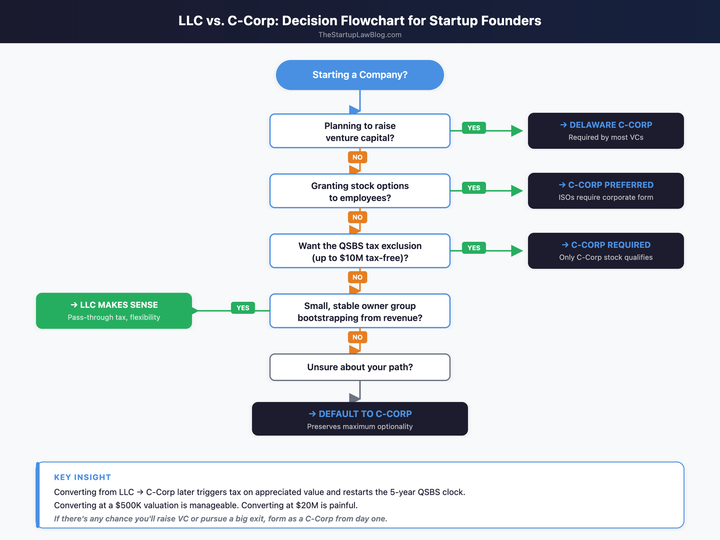
A Delaware C-Corp is a common fit for institutional venture financing. Confirm the proposed investors’ requirements before choosing or changing the entity.
Investor tax concerns. A partnership-taxed LLC generally issues K-1s to its members. Its operating income can create unrelated business taxable income for tax-exempt investors and U.S. tax obligations for foreign investors. Fund restrictions and the cost of addressing those consequences can make a C-Corp preferable.
Preferred equity. Corporations can issue preferred stock under familiar financing documents. LLCs can also create preferred economic and governance rights, but those rights must be coordinated with the operating agreement and partnership tax provisions.
Board governance. C-Corps come with a well-established governance framework: a board of directors, officers, and shareholder voting rights. VCs expect board seats and the governance protections that come with the corporate form.
Practice Note: An investor’s willingness to fund an LLC is not itself a warning sign. Review investor eligibility, tax treatment, governance, and any required conversion before agreeing to the financing structure.
03. When an LLC Actually Makes Sense
Not every startup needs venture capital, and not every startup should be a C-Corp. An LLC can be the better choice when:
You expect regular distributions. Pass-through treatment can avoid the federal corporate-income-tax and dividend-tax combination. Compare owner-level income and self-employment taxes, available deductions, and state taxes before concluding which structure costs less.
You have a small, stable ownership group. Two co-founders building a consulting firm, a software agency, or a real estate venture? An LLC's flexibility in allocating profits and losses among members can be valuable.
You need flexible economics. Partnership-taxed LLCs can make special allocations, but the allocations must comply with partnership tax rules, including Section 704(b). A distribution provision and a tax allocation are not the same thing.
You're in a capital-light business. If you don't need to raise outside capital and won't need to grant stock options to employees, the simplicity of an LLC can be appealing.
Illustration: Assume a two-owner LLC allocates $200,000 of taxable profit equally. Each owner reports $100,000 even if cash is retained. A C-Corp with the same $200,000 of federal taxable income pays $42,000 at the 21% federal rate, leaving $158,000 before other taxes. If all of that is distributed as a dividend, shareholders may owe additional tax. The overall comparison depends on their rates, deductions, employment taxes, and whether dividends qualify for preferential rates.
04. Tax Treatment: It's More Nuanced Than You Think
Compare operating taxes and exit taxes separately. Retaining profits can defer shareholder tax, but it does not eliminate every potential second layer.
Retained earnings and exits. A C-Corp generally does not pass its undistributed operating income through to shareholders. An eventual asset sale and distribution may nevertheless create two levels of tax. A qualifying stock sale may receive different treatment, including possible Section 1202 relief.
Loss deductions have limits. C-Corp losses generally remain at the corporate level. Partnership losses may pass through, but a member’s deduction can be limited by tax basis, at-risk rules, passive-activity rules, and excess-business-loss rules. A K-1 loss is not automatically deductible against salary. See IRS Publication 541.
The phantom income problem with LLCs. This catches founders off guard. If your LLC is profitable but you don't distribute enough cash to cover members' tax liabilities, members owe tax on income they never received. This is called "phantom income," and it becomes a real issue as the company grows.
Illustration: If Priya is allocated 30% of a partnership-taxed LLC’s $500,000 taxable profit, she reports $150,000 even if it retains all cash. At an assumed effective tax rate of 40%, that produces $60,000 of tax. Actual allocations and tax rates may differ.
Practice Note: Consider a tax-distribution provision specifying assumed rates, timing, available-cash limits, and coordination with other distributions. It cannot guarantee payment of every member’s actual tax bill, and distributions remain subject to applicable law and financing restrictions.
05. Equity Compensation: The C-Corp Advantage
The corporate form offers familiar stock-option arrangements. An LLC can also provide equity compensation, but the tax classification and award structure matter.
Corporate options. Corporations can grant ISOs and NSOs if the applicable requirements are met. A qualifying ISO exercise generally produces no regular federal income tax at exercise, but it can create an alternative minimum tax adjustment. The eventual sale and holding periods also matter.
LLC awards. A partnership-taxed LLC cannot grant ISOs. It may grant profits interests or other unit-based awards with their own tax and partner-status consequences. An LLC taxed as a corporation requires a different analysis; its state-law label alone does not determine every federal equity-tax result.
Valuation. Nonqualified corporate options commonly rely on the Section 409A stock-right exemption, which requires a grant-date exercise price at least equal to fair market value and satisfaction of other conditions. An independent appraisal is one safe harbor. LLC awards also require appropriate valuation analysis; not every award is governed by identical rules.
Recruiting. Explain the award’s economics, vesting, exercise or purchase cost, and tax consequences. With partnership equity, recipients may become partners for tax purposes and receive K-1s rather than continuing ordinary employee treatment.
→ For a deeper dive, see my guide on ISOs vs. NSOs.
06. QSBS and Section 1202: The Tax Benefit That Tips the Scale
Section 1202 can exclude eligible gain on qualifying stock. Its per-issuer eligible-gain limit generally uses the greater of the remaining applicable dollar limit or 10 times qualifying basis in stock sold that year. The $10 million or $15 million dollar-limit regime depends on acquisition date under the statutory rules; prior eligible gain and married-return rules matter. Apply the applicable exclusion percentage to eligible gain, rather than treating the cap as an automatic tax-free amount.
An interest in a partnership-taxed LLC is not itself QSBS. But an LLC holding qualifying C-Corp stock may pass eligible stock-sale gain through to qualifying members under Section 1202(g). An LLC taxed as a C corporation requires separate analysis under federal classification rules.
Tax savings depend on the shareholder’s actual gain, holding period, applicable exclusion percentage, and remaining limit. A company’s acquisition price alone does not establish any one investor’s exclusion or savings.
QSBS can favor C-Corp treatment for an eligible business, but compare the expected holding period, likely stock or asset exit, operating taxes, and qualification risks.
Key QSBS requirements:
- Original-issue stock in a qualifying domestic C corporation, acquired for permitted consideration.
- The applicable gross-assets ceiling must be satisfied before and immediately after issuance, including predecessor history and issuance proceeds: $50 million for stock issued on or before July 4, 2025, and $75 million after, with inflation adjustments after 2026.
- The applicable acquisition-date and holding-period rules described below must be satisfied.
- C-Corp status and the active-business requirements must hold during substantially all of the holding period; the general active-use test is 80% of asset value, subject to statutory rules.
- Excluded businesses include specified professional services, finance, farming, extraction, and hotels, motels, restaurants, and similar businesses. Disqualifying redemptions can also defeat eligibility.
Practice Note: Contributing property from a partnership or disregarded business for stock generally starts the Section 1202 holding period at the exchange. Earlier LLC operating years do not count. If an LLC already elected C-Corp taxation, a later state-law conversion requires its own continuity analysis; it does not necessarily start a new clock.
→ For the complete breakdown, see my QSBS and Section 1202 guide.
07. The Conversion Question: LLC to C-Corp
Many founders start as an LLC for simplicity and plan to "convert later." This is possible, but the timing and tax consequences matter more than most people realize.
Conversion mechanics. Depending on applicable state law, an LLC may use a statutory conversion, merger, or asset or interest transfer. An eligible LLC can also elect corporate tax classification without changing its state-law form. The classification regulations specify deemed transactions for that election.
Conversion tax. Section 351 can permit nonrecognition when property is transferred for stock and the transferors satisfy the immediate-control requirement. Appreciation alone does not force tax. Boot, transaction sequencing, and liabilities can change the result. Section 357(c) generally recognizes gain where assumed liabilities exceed transferred asset basis, subject to exceptions. A negative book or tax capital account is not, by itself, a universal taxable-conversion test.
Illustration: Assume a founder transfers a business with $50,000 adjusted asset basis, $2 million fair market value, and no liabilities for stock in a transaction meeting Section 351. The ordinary stock basis generally remains $50,000. If the stock later sells for $3 million, total realized gain before any Section 1202 exclusion is $2.95 million, but Section 1202(i)’s $2 million basis floor limits potential QSBS gain to $1 million. The $1.95 million of pre-contribution appreciation is not excluded under Section 1202. Separately, the corporation generally retains carryover asset basis under Section 362, so its own asset sale may recognize gain. The special QSBS basis floor does not erase corporate-level gain.
When to convert. Review financing plans, liabilities, tax bases, contributed-property values, and the likely exit date. The QSBS gross-assets test values contributed property at fair market value; low historical tax basis does not ensure eligibility.
The holding period. For stock acquired after July 4, 2025, the exclusion tiers are 50% after at least three years, 75% after at least four, and 100% after at least five. Stock acquired on or before that date generally needs more than five years, with the exclusion percentage depending on its acquisition period. Apply the statutory acquisition-date rules.
Planning point: Choose the structure before financing or compensation commitments make a change difficult. Earlier C-Corp treatment can start a qualifying holding period sooner, but it also changes operating taxation.
08. State-Specific Considerations
Your choice of entity doesn't exist in a vacuum — state tax law matters, and it matters more than it used to.
Delaware. Delaware incorporation is common in venture financing and does not require operating there. Budget for registered-agent costs, annual reports, franchise tax, and registration where the company actually does business. Do not assume franchise tax is always a nominal amount.
Washington. Model taxes at both the entity and owner levels, including the treatment of retained earnings, compensation, dividends, and a future exit. Federal pass-through status does not exempt a business from Washington business taxes.
For Washington’s income-tax and pass-through-entity planning rules, including effective dates and limitations, see How Washington’s New Income Tax Changes the Entity Choice Calculus. Do not assume an entity election automatically creates a federal deduction or eliminates owner-level tax.
California. LLCs subject to the state’s LLC tax regime generally owe an $800 annual tax and may owe an additional fee based on total California income. The $11,790 fee applies at $5 million or more. Corporations generally face an $800 minimum franchise tax, but newly incorporated or qualified corporations have a first-taxable-year minimum-tax exception; income-based tax can still apply. See the FTB’s LLC and corporation guidance.
Multistate operations. Incorporating in one state does not remove tax or registration obligations in other states where the business operates or owners reside. Compare the actual operating footprint and income sources.
→ For a detailed state-by-state analysis, see my State Tax Comparison for Startup Founders.
09. Cost and Complexity Comparison
Formation costs. Compare current filing fees, expedited service, registered-agent charges, legal work, and foreign registrations. Costs depend on the jurisdiction and capital structure; a single generic fee range can be misleading.
Ongoing compliance. Corporations need appropriate board and shareholder action and records; valid written consents may substitute for meetings when permitted. LLCs also need operating-agreement compliance, required approvals, and records of major decisions.
Financing costs. Standard corporate financing documents can reduce drafting work. LLC financings may require additional partnership-tax and operating-agreement provisions. Neither structure guarantees a particular legal bill or cost multiple.
Tax preparation. C-Corps generally file Form 1120. A domestic multi-member LLC taxed as a partnership generally files Form 1065 and provides K-1s; a disregarded LLC or one with a corporate election follows different rules.
10. Decision Framework by Stage
Pre-seed / Idea stage:
- Planning institutional venture funding? Confirm investor requirements and consider a Delaware C-Corp.
- Bootstrapping with a small ownership group? Compare pass-through taxation, distributions, and exit plans.
- Unsure? Model both structures; conversion has costs and tax consequences in either direction.
Seed stage:
- Taking institutional money? Resolve entity and investor tax requirements before signing.
- Still bootstrapping? Revisit operating taxes, QSBS timing, and financing plans.
- Granting equity? Compare corporate options with the economics and tax consequences of LLC awards.
Series A and beyond:
- Before a major round, confirm the entity, capitalization, equity awards, and investor requirements. Do not convert solely because a financing has a particular stage label.
Planning point: Valuation alone does not determine whether a conversion is taxable or straightforward. Review ownership, consents, tax bases, liabilities, and financing documents before implementing it.
11. FAQ
Can I start as an LLC and convert to a C-Corp later?
Yes. Section 351 can permit a tax-deferred conversion when its conditions are satisfied. Appreciation alone does not trigger tax, but liabilities, boot, control, and transaction structure matter. Earlier conversion does not guarantee a tax-free result.
Do I need a Delaware C-Corp, or can I incorporate in my home state?
Delaware is commonly preferred for venture financing. Home-state incorporation can also be appropriate. Either way, registration may be required in other states where the company does business.
Can an LLC elect to be taxed as a C-Corp instead of converting?
Yes. An eligible LLC can elect corporate tax treatment using Form 8832 while retaining its state-law LLC form. The election has deemed-transaction tax consequences. A later legal conversion should be coordinated with that election and the company’s financing and equity arrangements.
What about S-Corps?
S status is a federal tax election available to eligible corporations, including eligible LLCs. Section 1361 generally limits ownership to 100 shareholders, with special counting rules, and permits only one economic class of stock. Nonresident aliens cannot be direct shareholders; non-U.S. citizenship alone is not disqualifying. Most partnerships and corporations cannot be shareholders, which limits conventional venture-fund investment.
Does my entity choice affect QSBS eligibility?
Yes. Partnership or disregarded LLC interests are not themselves QSBS. C-Corp tax classification is necessary but not sufficient. The holding-period tiers, original-issue rules, business qualifications, and per-issuer limits must also be met; conversion does not shelter pre-contribution appreciation.
An S corporation's own stock is not QSBS; however, an S corporation may in some cases hold newly issued QSBS of a C-corporation subsidiary, so existing S-corporation owners should separately evaluate that future-appreciation strategy—see Can an S Corporation Get QSBS? The C-Corporation Subsidiary Strategy.
What if I'm a solo founder?
A domestic single-member LLC is generally disregarded for federal income tax unless it elects otherwise. It can be a practical starting point, but compare liability, state compliance, anticipated investment, compensation, and exit plans.
The Bottom Line
A C-Corp is often a practical fit for institutional venture funding and conventional stock options. QSBS can strengthen that case when the business and stock qualify, but it is not an automatic benefit.
An LLC taxed as a partnership or disregarded entity may fit a closely held business seeking flexible economics and regular distributions. An S election can also merit consideration when its restrictions fit the owners and financing plans.
Make the decision using an operating-tax and exit-tax comparison. If you begin as an LLC, revisit the choice before major financing, equity grants, or a potential sale.
For counsel on entity choice, founder equity, and the financing that follows formation, see my Seattle startup law practice. The service overview explains the matters I handle and how to begin.
If you have questions about entity selection for your startup, I'm happy to discuss your specific situation. → Book a call
Forming a company? My Founder Formation service is a fixed-fee ($3,500) Delaware C-Corp formation handled by a startup tax lawyer — stock issuances, 83(b) elections, IP assignment, and vesting documented as part of the formation process.
This post is for informational purposes only and does not constitute legal or tax advice. Consult with a qualified attorney and tax advisor regarding your specific circumstances.
Related: QSBS pillar