Oregon now taxes QSBS gains that are fully excluded under federal law. Senate Bill 1507, signed April 9, 2026 and applicable to tax years beginning on or after January 1, 2026, decoupled Oregon from the federal Section 1202 exclusion. For an Oregon founder or investor heading toward a liquidity event, that single change is the strongest reason yet to look hard at Washington — the only West Coast state where the federal exclusion still carries through to the state level.
Here is what changed, who it actually hits, and why it pushes Oregon exit planning toward a Washington domicile change.
Senate Bill 1507 changes how Oregon ties to the Internal Revenue Code by selectively decoupling from certain federal provisions — including the Section 1202 qualified small business stock (QSBS) exclusion.
The QSBS add-back applies to tax years beginning on or after January 1, 2026.
✅ Update (April 17, 2026): Governor Kotek signed SB 1507 into law on April 9, 2026. In her signing letter, the Governor acknowledged that the bill could affect Oregon’s economic competitiveness and committed to working with her Prosperity Council to propose legislation in the 2027 legislative session to address the QSBS exemption specifically. Separately, a Republican-led referendum effort was launched to refer the bill to voters; it later failed to qualify by its June 4, 2026 deadline (see Status of the Bill below). The QSBS add-back applies retroactively to tax years beginning on or after January 1, 2026.
This post is part of our Complete Guide to QSBS and Section 1202.
The Key Change: Oregon No Longer Follows the Federal QSBS Exclusion
Oregon has historically conformed to federal taxable income with modifications. SB 1507 introduces targeted add-backs for items that are excluded at the federal level.
That includes:
- QSBS gain exclusion (Section 1202) — the entire framework, not just post-OBBBA changes
- 100% bonus depreciation
- Certain new federal deductions (e.g., auto loan interest)
The practical effect: income that is excluded from federal taxable income may still be taxed in Oregon.
What This Means for QSBS
Under federal §1202, the applicable per-taxpayer, per-issuer dollar limit is generally $10 million for stock acquired on or before July 4, 2025 and $15 million for stock acquired after that date, coordinated with prior exclusions and the alternative 10-times-basis limit. Eligible later-acquired stock can qualify for 50%, 75%, or 100% exclusion after three, four, or five years. Earlier stock has different holding-period and exclusion-percentage rules.
Under SB 1507:
- That excluded gain gets added back for Oregon tax purposes
- Oregon residents could face full state taxation on QSBS exits
- The add-back applies even to gain that would have been excluded if the stock had been sold before 2026
Example
A founder sells QSBS stock for a $10 million gain:
| Federal | Oregon | |
|---|---|---|
| Gain excluded | $10M | $0 |
| Tax owed on that gain | $0 | Up to ~$990,000 (at Oregon's ~9.9% top rate) |
This is a fundamental break from the federal framework.
A Critical Detail: Residency at the Time of Sale Is What Matters
SB 1507 adds federally excluded §1202 gain back to Oregon taxable income; it is not a residents-only rule. A nonresident’s gain from personally held investment stock generally is not Oregon-source income, but Oregon can tax gain from intangible property employed in an Oregon business. Apply ORS 316.127 and OAR 150-316-0171 to the actual property and transaction.
A genuine move before the relevant gain is recognized can change the result for personally held investment stock. A move does not guarantee exemption: check statutory residency as well as domicile, Oregon-source income, recognition timing, and the transaction’s facts before estimating savings.
Related → See what your QSBS attestation letter should cover — even if Oregon decouples, federal substantiation still matters for the IRS side.
For Oregon tax purposes, “resident” generally means someone domiciled in Oregon, or someone who maintains a permanent place of abode in Oregon and spends more than 200 days in the state during the year (ORS 316.027). An Oregon domiciliary may qualify for nonresident treatment by maintaining a permanent home outside Oregon all year, keeping no Oregon home during the year, and spending fewer than 31 days in Oregon. Other statutory exceptions also require review. Domicile is your true, fixed, permanent home — the place you intend to return to. Simply spending time outside Oregon does not automatically change your domicile.
To successfully establish a new domicile before a liquidity event, you generally need to: (1) physically move to the new state, (2) take concrete steps to establish ties there (driver's license, voter registration, banking), and (3) clearly abandon your Oregon domicile. The timing and documentation of these steps matters significantly, and the window between a signed term sheet and closing can be very short. Anyone considering this path should work with a qualified multi-state tax advisor well in advance of any transaction.
Why Oregon Is Doing This
Oregon decoupled to protect its general fund. Without SB 1507, the state would have automatically absorbed these federal changes at a cost the Legislative Revenue Office estimated at roughly $888 million over the 2025–27 budget cycle.
The West Coast QSBS Picture
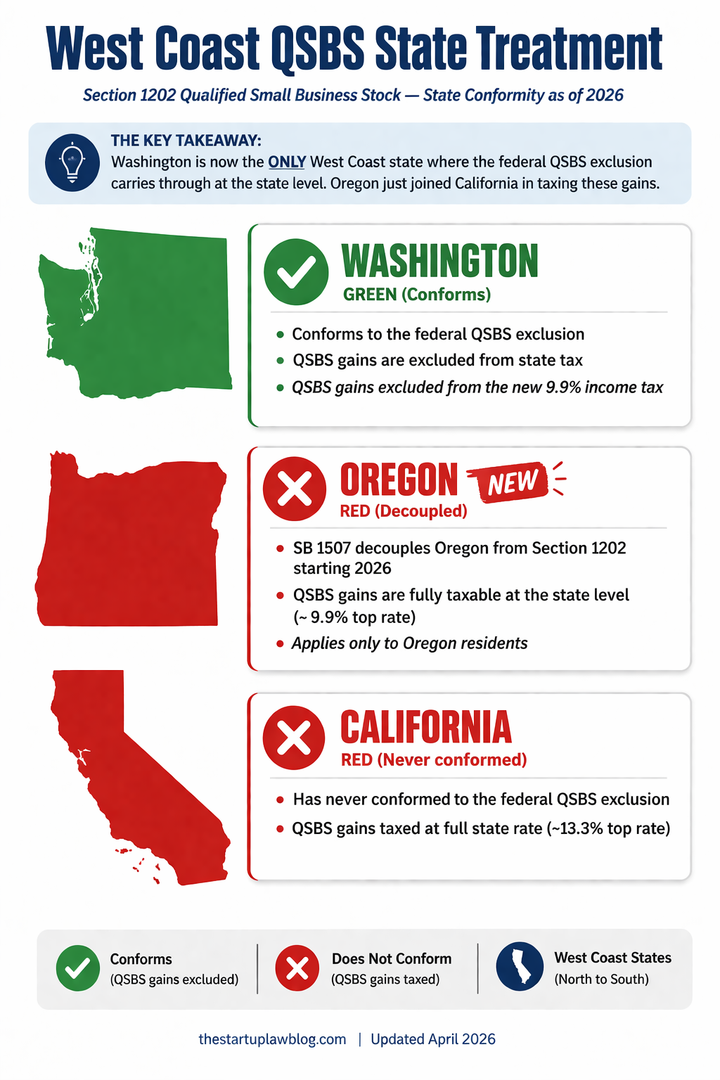
Oregon's move puts the entire West Coast in an unfavorable position for QSBS holders:
- Washington — Conforms to the federal QSBS exclusion (QSBS gains are not subject to the new 9.9% income tax)
- Oregon — Decoupled starting 2026 (full state tax on excluded gains)
- California — Does not currently conform to Section 1202 (QSBS gains taxed at the state level)
Washington is now the only West Coast state where the federal QSBS exclusion carries through to the state level.
For selected jurisdictions and recent changes, see our QSBS State Conformity Guide.
Status of the Bill
SB 1507 originated in the Senate, which passed it in mid-February 2026; the House followed on February 25, 2026 on a 34–21 party-line vote. Governor Kotek signed the bill into law on April 9, 2026. In the signing letter, the Governor named the QSBS exemption specifically and committed to working with her Prosperity Council to propose legislation addressing it in the 2027 session.
A referendum campaign led by Rep. Ed Diehl (R-Scio) sought to refer SB 1507 to the voters but failed. Notably, the referendum specifically targeted the auto-loan interest and bonus depreciation provisions — not the QSBS add-back — so even a successful referendum would not have restored the Section 1202 exclusion. Petitioners had 90 days from the adjournment of the legislative session to gather the roughly 78,000 signatures required, and organizers conceded in early June 2026 that they would not meet the June 4 deadline. Rep. Diehl had previously led a successful referendum against a 2025 transportation tax package, but this effort fell short. SB 1507 remains enacted. Governor Kotek has committed to pursue corrective QSBS legislation in the 2027 session.
The provisions apply retroactively to tax years beginning on or after January 1, 2026.
- Tax years beginning January 1, 2026 or later — QSBS add-back applies
- February 25, 2026 — SB 1507 passed the Oregon House 34–21
- April 9, 2026 — Governor Kotek signed SB 1507 into law
- April 2026 — Republican-led referendum campaign launched (failed to qualify by the June 4, 2026 deadline; SB 1507 stands)
For tax years beginning on or after January 1, 2026, Oregon adds federally excluded §1202 gain back to taxable income. The taxpayer’s residence, sourcing, and recognition facts determine the resulting Oregon tax.
Planning Considerations
For founders, investors, and advisors:
- Exit planning is now state-sensitive. Residency at the time of sale matters more than ever. Oregon residents approaching a liquidity event should evaluate whether a domicile change before the sale would be appropriate.
- QSBS no longer guarantees state-level tax efficiency. Federal exclusion ≠ state exclusion. This is now true across the entire West Coast except Washington.
- Compare destination-state rules. Washington excludes federally excluded §1202 gain from its capital-gains tax base; Texas and Florida have no individual income tax. Evaluate the full tax and residency consequences of any move.
- Timing decisions may shift. Oregon residents who sold in a tax year beginning on or after January 1, 2026 — for a calendar-year taxpayer, any 2026 sale — may already be affected.
- Coordinate with multi-state tax advisors. Model the federal vs. state divergence before any significant transaction.
Frequently Asked Questions
Does SB 1507 affect QSBS sales that already closed in early 2026?
Yes. The provisions apply retroactively to tax years beginning on or after January 1, 2026. If you sold QSBS while an Oregon resident in a tax year beginning on or after January 1, 2026 — for a calendar-year taxpayer, any 2026 sale, even one that closed before the bill passed — you may owe Oregon state tax on gain that was excluded federally. Consult a tax advisor to understand your specific exposure.
What if I move out of Oregon before the QSBS sale closes?
A genuine move before gain recognition can change the result for personally held investment stock, but a new domicile alone does not guarantee exemption. Oregon statutory residency and Oregon-source income must also be tested. Intangible property employed in an Oregon business can remain taxable to a nonresident under ORS 316.127 and OAR 150-316-0171. Review the transaction and recognition timing before relying on relocation.
Does this apply to all QSBS, or only stock issued after a certain date?
The add-back covers federally excluded §1202 gain under both older and newer stock rules. It applies to tax years beginning on or after January 1, 2026. Oregon residence and sourcing rules determine the taxpayer’s Oregon exposure; stock issuance date does not itself create an exemption from the add-back.
What states still conform to the federal QSBS exclusion?
Washington’s capital-gains tax does not reach federally excluded §1202 gain. Texas and Florida impose no individual income tax, so there is no individual income-tax exclusion to claim there. California and Oregon tax federally excluded gain under their own rules. Our QSBS state conformity guide currently covers selected jurisdictions and recent changes.
Bottom Line
Oregon SB 1507 materially changes the value of QSBS for state tax purposes.
Need a letter, not just a checklist?
If you need to prepare a QSBS attestation letter drafted and signed by counsel — covering the gross-assets test, active-business analysis, redemption history, and OBBBA tranche bifurcation — we offer flat-fee engagements after a short intake call.
QSBS remains powerful federally — but state-level outcomes are increasingly fragmented. For anyone planning a significant exit, ignoring state tax treatment is no longer viable.
For selected jurisdictions and recent changes, see our QSBS State Conformity Guide.
For Washington-specific tax planning, see our Washington State Taxes hub and the Complete Guide to QSBS & Section 1202.
Have questions about how SB 1507 affects your specific situation? Book a call to discuss your QSBS planning needs.
Related Posts
- QSBS Stacking: How to Multiply the $15M Exclusion with Trusts and Family Gifts
- Washington's 9.9% Income Tax: What High Earners Must Do Before 2028
- Stock Option Exercise Timing: Planning Before Washington's 2028 Income Tax
- Washington vs. California: A Tax Comparison for Founders and Investors
- Section 1045 Rollovers: How to Defer QSBS Gains When You Sell Too Early
- The Complete Guide to QSBS and Section 1202
Related Reading
For a comprehensive comparison of state taxes across 11 states — including income tax, capital gains, QSBS conformity, and estate tax — see our State Tax Comparison for Startup Founders.