
Washington already had one of the most aggressive estate tax regimes in the country: a ~$3 million exemption ($3,076,000 for deaths through June 30, 2026, then $3 million under SB 6347 — effectively frozen, because the bill ties future indexing to the discontinued Seattle–Tacoma–Bremerton CPI, the same defunct reference that froze the old $2,193,000 exemption after 2018), graduated rates from 10% to 20% (the top rate, briefly 35% under SB 5813, was rolled back to 20% by SB 6347 effective July 1, 2026), and no portability between spouses. ESSB 6346 adds a 9.9% income tax on top of that. The result is a double-tax problem that changes the estate planning calculus for every high-net-worth Washington resident.
Before January 1, 2028, review how the new income tax affects your estate plan. GRATs, gifting, ILITs and Roth conversions each require their own analysis; accelerating a transaction is useful only when its projected benefits outweigh its costs.
(For an overview of ESSB 6346, see Washington’s New Income Tax: What Founders, Investors, Athletes, and High Earners Need to Know. For the full tax landscape, see Washington State Taxes.)
This post is part of our Complete Guide to Washington's New Income Tax.
The Double Tax Problem
Washington imposes separate taxes on income and transfers at death. ESSB 6346 imposes a 9.9% income tax beginning January 1, 2028, after the applicable deduction and other adjustments; it does not provide a general credit for Washington estate tax. But saying there is no coordination at all is too broad. Qualifying unpaid taxes on the decedent’s pre-death income can reduce the taxable estate under IRC §2053 and Treas. Reg. §20.2053-6(f). Taxes on income received after death are not deductible under that rule. Washington begins its estate-tax calculation with the federal taxable estate, subject to its own statutory modifications and fixed federal-law reference in RCW 83.100.020. Income taxes already paid during life reduce the assets remaining in the estate; they are not deducted again.
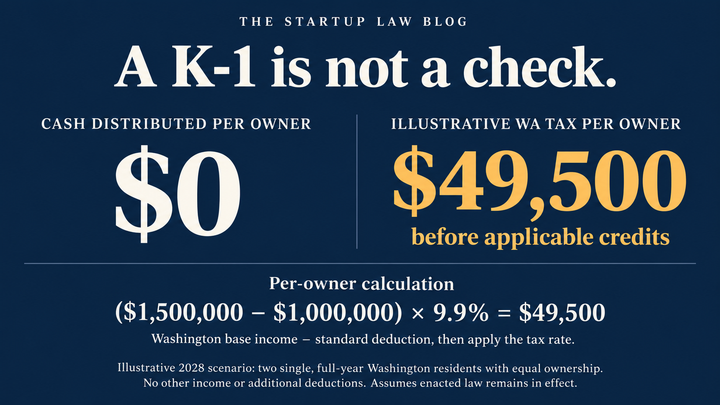
Consider a full-year Washington resident with $1.5 million of Washington base income in 2028. Assuming the full $1 million standard deduction, no other deductions and no credits, Washington income tax would be $49,500. Separately, a $20 million gross estate, all attributable to Washington, would produce $17 million of Washington taxable estate after the $3 million exclusion if there were no other deductions or adjustments. Under the rate schedule effective July 1, 2026, the estate tax would be $3.09 million. This is an illustration using current estate-tax rules, not a projection of future asset values or law. Qualifying debts, including unpaid pre-death income taxes, can reduce that estate-tax base. At the federal level, IRC §691(c) also provides an income-tax deduction for federal estate tax attributable to income in respect of a decedent; that is not a general credit for Washington estate tax.
Review estate inclusion and annual income taxation together. A strategy can reduce one tax while leaving the other unchanged, so compare the combined result before transferring assets or accelerating income.
GRATs: Removing Appreciation from the Estate
A Grantor Retained Annuity Trust (GRAT) can transfer investment returns above the actuarial hurdle to beneficiaries while paying you a specified annuity. The initial taxable gift is the contributed value less the actuarial value of the qualified retained annuity under IRC §2702 and §7520. A properly structured GRAT can make that initial gift very small. The remaining assets may escape your estate if you survive the term and retain no interest causing estate inclusion; death during the term can bring some or all of the trust back into the gross estate under Treas. Reg. §20.2036-1(c)(2).
A GRAT commonly is structured as a grantor trust, with its taxable income attributable to the grantor. Starting before 2028 does not make its income subject only to federal tax: Washington’s existing capital-gains tax can already apply to taxable gains. Unrealized appreciation is not itself taxable income. From 2028, the new income tax depends on the grantor’s Washington tax base, deductions and credits, including the capital-gains-tax credit. A two-year GRAT funded during 2026 generally runs into 2028; funding in 2026 does not confine its term to tax years 2026–2027.
Illustration, not a quoted IRS rate: Assume $5 million is contributed to a two-year GRAT, a hypothetical 5% §7520 rate, equal annuities paid at each year-end, 15% annual investment returns before those payments, and no fees or tax payments from the trust. An annual annuity of approximately $2,689,024 has a two-year present value of $5 million at 5%. After the first payment the trust holds approximately $3,060,976; after the second, approximately $831,098 remains for beneficiaries. This simplified near-zero-gift illustration assumes a qualified fixed-term annuity and survival of the term. Use the actual funding-month rate, payment schedule and trust terms; a different structure produces a different remainder.
The GRAT’s potential benefit is shifting investment performance above the actuarial hurdle, subject to survival and proper administration. A pre-2028 start can affect when taxable income arises, but it does not guarantee exemption from Washington tax or remove income earned after 2028 from the grantor’s return. Model realized income and gains separately from asset appreciation and annuity payments.
Accelerated Gifting
A completed gift can remove property and future appreciation from your estate if you retain no interest or power causing estate inclusion. Income-tax ownership is a separate question: under the grantor-trust rules, you may still report income from assets you have given to an irrevocable trust. An outright gift may shift future income to the recipient, but it does not necessarily eliminate the family’s Washington tax.
The 2026 federal basic gift-and-estate exclusion is $15 million per person, with potential combined use of $30 million by spouses subject to prior gifts and applicable rules. The 2025 legislation removed the scheduled sunset and provides inflation adjustments from 2027; it did not make estate planning irrelevant or prohibit future legislative changes. Washington has no gift tax, but lifetime transfers still matter to its estate tax when included in the federal gross estate. Evaluate estate inclusion and income-tax attribution separately before making a large gift.
Annual exclusion gifts. For 2026, the annual exclusion is $19,000 per donor per recipient for qualifying present-interest gifts. Spouses can potentially give $38,000 together; a gift-splitting election may require gift-tax returns. Future-interest gifts do not qualify merely because their value is below the dollar limit. Aggregate each donor’s gifts to the recipient during the year, including qualifying trust contributions.
Lifetime exclusion gifts. A taxable gift above the annual exclusion generally uses available federal lifetime exclusion and can require Form 709 even when no gift tax is payable. Removing property from the estate does not itself shift income from a grantor trust to its beneficiaries. An outright recipient may owe tax on later income, and gifted property generally carries the donor’s basis for gain under IRC §1015. Compare estate-tax savings with future income taxes, retained rights and the donor’s financial needs.
Irrevocable Life Insurance Trusts (ILITs)
A properly structured and administered ILIT can hold insurance outside the insured’s gross estate. That result depends on ownership and retained powers under IRC §2042; transferring an existing policy can trigger the three-year inclusion rule. Death benefits generally receive an income-tax exclusion under IRC §101, subject to exceptions. The trust’s name alone guarantees neither exclusion. Its terms can permit properly structured loans to, or asset purchases from, the estate to provide liquidity.
With Washington’s estate tax rates reaching 20% on large estates, the liquidity need is substantial. Under the assumptions in the earlier $20 million example, Washington estate tax would be $3.09 million. Actual liability depends on available deductions, adjustments, and the portion attributable to Washington. If the estate consists primarily of illiquid assets (a business, real estate, startup equity), the ILIT provides cash to pay the tax without forcing a fire sale.
Premium contributions to an ILIT qualify for the annual gift-tax exclusion only if the beneficiaries receive qualifying present interests under IRC §2503(b). Crummey withdrawal rights require genuine, enforceable withdrawal opportunities and proper administration; simply naming beneficiaries is insufficient. Other gifts to each beneficiary use the same annual limit. Funding before 2028 does not create an income-tax deduction for premiums or exempt later earnings used to fund them. Choose funding based on coverage needs, policy performance and gift-tax rules, not a supposed 2028 expiration of ILIT benefits.
Roth Conversions and Estate Planning
A traditional-to-Roth IRA conversion generally includes the otherwise taxable amount in federal income; after-tax IRA basis can make part nontaxable. The conversion is not automatically taxable in its entirety. Roth distributions are income-tax-free when qualified under IRC §408A. For inherited Roth IRAs, death satisfies one qualifying condition, but the owner’s five-tax-year requirement still matters. Earnings in a nonqualified distribution may be taxable.
The pre-2028 comparison: A taxable conversion completed before January 1, 2028 precedes Washington’s new income tax. For a simple 2028 illustration, assume a full-year Washington resident converts $2 million of entirely pretax IRA assets, has no other Washington base income, receives the full $1 million standard deduction and has no other deductions or credits. Washington tax would be $99,000 under ESSB 6346. That is not every taxpayer’s savings: other income, basis, residency, deductions and credits change the result. Compare the additional federal tax from accelerating income, liquidity and expected future withdrawal rates before converting.
The estate-planning angle: A Roth conversion does not remove the retirement account from the gross estate. Qualified inherited Roth distributions are excluded from federal income and ordinarily from Washington’s AGI-based income tax. Heirs still face beneficiary distribution requirements; many nonspouse designated beneficiaries must empty the account by the end of the tenth year after death, while spouse and other eligible-beneficiary rules differ. Check IRS Publication 590-B for the applicable category and the treatment of nonqualified withdrawals. Paying conversion tax reduces other assets, which belongs in the estate and income-tax comparison.
For a detailed analysis of Roth conversions and Washington’s tax, see Is Retirement Income Subject to Washington’s 9.9% Tax?.
The No-Portability Problem
Federal portability requires an election; unused exclusion does not pass automatically. The 2026 basic exclusion is $15 million per person, so a couple may potentially use $30 million in total, subject to prior taxable gifts, available deceased-spousal unused exclusion and the applicable rules. To preserve unused exclusion, the deceased spouse’s executor generally must file a timely and complete Form 706 electing portability, even when no return otherwise would be required. Relief may be available for certain late elections. See IRS estate-tax guidance and IRC §2010(c). Asset ownership and the estate plan still matter.
Washington does not provide portability of its estate-tax exclusion. The exclusion applicable at each spouse’s death must be used through that spouse’s estate; an unused amount cannot simply be added to the survivor’s exclusion. A $4 million gross estate does not necessarily pay tax on $1 million: the result also depends on deductions, including a qualifying marital deduction. With the $3 million exclusion and no other deductions or adjustments, a wholly Washington $4 million estate would leave $1 million taxable.
A bypass or credit-shelter trust is one way to use the first spouse’s Washington exclusion while providing for the survivor. It must be properly funded and drafted so its assets are not included in the survivor’s estate. It is not mandatory for every couple: direct transfers to other beneficiaries and other arrangements may also use the exclusion. Compare estate-tax savings with access to assets, trust administration and income-tax basis consequences before choosing the structure.
For illustration, assume a married couple owns $8 million equally, both deaths occur under the $3 million exclusion and July 1, 2026 rate schedule, all assets are attributable to Washington, the surviving spouse is a U.S. citizen, and there is no growth, spending or other deduction. If the first spouse’s $4 million passes outright to the survivor and qualifies for the marital deduction, no Washington estate tax is due at the first death. The survivor’s $8 million estate then yields $5 million taxable and $730,000 of tax. If $3 million instead funds a qualifying bypass trust and $1 million passes to the survivor, the survivor later owns $5 million, leaving $2 million taxable and $240,000 of tax: $490,000 less under these assumptions. See marital-deduction requirements and the enacted Washington rate schedule.
Community Property Considerations
Washington is a community-property state, but acquisition during marriage does not make every asset community property. Premarital property and property acquired by gift or inheritance generally remain separate under RCW 26.16.010. Classification depends on the source of funds, applicable law and any effective agreements; title alone is not conclusive. Confirm the property’s actual character before relying on the community-property basis rule.
Under IRC §1014(b)(6), the surviving spouse’s half of qualifying community property receives a basis adjustment if at least half of the entire community interest is includible in the deceased spouse’s federal gross estate. Together with the adjustment to the deceased spouse’s share, this generally resets both halves to fair market value at death, subject to applicable valuation rules and exceptions. It can be a step-down when value has fallen. Income in respect of a decedent is excluded by §1014(c). For qualifying community stock worth $10 million with $2 million of prior basis, assuming date-of-death valuation and no exception, the total basis becomes $10 million. See IRS Publication 555.
The basis adjustment can eliminate gain attributable to appreciation before death; it does not exempt all future appreciation from capital gains tax. If qualifying stock has a $10 million adjusted basis and is later sold for net proceeds of $11 million, the gain is $1 million. A sale for net proceeds equal to adjusted basis produces no gain, assuming no intervening basis adjustments. IRC §1001 measures gain against adjusted basis. Any resulting Washington tax depends on the applicable tax base, exclusions, deductions, allocation and credits.
The Federal Exemption: Now Permanent
The Tax Cuts and Jobs Act doubled the federal estate tax exemption (it reached $13.99 million per person in 2025), and that doubling had been scheduled to sunset after 2025, cutting the exemption back to roughly $7 million. The One Big Beautiful Bill Act, signed July 4, 2025, repealed that sunset and set the exemption permanently at $15 million per person ($30 million per couple) for 2026, indexed for inflation from 2027.
A $10 million estate may be below the 2026 federal basic exclusion, but prior taxable gifts and the rest of the federal estate-tax calculation still matter. The exclusion is shared across lifetime taxable gifts and the estate; it is not a fresh $15 million allowance at death. Washington’s much smaller estate exclusion and its income tax beginning in 2028 require separate analysis.
The scheduled federal sunset was removed, but neither gifting nor its potential estate-tax benefits expire in 2028. A later completed gift can still remove assets and subsequent appreciation from the estate if the applicable requirements are met. Earlier action may shift more future appreciation; income-tax savings depend on who is treated as owning the income and on the recipient’s tax position. The January 1, 2028 income-tax start date is a planning consideration, not a universal deadline for effective estate planning.
The Bottom Line
Washington’s income tax makes 2026–2027 a useful period to review the estate plan. It does not make every GRAT, gift, ILIT premium or Roth conversion more valuable merely because it is completed before 2028. Compare each strategy’s tax treatment, cash needs, beneficiary consequences and timing under the family’s actual facts.
The potential tax cost is substantial, but a lifetime total cannot be inferred from a $20 million estate alone. It depends on income, deductions, credits, asset growth, distributions and the timing of death. Use a coordinated projection before making irreversible transfers or accelerating taxable income.
Need to re-evaluate your estate plan in light of Washington’s income tax? Book a 20-minute intro call to discuss your situation. Also see: Washington State Taxes Guide | Income Tax Planning Guide for High Earners
Related Posts
- Washington vs. California: A Tax Comparison for Founders and Investors
- Is Retirement Income Subject to Washington's 9.9% Income Tax? (Social Security, Pensions, 401(k), IRAs)
- Stock Option Exercise Timing: Planning Before Washington's 2028 Income Tax
- QSBS Stacking: How to Multiply the $15M Exclusion with Trusts and Family Gifts
- How to Change Your Washington Domicile to Avoid the Income Tax
- Washington's New Income Tax: The Complete Guide
This post is for educational purposes only and is not legal or tax advice. Consult a qualified attorney about your specific situation.