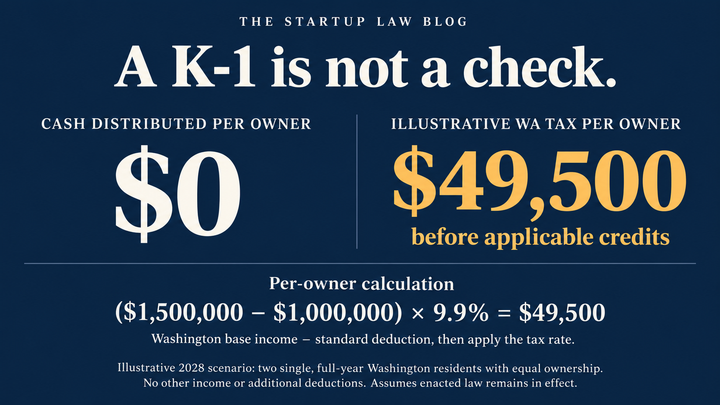

For Washington founders approaching a sale, the planning window through December 31, 2027, before ESSB 6346 takes effect offers time to coordinate stock qualification, sale timing, and any planned move. The reason: three separate taxing systems — federal income tax, Washington's existing capital gains tax (7%, rising to 9.9% on gains above $1 million), and the new 9.9% income tax — interact around a single event (the sale), and each one is sensitive to different planning variables.
This post walks through the interaction, with a focus on QSBS-qualifying stock. We cover the four levers that matter, the common sequencing mistakes, and the specific cases where a domicile change dramatically changes the math.
The taxes and QSBS exclusion on a founder's sale
When a Washington-resident founder sells long-held C-corp stock in 2028, three taxes and one exclusion need to be considered:
- Federal capital gains tax (0%, 15%, or 20%, plus 3.8% NIIT) — applies unless excluded under §1202.
- Federal §1202 QSBS exclusion — can exclude some or all eligible gain, subject to the acquisition-date rules, holding period, and per-issuer limit explained below. The exclusion reduces tax; it is not a separate tax.
- Washington capital gains tax (9.9% on gains above $1M, 7% beneath, after a ~$278K standard deduction) — applies to long-term capital gain in excess of a standard deduction (~$278K for 2025, indexed), with some federal conformity for §1202.
- Washington income tax (9.9%) — applies to Washington taxable income — federal AGI with Washington modifications — above a $1 million standard deduction (one per individual; spouses and registered domestic partners share one) starting 1/1/2028.
The QSBS exclusion reduces the gain exposed to these taxes. RCW 82A.04.130 provides a nonrefundable credit for Washington capital gains tax imposed for the same year, limited to the income tax otherwise due. Calculate the combined Washington liability rather than adding the headline rates.
§1202: acquisition dates, holding periods, and limits
Section 1202 of the Internal Revenue Code excludes federal capital gains tax on qualified small business stock. The exclusion percentage and the dollar cap both turn on the stock’s acquisition date, determined after applicable holding-period tacking under §1202(a)(6)(B); the gross-assets ceiling separately turns on the issuance date.
For stock acquired on or before July 4, 2025, a holding period of more than five years is required. The general exclusion percentage is 50% for stock acquired on or before February 17, 2009, 75% for stock acquired from February 18, 2009 through September 27, 2010, and 100% for stock acquired from September 28, 2010 through July 4, 2025. Special empowerment-zone rules can affect some older stock. The eligible-gain limit is generally the greater of the remaining $10 million per-issuer dollar limit or 10 times the adjusted basis of qualifying shares sold that year. A sale before the required holding period produces no §1202 exclusion.
For stock acquired after July 4, 2025, the One Big Beautiful Bill Act replaced the binary rule with a tiered one — 50% at three years, 75% at four, and 100% at five years or more — and raised the cap to the greater of $15 million (indexed beginning in 2027) or 10 times basis.
Under both regimes the stock must have been acquired at original issuance from a domestic C corporation whose aggregate gross assets did not exceed $75 million ($50 million for stock issued on or before July 4, 2025) at the time of issuance, with the corporation conducting a qualified trade or business (excluding certain industries — financial services, farming, personal services, hospitality, mining, and a few others).
The tiers are less generous than the headline percentages suggest. Within the applicable eligible-gain limit, the taxable portion under the 50% or 75% exclusion tier is “section 1202 gain,” taxed at a maximum federal rate of 28% under §1(h)(4)(A)(ii) rather than 20%, plus the 3.8% net investment income tax. A three-year exit on post-OBBBA stock excludes half the gain and pays roughly 31.8% on the other half — better than nothing, but well short of the zero rate the five-year hold buys. The one piece of good news: OBBBA amended §57(a)(7) so the partial tiers carry no AMT preference, unlike the pre-2010 50% and 75% stock they resemble.
Washington’s answer comes from two statutes, not from the federal AGI mechanics alone. RCW 82.87.020(1) measures the capital gains tax starting from federal net long-term capital gain, and gain that §1202 excludes is never in that figure. RCW 82A.04.210, the base-income provision for capital gains enacted by ESSB 6346, removes federal long-term capital gains and reverses federal long-term capital losses. When Washington capital gains tax is owed, the income-tax calculation adds back taxable Washington capital gains plus the capital-gains standard deduction claimed. Exempt long-term gains remain excluded; the separate income-tax deduction and credits then apply. Gain actually excluded under federal Section 1202 stays outside both Washington tax bases.
The federally excluded portion stays outside both Washington tax bases even when the exclusion is partial. The remaining taxable long-term gain may enter the Washington computations, subject to allocation, deductions, and credits. This includes gain left taxable by a partial exclusion and gain above the per-issuer limit.
Treat that as current law rather than a permanent feature. In the 2026 session, SB 6229 and companion HB 2292 would have amended RCW 82.87.020 to add federally excluded §1202 gain back into the Washington computation. Neither was enacted. The Washington result survives because the legislature declined to change it, and a future session can take the question up again.
The four planning levers
1. Qualify the stock for §1202 to begin with
Many founders assume their stock is QSBS when it is not. Common disqualifiers include S-corp origination, stock received in a §351 exchange from an S-corp, stock acquired after the issuing corporation passed the $75M gross-asset test, or acquisition at secondary sale rather than original issuance.
An S-corp origination or a §351 exchange from an S corporation can disqualify the stock received, but an S corporation may in some cases hold newly issued QSBS of a C-corporation subsidiary; see Can an S Corporation Get QSBS? The C-Corporation Subsidiary Strategy for the separate future-appreciation analysis.
This is a federal question, not a Washington question, but it is the first and most important filter. Stock that qualifies passes most of the rest of the analysis automatically. Stock that doesn't qualify has to run the full non-QSBS gauntlet below.
Related → See what your QSBS attestation letter must show before the sale closes — particularly if your move date and your sale date are in different tax years.
2. Satisfy the holding period
The holding period runs from the stock’s acquisition date, determined after applicable holding-period tacking, not from employment start. For restricted stock subject to §83, that date is generally just after the stock substantially vests, unless a timely §83(b) election starts it just after transfer — Treas. Reg. §1.83-4(a). Stock acquired on or before July 4, 2025 requires more than five years of holding; its acquisition date also determines whether the applicable exclusion is 50%, 75%, or 100%. Stock acquired after July 4, 2025 qualifies for 50% at three years, 75% at four years, and 100% at five years or more. A founder reaching the five-year mark in 2028 therefore has legacy stock and must satisfy the more-than-five-year requirement. Later-acquired stock cannot reach the new five-year full-exclusion tier until after July 4, 2030. In every case, calculate the sale date for each tranche and confirm the remaining per-issuer limit before promising a fully excluded exit.
The other route is a §1045 rollover. A founder who has held QSBS more than six months and reinvests the proceeds in replacement QSBS within 60 days defers the gain and tacks the holding period. For pre-OBBBA stock that is a rescue — without it, an early sale forfeits §1202 entirely. For qualifying post-OBBBA stock held at least three or four years, compare the available 50% or 75% exclusion and tax on the remaining gain with a rollover, accepting the reinvestment risk and the burden of qualifying the replacement stock. Before three years, those partial exclusions are unavailable. One trap either way — pre-OBBBA stock cannot be converted into the post-OBBBA tiers through a rollover or exchange; the acquisition-date rules follow §1223.
3. Time the sale relative to the Washington income tax effective date
Where §1202 excludes the gain in full — the applicable 100% acquisition-date regime and holding period are satisfied, and gain is within the available per-issuer limit ($10M for legacy acquisitions or $15M for acquisitions after July 4, 2025, subject to indexing, prior exclusions, and the alternative 10-times-basis test) — the Washington income tax does not apply regardless of when you sell, because excluded gain never enters federal AGI. But for:
- Non-QSBS gain.
- QSBS gain in excess of the §1202 cap.
- The non-excluded 50% or 25% on post-July 4, 2025 stock sold at three or four years.
- Ordinary compensation income (phantom gain from ISO disqualifying dispositions, RSU vesting, etc.).
... the recognition year matters, but the savings differ by income category. Ordinary compensation recognized before 2028 may avoid the new Washington income tax. Taxable long-term stock gains may already bear Washington capital-gains tax in 2026 or 2027; from 2028, calculate the income tax and its capital-gains credit together. Moving a stock sale before 2028 does not automatically save another 9.9%.
For a proposed secondary sale, compare total Washington liability under both closing dates, including deductions, other income, and available credits. Consider any lost QSBS benefits before accelerating a sale.
4. Change domicile before the sale
The most powerful lever, and the most complex. Illustrative 2028 figures for a full-year Washington resident who closes a $50M sale of personally held stock with $10M excluded under §1202 and $40M of Washington-allocated taxable long-term gain, and — for the pure-gain illustration — no other Washington base income and only the capital-gains credit. The capital-gains standard deduction is frozen at the published 2025 amount of $278,000 for illustration, not the actual 2028 deduction:
- $0 federal on the first $10M of QSBS gain (pre-OBBBA stock — the $15M post-OBBBA cap cannot pair with a full five-year hold until after July 4, 2030); 20% + 3.8% on the remaining $40M of non-QSBS gain.
- Washington capital-gains tax of about $3.9M under RCW 82.87.040: 7% × ($1,000,000 − $278,000) + 9.9% × ($40,000,000 − $1,000,000) = $50,540 + $3,861,000 = $3,911,540.
- Under those assumptions, income tax before the capital-gains credit is about $3.86M (9.9% × ($40M − $1M) after the income-tax standard deduction), which is less than the capital-gains tax, so income tax after the credit is $0 and combined Washington liability is about $3.9M (the capital-gains tax). That $0 additional income tax is assumption-dependent: when other income makes pre-credit income tax larger than capital-gains tax, additional income tax remains. Ignoring other credits, combined liability equals the greater of the two tax liabilities, not the greater of the two headline rates. The income-tax addback and capital-gains credit are in RCW 82A.04.210 and RCW 82A.04.130 (ESSB 6346 §§302 and 205). For the mechanics, see Washington capital gains tax vs. income tax.
The same founder who completes a legitimate domicile change to Texas before the stock sale generally takes that personally held stock gain outside Washington’s capital-gains allocation. Whether Washington income tax remains due requires a separate review of resident status and Washington-source income; a move does not erase compensation for Washington work.
On a $50M sale with $40M of non-QSBS gain, the Washington tax savings from a successful domicile change approach $3.9 million. That is the magnitude of planning at stake.
For the mechanics of the move, see How to Leave Washington and the Domicile Planning Checklist.
The "when did you change?" problem
Washington capital-gains tax uses domicile when a sale of stock occurs to allocate the gain under RCW 82.87.100(1)(b). The year the gain is recognized determines when it is reported; it does not replace the sale-date domicile test. Analyze each transaction separately:
- Stock sale for cash: determine when the sale occurs under the agreement and closing conditions; a cash sale is generally completed at closing. Use domicile on that sale date for Washington capital-gains allocation.
- Stock sale for acquirer stock (§368 reorg): a qualifying reorganization may defer gain on the stock consideration, while cash boot may trigger current gain. A later sale of the replacement shares is a separate transaction. Analyze each sale or exchange and its allocation date.
- Installment sale: eligible gain is generally reported as payments are received, but allocation of the original stock-sale gain still uses domicile when that sale occurred. A later move does not reallocate that gain. Taxpayers can elect out of installment reporting under §453(d).
- Earnouts: the agreement determines whether a payment is additional sale proceeds or compensation and how it is reported. Do not assume the payment date determines domicile allocation for the original stock sale.
- Escrow holdbacks: recognition depends on the escrow terms, the seller’s rights, and applicable tax rules. Release of cash is not automatically the sale date or a new domicile-allocation date.
A founder who actually changes domicile to Texas before a September 1, 2028 stock sale generally has an out-of-state allocation for that sale under Washington’s capital-gains tax. Moving on September 15 would be too late to change the allocation of the September 1 sale, even if installment payments arrive later. For the 2028 income tax, separately examine resident status, Washington-source income, modifications, and credits.
The recommended sequencing
For a Washington founder with a plausible 2028+ exit on the horizon:
Need a letter, not just a checklist?
If you need a QSBS attestation letter for your sale or transfer drafted and signed by counsel — covering the gross-assets test, active-business analysis, redemption history, and OBBBA tranche bifurcation — we offer flat-fee engagements after a short intake call.
- 2026 Q4: Confirm §1202 qualification for all tranches of founder stock. If anything is broken, fix it now while there is time.
- 2027 H1: If domicile change is feasible, make the move. Establish and document your new domicile before the sale. Six months is not a statutory safe harbor; the actual facts control.
- 2027 H2: Evaluate whether ordinary compensation can appropriately be recognized before 2028. For secondary sales and other long-term gains, compare total Washington tax after the capital-gains credit and consider any lost QSBS benefits.
- 2028+: Close the primary transaction. Document the residency story contemporaneously. Retain records supporting domicile and income sourcing in case of an audit.
For founders who cannot relocate, the sequencing shifts heavily toward QSBS maximization (including stacking into multiple trusts — see QSBS Stacking Using Trusts) and selective pre-2028 recognition of ordinary income where appropriate, with a separate combined-tax analysis for non-excluded long-term gains.
Takeaways
- For §1202 gain that is excluded in full — applicable 100% exclusion regime and holding period satisfied, within the available per-issuer cap — neither Washington capital gains tax nor ESSB 6346 applies. A partial exclusion flows through only partially: the non-excluded 50% or 25% sits in both Washington bases.
- For non-QSBS gain and for QSBS gain above the cap, the Washington capital gains tax and income tax both reach the gain. The income-tax addback (RCW 82A.04.210) and nonrefundable capital-gains credit (RCW 82A.04.130) coordinate the two regimes. Ignoring other credits, combined Washington liability equals the greater of the capital-gains tax and income tax calculated before that credit — not the sum of the two headline rates, and not an automatic ~9.9% with $0 additional income tax in every case.
- For personally held stock, a domicile change completed before the sale can take the gain outside Washington’s capital gains tax: under RCW 82.87.100(1)(b), gain on intangible property is allocated to Washington on the basis of domicile at the time of the sale. That is narrower than eliminating every Washington layer.
- The planning window closes every day. Move the domicile change to the front of 2027 if it is happening.
For a stock sale, RCW 82.87.100(1)(b) allocates intangible gain by domicile at the time of sale for the capital-gains tax; any QSBS exclusion is a separate qualification issue. Resident status does not control every other tax result: ESSB 6346 §401 can allocate Washington-source income to nonresidents as well. The full-year 30-day safe harbor concerns resident status for a domiciliary and does not itself change domicile. See Washington's 30-day rule for tax residency: what it actually means (ESSB 6346) for its three conditions and documentation requirements.
Full context: ESSB 6346 Complete Guide. Movement playbook: How to Leave Washington.
Last reviewed: September 20, 2026. Nothing in this article is legal or tax advice. §1202 planning is fact-specific and mistakes are often irreversible — consult qualified tax counsel before acting.