
Here is a question I get asked constantly: "I'm looking at a $40 million exit. Can I really only exclude $15 million under Section 1202?"
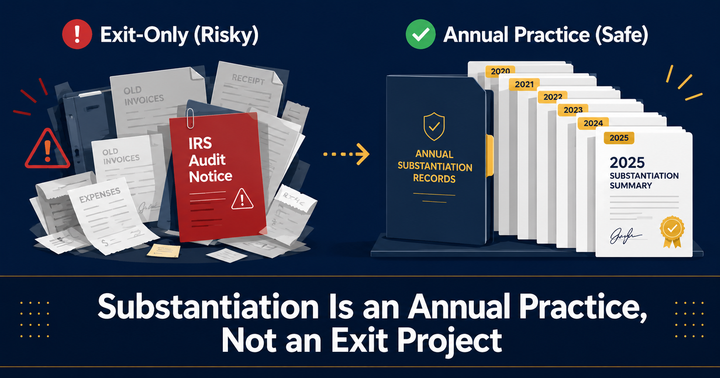
Related: Each non-grantor trust holding QSBS needs its own substantiation file. For what those files should actually contain, see QSBS attestation letter requirements.
In This Guide
- → The Basic Math: Why Stacking Works
- → Level 1: Spousal Stacking
- → Level 2: Gifting to Family Members
- → Level 3: Trust Stacking — The Advanced Play
- → QSBS and Trusts & Estates: A Detailed Guide
- → The Mechanics: Step by Step
- → Common Mistakes That Blow Up Stacking
- → Washington State Implications
- → Worked Example: The Chen Family
- → The Bottom Line
The answer is no — with proper planning, you may be able to exclude far more. In some cases, the entire gain.
The key is a strategy called QSBS stacking, and it is the single most powerful tax planning technique available to founders and early-stage investors approaching a significant exit.
This post is part of our Complete Guide to QSBS and Section 1202.
The Basic Math: Why Stacking Works
Under Section 1202 of the Internal Revenue Code, as enhanced by the One Big Beautiful Bill Act (OBBBA), a taxpayer can exclude the greater of $15 million or 10 times their adjusted basis in qualified small business stock per issuer.
The critical word in that sentence is taxpayer. The exclusion is per taxpayer per issuer — not per company, not per transaction. Every individual or qualifying entity that holds QSBS gets their own exclusion.
A married couple where both spouses hold QSBS? That is $30 million in exclusion. Add two adult children? $60 million. Add two non-grantor trusts? $90 million.
This is not a loophole. It is the plain text of the statute. But it requires advance planning, proper execution, and careful attention to the rules that can disqualify the strategy.
Level 1: Spousal Stacking
The simplest form of stacking involves both spouses holding QSBS directly. If each spouse owns qualifying stock, each gets their own $15 million exclusion — $30 million total.
There are two ways to achieve this:
From the start. When the company is formed, both spouses can be listed on the cap table as separate stockholders. Each spouse acquires stock at original issuance, satisfying the Section 1202 requirement.
Through gifting. One spouse gifts QSBS to the other. Under Section 1041, transfers between spouses are tax-free, and the recipient spouse takes the donor's basis and holding period. The recipient spouse then has their own $15 million exclusion.
A note on community property. Washington is a community property state. Whether community property QSBS automatically provides both spouses with separate exclusions is an unsettled question. The safest approach is to hold the stock as separate property — either through a prenuptial or postnuptial agreement, or by having each spouse on the cap table independently from the start. Do not assume community property treatment gives you automatic stacking; structure it deliberately.
Level 2: Gifting to Family Members
Every family member who receives QSBS before a sale gets their own $15 million exclusion. Adult children are the most common recipients.
How it works. You gift shares of QSBS to your adult children (or other family members). Under Section 1202(h)(2)(A), the recipient takes the donor's holding period and basis. The recipient then sells the stock and claims their own Section 1202 exclusion.
Gift tax considerations. For 2026, you can gift up to $19,000 per recipient per year ($38,000 if both spouses elect gift splitting) without using any of your lifetime exemption. For larger gifts, you use a portion of your lifetime gift and estate tax exemption, which is currently approximately $15 million per person under the OBBBA.
For a founder with stock worth $0.001 per share, gifting millions of shares triggers minimal gift tax because the gift is valued at the fair market value at the time of the gift — not the eventual sale price. This is why timing matters: gift the stock when it is worth little, and the gift tax cost is negligible.
The critical rule: gift before any sale is on the horizon. The IRS can recharacterize a gift-then-sale as an assignment of income if the gift appears to be a prearranged step in a single transaction. If you gift stock on Monday and the company announces an acquisition on Tuesday, the IRS will argue that you effectively sold the stock yourself and assigned the proceeds.
There is no bright-line rule for how far in advance gifts must be made. The further removed the gift is from any sale discussions, the safer it is. Gifts made years before an exit are virtually bulletproof. Gifts made after a letter of intent is signed are virtually indefensible.
Level 3: Trust Stacking — The Advanced Play
Trusts are where the real multiplication happens. A properly structured trust is a separate taxpayer for federal income tax purposes, entitled to its own $15 million QSBS exclusion.
Non-grantor trusts. These are the cleanest structures for QSBS stacking. A non-grantor trust is a separate taxpayer with its own tax ID number. The IRS has not challenged the position that non-grantor trusts receive their own Section 1202 exclusion. Each non-grantor trust you create and fund with QSBS gets a $15 million bucket.
Grantor trusts and IDGTs. Intentionally defective grantor trusts (IDGTs) are commonly used in estate planning. For income tax purposes, a grantor trust is disregarded — all income is reported on the grantor's personal return. The question is whether a grantor trust gets its own Section 1202 exclusion or whether it shares the grantor's.
This is an unsettled area. The IRS has not issued definitive guidance. Some practitioners take the position that grantor trusts are separate taxpayers for Section 1202 purposes; others disagree. If you want certainty, use non-grantor trusts for QSBS stacking.
How many trusts is too many? There is no statutory limit on the number of trusts that can hold QSBS. However, the IRS can challenge structures that lack economic substance. Each trust should have a genuine purpose beyond tax avoidance — different beneficiaries, different distribution standards, different trustees. Creating ten identical trusts with the same beneficiary solely to multiply the exclusion invites scrutiny.
A reasonable approach: create separate trusts for each child or family line, with distinct terms and independent trustees. Two to four trusts is common and defensible. Ten trusts for a single beneficiary is aggressive.
QSBS and Trusts & Estates: A Detailed Guide
Trust and estate planning is one of the most powerful — and most technical — dimensions of QSBS strategy. Done right, trusts can multiply the number of available exclusions within a family. Done wrong, they can destroy QSBS status entirely.
Grantor Trusts
A grantor trust is disregarded for income tax purposes — the grantor is treated as the owner of the trust's assets. This means QSBS held by a grantor trust is treated as held by the grantor, and the grantor claims the exclusion. Transferring QSBS to a grantor trust is generally safe and does not restart the holding period or trigger a disqualifying event.
For most founders, a revocable living trust is the simplest example: you remain the grantor, you control the trust, and if the trust sells the QSBS, you claim the Section 1202 exclusion on your personal return. Nothing changes from a tax perspective — but the shares avoid probate, which matters for succession planning.
The key risk with grantor trusts is toggling: if a grantor trust loses its grantor status during the holding period (for example, because the trust becomes irrevocable upon the grantor's death and the successor trustee is not treated as a grantor), the trust becomes a non-grantor trust. At that point, the analysis shifts — and timing matters.
Non-Grantor Trusts and Exclusion Multiplication
This is where it gets complicated — and where the planning opportunity is largest.
A non-grantor trust is a separate taxpayer. That means it gets its own Section 1202 exclusion — its own $10 million (pre-OBBBA stock) or $15 million (post-OBBBA stock) per-issuer cap. For a founder with a large position, this creates a meaningful planning opportunity: transfer shares to one or more non-grantor trusts, and each trust can potentially claim its own full exclusion on a future sale.
But the transfer must be structured correctly. The trust must acquire the stock at original issuance or through a qualifying transfer (generally a gift). And the critical question is whether the trust meets the "original issuance" requirement — Section 1202(h)(2)(A) provides that stock acquired by gift retains its QSBS character, and the transferee steps into the transferor's holding period.
Here is where founders most often stumble:
Timing of the transfer matters. If you transfer QSBS to a non-grantor trust by gift, the trust inherits your holding period and your QSBS status. But the trust must be a non-grantor trust at the time it claims the exclusion — not just at the time of transfer. If you transfer shares to a trust that is currently a grantor trust and it later converts to non-grantor status, the conversion itself should not destroy QSBS character, but the analysis is more complex and less well-settled.
Number of trusts and beneficiaries. Some practitioners use multiple non-grantor trusts — one for each child or family line — to create multiple exclusion "buckets." If a founder has $30 million of gain in post-OBBBA stock with a $15 million per-issuer cap, two non-grantor trusts (each holding transferred shares) could theoretically shelter up to $45 million in total: $15 million for the founder plus $15 million for each trust.
Gift tax implications are real. Transfers to non-grantor trusts are completed gifts. You will use lifetime gift tax exemption (currently $13.99 million per individual in 2025, but subject to potential reduction after 2025 under the OBBBA's extended sunset provisions). The gift is valued at fair market value at the time of transfer — so earlier transfers (when valuations are lower) preserve more exemption.
Practice note: The IRS has not issued detailed guidance on non-grantor trust exclusion multiplication, and the case law is thin. This is an area where the tax benefit is significant but the execution risk is real. Anyone pursuing this strategy needs coordinated advice from startup counsel, a tax advisor, and an estate planning attorney — ideally before the shares are transferred.
Gifting QSBS: Additional Considerations
Under Section 1202(h)(2)(A), the recipient of a gift of QSBS inherits the donor's holding period and basis, and the stock retains its QSBS character. Each donee — whether an individual or a qualifying trust — gets a separate per-issuer cap.
This means a founder who gifts QSBS to a spouse and two adult children has potentially created four separate exclusions on the same issuer's stock: the founder's, the spouse's, and each child's. For post-OBBBA stock, that is up to $60 million in excludable gain from a single company.
The practical constraints are gift tax (you are using exemption), valuation (you need a defensible FMV at the time of gift), and control (once gifted, the shares are gone). Founders also need to be careful about the timing of gifts relative to a known exit — gifting stock days before a closing can raise step-transaction and substance-over-form arguments.
Key point: Gifts of QSBS to minors via custodial accounts (UTMA/UGMA) can also create separate exclusions. The minor is a separate taxpayer. But consider the practical implications — once the minor reaches the age of majority, they control the account.
Estates and Inherited QSBS
QSBS that passes through an estate at death can retain its QSBS character. Under Section 1202(h)(2)(A), the heir inherits the decedent's holding period. But here is the critical distinction that catches people: the heir does not receive a stepped-up basis for Section 1202 purposes. The gain for exclusion purposes is still calculated from the decedent's original basis.
This creates a planning tension. For non-QSBS stock, death produces a stepped-up basis that eliminates unrealized gain entirely. For QSBS, the step-up applies for general income tax purposes, but the Section 1202 exclusion is still calculated based on the original issuance price — which is usually what you want anyway, because the exclusion is more valuable than the step-up for large gains.
The estate planning question then becomes: should the founder gift QSBS during life (to multiply exclusions across family members) or hold until death (to preserve the general basis step-up for any gain that exceeds the exclusion cap)?
There is no universal answer. For a founder whose total gain is well within the per-issuer cap, holding until death may be simpler — the heir gets the exclusion and there is nothing to multiply. For a founder whose gain far exceeds the cap, lifetime gifting to create additional exclusion buckets can shelter millions more in gain. The analysis depends on the size of the position, the number of potential donees, the gift tax exemption available, and the founder's own liquidity needs.
Planning tip: The decision to gift versus hold should be made well before any exit is imminent. Gifting while valuations are low preserves more gift tax exemption and reduces the risk of step-transaction arguments. If you are a founder sitting on QSBS with a five-year-plus holding period and no exit on the immediate horizon, this is the time to have the conversation with your estate planning attorney.
The Mechanics: Step by Step
Here is how a stacking strategy is typically implemented:
Step 1: Confirm QSBS qualification. Before gifting any stock, verify that it qualifies under Section 1202 — C corporation, gross assets under $75 million at issuance, active business requirement, original issuance to the donor. If the stock does not qualify as QSBS, stacking is irrelevant.
Step 2: Establish trusts and identify recipients. Create non-grantor trusts with independent trustees and distinct beneficiaries. Identify adult children or other family members who will receive stock.
Step 3: Gift QSBS well in advance of any sale. Transfer stock to each trust and family member. Obtain qualified appraisals for gift tax reporting. File gift tax returns (Form 709) as required.
Step 4: Wait. The gifts must be completed and genuine. Do not begin sale negotiations immediately after gifting. The longer the gap between gift and sale, the stronger your position.
Step 5: Each holder sells independently. When the company is eventually sold, each trust and family member sells their own stock and claims their own Section 1202 exclusion on their own tax return.
Common Mistakes That Blow Up Stacking
Gifting after a letter of intent. This is the number one mistake. Once a deal is being negotiated, it is too late to gift. The IRS will apply the step transaction doctrine and treat the entire sale as yours.
Prearranged transactions. Even without a formal LOI, if you gift stock while actively marketing the company for sale, the IRS can argue the gift and sale were prearranged steps. Keep gifting and deal-making in separate timelines.
Assignment of income. If you have already earned the right to the sale proceeds — through a binding agreement or constructive receipt — gifting the stock does not shift the income. The income is yours regardless of who holds the stock.
Trusts without substance. Trusts created solely for tax avoidance, with no independent trustee, no genuine beneficiaries, and no economic purpose, can be disregarded by the IRS. Each trust must stand on its own as a legitimate estate planning vehicle.
Inadequate documentation. Keep records of every gift: board consents, stock transfer forms, gift tax returns, appraisals, trust agreements, and correspondence showing the gifts were made independent of any sale process.
Washington State Implications
For Washington residents, QSBS stacking is doubly powerful. QSBS gains excluded under Section 1202 are not included in federal adjusted gross income, which means they are also excluded from Washington's 7% capital gains tax and the new 9.9% income tax (ESSB 6346, effective 2028).
The Washington legislature considered decoupling from the federal QSBS exclusion during the 2026 session (SB 6229 and HB 2292). Those bills did not pass. Under current law, stacking multiplies your Washington tax savings alongside your federal savings.
A founder in Seattle who stacks $75 million in QSBS exclusions across family members and trusts could avoid approximately $7.4 million in Washington capital gains tax and $7.3 million in Washington income tax — in addition to the federal savings.
There is no guarantee future legislatures will not revisit this. Plan accordingly.
Worked Example: The Chen Family
Sarah Chen founded a SaaS company in 2021 as a C corporation. She and her husband David each received 1.5 million shares at $0.001 per share. Over the next two years, they gifted 750,000 shares each to two adult children and two non-grantor trusts.
In 2027, the company is acquired for $12.50 per share. Total gain: approximately $75 million.
|----------|--------|------|----------------------|----------|
Without stacking: Sarah alone would exclude $15 million and owe tax on $60 million — approximately $18 million in combined federal and Washington tax.
With stacking: The family excludes $67.5 million and owes tax on only $7.5 million — approximately $2.25 million in combined tax.
Tax savings from stacking: approximately $15.75 million.
And with slightly different allocation (more shares to trusts and children, fewer to Sarah and David), the family could have excluded the entire $75 million.
Stacking Meets Section 1045 Rollovers
Here is a combination most advisors miss: you can stack AND roll. Each family member or trust that holds QSBS can independently execute a Section 1045 rollover. If a trust sells QSBS at year three and reinvests in new QSBS within 60 days, the trust defers its gain and the holding period tacks. Two years later, the trust sells the replacement stock with a full five-year hold and claims its own $15 million Section 1202 exclusion.
This means stacking is not limited to a single exit event. A founder who gifts QSBS to four family members and two trusts, and the company is acquired at year three, can have all six holders roll into new QSBS via Section 1045 — preserving six separate $15 million exclusion buckets for the next company.
The Section 643(f) Risk
One risk that sophisticated planners must address: Section 643(f) of the Internal Revenue Code gives the IRS authority to treat multiple trusts as a single trust if they have substantially the same grantors and beneficiaries and a principal purpose of tax avoidance. If the IRS successfully collapses your trusts, the stacking benefit disappears — all the trusts share one $15 million exclusion instead of each having their own.
The defense: each trust should have different beneficiaries, different trustees, different distribution standards, and a legitimate non-tax purpose (such as asset protection or generation-skipping planning). Creating four identical trusts for the same child with the sole purpose of multiplying the exclusion is exactly the fact pattern 643(f) was designed to address.
Is It Worth the Cost?
A common founder question: how much does this actually cost to set up? Non-grantor trust formation typically runs $3,000 to $10,000 per trust in legal fees. Annual trust administration costs $1,000 to $3,000. A family with two trusts might spend $15,000 to $25,000 over a five-year holding period on setup and maintenance.
The math: if each trust shelters even $5 million in gain, the combined federal and Washington tax savings at a 30%+ effective rate is $1.5 million per trust. Spending $12,000 to save $1.5 million is not a close call.
Multi-State Founders: Watch the State Line
Stacking works at the federal level regardless of where you live. But state treatment varies dramatically. Washington currently conforms to the federal QSBS exclusion — stacking multiplies your Washington tax savings alongside federal. California does not conform to Section 1202 at all, meaning stacking provides zero California benefit (you owe up to 13.3% on the full gain regardless). If you are a multi-state founder or have beneficiaries in non-conforming states, model the state tax separately for each holder.
The Bottom Line
QSBS stacking is not something you implement when a deal is on the table. It is something you plan years in advance, ideally at or near the time of company formation.
If you are a founder holding appreciated startup stock, the time to think about stacking is now — not when a buyer shows up. The same goes for angel investors sitting on QSBS in multiple companies.
The $15 million per-taxpayer exclusion is generous. But with proper planning, it is just the starting point.
For a complete treatment of QSBS qualification, the OBBBA enhancements, and Washington State tax implications, see [The Complete Guide to QSBS & Section 1202](/the-complete-guide-to-qsbs-section-1202/).
For a comprehensive planning guide covering QSBS, domicile, entity structure, and the 2026-2028 planning window, get the [Washington State Tax Planning Guide for High Earners](https://joewallin.gumroad.com/l/mtvvb).
Have questions about QSBS stacking for your specific situation? [Book a 20-minute intro call.](/book-a-call)
Related Posts
- Washington's 9.9% Income Tax: What High Earners Must Do Before 2028
- Stock Option Exercise Timing: Planning Before Washington's 2028 Income Tax
- Washington vs. California: A Tax Comparison for Founders and Investors
- How to Change Your Washington Domicile to Avoid the Income Tax
- Washington's New Income Tax: What Founders, Investors, Athletes, and High Earners Need to Know
- The Complete Guide to QSBS and Section 1202