
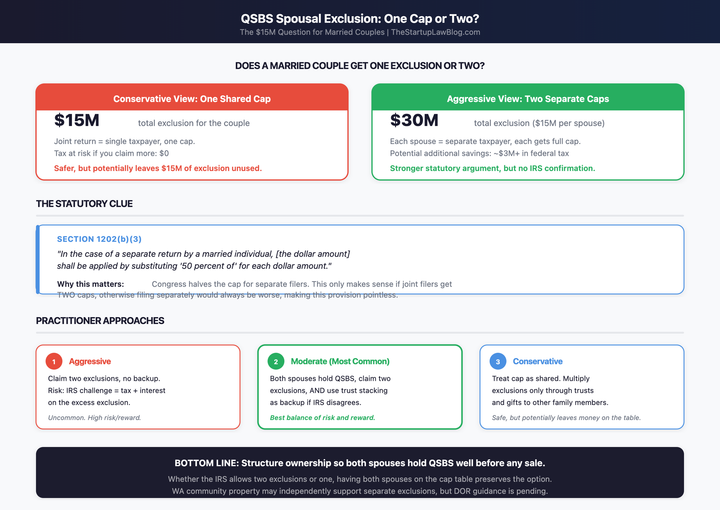
Section 1202 expressly addresses married individuals filing separately and allocates gain between spouses on a joint return for later-year calculations. The disputed question examined here is narrower: whether spouses who each own qualifying shares in the same issuer can claim two full dollar limitations on one joint return. The text’s separate-return and allocation rules must be considered alongside the individual-taxpayer argument. This article presents the competing readings; it does not establish authority for a particular return position. IRC §1202(b).
01 — The Statutory Framework: What Section 1202 Actually Says
Let's start with the text, because the answer to this question lives — or fails to live — in the statute.
Section 1202(a) provides that a taxpayer may exclude from gross income a percentage of gain from the sale of qualified small business stock (QSBS) held for more than five years (or, after the One Big Beautiful Bill Act, graduated percentages for stock held three, four, or five years).
Section 1202(b)(1) limits eligible gain using the greater of the applicable dollar branch or 10 times the adjusted basis of qualifying stock sold during the year, disregarding post-issuance basis additions for that calculation. The base dollar amount is $15 million for stock acquired after July 4, 2025, and $10 million for stock acquired on or before that date, subject to prior-gain reductions and the married-separate rules. The newer dollar amount is indexed beginning in 2027. Acquisition timing incorporates applicable holding-period tacking under §1202(a)(6); issuance date alone is not always the answer. The exclusion percentage is applied separately. For qualifying property-for-stock exchanges, §1202(i)(1) provides a fair-market-value minimum basis rule for Section 1202 purposes.
Here is the critical provision. Section 1202(b)(3)(A), as amended by the OBBBA, provides in substance:
For a married individual filing separately, the statute substitutes $5 million for the older $10 million dollar amount and one-half of the applicable newer dollar amount. This adjustment concerns the dollar-limit branch; it does not halve the separate 10-times-basis alternative.
For married filing separately, the base dollar amounts are $7.5 million rather than $15 million for the newer acquisition regime, and $5 million rather than $10 million for the older regime. Apply the applicable inflation adjustment and prior-gain reductions. These are dollar-branch amounts, not an automatic halving of the entire eligible-gain limit: §1202(b)(1)(B) retains the alternative based on 10 times the adjusted basis of qualifying stock sold during the year.
Section 1202(b)(3)(B) allocates gain taken into account under subsection (a) equally between spouses on a joint return for subsequent-year calculations. Subparagraph (C) determines marital status under Section 7703. Those provisions are part of the statutory context for evaluating the claimed separate limits.
The question is how to read the per-taxpayer limitation together with the express married-individual rules. The absence of a sentence expressly approving or rejecting two full joint-return dollar limits does not resolve that interpretation.
The debate concerns how the per-taxpayer limitation interacts with the express married-individual rules. It should not be described as a complete absence of statutory direction about joint returns.
02 — The Core Question: "Taxpayer" Means What, Exactly?
The exclusion applies to "the taxpayer." The cap is measured against gains recognized by "the taxpayer." The basis computation uses "the taxpayer's" adjusted basis.
On a joint return, is "the taxpayer" the married couple filing together? Or is each spouse a separate "taxpayer" who happens to be filing on the same return?
Joint-return treatment depends on the particular Code provision. Analogies to other exclusions or limits must account for Section 1202’s own text and structure.
03 — The Argument for Two Separate Exclusions
The argument that each spouse gets a separate $15 million exclusion rests on several pillars:
The joint-return allocation rule tracks each spouse’s exclusion history. Section 1202(b)(3)(B) allocates gain taken into account under subsection (a) equally between spouses for applying the limitation in subsequent years. Proponents of separate limits point to that individual tracking. But it also has a function under a shared-limit reading if spouses later file separately or the marriage ends. The allocation rule therefore does not, by itself, establish two full current-year dollar limitations. IRC §1202(b)(3)(B).
Actual separate ownership. The limitation in Section 1202(b) is measured by reference to gain from dispositions by the taxpayer of stock issued by a particular corporation. Where each spouse independently acquired qualifying shares at original issuance and holds them in their own right, each spouse has their own stock, their own basis and their own gain. Those are the strongest facts for the two-limitation reading. The argument is weakest where one spouse's shares were moved to the other shortly before a sale.
The individual-taxpayer argument must account for the legal effects of a joint return. Under §6013(d)(3), tax is computed on aggregate income and liability is joint and several, subject to applicable relief provisions. Joint filing is therefore more than an administrative convenience. Those rules do not, by themselves, resolve how a particular §1202 limitation applies. IRC §6013(d)(3)
Limits of the installment-sale analogy. TAM 9853002 is sometimes invoked in this debate, but it concerns Section 453A rather than Section 1202. A technical advice memorandum cannot be used or cited as precedent under Section 6110(k)(3). Section 453A also has its own aggregation rule, incorporating Section 52(a) and (b). An analogy from that provision does not establish that joint filers receive two full Section 1202 dollar limits. Evaluate the text and structure of Section 1202 directly; do not treat the memorandum as IRS approval of spousal QSBS doubling. IRC §6110(k)(3) IRC §453A(b)(2)(B)
Marriage neutrality is a policy argument for separate limits, not proof of congressional intent. This article identifies no legislative history establishing that Congress intended two full dollar limitations on a joint return. The argument must be tested against the enacted married-individual rules.
What the argument does not rest on. The married-filing-separately rule is often offered as proof of doubling. It is not. Two separate-return amounts of $7.5 million total $15 million before inflation adjustments and prior-gain reductions — arithmetic that is equally consistent with one shared $15 million joint-return amount, and with $5 million plus $5 million under the older regime. The separate-return rule is relevant context. It does not compel the two-limitation reading, and a position built on it alone is thin.
04 — The Argument for One Shared Exclusion
The conservative position — that a married couple filing jointly shares a single $15 million cap — also has support:
A joint return combines the spouses’ income for computing tax. That supports examining §1202 in the context of joint-return rules, but it is not a universal rule that every exclusion or limitation applies only once per return. The shared-dollar-limit argument must rest on §1202’s text and structure, including its married-separate and later-year allocation provisions. Joint-return computation rules
The separate-return rule is consistent with one shared dollar amount. Two half-sized separate-return dollar amounts can preserve the same combined amount as a single joint-return dollar amount. That explanation does not depend on community-property ownership; §1202(b)(3)(A) is not limited to community-property states. The actual result still depends on each spouse’s gain, basis and exclusion history.
This article does not identify affirmative IRS guidance approving two full dollar limitations for spouses filing jointly. That gap does not itself resolve the statutory interpretation. Anyone considering that position should identify the authorities supporting it and separately assess disclosure and penalty standards.
Do not substitute claims about practitioner consensus for legal analysis. This article does not establish how often either position is taken. Evaluate the statutory arguments, each spouse’s stock ownership and exclusion history, and the authority supporting the proposed return.
Related → See the holding-period and transfer representations in your attestation letter — a qualifying gift under Section 1202(h) carries the donor’s holding period. Keep records supporting the original acquisition and transfer; if an attestation letter is prepared, it should accurately describe those facts.
05 — Community Property States: A Different Wrinkle
For couples in community property states — Arizona, California, Idaho, Louisiana, Nevada, New Mexico, Texas, Washington, and Wisconsin — there's an additional layer of complexity.
Community-property characterization depends on the applicable state law, the spouses’ domicile when the property was acquired, the source of the purchase funds, and any valid marital-property agreement. Shares acquired during marriage are not necessarily community property: shares received separately by gift or inheritance, or purchased with traceable separate funds, may remain separate. Mixed funding can produce both separate and community interests. A cap-table entry in one spouse’s name does not, by itself, settle the ownership question. IRS Publication 555
This raises the question: if each spouse owns half the stock as community property, and each spouse is a separate "taxpayer," does each spouse get a $15 million exclusion on their half of the gain?
State ownership law and federal tax law perform different functions. State law establishes the spouses’ property rights; federal law determines the tax consequences of those rights. Morgan v. Commissioner explains that general distinction, but does not decide the QSBS question. Establishing that each spouse owns an interest in the shares is one part of the analysis. Whether a joint return may use two full Section 1202 dollar limitations remains a separate federal statutory question. Morgan v. Commissioner, 309 U.S. 78, 80–81 (1940)
Washington founders take note: Washington is a community property state. If you incorporated your startup during your marriage and paid for your founder shares with community funds, your spouse may have a community property interest in that stock. This matters for QSBS planning — and it will matter more once Washington's 9.9% income tax takes effect on January 1, 2028 (ESSB 6346). Maximizing QSBS exclusions reduces federal tax exposure and, under current law, Washington capital gains tax exposure as well.
06 — The Gift-to-Spouse Strategy
One of the most discussed spousal QSBS strategies is simple in concept: before a sale, one spouse gifts QSBS to the other spouse, so that both spouses hold stock and each claims their own exclusion.
How it works under current law:
Section 1041 generally provides income-tax nonrecognition for transfers to a spouse or to a former spouse incident to divorce, with carryover basis and gift treatment for income-tax purposes. It has exceptions, including transfers to a nonresident-alien spouse and certain transfers in trust where liabilities exceed basis. Income-tax nonrecognition is not a blanket exemption from gift-tax or reporting rules. For a qualifying gift of QSBS, §1202(h) preserves the donor’s manner of acquisition and holding period. These rules preserve attributes; they do not independently establish a second dollar limitation on a joint return. IRC §1041 IRC §1202(h)
For illustration only, assume qualifying stock acquired in 2026 is held for at least five years, the gift is respected, the spouses file jointly for the sale year, each spouse realizes $10 million of gain (not merely $10 million of sale proceeds), and neither has prior exclusions from the issuer. The claimed two-limit position would seek to exclude $20 million. A shared dollar-limit treatment could leave some gain taxable, depending on the inflation-adjusted dollar amount and the 10-times-basis alternative. This example illustrates the disputed position; it does not establish its validity. Filing separately invokes the married-separate dollar amounts; it does not by itself produce two full $15 million dollar limitations.
The risks:
The claimed additional dollar limitation depends on the disputed joint-return interpretation. Under a shared-dollar-limit treatment, the gift does not by itself create a second full dollar amount. That does not mean all otherwise available QSBS exclusion is lost or that the gift has no other effect. Evaluate ownership, basis, prior eligible gain, the applicable exclusion percentage, and the transfer’s other tax and estate-planning consequences separately.
Section 1202(h) preserves specified acquisition and holding-period attributes for qualifying gifts. That rule addresses continuity of QSBS attributes, while §1202(b) addresses the eligible-gain limitation. Preserving the gifted stock’s attributes does not itself decide how many dollar limitations apply on the spouses’ joint return. This article does not establish a contrary result from legislative history. IRC §1202(b) and (h)
Practical consideration: If you are going to pursue this strategy, the gift should be completed well before a sale is imminent. A last-minute gift of QSBS on the eve of a sale could invite scrutiny — the IRS could invoke the step-transaction doctrine or argue anticipatory assignment of income if the transfer occurs when a sale is effectively locked in. The cleaner the separation in time and the more genuine the donee spouse's ownership (including, ideally, their own decision about when to sell), the stronger the position.
07 — How the One Big Beautiful Bill Act Changes the Math
The One Big Beautiful Bill Act, signed July 4, 2025, made several changes to Section 1202 that affect spousal planning:
The base dollar branch is $15 million for stock acquired after July 4, 2025, with indexing beginning in 2027 and applicable tacking rules. The older $10 million and newer dollar amounts are not independent buckets for the same issuer. Prior-year eligible gain taken into account under Section 1202(a), from either acquisition regime, reduces the dollar branch. Current-year eligible gain from older stock also reduces the newer dollar branch. Track eligible gain taken into account, not merely the amount excluded after applying a percentage. Apply the married-separate rules and 10-times-basis alternative separately. See Section 1202(b)(4).
The issuer gross-assets ceiling increased to $75 million for stock issued after July 4, 2025, with indexing beginning in 2027. Stock issued on or before that date remains subject to the $50 million ceiling. This issuance-date test is distinct from the acquisition-date rules governing the exclusion percentage and dollar branch.
The newer exclusion percentages apply to stock acquired after July 4, 2025, taking applicable tacking into account: 50% at three years, 75% at four years and 100% at five years. Older stock generally requires more than five years. Within that older regime, stock acquired after September 27, 2010 generally receives 100%, stock acquired after February 17, 2009 and before September 28, 2010 generally receives 75%, and earlier qualifying acquisitions generally receive 50%, subject to applicable special rules.
The separate-return adjustment applies to the newer dollar amount: a $7.5 million base amount before applicable adjustments. It does not cut the 10-times-basis alternative in half.
Measure the potential additional benefit against the exclusion already available under a shared-limit treatment, rather than counting all QSBS tax savings as the benefit of spousal doubling. The comparison depends on the acquisition regime, applicable inflation adjustment, prior eligible gain, basis alternative, holding-period percentage, and state treatment. Two nominal $15 million amounts do not establish either a valid $30 million exclusion or the incremental tax savings.
Congress’s update of the separate-return dollar amount does not establish that joint filers receive two full dollar amounts. The revised figures remain consistent with a shared amount: $7.5 million plus $7.5 million equals $15 million before adjustments. The amendment does not turn that arithmetic into proof of spousal doubling.
08 — Spousal Planning vs. Trust-Based Stacking
A gift of QSBS to a non-grantor trust may allow a separate exclusion for gain properly taxable to that trust, if the stock, transfer and trust satisfy the applicable requirements. The base dollar limit depends on the stock’s acquisition regime and is subject to prior-gain reductions, with a separate 10-times-basis alternative; not every trust receives an automatic $15 million exclusion. See the QSBS Stacking guide.
The spouse-beneficiary issue: Under §677(a), income distributable or accumulable for the grantor or the grantor’s spouse without an adverse party’s approval can cause grantor ownership of the relevant trust portion. Section 672(e) also attributes certain spousal powers and interests to the grantor. Requiring a genuinely adverse party’s consent can address the relevant §677 trigger, but does not by itself establish non-grantor status under all of §§671–679. A SLANT label or standard SLAT form is insufficient; analyze every ownership trigger and the actual administration. Gain attributable to a grantor-owned portion is reported by the deemed owner, bringing the spousal-limit issue back into play.
The practical takeaway: Evaluate trust planning and spousal return positions separately. A trust may claim an available exclusion for gain properly attributable to its qualifying stock. Its unused exclusion cannot shelter gain the spouses recognize personally if their second spousal exclusion is disallowed. Prospective gifts must also fit the family’s economic and estate-planning goals; trust planning is not an automatic recommendation for every couple.
09 — Comparing Planning and Return Positions
The following are possible planning and return positions, presented for comparison rather than as a survey of practitioner behavior:
Two-limit position: The spouses claim separate full dollar limitations on one joint return. Before taking that position, assess the actual authorities, facts, and applicable return-preparer and taxpayer standards, including disclosure and penalties. Merely describing a position as aggressive does not establish that it is permissible to report.
Conservative position on the disputed spousal issue: Apply one shared dollar-branch amount on the joint return, with the applicable acquisition regime, adjustments, and 10-times-basis alternative considered. This position does not require trusts or gifts. Evaluate any proposed transfer separately for its legal support, economic consequences, and the family’s objectives.
Penalty exposure requires separate analysis. An unsuccessful position can produce additional tax, interest and an accuracy-related penalty. Under §6662(d)(2)(B), the substantial-understatement reduction generally requires either substantial authority or adequate disclosure and reasonable basis. Filing Form 8275 alone is insufficient. Section 6662(d)(2)(C) excludes tax-shelter items from that reduction; the statutory definition must be evaluated for the actual arrangement. Do not assume that this article establishes reasonable basis, substantial authority, or protection from other penalties. Those conclusions require analysis of the authorities and facts supporting the return position.
10 — Ownership and Transfer Records
Document ownership and transfers. Keep the issuance records, source-of-funds evidence, applicable marital-property agreements, and any transfer documents. For a transfer governed by Section 1041, the transferor must supply the recipient, at the time of transfer, with records sufficient to determine the stock’s adjusted basis and holding period; the recipient must preserve those records. A qualifying QSBS gift can carry the donor’s holding period under Section 1202(h), so the recipient does not necessarily need a new three- or five-year holding period. Transfer timing and attribution of sale gain still require separate review. Treas. Reg. §1.1041-1T, Q&A 14 IRC §1202(h)
If you have QSBS and want to discuss spousal planning for your specific situation, I'm happy to help. → Book a call
This post is for informational purposes only and does not constitute legal or tax advice. Consult a qualified attorney or tax advisor for advice specific to your situation.
Related Reading:
→ The Complete Guide to QSBS and Section 1202
→ QSBS Stacking: How to Multiply the $15M Exclusion with Trusts and Family Gifts
→ Does QSBS Avoid Washington's New 9.9% Income Tax?
→ The Complete Guide to 83(b) Elections
Need a letter, not just a checklist?
If you need a QSBS attestation letter drafted and signed by counsel — covering the gross-assets test, active-business analysis, redemption history, and OBBBA tranche bifurcation — we offer flat-fee engagements after a short intake call.
Related: QSBS pillar