
Washington’s enacted income-tax law specifically addresses incomplete-gift nongrantor trusts, often called ING trusts. For a Washington resident, putting assets in an ING in Nevada, Delaware, or another state does not remove the trust’s income from the Washington base merely because the trust is located elsewhere.
The rule is in RCW 82A.04.260, enacted as §307 of ESSB 6346. It applies in calculating the new income tax beginning in 2028. For the tax’s broader framework, see the Washington income-tax overview.
What is an ING trust?
An ING seeks two different federal tax results: nongrantor treatment for income-tax purposes and incomplete-gift treatment for the funding transfer. NING and DING describe Nevada and Delaware versions of that approach.
Nongrantor status means the trust is not treated as owned under the federal grantor-trust rules; retained taxable income and distributions then follow the applicable trust and beneficiary rules. Gift completion depends separately on retained dominion and control under Treas. Reg. §25.2511-2. Neither result follows from the trust’s name.
An incomplete portion of a funding gift does not itself use gift-tax exclusion as a completed gift would. Completed portions, later changes, and reporting requirements still need review. Incomplete-gift status is not a blanket exemption from gift-tax return requirements.
What the Washington addback does
The statute requires a resident taxpayer to add income from a federally nongrantor trust funded with an incomplete gift to Washington base income, to the extent the trust income is not otherwise included. Federal separation therefore does not, by itself, remove that income from the resident’s Washington calculation.
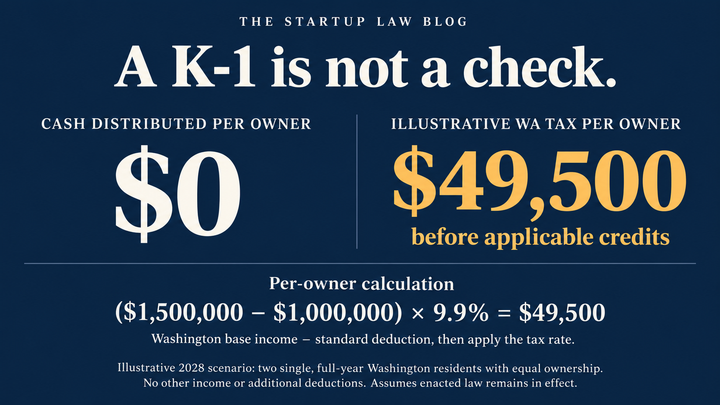
An addback is not a separate 9.9% tax on every dollar of trust income. Compute the taxpayer’s overall base, applicable modifications and deductions, and credits. Inclusion does not establish that tax is owed in every case.
Washington’s existing capital gains rule also addresses incomplete gifts. Under WAC 458-20-301(2)(f), the grantor includes long-term gain or loss attributable to incomplete-gift assets to the extent specified by the rule and allocated to Washington. Analyze that separately from the new income-tax addback.
What if the trust already exists?
RCW 82A.04.260 contains no general grandfathering exception for a trust created before the new tax or its implementing regulations. Review the actual funding, retained powers, administration, and income before assuming an existing arrangement falls outside the rule.
The trust may still serve family or other purposes, but those benefits depend on its terms and applicable law. Compare them with trustee fees, administration, reporting, and tax costs. Do not assume a trust should be terminated or decanted solely because the anticipated Washington income-tax benefit is unavailable; either action requires its own legal and tax review.
How other trusts differ
Completed-gift nongrantor trusts: the ING addback is directed at incomplete-gift funding. Completing a gift presents a different analysis, with real ownership, transfer-tax, and reporting consequences. It does not establish that all income escapes Washington tax. Retained income, distributions, source, and the relevant taxpayers’ state connections matter.
Charitable remainder trusts: a qualifying CRT has a genuine charitable remainder and follows Section 664. Payments follow statutory income tiers; federal treatment does not automatically determine Washington treatment. A potential deduction, state eligibility, and the tax on distributions require separate calculations.
Grantor retained annuity trusts: a GRAT is primarily a wealth-transfer structure. To the extent its income is attributed to the grantor, it remains in that person’s income-tax calculation. An estate-planning purpose should not be presented as proof of a Washington income-tax saving.
For the evaluation process—including control, sale timing, basis, distributions, and costs—see the trust-planning guide.
What to review
Bring the trust instrument, funding history, tax returns, distribution records, and proposed transactions to the review. Identify the income the plan is intended to affect and compare the actual result with the existing arrangement. If a personal move is part of the plan, examine domicile, residency, and Washington-source income separately.
To discuss an existing or proposed trust, book a 20-minute call with Joe Wallin or email wallin@carneylaw.com.
Last reviewed: September 10, 2026. General educational information, not legal or tax advice for a particular trust or taxpayer.