
You bought late-stage private-company stock on the secondary market, exercised options, or received stock in settlement of RSUs. Those paths have different §1202 consequences. A secondary purchase generally fails the original-issuance requirement. Stock from an option exercise or RSU settlement may qualify if the issuer and stock meet all the tests when the shares are issued. A unicorn valuation alone does not establish that the statutory gross-assets limit was exceeded.
If your position does not qualify for QSBS, plan for the taxable gain. Starting January 1, 2028, Washington’s tax environment for high earners gets meaningfully worse.
If you hold a large private-company position, this post is for you. Review the possible sale, your other income and your estate plan before committing to a transaction. The 2028 income-tax start date is one planning consideration, not a reason to assume that every available strategy expires beforehand.
For illustration, assume you have $150 million available to invest after all sale taxes, costs and other uses of the proceeds. That is an assumption, not the calculated net proceeds of a $200 million sale. A 4%–6% annual taxable cash yield would produce $6 million–$9 million of income. Assuming all of it enters the Washington income-tax base, the full $1 million deduction is available, and there are no other income items, adjustments or credits, 9.9% produces $495,000–$792,000 of annual tax. Actual investment returns, income character, deductions and future law can change the result.
Plan early, but tie each deadline to the actual transaction and tax rule. A full-year domiciliary safe harbor for 2028 requires both abode conditions for the entire year, while an actual domicile change can occur during a year and requires a part-year analysis. Gifts and trusts need sufficient time for sound valuation, genuine transfers and administration. There is no universal rule making these strategies unavailable in 2027 or requiring every structure to be completed 12–24 months before an exit.
Planning before a liquidity event gives you time to evaluate transfers, valuation, charitable intent and the tax consequences of a move.
This post walks through what's actually changing, and what to do about it. None of it is legal advice for your specific facts. But it's how I think about the problem.
Why §1202 isn't your answer
Quick housekeeping for readers wondering whether they should be looking at QSBS.
Section 1202 generally requires original issuance for money, qualifying property or services. Certain gifts, transfers at death and other qualifying transactions have special rules under §1202(h). An ordinary secondary-market purchase generally does not satisfy the original-issuance requirement.
Stock issued on an option exercise can qualify as QSBS if all §1202 conditions are met. The issuer’s aggregate gross assets must not have exceeded the applicable limit at any time before issuance and must not exceed it immediately afterward, including the issuance proceeds. The limit is $50 million for stock issued on or before July 4, 2025, and $75 million for stock issued afterward, with inflation adjustments beginning in 2027. The statutory measure generally uses cash and adjusted tax bases, with special rules for contributed property; it is not the company’s headline valuation. See §1202(d).
An RSU is generally an unfunded promise to deliver cash or shares; vesting alone does not necessarily deliver stock. For a stock-settled RSU, examine QSBS eligibility when the shares are actually issued in settlement. Vesting and settlement may coincide, but need not. Cash-settled RSUs do not produce QSBS. See Treas. Reg. §1.83-3(e) and §1202(c).
§1045 rollover does not convert a non-QSBS sale into a qualifying sale. §1045 generally requires eligible QSBS held for more than six months and replacement QSBS purchased within the statutory 60-day period, along with the other requirements.
If you do happen to hold some QSBS-eligible stock alongside the bigger non-qualifying position — early angel investments, or a co-founded company on the side — the rules are very different and the planning is different. That's a separate conversation.
If the stock is not QSBS, determine the taxable gain using the amount realized and adjusted basis. Non-QSBS status alone does not establish long-term capital-gain treatment: holding period and the distinction between compensation income and later stock appreciation still matter.
What's actually changing on January 1, 2028 — and what isn't
Read this section carefully, because the conventional framing of "sell before 2028 to avoid 9.9% Washington tax" is overstated, and acting on the wrong version of the urgency leads to wrong decisions.
The capital gains tax is already here. Washington's capital gains excise tax has been in force since 2022. SB 5813, signed in 2025, added a tiered rate structure: 7% on the first $1 million of taxable long-term gain (after the ~$278K standard deduction for 2025, indexed annually), and 9.9% on taxable gain above $1 million — i.e., total gains above roughly $1,278,000. That 9.9% top tier is already in effect — has been since January 1, 2025.
If a stock sale produces nonexempt long-term gain allocated to Washington, the 9.9% rate applies to Washington taxable capital gains above $1 million after the applicable deductions. Gross sale proceeds, total federal gain and Washington taxable capital gains are different amounts.
ESSB 6346 coordinates with the capital-gains tax through separate base calculations and a credit; it does not guarantee identical total tax before and after 2028. Section 302 first removes federal long-term gains and losses, then adds Washington capital gains subject to tax plus the capital-gains standard deduction for taxpayers owing that tax. Section 205 allows a credit for the same year’s Washington capital-gains tax, capped at income-tax liability, with no refund or carryover of unused credit. Model both bases, deductions and credits rather than assuming the credit eliminates every additional dollar of income tax.
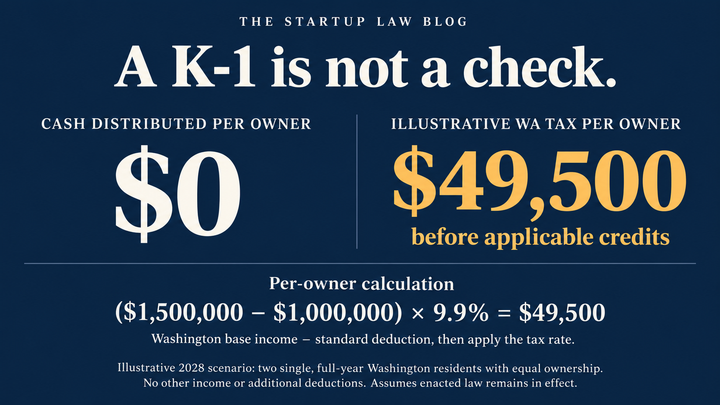
What ESSB 6346 changes extends beyond capital gains. Starting January 1, 2028, Washington imposes 9.9% on taxable income above a $1 million standard deduction — $1 million per individual, one $1 million for a married couple or registered domestic partnership. The starting point is federal AGI, subject to Washington modifications, deductions, allocation rules and credits. It can include wages, bonuses, taxable RSU settlements and option exercises, business income, partners’ distributive shares, interest, dividends and short-term gains. A partnership cash distribution is not itself the same thing as taxable partnership income.
For someone holding nine figures of private company stock, the practical impact looks like this:
- The embedded long-term gain may already be subject to Washington’s capital-gains tax, depending on allocation and exemptions. From 2028, calculate the separate income-tax base and the §205 credit as well; similar headline rates do not establish identical combined liability.
- Wages, bonuses and ordinary compensation can enter the Washington income-tax base from 2028. Washington does not currently impose a general individual income tax on these items; other taxes can apply. The $1 million deduction applies to the combined base, not separately to each income category.
- Taxable RSU settlement income, potentially at an IPO: review the actual federal inclusion date and Washington allocation. Vesting alone does not necessarily trigger income; payroll-tax timing can differ. Amounts included from 2028 can enter the new income-tax base.
- Business income and partners’ distributive shares can enter the new income-tax base from 2028, even without cash distributions. Cash distributions require a separate basis and gain analysis; see §702 and §731.
- Post-sale interest, dividends and short-term gains can enter the Washington income-tax base from 2028, subject to state modifications. These items do not each receive a separate $1 million deduction. Federal tax and other applicable taxes must be modeled separately.
The illustrative $495,000–$792,000 annual tax above assumes $6 million–$9 million of fully taxable investment income and a single $1 million deduction. Tax-exempt income, unrealized appreciation and capital gains subject to separate state adjustments cannot simply be treated as the same taxable cash yield.
Recurring tax on post-sale income belongs in the planning model alongside the sale-year tax. It is not a guaranteed lifetime charge at an unchanged rate on every dollar of investment return.
Move 1: Change domicile and analyze the residency tests
A move can affect both the existing capital-gains tax and the income tax beginning in 2028. Whether it is worthwhile depends on your income, transaction timing and personal circumstances.
A real departure requires a defensible domicile record. The 30-day safe harbor is a separate fallback for a person still treated as a Washington domiciliary; it is not a mandatory procedure for every person who moves away. The income tax also has a statutory-residency test and a part-year rule. See ESSB 6346 §101(8).
To use the full-year domiciliary safe harbor, satisfy all three conditions:
- No permanent place of abode in Washington at any time during the year. Review the facts of a retained condo, room or vacation property rather than deciding by its label. For the capital-gains tax, WAC 458-20-301(2)(l) examines the dwelling’s characteristics and use; a vacation home suitable and actually used only for vacations is not indicative of a permanent abode. The 2028 income-tax statute must be applied on its own terms; do not assume either that every retained vacation property defeats its safe harbor or that the capital-gains regulation automatically resolves its treatment.
- A maintained permanent place of abode outside Washington for the entire year. Real home, real lease or deed, real utilities.
- 30 days or fewer in Washington during the year. Partial days count as full days. An early morning departure, an afternoon meeting, an overnight layover — each counts as a full day.
Failing a condition defeats the safe harbor. It does not automatically make you a resident for the entire year. Determine whether and when domicile changed, whether the separate abode-and-day-count test applies, and the period of residency under §101(8)(c). Washington-source income requires its own analysis.
Keeping a qualifying Washington abode defeats this safe harbor even with only 10 Washington days. A retained home also matters to the evidence of domicile. But a person who genuinely establishes domicile elsewhere must be analyzed under the separate residency rules; the retained home alone does not decide the result.
For the 2028 full-year safe harbor, the Washington abode must be given up and the out-of-state permanent abode maintained before the year begins; Washington presence must stay within the 30-day limit during the year. A genuine domicile change during 2028 instead requires a part-year analysis. Build a defensible record before the transaction rather than assuming a single universal departure deadline.
I have a separate post that walks through the 30-day rule, the three prongs, and the most common planning mistakes in detail. And a separate post on what a real domicile change looks like in practice.
A few things worth knowing about the move itself.
Domicile depends on the facts of your life and your intent, supported by a consistent record. Keep travel logs, lease and utility records, and banking and registration history. Document any separate QSBS claim as well: here is what a QSBS attestation letter needs to say. Do not assume that a declaration of residence establishes the tax result.
Even after you become a nonresident, Washington can still tax Washington-source income — for example, allocable partnership income tied to a Washington business, Washington rental income, or compensation for services performed in Washington. A company’s Washington address alone does not determine the source of board fees. Leaving removes resident worldwide-income exposure only for the nonresident period; source-based taxation requires a separate analysis.
At nine figures, recurring state income tax can materially affect long-term investment returns. Model the actual income, deductions and credits across the distribution years. The planning case for a real move rests on those facts and the separate residency tests, not a requirement that every mover pass the 30-day safe harbor.
Move 2: Pre-liquidity-event trust planning
Trust planning can address estate-transfer goals for a large position. Whether it also changes income-tax exposure requires a separate analysis; the size of the position alone does not establish that a trust is appropriate.
The basic idea is to evaluate a genuine transfer of stock before a sale. Gift value must reflect fair market value at the transfer date, including relevant known transaction developments. A completed gift does not by itself establish either estate-tax exclusion or nongrantor income-tax status. Retained enjoyment or powers can cause estate inclusion under §2036 and related rules. Model those issues before attributing future appreciation or income to someone else.
The toolkit:
Grantor Retained Annuity Trusts (GRATs). A qualifying GRAT retains an annuity for the grantor and can transfer remaining appreciation to beneficiaries. Results depend on the trust terms, investment performance, valuation assumptions and the grantor’s survival through the term. Review Treas. Reg. §25.2702-3; expected growth alone does not guarantee a successful transfer.
Intentionally Defective Grantor Trusts (IDGTs). A properly structured sale can exchange appreciating property for a fixed payment obligation, but valuation, adequate consideration and retained rights matter. Income from the grantor-owned portion remains taxable to the deemed owner. Under Rev. Rul. 2004-64, the grantor’s payment of that income tax is not itself an additional gift to the beneficiaries; tax-reimbursement rights can have estate-tax consequences.
Nongrantor trusts and state tax. An out-of-state trustee or trust address does not alone remove Washington tax. WAC 458-20-301(2)(f) attributes qualifying capital gain from incomplete-gift nongrantor trusts to the grantor. From 2028, ESSB 6346 §307 also requires a resident taxpayer to add income from an incomplete-gift nongrantor trust to the extent not otherwise included. Completed-gift status, federal ownership, distributions, sourcing and each relevant state’s law need separate review. This article does not conclude that a particular trust avoids Washington tax.
Two things drive the lead-time problem.
First, valuation. Gift-tax value is fair market value at the transfer date under Treas. Reg. §25.2512-1. A 409A valuation prepared for compensation purposes is not automatically the correct gift-tax value or a gift-tax safe harbor. Review its valuation date, share rights and assumptions against all relevant facts, including known financing, tender and sale developments. Do not assume a discount to the next transaction price is always supportable.
Second, structural execution. Allow time for drafting, transfer restrictions, funding and administration. A pending tender or sale requires particular attention to valuation and whether income has already become attributable to the transferor.
If your company offers periodic tenders, use the interval to assess whether a trust serves your goals. A decision not to transfer stock can also be reasonable after considering costs, control and tax consequences.
Move 3: Take liquidity when it's offered
This one needs a different framing than people usually give it.
A tender before 2028 can still incur Washington capital-gains tax. Compare the actual pre- and post-2028 liabilities, including allocation, deductions and credits, rather than assuming identical tax or an automatic saving. Other considerations include:
- Concentration risk. Holding nine figures of one private company is a risk-management problem regardless of taxes.
- Liquidity for planning. A tender can fund expenses and cash commitments. Trusts and charities may instead accept stock, subject to their terms and transfer restrictions; selling first is not a universal prerequisite.
- Locking in valuation. Private company valuations are not guaranteed to keep going up. Some readers know this in their bones already.
Evaluate how much to sell, when to sell and how to use the proceeds. Whether Washington taxes the gain remains a separate question of allocation, exemptions and deductions.
Rolling everything into the IPO and hoping for the best is a bet, not a plan.
Move 4: Charitable structures at scale
If you have charitable intent — meaning you'd give the money away anyway — the structures available at this scale change the math meaningfully.
Charitable Remainder Trusts (CRTs) can provide payments for life or a qualifying term, with the remainder going to charity. A qualifying trust is generally exempt from federal income tax under §664, but unrelated business taxable income triggers a separate excise tax. Beneficiary payments follow statutory tiers: ordinary income, capital gains, other income, then corpus. The potential charitable deduction is limited to the qualifying remainder interest and applicable deduction rules. Review IRS CRT guidance. Federal treatment does not by itself establish the Washington result; model trust attribution and beneficiary distributions under each state tax before claiming a deferral benefit.
Donor-Advised Funds (DAFs) can accept qualifying appreciated stock while the donor recommends later charitable grants. The sponsor must have legal control of the contributed assets; the donor cannot retain ownership. A deduction depends on §170 limits and substantiation, including applicable valuation requirements. A completed gift before income has become attributable to the donor can avoid donor recognition of the donated appreciation, but a last-minute transfer near a sale does not guarantee that result. See Ferguson v. Commissioner on anticipatory assignment of income.
Private foundations can support sustained family involvement in philanthropy, with additional administration and restrictions. For a typical private nonoperating foundation, a gift of appreciated private-company stock generally has its deduction reduced by the appreciation under §170(e)(1)(B)(ii). The qualified-appreciated-stock exception in §170(e)(5) requires readily available market quotations on an established securities market; do not assume privately held shares qualify. Compare the actual deduction and ongoing compliance costs with other charitable vehicles.
Start with the amount you genuinely want to give. A gift reduces the property you retain, and a deduction does not reimburse the whole gift. Donating appreciated stock before a sale may be more tax-efficient than donating cash afterward, but the result depends on timing, the recipient, deduction limits and the stock’s characteristics.
Move 5: Integrate the income tax planning with estate planning
At nine-figure positions, estate planning also matters. The federal basic estate and gift exclusion is $15 million per person for 2026, subject to prior use; future inflation adjustments and later law must be checked for the relevant year. Washington’s exclusion is $3 million for deaths on or after July 1, 2026. Review the separate state rules and generation-skipping transfer tax before deciding whether to use federal exclusion now.
Coordinate income-tax and estate planning, but evaluate their effects separately. A GRAT or IDGT can serve transfer-tax goals while income from a grantor-owned portion remains attributable to its deemed owner under §671. Do not assume that a structure reduces the grantor’s Washington income-tax base merely because it may shift appreciation for estate-tax purposes. Trust status, distributions, sourcing and state modifications require their own analysis.
The wrong way to do this is to make an income tax move now and discover two years later that you've used estate exemption you needed for something else, or locked yourself out of a structure that would have been more valuable.
Moves worth mentioning and mostly dismissing
Installment sales. Eligible private-stock sales may spread gain recognition under §453; sales of stock traded on an established securities market are excluded by §453(k). Consider buyer credit risk, interest and other installment-sale limitations. For Washington's capital gains tax, federal timing generally governs eligible post-2021 sales, but intangible gain allocation depends on domicile at the sale—not merely where you live when a later payment arrives. Pre-2022 sales have a specific exclusion under WAC 458-20-301(3)(a)(i)(B). Do not assume a pre-2028 sale shields all later receipts from the new income tax: apply the recognition-year base, sourcing and credit rules separately.
Opportunity Zone investments. Evaluate investment quality and liquidity first. Federal deferral rules differ for investments made before and after January 1, 2027; IRS Notice 2026-40 explains the transition. Washington’s capital-gains calculation disregards federal §§1400Z-1 and 1400Z-2 under WAC 458-20-301(2)(e), so federal Opportunity Zone treatment does not automatically defer Washington capital-gains tax.
Wait for repeal or court challenge. Use enacted law for the baseline and monitor actual legislative and court developments. A hoped-for repeal or judicial outcome does not itself eliminate a filing obligation or tax liability. Revisit the model if the governing law changes.
The honest option: stay and pay
For some readers, remaining in Washington and paying the applicable tax is the right choice. Calculate the 9.9% income tax on the actual Washington taxable base after the available deduction, then apply any credits; the headline rate alone is not a complete estimate.
If your roots are deep, your family is here, and the structural moves don't fit your situation, paying the tax may be the cleanest path. There's no shame in that.
For a large position, compare the modeled tax savings with the costs, loss of control and personal consequences of each strategy. Trust formation or relocation should not be assumed worthwhile solely from the size of the account.
What you should actually do this quarter
If you're in this situation, here's the order I'd work through it:
- Get a real number on your combined exposure — the existing capital gains tax on the embedded gain, plus ESSB 6346 on projected post-sale investment income, plus any non-cap-gain comp income, modeled across realistic liquidity and timing scenarios.
- Decide honestly whether you are moving. Start the domicile record early. If relying on the 2028 full-year 30-day safe harbor, establish both abode conditions before January 1, 2028. If relying on an actual domicile change, analyze its effective date, statutory residency, Washington-source income and the move-year deduction.
- If domicile change isn't on the table, get serious about trust planning. Start the conversation now, not when a tender is announced.
- Integrate any planning with your estate plan, not as a separate exercise.
Start with the real deadlines: the sale and completed-gift dates, the effective date of any domicile change, and the full-year abode conditions if claiming the 2028 domiciliary safe harbor. January 1, 2028 is the income-tax start date, not a universal expiration date for every planning strategy. Early preparation expands practical options without turning 2027 into a statutory cutoff.
If you want my help thinking through your situation, book a consultation.
This post is for educational purposes only and is not legal or tax advice. Consult a qualified attorney about your specific situation.