State Tax Comparison for Startup Founders: Where to Incorporate and Where to Live
When you're building a startup, state tax planning rarely feels like the most urgent problem. Your product isn't launched. Fundraising is consuming your calendar. The last thing on your mind is whether Delaware's franchise tax or California's capital gains treatment will affect your eventual exit.
In This Guide
- → The Two Critical Decisions (That Are Completely Different)
- → State-by-State Tax Comparison
- → Quick Comparison Table
- → Incorporation State vs. Residence State: Why They Matter Differently
- → The Deep Dive: QSBS State Conformity and Section 1202 Exclusions
- → Scenario Analysis: Four Founder Stories
- → The Remote Work Wrinkle: Multi-State Taxation and Nexus
- → Tax Planning Strategies for Founders
- → Conclusion: Key Takeaways for Founders
But here's the reality: state tax decisions can easily cost founders hundreds of thousands—or millions—of dollars. The difference between incorporating in Delaware versus your home state, or between living in California versus Texas when you exit, isn't academic. It's the difference between keeping $7 million and $5 million from a $10 million QSBS sale.
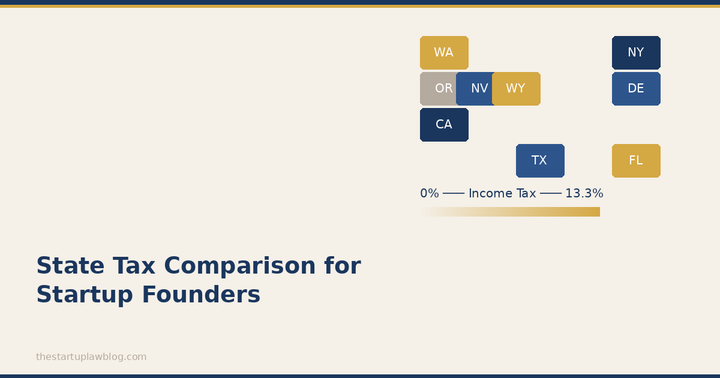
And everything is shifting. Washington State just enacted a 9.9% income tax starting in 2028, challenging its no-income-tax advantage. Oregon is limiting the capital gains exclusion. California's 13.3% top capital gains rate remains the highest in the nation. Meanwhile, Texas, Florida, Nevada, and Wyoming continue to offer zero state income tax.
This guide walks you through the state tax landscape for startup founders and investors. We'll cover where to incorporate, where to live, how QSBS exclusions work across state lines, and what your options look like in the most important startup jurisdictions.
The Two Critical Decisions (That Are Completely Different)
Before we go state-by-state, let's clarify the most common founder mistake: confusing incorporation state with residence state.
Where you incorporate determines your choice-of-law for corporate governance and exposes you to franchise taxes in that state. It's primarily a legal and Delaware-specific governance question. Most VC-backed startups incorporate in Delaware, regardless of where the founder lives, because Delaware has predictable corporate law, specialized courts, and investor expectations.
Where you live (your tax domicile) determines your personal income tax, capital gains tax, and estate tax exposure when you sell your equity. This is where the real tax planning happens. A Delaware C-corp in the hands of a California resident gets hammered differently than the same corp in the hands of a Texas resident.
The second decision matters more for your after-tax proceeds. We'll explain why throughout this guide.
State-by-State Tax Comparison
Delaware
Incorporation Favorite: Delaware is the de facto standard for VC-backed companies. It has:
- Predictable corporate law developed over 130+ years
- Delaware Court of Chancery (specialized, sophisticated)
- Pro-management case law preferred by investors
- Flexibility in corporate governance
Personal Taxes (if you live there):
- Income Tax: Graduated rates up to 6.6% on income over ~$60,000
- Capital Gains Tax: Taxed as ordinary income (up to 6.6%)
- Franchise Tax: $175–$250,000+ annual tax for Delaware corporations (you pay this regardless of where you live, if incorporated in Delaware)
- Sales Tax: No sales tax
- Estate Tax: No state estate tax
QSBS Conformity: Delaware conforms to federal Section 1202 QSBS exclusion for state tax purposes.
For Founders: Delaware incorporation is the standard for VC-backed companies even if you don't live there. The franchise tax is a cost of doing business with VC investors. Delaware's personal income tax rate (6.6%) is moderate compared to California or New York, but it's not zero — founders sometimes confuse Delaware's no-sales-tax policy with no income tax. If you live in Delaware, you'll pay 6.6% on capital gains, though the QSBS exclusion applies at the state level, which significantly reduces exit taxes for qualifying stock.
California
Income Tax: 9.3% base + 1% Mental Health Tax (net income over $1M) = 10.3% typical rate. Top marginal rate on investment income reaches 13.3% (9.3% + 1% Mental Health Tax + 3.8% Net Investment Income Tax for high earners).
Capital Gains Tax: California taxes capital gains as ordinary income at regular rates. No preferential treatment.
QSBS Conformity: CRITICAL: California does NOT conform to federal Section 1202. If you're a California resident and sell QSBS for $10 million, the entire $10 million is subject to California's 13.3% top rate, even though federal law allows you to exclude 100% of the gain (up to $10 million per investment).
This is arguably the single largest tax cost of being a California startup founder.
Corporate Tax: 8.84% corporate income tax (one of the highest in the nation). C-corps also pay a minimum franchise tax of $800-$14,000 depending on gross income.
Sales Tax: 7.25% base + local taxes (effective 7.25%-10.75% depending on county).
Estate Tax: No state estate tax, but federal estate tax applies to large estates.
For Founders: If you're building a successful startup in California (or willing to start there), understand that QSBS non-conformity is a massive cost. A $10 million exit costs you an extra $1.33 million in California taxes compared to a zero-income-tax state. Many founders time their move out of California before an anticipated exit, though this requires legitimate residency changes and carries legal risk if the IRS scrutinizes the timing.
Washington
Income Tax: No income tax—until 2028. Starting January 1, 2028, Washington imposes a 9.9% capital gains tax on certain capital gains (generally $250,000+ per person, but with complex phase-in mechanics). This is a seismic shift.
Capital Gains Tax: Starting 2028, a 9.9% tax on long-term capital gains and certain other gains. Founders selling QSBS will likely be subject to this tax if the gain exceeds $250,000.
QSBS Conformity: Currently yes—Washington conforms to federal Section 1202 QSBS exclusion. However, with the new capital gains tax, the interaction is complex. The state has said publicly it intends to honor the federal exclusion, but we won't have definitive guidance until 2028 or later.
Corporate Tax: No corporate income tax. Businesses pay a B&O (Business and Operations) tax ranging from 0.471% to 1.75% depending on gross income and business classification.
Sales Tax: 6.5% state base + local sales tax (effective 6.5%-10.25% depending on county).
Estate Tax: Washington has one of the highest state estate taxes in the nation — up to 20% on estates over ~$3 million ($3,076,000 for 2026 under SB 5813; resets to $3M flat July 1, 2026 under SB 6347). This is a significant concern for founders with large equity positions. Note: Governor Ferguson signed a temporary rollback to 35% in 2025–2026 before rates return to the standard schedule.
For Founders: Washington was one of the best states for startup founders in America until 2028. If you're currently based in Washington and expecting an exit after 2028, plan for the new 9.9% capital gains tax. (See our detailed Washington vs. California comparison and guide to changing your Washington domicile.) Before 2028? Washington is still excellent. The state continues to conform to federal QSBS exclusion (though this could change—monitor legislative updates).
Texas
Income Tax: No state income tax.
Capital Gains Tax: No capital gains tax.
QSBS Conformity: Texas has no state income tax, so QSBS conformity doesn't apply. You pay zero state tax on QSBS gains.
Corporate Tax: No corporate income tax. Instead, Texas imposes a Franchise Tax (Texas Margin Tax) of 0.375%-0.75% depending on gross revenues and entity type.
Sales Tax: 6.25% state base + local sales tax (effective 6.25%-8.25% depending on county).
Estate Tax: No estate tax.
For Founders: Texas is one of the two or three best jurisdictions for founders, especially post-exit. No state income tax, no capital gains tax, no estate tax. The Franchise Tax on corporations is a modest cost. Austin has become a major startup hub, and many founders who initially built companies elsewhere have relocated to Texas as exits approached.
Florida
Income Tax: No state income tax.
Capital Gains Tax: No capital gains tax.
QSBS Conformity: Not applicable (no state income tax).
Corporate Tax: 5.5% corporate income tax on net income over $50,000. This applies to C-corps doing business in Florida, but many startups pay little or no Florida corporate tax due to losses and deductions in early years.
Sales Tax: 6% state base + local sales tax (effective 6%–7.5% depending on county).
Estate Tax: No estate tax.
For Founders: Florida's zero personal income tax and zero capital gains tax make it one of the most attractive states for founders at exit. South Florida (Miami, Fort Lauderdale) and Tampa Bay are growing startup hubs with significant venture capital activity. The 5.5% corporate tax is modest and often irrelevant for early-stage companies. Like Texas, Florida is exceptionally friendly for founders at exit.
Nevada
Income Tax: No state income tax.
Capital Gains Tax: No capital gains tax.
QSBS Conformity: Not applicable.
Corporate Tax: No corporate income tax. Corporations pay annual filing fees of roughly $150 plus a $75 license fee.
Sales Tax: 6.85% state base + local sales tax (effective 6.85%-8.375% depending to district).
Estate Tax: No estate tax.
For Founders: Nevada has no income, capital gains, or corporate tax—making it similar to Texas and Florida in tax treatment. However, Nevada has traditionally been less popular with VCs for incorporation (Delaware still dominates). Nevada is used primarily by founders seeking tax-free residency and privacy (Nevada corporate law provides some asset protection benefits). Las Vegas and Reno are growing startup communities, though smaller than Austin or Miami.
Wyoming
Income Tax: No state income tax.
Capital Gains Tax: No capital gains tax.
QSBS Conformity: Not applicable.
Corporate Tax: No corporate income tax. Corporations pay an initial filing fee of $100 and annual license fees of roughly $50 per year.
Sales Tax: 4% state base + local sales tax (effective 4%-6.5% depending on county). Lowest base sales tax in the nation.
Estate Tax: No estate tax.
For Founders: Wyoming offers the friendliest tax environment in the nation for founders: no income, capital gains, or corporate tax. It's gaining popularity with tech founders as a residency state, particularly for those seeking tax optimization and privacy. However, Wyoming doesn't have the venture capital infrastructure or startup culture of Texas, Florida, or California. Many founders maintain Wyoming residency while operating remotely.
New York
Income Tax: 6.85% base state tax + New York City 3.876% income tax (if NYC resident) = roughly 10.76% combined top rate.
Capital Gains Tax: Capital gains taxed as ordinary income at regular rates (up to 10.76% in NYC). No preferential treatment.
QSBS Conformity: New York conforms to federal Section 1202 QSBS exclusion at the state level.
Corporate Tax: 6.5% corporate income tax. C-corps also pay a minimum tax of $4.50 per $1,000 of gross income (minimum $25, maximum $$4,500).
Sales Tax: 4% state base + local taxes (effective 4%-8.875% depending on county). NYC is 8.875%.
Estate Tax: State estate tax up to 16% on estates over $6.58 million (2024). This is significant for large exits.
For Founders: New York (especially NYC) is a major financial and tech hub, but the tax burden is substantial. While New York does conform to QSBS federal exclusion, capital gains are still taxed as ordinary income up to 10.76%. The state estate tax is a secondary concern for most founders but matters for very large exits. Founders in NYC should seriously consider relocation before large exits, or at least understand the tax implications.
Oregon
Income Tax: 5.75% base rate, tiered up to 9.9% on higher incomes. Top rate of 9.9% on income over roughly $125,000 (2024).
Capital Gains Tax: Taxed as ordinary income. However, Senate Bill 1507 (effective 2026) creates an additional 5% tax on capital gains over $1 million per year.
QSBS Conformity: This is where it gets complex. Historically, Oregon conformed to federal QSBS exclusion. However, SB 1507 may limit or eliminate this conformity for high-gain sales. Guidance is still being developed, but founders should assume Oregon will tax QSBS gains under the new regime. This could be a game-changer for Oregon-based founders.
Corporate Tax: 7.6% on most corporations (varies by structure). Also a minimum tax of 0.8% of net income under certain thresholds.
Sales Tax: No state sales tax (Oregon is one of only five states without sales tax).
Estate Tax: No state estate tax.
For Founders: Oregon has historically been tax-friendly because of no sales tax and conformity to QSBS exclusion. However, SB 1507 is changing this calculus significantly. Founders in Oregon should monitor legislative guidance closely on how SB 1507 interacts with QSBS. If Oregon limits the federal exclusion, the state becomes much less attractive for startup founders planning major exits.
Colorado
Income Tax: Flat 4.4% on all income. One of the lowest in the nation.
Capital Gains Tax: Taxed as ordinary income at 4.4% rate.
QSBS Conformity: Colorado conforms to federal Section 1202 QSBS exclusion.
Corporate Tax: 4.4% on corporate income (same rate as individual income tax).
Sales Tax: 2.9% state base + local sales tax (effective 4%-8% depending on county and locality).
Estate Tax: No state estate tax.
For Founders: Colorado is an emerging startup hub (Denver and Boulder) with a favorable tax climate. The flat 4.4% income tax is significantly lower than California, New York, or Oregon. Colorado conforms to federal QSBS, making capital gains from qualifying stock sales eligible for the exclusion. For founders willing to build in Colorado, the tax treatment at exit is reasonable, and the lifestyle benefits are well-known.
Massachusetts
Income Tax: 5% flat tax on most income, plus a 4% surtax on income over $1 million (the "Millionaire's Tax," approved by voters in 2022). Effective top rate: 9% on income above $1M.
Capital Gains Tax: Short-term gains (held less than 1 year) taxed at 12%. Long-term gains taxed at the standard 5% rate, plus the 4% surtax if total income exceeds $1M — effective 9% on large exits.
QSBS Conformity: Massachusetts conforms to federal Section 1202 QSBS exclusion.
Corporate Tax: 8.8% on corporate income. Also a gross receipts tax for certain businesses.
Sales Tax: 6.25% state base + limited local options (typically 6.25%).
Estate Tax: Massachusetts has a state estate tax with a $2 million threshold — one of the lowest in the nation. Estates over $2M are taxed on the entire value (not just the excess), with rates up to 16%.
For Founders: Massachusetts is home to the Boston tech ecosystem and prestigious universities (MIT, Harvard). While the state has good QSBS conformity, the effective 9% rate on exits over $1M (after the millionaire's surtax) is substantial, and the state's aggressive estate tax ($2M threshold) is a concern for founders with significant equity. Boston remains a top startup hub despite the tax burden, driven by talent density and investor concentration. Founders in Boston should understand the tax implications but may choose the ecosystem benefits over optimal tax treatment.
Quick Comparison Table
| State | Top Income Tax | Capital Gains Tax | QSBS Conformity | Estate Tax |
|---|---|---|---|---|
| Delaware | 6.6% | 6.6% | Yes | None |
| California | 13.3% | 13.3% | No | None |
| Washington | None (9.9% cap gains from 2028) | None (9.9% from 2028) | Yes (currently) | Up to 20% |
| Texas | None | None | N/A | None |
| Florida | None | None | N/A | None |
| Nevada | None | None | N/A | None |
| Wyoming | None | None | N/A | None |
| New York | 10.76% (NYC) | 10.76% (NYC) | Yes | Up to 16% |
| Oregon | 9.9% | 9.9% + 5% (over $1M) | Uncertain (SB 1507) | None |
| Colorado | 4.4% | 4.4% | Yes | None |
| Massachusetts | 9% (over $1M) | 9% (over $1M) | Yes | Up to 16% |
Incorporation State vs. Residence State: Why They Matter Differently
Let's walk through a concrete example to illustrate why this distinction matters.
Scenario: You start a SaaS company and incorporate in Delaware (standard for VC funding). You live in California. You bootstrap and bootstrap, and seven years later you raise a Series A. The Series A term sheet requires a Delaware corporation—you're already there, great. You pay Delaware's annual franchise tax ($175-$250K) every year, which is built into the cost of doing business with VCs.
Fast forward to Year 10: You sell the company for $100 million. Your equity stake is worth $10 million pre-tax.
Federal tax: You owe federal capital gains tax at 20% = $2 million. Plus 3.8% net investment income tax (NIIT) on high earners = another $380,000. Federal total: $2.38 million.
State tax: Because you're a California resident at the time of the sale, California taxes your entire $10 million gain at 13.3% = $1.33 million. (California does NOT conform to federal QSBS exclusion, so you get zero state benefit from the federal 100% exclusion).
Total tax cost: $2.38M (federal) + $1.33M (state) = $3.71 million. You take home $6.29 million after state and federal taxes.
Now, same scenario if you lived in Texas: You still incorporated in Delaware (VC requirement, unchanged). But you moved to Austin three years before the exit and established Texas residency.
Federal tax: Identical: $2.38 million.
State tax: Texas has no income tax, no capital gains tax. You owe zero state tax on your $10 million gain.
Total tax cost: $2.38M (federal) + $0 (state) = $2.38 million. You take home $7.62 million after state and federal taxes.
Difference: $1.33 million. Just from moving to Texas.
This is why residence state is more important than incorporation state for personal wealth outcomes. Delaware incorporation is table-stakes for VC funding, but where you live for tax purposes is a choice that can save you millions.
The Deep Dive: QSBS State Conformity and Section 1202 Exclusions
Section 1202 of the U.S. Tax Code allows founders and early investors to exclude 100% of capital gains on "qualified small business stock" (QSBS), up to the greater of $10 million or 10 times the basis. This is one of the most valuable tax provisions for startup founders.
The federal benefit is enormous: If your QSBS qualifies, a $10 million gain is federally taxed at zero on the first $10 million. (Subject to AMT and other limits, but broadly: zero.)
But states don't always follow federal law. Some states conform to Section 1202 at the state level (meaning zero state tax on QSBS gains). Other states ignore it and tax the gains as ordinary income.
States that conform to QSBS Section 1202 exclusion:
- Delaware
- Colorado
- Massachusetts
- New York (state level; NYC has separate rules)
- Washington (currently, but monitor post-2028)
States that DO NOT conform (and thus tax QSBS gains as ordinary income):
- California – This is the biggest one. Non-conformity. QSBS gains are taxed at California's ordinary income rates (up to 13.3%).
States with uncertain or limited conformity:
- Oregon – SB 1507 (effective 2026) creates uncertainty. The state may limit conformity for gains over $1 million. Founders should not assume QSBS exclusion applies in Oregon post-2026 without further guidance.
States with no income tax (QSBS doesn't apply because there's no tax to exclude):
- Texas, Florida, Nevada, Wyoming
Why this matters: For a founder in California with a $10 million QSBS gain, the federal exclusion saves $2 million in federal tax (20% rate on $10M). But California's lack of conformity means you still owe $1.33 million to California (13.3% of $10M). A founder in Texas pays zero state tax on the same gain.
This is perhaps the single most important tax planning point for startup founders: if you're planning a significant exit and you're in California, understand that California will tax your QSBS gains as ordinary income despite the federal exclusion.
Scenario Analysis: Four Founder Stories
Scenario 1: Founder in California, $10M QSBS Exit
Setup: Started a software company in San Francisco, incorporated in Delaware, been there for 8 years. Exit at $100M valuation. Your stake: $10M.
Federal tax: QSBS exclusion applies. First $10M excluded from federal tax (subject to AMT). Assuming you have other income to trigger AMT, roughly $200-500K in federal tax. Conservatively assume $300K federal tax.
California tax: California does not conform to QSBS. The full $10M is taxed as ordinary income. $10M x 13.3% = $1.33M.
Total tax: $1.63M. After-tax proceeds: $8.37M.
Scenario 2: Washington Founder, $10M QSBS Exit (2027, Pre-Capital-Gains-Tax)
Setup: Started a company in Seattle, incorporated in Delaware, still living in Washington. Exit in 2027 (before the new capital gains tax kicks in 2028).
Federal tax: QSBS exclusion applies. Roughly $300K federal tax (same as scenario 1).
Washington state tax: No income tax, no capital gains tax (in 2027). Zero state tax.
Total tax: $300K. After-tax proceeds: $9.7M.
Important note: If this exit happens in 2028 or later, Washington's new 9.9% capital gains tax kicks in. The same $10M gain would be hit with $990K in Washington state capital gains tax (assuming the gain exceeds $250K threshold). This would bring after-tax proceeds down to roughly $8.7M—still better than California but a dramatic change from 2027.
Scenario 3: Texas Founder, $10M QSBS Exit
Setup: Started a company in Austin, incorporated in Delaware, living in Texas. Exit at $100M.
Federal tax: QSBS exclusion applies. Roughly $300K federal tax.
Texas state tax: No income tax, no capital gains tax, no estate tax. Zero state tax.
Total tax: $300K. After-tax proceeds: $9.7M.
Analysis: Texas is identical to Washington (pre-2028) from a tax perspective. No state tax on capital gains. The difference is that Texas's tax treatment is permanent, while Washington's expires at the end of 2027.
Scenario 4: California Founder Who Relocates, $10M QSBS Exit
Setup: Started a company in San Francisco, incorporated in Delaware. Lived in California for 6 years building the company. Two years before anticipated exit, you smell success and move to Texas, establishing legitimate residency (new home, business operations, family). Exit happens with you as a Texas resident.
Federal tax: QSBS exclusion applies. Roughly $300K federal tax.
Texas state tax: Zero.
Total tax: $300K. After-tax proceeds: $9.7M.
The difference from Scenario 1 (staying in California): $1.33M in additional after-tax proceeds by relocating.
Important caveats:
- Establishing residency requires genuine economic ties: you must actually move, establish a home, potentially move family, conduct business from the new state. The IRS and California will scrutinize moves that occur very close to exits.
- If the exit occurs within 18-24 months of your relocation, tax authorities may challenge your residency claim and argue you're still a California resident for tax purposes.
- You must not maintain primary residence or significant business ties in California. This is a real move, not a paper change.
- Even with genuine relocation, you may owe California "exit tax" on certain appreciated assets if you're considered a California resident at the time of appreciation. State's rules here are complex.
The bottom line: relocating before an exit can save massive amounts of money, but it must be done carefully and early enough to withstand IRS scrutiny.
The Remote Work Wrinkle: Multi-State Taxation and Nexus
The last five years have complicated state tax planning dramatically. With remote work normalized, founders and employees live in different states from where the company operates.
The basic rule: You owe income tax to the state where you earned the income, not where you currently live. So a founder who works for a Delaware-incorporated company but lives in California is generally taxed on her salary by California (her state of residency).
But it gets complicated:
New York's Convenience of Employer Rule: New York taxes you on wages earned anywhere in the world if your employer is based in New York, even if you work remotely from another state. So if your company is headquartered in NYC and you work from California or Florida, New York may claim the right to tax your wages. California and Florida don't have matching rules, so you could owe income tax to both states on the same income. (This is one reason some founders leave NYC.)
Multi-state apportionment: If your company does business in multiple states and you're a founder/employee, your compensation and exit proceeds may be subject to income apportionment under each state's apportionment formula. This is particularly important for companies with physical operations in multiple states.
Sales tax nexus: If your company has sales tax obligations in multiple states, this adds operational complexity but doesn't directly affect your personal tax rate. It does affect your company's after-tax profitability.
For founders: If you're building remotely and your company is incorporated in Delaware with no physical operations in any single state, remote work simplifies your tax situation. But if you're in a state like New York with aggressive tax rules, or if your company has meaningful operations in California, Texas, or other states, remote work complicates things. Consider professional tax advice if your situation is complex.
Tax Planning Strategies for Founders
1. Plan Your Incorporation State Strategically (But Delaware Usually Wins)
For a VC-backed company, Delaware incorporation is nearly mandatory. VCs expect it, the courts are predictable, and the ecosystem is built around it. The franchise tax is a cost of doing business.
For a bootstrapped or self-funded company, you have more flexibility. Some founders incorporate in their home state (California, Texas, etc.) to avoid Delaware franchise taxes. This works fine if you're not raising VC. But if you think you might raise institutional funding later, Delaware incorporation usually becomes necessary anyway, so you may as well do it from the start and avoid the re-incorporation costs.
2. Plan Your Residency State Well Before Exit
This is the biggest lever you have. If you're in California and expecting an exit in 3-5 years, start thinking now about whether relocation is feasible.
The move must be real: new home, new employment base, family relocation, etc. Don't rely on the tax savings alone; if relocation makes sense for other reasons (lifestyle, business opportunities, cost of living), the tax benefit is a bonus.
Establish residency at least 18-24 months before the anticipated exit to withstand IRS scrutiny. If you're selling your company in 2026, aim to move by 2024.
3. Understand QSBS Qualification and State Conformity
Make sure your stock qualifies for federal Section 1202 QSBS treatment. Generally, this requires:
- Stock purchased in a C-corporation (not LLC or S-corp)
- Stock held for 5+ years
- Corporation's gross assets under $50 million at the time of issuance
- Corporation engages in active business (not passive investment)
Assuming you meet federal requirements, check which state(s) you'll be in at exit and whether they conform to QSBS. If California is your home state, assume zero conformity and plan accordingly.
4. Monitor Changing State Tax Laws
Washington's new capital gains tax (2028), Oregon's SB 1507 (2026), and other recent changes show that state tax law is in flux. What's true today may change by the time you exit.
For Washington-based founders: If your exit is likely after 2027, assume you'll owe 9.9% capital gains tax. Budget for it.
For Oregon-based founders: Monitor SB 1507 implementation closely. If Oregon limits QSBS conformity for large gains, Oregon becomes much less attractive.
For California-based founders: No near-term changes to QSBS non-conformity, but keep an eye on political developments. Prop 30 (global minimum income tax) was narrowly defeated in 2022; similar proposals could return.
5. Consider Entity Structure for Tax Optimization
For bootstrapped companies, consider:
- S-corp vs. C-corp: C-corp is required for QSBS treatment. (See our C Corp vs. S Corp vs. LLC guide.) S-corps don't qualify.
- LLC taxed as C-corp: This is possible and sometimes used for tax flexibility, but it sacrifices QSBS treatment.
- Timing of elections: For early-stage companies, sometimes staying as a LLC taxed as a partnership can reduce current taxes while preserving future QSBS eligibility if you convert to C-corp later.
Work with a startup tax CPA on this—the optimization depends on your specific situation and timeline.
6. Coordinate with Equity and Compensation Planning
For founder shares: Make sure your purchase happens early (ideally at formation) and at FMV to minimize QSBS holding-period issues and to establish a low cost basis (which maximizes QSBS exclusion benefit).
For employee equity (if you have employees): Equity compensation (options and RSUs) can be optimized for tax efficiency, but this is separate from QSBS planning. Work with counsel and a tax CPA.
Conclusion: Key Takeaways for Founders
1. Incorporate in Delaware (likely). For VC-backed companies, it's table-stakes. The annual franchise tax is a manageable cost.
2. Optimize your residence state. This is where the real tax savings happen. A California founder can save $1M+ by relocating to Texas or Florida before an exit.
3. Understand QSBS conformity in your state. If you're in California, you're not getting the federal QSBS exclusion at the state level. Plan accordingly. If you're in Colorado, Massachusetts, or Washington (pre-2028), you get full conformity.
4. Plan early. Tax-driven relocations need to happen 18-24 months before an anticipated exit to withstand scrutiny. Don't wait until the deal is imminent.
5. Monitor new state taxes. Washington's capital gains tax and Oregon's SB 1507 are game-changers. Other states may follow. Stay informed.
6. Hire professionals. A startup tax CPA and securities attorney should be part of your team before you're in serious exit discussions. The tax planning pays for the professional fees many times over.
7. The best state is the one where you build. If you're building a successful company, tax is a secondary factor. San Francisco has advantages beyond taxes. Austin is growing. Boston has talent. Don't relocate to a tax haven where you can't build. But if you're post-exit and looking at a significant capital gains tax bill, relocation before closing can save you millions.
Frequently Asked Questions
Q: I'm a California founder considering a move to Texas before my exit. How long do I need to live in Texas to establish residency?
A: There's no bright-line rule, but 18-24 months is the rough threshold. The IRS and California look at "badges of residency": where you own a primary home, where your family lives, where you do business, driver's license, voter registration, etc. You need multiple badges in your new state and multiple severed ties in your old state. A move that happens within 12 months of an exit will likely be scrutinized. If you're thinking about relocating, do it 2+ years before the anticipated exit and maintain genuine ties to the new state throughout.
Q: Does Delaware incorporation shield my personal income tax liability?
A: No. Delaware incorporation determines your corporate law and exposes your company to Delaware franchise taxes, but it does not shield your personal income tax. Your personal income tax is determined by where you live (your tax domicile). A Delaware corp in the hands of a California resident gets no special income tax treatment—the founder still owes California tax on her salary and capital gains.
Q: My company is currently a Delaware LLC. Can I still get QSBS treatment?
A: QSBS treatment requires C-corp stock, not LLC membership interests. If you're a Delaware LLC, you can elect to be taxed as a C-corp (Form 8832), but this has other implications. Better to convert the LLC to a C-corp before the sale. Timing matters for holding periods. Consult with counsel.
Q: What happens if I'm a Washington founder and I sell QSBS in 2028?
A: Washington's 9.9% capital gains tax kicks in January 1, 2028. If you sell QSBS after that date, the new tax applies. However, Washington has stated publicly it intends to honor the federal Section 1202 QSBS exclusion, so the state should not tax the excluded portion. However, this hasn't been definitively tested. If your exit is planned for 2028 or later, assume 9.9% tax applies to non-excluded gains and budget accordingly. Monitor state guidance.
Q: I live in New York and my company is headquartered in New York. Does the convenience-of-employer rule affect my equity at exit?
A: The convenience-of-employer rule is primarily a wage tax issue and applies to ordinary income, not capital gains. It's unclear whether New York would apply it to the proceeds of an equity sale. However, if your company has significant New York operations and income, New York may claim the right to apportion some of your exit proceeds to the state under apportionment rules. This is beyond the scope of a general guide; work with a New York tax professional if this applies to you.
Q: I'm in Oregon and planning an exit. How does SB 1507 affect me?
A: SB 1507 creates a 5% tax on capital gains over $1 million per year starting in 2026. Oregon has indicated it intends to honor federal QSBS conformity, but this is not yet settled. If your exit includes more than $1M in capital gains and it happens in 2026 or later, assume you'll owe 9.9% (ordinary rate) + 5% (gains tax) + potentially QSBS conformity (if honored). Until Oregon issues detailed guidance, plan conservatively and expect higher taxes than before SB 1507.
Related: WA income tax guide