Probably not. Almost nobody has. That's the problem.
Annual QSBS substantiation — documenting each year that the company satisfied the §1202 active-business and qualified-trade-or-business tests — is the difference between an exclusion that survives an audit and one that collapses for lack of proof.
The way most founders think about QSBS (qualified small business stock) substantiation: it's something a lawyer does at exit. The deal lawyer or tax counsel writes an attestation letter, you sign it, it goes in the closing binder, you claim the exclusion on your tax return, and you move on.
That's backwards. By the time you're at exit, the easiest, most credible substantiation is already gone.
You Already Substantiate the $50 Lunch
Every startup in America has a system for substantiating a $50 lunch. The receipt gets photographed, coded to an expense category, and filed in the accounting system, all so that years later, if an examiner asks, the company can prove the deduction. We spend real money, every single month, defending the smallest line items on the return.
Now ask a simple question: what does that same company do, on an annual basis, to substantiate its most valuable tax position of all — the qualified small business stock exclusion under Section 1202?
For almost every company I see, the answer is nothing. Not a memo. Not a certification. Not a signed schedule. (When a company finally fixes this, here is what a QSBS attestation letter needs to say.) The company thinks about QSBS at issuance, maybe, and then never again until someone is staring down an exit and a tax bill. That is backwards, and the venture financing documents that the entire industry relies on are part of the problem.
The Pattern That Creates Audit Disasters
Here's the timeline that should worry you:
- 2020. Your C-corp issues you stock. The company is small, the gross assets test is easily met, the business is plainly a qualified trade.
- 2025. You sell for $40 million of gain. Your lawyer prepares an attestation letter at closing. You claim Section 1202.
- 2027. An IRS notice arrives. They want to see substantiation for the §1202 position on your 2025 return.
The question now isn't whether the stock qualified back in 2020. The question is: can you prove it now, seven years after issuance, with a CFO who left in 2022, on a balance sheet that's been restated twice, using a cap table that migrated from one platform to another?
You can try. But you're reconstructing — and the IRS is trained to be skeptical of reconstructions.
What This Looks Like in Practice: A Founder's Story
Sarah is a co-founder of a B2B SaaS company incorporated in Delaware in early 2020. In March of that year, the company issues her 4 million shares of common stock at a price of $0.0001 per share. She pays $400. The company has about $800,000 in gross assets at the time — well under the §1202 threshold. It's a C corporation. The business is a software platform for logistics teams.
Her lawyer sends her two documents: a stock certificate and a two-page cover letter. The letter says, in effect: congratulations, you now hold QSBS-eligible shares under §1202, file your 83(b) election within 30 days, and keep this letter. Sarah files the 83(b). She puts the IRS acknowledgment in a folder on her laptop labeled "Legal." That folder is the entirety of her QSBS substantiation file for the next five years.
2021: The First Year Nothing Happened
The company raises a seed round. Gross assets climb to $3.2 million post-close. Still comfortably under $50 million. The business is doing the same thing — logistics software. No redemptions. Still a C-corp. All four boxes check. But nobody writes anything down. There is no attestation. There is no signed document memorializing these facts. There is only a QuickBooks file and a Carta cap table, both of which accurately reflect reality as of December 31, 2021.
2022: The Year Things Got Complicated
The company raises a $12 million Series A. Gross assets hit $14 million. The CFO — who joined at seed — leaves in October to take a job at a public company. A controller steps in on an interim basis. The company also quietly buys back 200,000 shares from a departing early employee in November. The company's lawyers advise that the redemption doesn't implicate §1202(c)(3) — it falls within the de minimis thresholds of Reg. §1.1202-2, they say — but nobody documents that analysis contemporaneously. The year closes. Nobody writes anything down.
2023: The Pivot
The company pivots. The logistics platform gets deprioritized. The team rebuilds around an AI-driven supply chain analytics product. By mid-year, the company's pitch deck — and its self-description in every press release — calls it "an AI infrastructure company." But in January, when the fiscal year starts, the company is still primarily a logistics SaaS business generating revenue from the original product. The transition is gradual. The year ends with the new product generating about 30% of revenue. The original product still drives 70%. A new CFO joins in Q4. Nobody writes anything down.
2024: The Near-Miss
The company raises a $40 million Series B. Gross assets briefly spike above $50 million in Q2. Sarah's existing shares are unaffected — her issuance-date test was satisfied in 2020, and later growth does not retroactively disqualify stock already issued. The company's ability to issue QSBS going forward is another matter entirely, and this is the part founders get wrong. §1202(d)(1)(A) asks whether aggregate gross assets exceeded the ceiling at all times on or after August 10, 1993 and before the issuance being tested. Once a corporation crosses that line, it has crossed it permanently: every later issuance fails the test, not just the ones during the spike. The options and warrants the company grants in Q2 will not produce QSBS when exercised, and neither will anything issued after — the grant date never controls, but here the exercise date doesn't save it either. The new CFO notes the gross assets question in passing during a board call. By year-end, after capital deployment, gross assets are $46 million. The cap table migrates from Carta to a new platform mid-year as part of a broader systems upgrade, and some historical transaction metadata doesn't transfer cleanly. Nobody writes anything down.
2025: The Exit
The company is acquired. Sarah's shares produce $43 million of gain. Her deal lawyer prepares a QSBS attestation letter at closing, as is customary. The letter is two pages. It states, in general terms, that the company believes Sarah's shares qualified as QSBS at issuance and throughout the holding period. It's signed by the company's CFO — the one who joined in late 2023, who was not present for the issuance, the seed round, the pivot, the redemption, or the gross assets spike. The letter goes in the closing binder. Sarah claims the §1202 exclusion on her 2025 return.
2027: The Letter
An IRS notice arrives. The examiner wants documentation supporting the §1202 exclusion on Sarah's 2025 return. She calls her lawyer. They begin to build the file.
The original CFO — the one who actually knew the 2021 and 2022 facts — doesn't respond to emails. The interim controller from late 2022 is reachable but has no records; everything she worked with was in the company's systems, which have since been migrated or archived. The cap table platform can produce current data but the historical export has gaps from the 2024 migration. The QuickBooks files from 2021 and 2022 are in a format the company's current accountant can't open without a legacy software license. The board package from Q4 2022 — the one that briefly discussed the gross assets question — lived in a Notion workspace that was archived when the company switched tools.
The 2023 pivot is the sharpest problem. Sarah's lawyer needs to demonstrate that the company was engaged in a qualified active business for substantially all of the holding period. The company's current self-description — on its website, in its press releases, in its Series B deck — calls it an AI infrastructure company. Calling it a logistics SaaS company for 2021, 2022, and most of 2023 will require affirmative explanation, ideally from someone who was there. The original CFO was there. He's not responding.
They reconstruct what they can. It takes three months and a significant legal bill. The substantiation they produce is detailed, footnoted, and defensible — but it is, at every step, a reconstruction. Assembled in 2027 from artifacts of 2020 through 2025. The IRS examiner is not hostile, but she is thorough, and she presses on every gap. The audit ultimately resolves in Sarah's favor. But it costs $80,000 in legal fees and takes eighteen months. And throughout the process, Sarah's lawyer says the same thing to her, repeatedly: if we'd had annual attestations, this would have been a two-week document production. This is where the forensic accountant gets hired — more on what that costs below.
What the Folder Would Have Looked Like
If Sarah had done annual attestations, her QSBS file would have contained six documents at the time of the audit notice.
The issuance file (her personal records): the stock purchase agreement, the 83(b) election, the IRS acknowledgment, and the original issuance letter from her lawyer — establishing original issuance, holding period start date, cost basis, and the baseline QSBS eligibility analysis. This is the shareholder-side file, and it's Sarah's to maintain personally, separate from anything the company holds.
Then five annual company-side attestations — one per year, each signed by whoever held the CFO or controller role at that time, each attached to the year-end balance sheet and a cap table snapshot:
The 2021 attestation, signed by the original CFO in January 2022: gross assets $3.2 million, qualified active business (logistics software platform serving mid-market shippers), no redemptions, C-corp status confirmed.
The 2022 attestation, signed by the interim controller in January 2023: gross assets $14 million, qualified active business (same logistics platform, now with enterprise contracts), one redemption of 200,000 shares from a departing employee noted and explained — with the legal analysis attached confirming it did not trigger §1202(c)(3) — C-corp status confirmed.
The 2023 attestation, signed by the new CFO in January 2024: gross assets $18 million, qualified active business described accurately — "logistics SaaS platform transitioning to supply chain analytics; primary revenue still derived from original logistics product" — no redemptions, C-corp status confirmed. That one sentence, written at the time, is worth everything in an audit about the active business test.
The 2024 attestation, signed in January 2025: gross assets $46 million at year-end, with a note that gross assets briefly exceeded $50 million intra-year during Q2 following the Series B close — documenting that Sarah's existing shares were unaffected (her issuance-date test was satisfied in 2020) and flagging that crossing the ceiling ends the company's ability to issue QSBS on a going-forward basis, so the Q2 option and warrant grants need to be tracked as outside §1202, qualified active business (supply chain analytics), no redemptions, C-corp status confirmed. That note about the Q2 spike — written contemporaneously, by someone who was there — is the difference between a clean answer and a three-month excavation.
The 2025 attestation, prepared at closing and covering year-to-date: same confirmations, same format, attached to the acquisition documents.
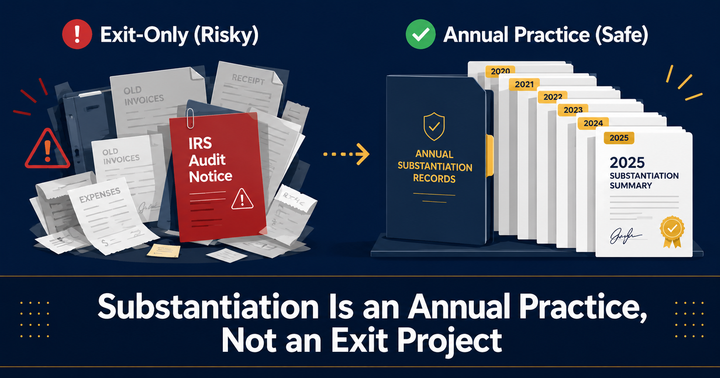
Substantiation Is an Annual Practice, Not an Exit Project
The shift in mindset: substantiation should look like a 409A. Like your annual board minutes. Like your D&O renewal. You do it every year, on the same cadence, whether or not anything material happened.
The cost of doing it annually is trivial. The cost of not doing it — discovered in an audit eight years later — can be the entire exclusion. Tens of millions of dollars of tax.
What Reconstruction Actually Costs
Here is what “we’ll deal with it at exit” means in practice.
The deal is signed, or close to it. Your tax preparer asks for support for your §1202 position, and the record it rests on has to actually exist. Nobody at the company can establish gross assets as of your issuance date — the CFO who knew is gone, the old accounting file won’t open, the cap table lives on a platform you migrated off two systems ago. So you hire a forensic accountant.
A forensic engagement on the eve of a sale means paying professionals to rebuild, under deal-deadline pressure, records the company could have generated contemporaneously for almost nothing: bank statements and general ledgers to establish gross assets at each issuance date, payroll and vendor records to support the 80% active-business analysis year by year, board minutes and product history to document what the business actually was during the pivot. Expect tens of thousands of dollars — often more than annual attestations would have cost over the company’s entire life — plus your deal lawyer’s time supervising it, all billed while the transaction clock is running.
And you still end up with the weaker product. A reconstruction is exactly what the IRS is trained to discount: an after-the-fact narrative assembled by paid professionals once the money was already on the table. A one-page attestation signed by your CFO each January is an hour of work and carries more evidentiary weight than a reconstruction costing a hundred times as much.
That’s the trade: an hour a year, or a forensic accountant at closing.
What the Annual Practice Actually Looks Like
Every January, send your CFO (or controller, or whoever signs the financial statements) a short attestation request. Three to five sentences. You're asking them to confirm, as of the prior year-end:
- For any stock issued during the year, the company met the applicable §1202 aggregate gross assets test (under $50 million, or the OBBBA $75 million threshold for stock issued after July 4, 2025) at all times before the issuance and immediately after it; and for all previously issued shares, the company maintained records sufficient to support the original issuance-date test and any tranche analysis.
- The company was engaged in a qualified active business during substantially all of the shareholder's holding period — with a one-sentence description of what the business actually did this year, not what it became.
- No redemptions occurred during any relevant §1202 testing window that would taint current-year issuances or previously issued shares — with a note of any redemptions that occurred, even if believed to be immaterial.
- The company has been and remained a C corporation during substantially all of the shareholder's holding period.
- For issuances after July 4, 2025: the tranche analysis under the OBBBA bifurcation. (The OBBBA — the One Big Beautiful Bill Act, enacted in July 2025 — raised the §1202 gross assets cap from $50M to $75M for stock issued after July 4, 2025, and requires a tranche-by-tranche analysis for issuances that straddle the effective date.)
Have them sign it. Attach the year-end balance sheet, a cap table snapshot, and a one-paragraph business description. File it. Done in fifteen minutes.
By year five, you have five dated, signed annual attestations sitting in a folder — each one prepared contemporaneously, by a person with personal knowledge, when the facts were still true.
That folder is your QSBS substantiation file.
Why Annual Beats Reconstruction
Four reasons the IRS treats contemporaneous records as dramatically stronger than after-the-fact reconstructions:
CFOs leave. By the time the audit arrives, the person who actually knew the gross assets, who actually managed the redemptions, who actually understood what the business did in 2021 — may not work at the company anymore. May not return your calls. May not remember.
Records age out. Cap table platforms change. Bank accounts close. Old QuickBooks files don't open. The 2021 board package that lived in someone's Dropbox folder isn't there in 2029.
Memory drifts. Business descriptions in particular get retroactively rewritten. The company was "a SaaS infrastructure company" in 2021 because that's what it became in 2024. But maybe in 2021 it was actually a consulting business that hadn't yet pivoted. That distinction matters for the active business test. You can't see it five years later. You can see it today.
Need a letter, not just a checklist?
If you need to get a defensible QSBS attestation letter drafted and signed by counsel — covering the gross-assets test, active-business analysis, redemption history, and OBBBA tranche bifurcation — we offer flat-fee engagements after a short intake call.
The timing math is worse than you think. You hold for five years before sale. The IRS audit window for your tax return runs three years after filing — six if you understate by more than 25%. So the audit notice can plausibly arrive eight to ten years after the stock was issued. Reconstruct that.
Can You Actually Prove It? A Five-Point Self-Check
Here's the five-point checklist I run through when reviewing a QSBS position:
Does the issuance record hold together? You should have a copy of your stock purchase agreement and a stock certificate or receipt evidencing your shares.
Can you establish the gross asset test was satisfied at issuance? §1202 requires that the corporation's gross assets were below a statutory threshold at the time your stock was issued. The practical solution is a certification from the company's CFO or CEO confirming that was the case. That's one of the five confirmations in the QSBS Confirmation Letter Template.
Is the active business requirement supportable? At least 80% of the company's assets must have been deployed in a qualified active trade or business during substantially all of your holding period — not just at issuance. This is the trickiest part of the test, and it's where silent gaps most often appear. The common fear here is misplaced: a company that closed a Series A and parked $8M in treasuries is usually fine. §1202(e)(6) treats assets held as part of the reasonably required working capital needs of the business — or held for investment and reasonably expected to be used within two years to finance research and experimentation or increases in working capital — as used in the active conduct of a qualified trade or business. The constraint bites later. After the corporation has been in existence for at least two years, no more than 50% of its assets may qualify under that rule, which as a practical matter caps cash and investment assets at roughly 70% of total value. The failure mode is not idle cash in year one; it is a large raise still undeployed after the company's second birthday. (I walk through that math in detail in the §1045 cash box trap.) A pivot to a new business line mid-hold creates a separate gap. This requirement needs to be true continuously, not just at the moment you sold.
This isn't just a one-time question. The active business requirement must be satisfied for substantially all of your holding period. An annual written confirmation from the company that it continues to meet the requirement is good practice — and much easier to produce than reconstructing years of history under audit pressure.
No disqualifying redemptions. Stock is not QSBS if the corporation purchased more than a de minimis amount of its stock from the holder or a related person during the 4-year period straddling issuance (2 years before to 2 years after), or made significant redemptions from any holder during the 2-year period straddling issuance (1 year before to 1 year after) exceeding 5% of the corporation's aggregate stock value (IRC §1202(c)(3); Treas. Reg. §1.1202-2). That 5% is measured by value, not share count, against the aggregate value of all the corporation's stock as of the beginning of the 2-year period. A purchase exceeds de minimis only if more than $10,000 is paid and more than 2% of the relevant stock is acquired (Treas. Reg. §1.1202-2) — so a purchase under either prong stays disregarded. Repurchases incident to a bona fide termination of an employee's or director's services, death (if purchased within 3 years and 9 months), disability or mental incompetency, or divorce are disregarded. This is something the company needs to confirm — you likely won't know it on your own.
Was the stock originally issued to you? §1202 requires original issuance. Transfers, secondary purchases, and certain exchanges can break eligibility. If your shares changed hands or you converted from a different instrument, that needs scrutiny.
The hard reality: most of these facts are set years before the exit. If your records aren't clean now, they're harder to reconstruct later — especially under audit pressure.
For the section-by-section breakdown of what a strong QSBS attestation letter actually needs to say, see my detailed walkthrough — header, gross-assets math, active-business confirmation, original-issuance reps, and the redemption history language IRS agents look for.
The QSBS Confirmation Letter Template covers the five key factual confirmations a company can make to a shareholder about their stock's §1202 status. It won't replace legal advice, but it's a concrete starting point.
If you have your stock purchase agreement, a CFO certification confirming the gross asset test and active business status, confirmation of no disqualifying redemptions, and documentation showing original issuance — you're in good shape. If any of those are missing or uncertain, that's worth addressing now, not at closing.
Want a second set of eyes on your QSBS position before a sale or liquidity event? Book a 20-minute scoping call — we'll walk through where your documentation stands, and I'll follow up with a flat-fee proposal if a fuller review makes sense.
What the NVCA forms actually do today
The National Venture Capital Association model documents — the forms that govern the overwhelming majority of priced venture rounds in this country — do address Section 1202. But look closely at how, and you find a structure that is backward-looking and almost entirely passive.
Start with the Stock Purchase Agreement. The company represents, as of the closing, that it is an eligible corporation and that at least 80% by value of its assets are used in the active conduct of one or more qualified trades or businesses within the meaning of Section 1202(e). Useful — but it is a single representation, true as of one day, and never refreshed.
The Investors' Rights Agreement carries the only ongoing QSBS covenant, and it is weaker than most founders and investors assume. The company agrees to use commercially reasonable efforts to cause the stock to qualify — except that obligation falls away if the board determines, in good faith, that qualification is not in the company's best interests. The company agrees to make the reports required under Section 1202(d)(1)(C). And then the operative mechanic: only upon a major investor's written request, the company — at its own option — either tells the investor whether the stock is QSBS, or simply hands over the factual information in its possession that the investor would need to figure that out for itself.
Read that again, because it is the whole problem. There is no annual obligation — if no investor sends a written request, the company is never required to produce anything at all. There is no requirement that anyone certify the facts; the company can discharge the covenant by passing along raw information, at its option. And there is no officer — no CFO, no principal financial officer — who has to put a name to anything. Nothing in the standard forms asks the company to confirm, in year two or year five or year nine, that the facts underlying the exclusion are still true.
And this is not a gap the NVCA simply hasn't gotten around to. The NVCA refreshed these very documents on October 2, 2025. It updated the QSBS language to track the new law — referencing the more generous post-OBBBA exclusion and the $75 million gross-asset threshold. In other words, it had the QSBS provisions open on the operating table. And it changed the dollar figures while leaving the documentation architecture exactly as it found it: passive, request-driven, uncertified. The gap is not an oversight. It is a choice the standard forms keep making.
The gap nobody is documenting
Here is why that single-moment approach is a real problem rather than a technicality: several of the core Section 1202 requirements are not issuance tests at all. They are continuous tests.
The active business requirement is the clearest example. Section 1202(c)(2) requires that the company meet the active qualified-business requirement during substantially all of the taxpayer's holding period — not just on the day the stock is issued. The 80% asset test, the prohibition on holding more than 10% of total asset value in real estate not used in the business, the limit on holding more than 10% of assets net of liabilities in portfolio stock and securities of other companies, the look-through questions that arise when the company owns subsidiaries — these are facts that can change, quietly, in any given year.
Imagine a company that issues clean QSBS at formation and then, in year three, spins up a consulting line that grows to half of revenue, or parks a large cash raise in a securities portfolio, or buys a building. None of that shows up in a closing representation signed years earlier. And under our system, the burden of proof on a tax position sits squarely on the taxpayer. When an examination letter arrives — and it tends to arrive a few years after the sale, when the company may not even exist anymore — the shareholder is the one who has to produce the facts.
This is no longer hypothetical. In Ju v. United States No. 22-1815T (Fed. Cl. Mar. 18, 2024), the first federal court decision to address a litigated §1202 exclusion claim, the taxpayer lost on exactly this. The court held that the taxpayer bears the burden of proving the gross assets test was satisfied at issuance — and financial statements from years after the issuance date did not carry it. The court also rejected his claim that he had owned the shares for years before their formal issuance, because nothing in the record showed the parties treating the shares as his during that period. Believing you qualified is not evidence. Contemporaneous records are.
So picture the realistic scenario. A company operates for ten years. It sells. Three years later, a notice shows up. Now someone has to reconstruct a decade of asset composition, revenue mix, and redemption history from records that were never assembled for that purpose, if they survive at all. That is an expensive, anxious, and entirely avoidable fire drill.
Do the certification at exit — and every year before it
Everyone agrees you should pull a QSBS substantiation package together at exit. You should. But why on earth would you wait? The facts are far easier to capture contemporaneously, while the people who know them are still in the building and the records are still warm. An exit-only approach is the equivalent of saving none of your receipts and then trying to rebuild your expense report the week before the audit.
The fix is not complicated. The company's CFO or principal financial officer should, once a year, sign a short certification confirming the facts that undergird the exclusion as of that year-end: that the company remained an eligible corporation engaged in the active conduct of a qualified trade or business; that at least 80% of its assets by value were so used; that it stayed within the real estate and portfolio-securities limits; that there were no disqualifying redemptions, including the related-person redemptions that reach further than people expect; and that the company's subsidiary structure, if any, did not knock it out of qualification.
For a CFO who knows the business, that is perhaps an hour of work a year. Set against a benefit that, post-OBBBA, can shelter the greater of $15 million or ten times basis per shareholder — with a 50% exclusion now available at three years, 75% at four, and 100% at five for stock issued after July 4, 2025 — an hour a year is not a cost. It is the cheapest insurance a company will ever buy.
A suggested change to the NVCA forms
This is, at bottom, a drafting problem, and it has a drafting solution. The NVCA Investors' Rights Agreement should convert the QSBS provision from a passive, request-driven statement into an affirmative annual covenant: an undertaking by the company to deliver, each year and without being asked, a certification signed by its principal financial officer as to the facts that underlie the Section 1202 qualification of the stock, for so long as the investor holds it. Three small changes to the existing covenant get you there — make delivery annual rather than triggered by a written request; make it a signed certification of facts rather than a statement the company may or may not give at its option; and close the escape hatch that lets the company satisfy the obligation by dumping raw information over the wall.
Companies will not generally volunteer this; it is one more obligation. But investors who actually care about their Section 1202 outcome — which is to say, every venture and angel investor who underwrote part of their return on a tax-free exit — should want it, and should be willing to ask for it. The marginal burden on the company is an hour of a CFO's time. The protection it creates for the cap table is measured in millions.
We substantiate the $50 lunch because the system rewards contemporaneous proof and punishes reconstruction. The same logic applies, with far more money at stake, to the single most important exclusion in the startup tax world. It is time the standard documents caught up.
This post argues a position about how the venture documents should be drafted; it is not legal or tax advice, and Section 1202 is full of traps that turn on specific facts. If you want help building an annual QSBS substantiation process for your company or your portfolio, that is something we do.
What to Do This Week
Stop reading and do this:
- Pick a date — say, the second Monday of January — and put it on your calendar as a recurring event. Title it "QSBS Substantiation."
- Draft a template attestation. Two paragraphs, five confirmations, signed and dated — use the five confirmations listed in the section above.
- Send it to your CFO (or to yourself, if you're a solo founder and the same person who signs the financials). Get it signed before January 31.
- Save it somewhere durable — not just your laptop, not just a cloud folder you'll lose access to when you leave. Print a copy if you want.
- Repeat next year.
If you've held QSBS-eligible stock for years and never done this, do this year's attestation now — and then do retrospective ones for each prior year you can credibly reconstruct. A reconstructed attestation prepared in 2026 for 2021 facts is weaker than a contemporaneous one. But it is far stronger than nothing, and dramatically stronger than reconstructing for the first time during an audit.
The Bottom Line
QSBS substantiation isn't a closing-binder document. It's an annual hygiene practice that compounds for as long as you hold the stock.
The lawyers and CFOs who treat it as a once-at-exit project are creating audit risk for their founders. The ones who treat it as an annual practice are building something the IRS can't punch holes in.
That's the standard we hold ourselves to, and it's what we help founders build.
If you've held QSBS-eligible stock and never done annual substantiation — or aren't sure whether your existing records would survive an audit — that's exactly what we do. This is a built service, not a plan: QSBS Sentinel™ runs annual §1202 substantiation on a fixed fee — the attestation letter, CFO outreach, file maintenance, and retrospective work for prior years, handled end-to-end. See how QSBS Sentinel works, or book a 20-minute call to talk through your situation.
Related reading: What your QSBS attestation letter must actually say · Whether your QSBS position will hold up · QSBS Checklist: Does Your Stock Qualify Under Section 1202? · QSBS & Section 1202: The Complete Founder's Guide · QSBS Sentinel™ — Annual §1202 Attestation
This post is for educational purposes only and is not legal or tax advice. Consult a qualified attorney about your specific situation.