The Rule 701 Math: How to Do It
Intro This post is a practical guide to making sure your equity compensation issuances fit within the federal securities exemption in Rule 701. It’s not legal advice and it doesn’t cover every nuance—Rule 701 can get weird fast—so confirm your own company’s facts with counsel.
- What Rule 701 does (and why the math matters) Rule 701 lets private companies issue compensatory equity—stock options, restricted stock, RSUs, stock appreciation rights, and similar awards—to employees, directors, and certain service providers without registering with the SEC. The “compensatory” part is critical: the issuer cannot use Rule 701 to sell securities for general fundraising.
Because it’s an exemption, Rule 701 has guardrails. In particular, it caps how much equity you can issue in any rolling 12‑month period. If you cross the cap, the exemption can still apply, but you trigger additional disclosure obligations and risk creating an expensive due diligence mess if you plan to raise capital or sell the company.
- The cap: “the greatest of three” test (rolling 12 months) Rule 701 measures the aggregate “sales price” (or “amount” of securities) sold during any consecutive 12‑month period. The cap is the greatest of:
- $1,000,000
- 15% of the issuer’s total assets (based on the most recent balance sheet)
- 15% of the outstanding securities of the same class being offered
This is not a calendar year limit. It moves as time passes. You are always looking backwards 12 months from each grant.
- What counts (and how to value it) This is where the practical math comes in.
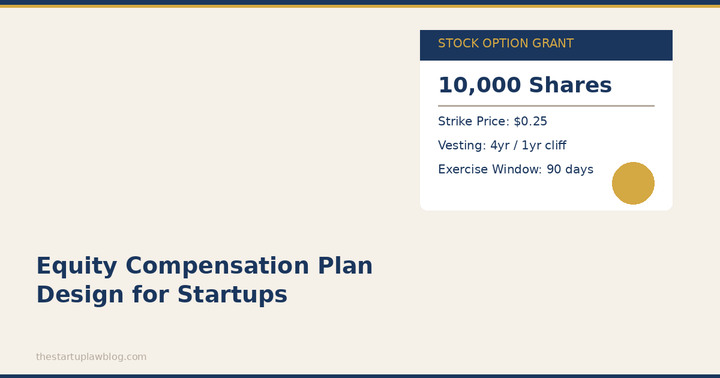
Options: count based on the aggregate exercise price at grant. Example: 100,000 options with a $2 strike consumes $200,000 of Rule 701 capacity.
Restricted stock: count based on what the grantee pays for the stock (if anything) or the value of the securities issued.
RSUs: RSUs count at the fair value at grant (typically tied to your 409A valuation, but confirm with your auditor/counsel). RSUs consume capacity quickly because there is no strike price to temper the dollars.
SARs and similar awards: generally count the value of the underlying securities per your plan and grant structure.
Mixed classes: if you issue multiple classes, do the 15% outstanding test separately for each class you are issuing, but track the $1M and total assets tests overall.
- The $10M disclosure trigger Separately, if your aggregate sales price (or amount) in any rolling 12‑month period exceeds $10,000,000, you must provide expanded disclosures (plan documents, risk factors, and financial statements) a reasonable time before the “sale” (often before option exercises). Crossing $10M doesn’t prohibit grants, but the disclosure logistics can be a real burden if you aren’t prepared.
- A working example (RSUs vs. options) Assume:
- Total assets: $25M
- Outstanding common stock: 12M shares
- Exercise price for new options: $1.50 per share
- Fair value for RSUs: $3.00 per unit
Cap: the greatest of:
- $1M
- 15% of assets = $3.75M
- 15% of class outstanding = 1.8M shares × $1.50 = $2.7M Cap = $3.75M.
If in the past 12 months you granted:
- 1M options @ $1.50 strike → $1.5M
- 400k RSUs @ $3.00 → $1.2M
- 100k restricted shares @ $1.50 purchase → $150k Total = $2.85M. A new grant of options equal to 500k shares adds $750k, bringing you to $3.6M (still within the cap). A new RSU grant of 300k units adds $900k and would push you past the $3.75M cap—this is a common outcome.
- Operationally, how to stay compliant
- Maintain a single Rule 701 ledger tied to your cap table and accounting system
- For each grant, recalculate a rolling 12‑month total and compare to the cap
- Track grants by class and award type (options vs RSUs) so valuation is not overlooked
- Monitor for acquisitions/mergers that change outstanding counts and assets
- Make a plan for the $10M disclosure trigger well in advance
- Common mistakes
- Treating RSUs like options (they aren’t; they use fair value)
- Forgetting that it’s a rolling 12‑month period
- Issuing to service providers who don’t fit within Rule 701’s “compensatory services” concept
- Missing the $10M disclosure trigger timing for option exercises
Closing Rule 701 compliance is mostly discipline. Get your inputs right, track on a rolling 12‑month basis, and don’t let RSUs silently eat your capacity.