409A Valuation: The Complete Guide for Startup Founders (2026)
Understand common-stock valuation, the three 409A safe harbors, when to update, and why an independent appraisal does not guarantee every option is exempt.



Page 4
Understand common-stock valuation, the three 409A safe harbors, when to update, and why an independent appraisal does not guarantee every option is exempt.
Before exercising options ahead of Washington’s 2028 income tax, compare NSO income, ISO AMT, QSBS holding periods, liquidity and the applicable deductions.
How Washington’s ING trust addback works, what it means for existing trusts, and why completed gifts, CRTs and GRATs require separate analysis.
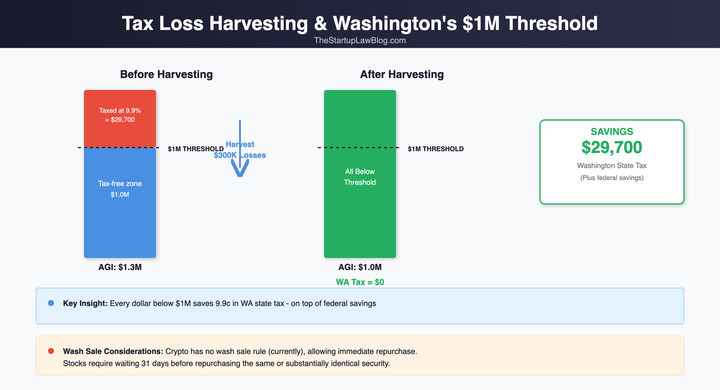
Federal AGI is only the starting point for Washington's 9.9% income tax. Tax loss harvesting works through Washington modifications, the capital gains tax, and credits — here's how to use realized losses strategically before and after 2028.
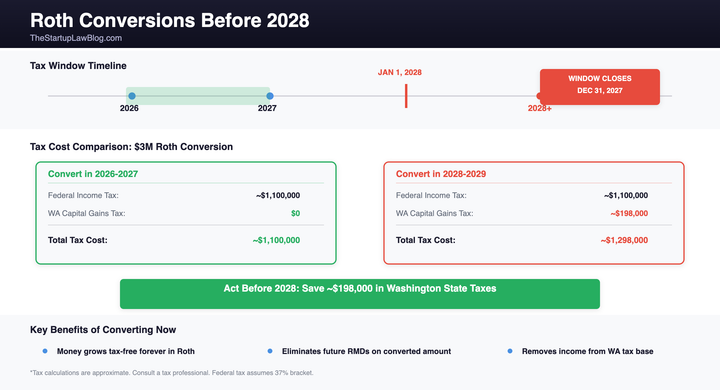
Roth conversions do not end in 2028. Washington’s tax depends on the taxable conversion plus other income, available deductions, and the timing of each year’s income.
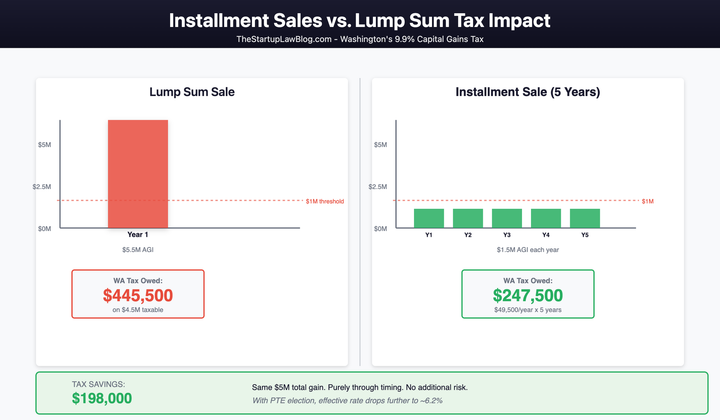
Installment sales can spread eligible gain, but Washington’s two tax bases, sale-date allocation, credits and financing risks determine the result.
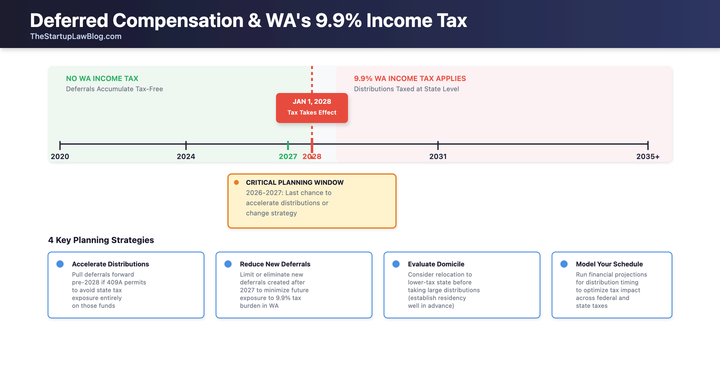
Compensation earned before 2028 under an NQDC plan can enter Washington's 9.9% income-tax calculation when included federally in 2028 or later — subject to residency, sourcing, §409A payment rules, and 4 U.S.C. §114.
Washington could raise its income tax, but increases are not inevitable. Compare state histories, the deduction’s indexing rules and practical planning scenarios.
Washington’s income tax begins in 2028. Estimated payments are not required before July 1, 2029. Understand the annual payment, 90%/100% penalty protection, and PTE rules.
Washington’s charitable deduction has a $100,000 cap shared by couples. DAF deductions, CRT distributions and QCD exclusions work differently; model both state taxes.