
Section 1202 Rollover Planning: Preserving QSBS Benefits When a Liquidity Event Comes Too Soon
One of the most painful scenarios for founders and early investors is watching a promising exit opportunity—an acquisition, secondary sale, or major financing event—arrive before you've held your company stock for five years. Under Section 1202 of the Internal Revenue Code, you can exclude up to 100% of your capital gains from qualified small business stock (QSBS), but only if you've held the stock for at least five years. Sell too early, and you lose that enormous tax benefit entirely.
But there's a tool that can save you: Section 1045 rollovers. This provision allows you to defer (and potentially preserve) your Section 1202 exclusion by rolling your proceeds into replacement QSBS within 60 days. It's not a perfect solution—there are real limitations and traps—but it can be a lifesaver when timing works against you.
The OBBBA Changes: Why This Matters More Now
The One Big Beautiful Bill Act (OBBBA), signed July 4, 2025, significantly changed the QSBS landscape. For stock issued after that date:
Tiered exclusions: 50% exclusion at 3 years, 75% at 4 years, 100% at 5+ years (previously, the full 5-year hold was required for any exclusion).
Increased gain cap: The per-issuer exclusion cap increased from $10 million to $15 million (or 10x adjusted basis, whichever is greater).
Higher asset threshold: The gross asset test increased from $50 million to $75 million, allowing more companies to issue qualifying QSBS.
These changes make Section 1045 rollovers significantly more powerful. Under the old rules, selling before 5 years meant zero exclusion — a 1045 rollover was your only option. Under the OBBBA’s tiered structure, you can now combine a partial 1202 exclusion with a 1045 rollover on the remainder. And because holding periods tack, a founder who rolls at year 3 only needs 2 more years on the replacement stock to reach the full 100% exclusion.
Understanding the 5-Year Holding Period Problem
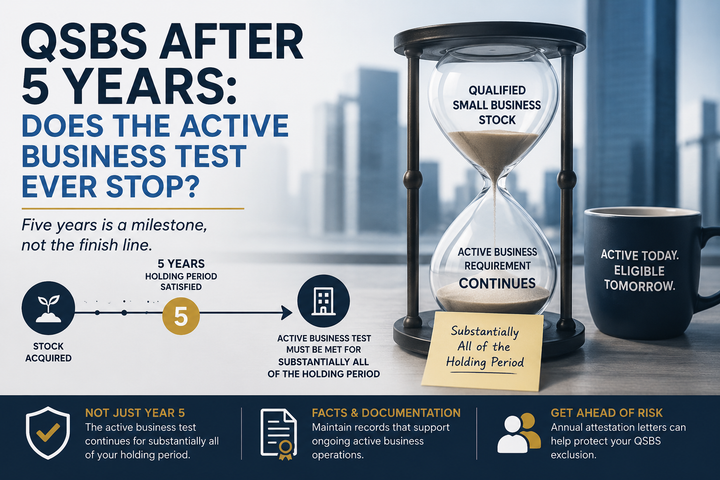
Section 1202 requires that you hold QSBS for at least five years from the date of original issuance to qualify for the permanent 100% exclusion. For many startup founders, this is straightforward: you buy stock at incorporation for $0.01 per share, hold it through the company's growth, and sell in year six or beyond. The gain is excluded from federal income tax.
But the real world doesn't always cooperate. You might face:
- An acquisition offer in year three: A larger company wants to buy your startup at a compelling valuation, but you've only held stock for three years.
- Secondary sale pressure: Early investors or founders need liquidity before the company is ready for a traditional exit, forcing an early secondary transaction.
- A company pivot requiring restructuring: Your company undergoes a significant restructuring that resets the clock on your holding period.
- A down round or emergency financing: New stock is issued, creating questions about which shares qualify and which don't.
In any of these scenarios, selling before five years means losing the Section 1202 exclusion—unless you use Section 1045 to defer the gain and reinvest the proceeds in new QSBS.
What Section 1045 Is and How It Works
Section 1045 allows you to defer the recognition of gain on the sale of QSBS if you reinvest the proceeds in new QSBS within 60 days. The mechanics are straightforward:
- You sell QSBS that doesn't yet qualify for the 5-year holding period.
- Within 60 days of the sale, you purchase new QSBS (in a different company or in a new issuance by your current company).
- The gain is not recognized in the year of sale.
- Your basis in the new stock is reduced by the deferred gain.
- You start a new 5-year holding period clock on the replacement stock.
Think of it as a tax deferral mechanism, not a tax elimination. You're not escaping tax—you're buying time by deferring the gain until you sell the replacement stock. If the replacement stock later qualifies for the Section 1202 exclusion (because you held it for five years), you can exclude 100% of that gain.
Here's a simplified example: You buy QSBS in Company A for $1,000 in year one. In year three, Company A is acquired, and you sell for $10,000, creating a $9,000 gain. Normally, you'd recognize $9,000 in income in year three. But under Section 1045, you can defer that gain if you reinvest at least $9,000 in new QSBS (say, in Company B) within 60 days. Your basis in the Company B stock would be $1,000 (the original $1,000 plus the $9,000 deferred gain, which reduces basis). If you hold Company B stock for five years and sell for $25,000, the $24,000 gain would be eligible for the Section 1202 exclusion.
The Requirements for a Successful Section 1045 Rollover
To use Section 1045, you must satisfy several strict requirements. Missing any one of them means the rollover fails, and you're stuck recognizing the full gain in the year of sale.
The original stock must be held for at least six months. Section 1045 doesn't apply to QSBS held for six months or less. This is a hard floor—even if you're one day short, the rollover is disallowed.
You must reinvest within 60 days. The 60-day window is strict. You must purchase the replacement stock no later than 60 days after the sale. This is not a tax return filing deadline—it's an actual calendar deadline. If the 60th day falls on a weekend or holiday, you can reinvest on the next business day, but missing this window is fatal to the rollover.
You must reinvest in new QSBS. The replacement stock must itself qualify as QSBS under Section 1202. This means it must be:
- Stock in a C corporation
- Issued after August 9, 1993
- Acquired for money or property (or in connection with the performance of services)
- In a company with less than $50 million in gross assets at the time of issuance ($75 million for stock issued after July 4, 2025, under the OBBBA)
- In a company engaged in an active business (not primarily holding passive investments)
You must reinvest an amount equal to or greater than the proceeds. If you sell QSBS for $50,000, you must invest at least $50,000 in replacement QSBS. If you invest $40,000, only $40,000 of the gain is deferred; the remaining $10,000 is recognized in the year of sale.
The stock must be held in your name at the time of the rollover. You can't use Section 1045 if the replacement stock is held in a trust, partnership, or other entity (with limited exceptions for spouses).
How the Holding Period Works on Replacement Stock
This is critical: when you use Section 1045, the holding period clock for Section 1202 purposes restarts on the replacement stock. You don't get to tack the old holding period onto the new one.
If you buy Company A stock in year one and sell it in year three (triggering a Section 1045 rollover into Company B stock), you have zero years of holding period in Company B stock as of the sale. You must now hold Company B stock for a full five years—until year eight—to qualify for the Section 1202 exclusion on the replacement stock.
However, for purposes of the six-month minimum required to use Section 1045, the holding period of the original stock counts. You can satisfy the six-month requirement with the original QSBS and then immediately sell and reinvest. But the five-year holding period requirement for the 100% exclusion begins anew with the replacement stock.
Practical Scenarios Where Section 1045 Planning Helps
Scenario 1: Early Acquisition
You founded Company A in 2021 and purchased founder stock for $5,000 at incorporation. In 2024 (year three), a strategic buyer offers $5 million for the company. You'd love to take the deal, but you don't qualify for the Section 1202 exclusion yet.
Solution: Use Section 1045 to defer the $4,995,000 gain. Within 60 days, invest at least $5 million in a new startup (either a company you're founding or a pre-Series A investment in an existing startup that qualifies as QSBS). You now have five years to hold the new QSBS. If the replacement investment works out and you hold for the full five years, you can exclude the entire gain at the time of the second exit.
Scenario 2: Secondary Sale Pressure
You and your co-founder own a profitable SaaS company. A larger PE firm wants to acquire the company but is only willing to pay a below-market price. However, an investor is offering to buy out the co-founder's shares at a fair valuation. You've held stock for three years.
Using Section 1045, the co-founder can sell their shares to the investor without triggering the full tax impact immediately. The proceeds can be reinvested in replacement QSBS (perhaps a seed investment in a new venture, a stake in another startup, or a new share class in your current company if the company issues new QSBS-qualifying shares). This gives the co-founder the liquidity they need while preserving the Section 1202 exclusion opportunity on the replacement stock.
Scenario 3: Company Restructuring
Your company undergoes a merger or reorganization. In many cases, old stock is exchanged for new stock in the surviving corporation. If the exchange isn't properly structured, you might lose QSBS status or reset your holding period. A well-planned Section 1045 rollover (or a combination of Section 1045 and tax-free reorganization treatment under Section 368) can help preserve the benefits and allow you to reinvest strategically.
The Relationship Between Section 1045 and Section 1202
These two provisions work together but serve different purposes. Section 1202 provides the exclusion; Section 1045 is the deferral mechanism that helps you buy time to eventually qualify for the exclusion.
On its own, Section 1045 is not a permanent tax benefit. You're deferring tax, not eliminating it. The real payoff comes when the replacement QSBS qualifies for the Section 1202 exclusion because you've held it for five years. Then you can exclude 100% of the gain—both the original deferred gain and any new appreciation on the replacement stock—from federal income tax.
If you use Section 1045 to buy time, but the replacement stock never qualifies for Section 1202 (because you sell it before five years, or because the company becomes ineligible for QSBS status), you'll eventually have to recognize the deferred gain. You don't lose the tax benefit forever—you just defer it to a later year.
Limitations and Traps in Section 1045 Planning
The six-month minimum can be a trap. If you sell QSBS before you've held it for six months, you cannot use Section 1045 at all. You must recognize the gain in the year of sale, and the replacement stock purchase doesn't help you. This can be a serious issue if a company is acquired very quickly after a funding round.
Documentation is essential. To claim a Section 1045 rollover, you must file Form 8949 (Sales of Capital Assets) and Schedule D with your tax return, clearly identifying the rollover and the replacement stock purchase. Without proper documentation, the IRS may disallow the deferral. Many taxpayers lose the benefit because they didn't properly report the rollover on their return.
The replacement stock must truly qualify as QSBS. If the replacement company has over $50 million in assets, is engaged in passive investment activities, or is an S corporation, the stock doesn't qualify. You'll recognize the full gain, and the rollover fails. This is why due diligence on the replacement investment is important.
You can't use Section 1045 if you don't reinvest. If you sell QSBS and pocket the proceeds without reinvesting within 60 days, you've lost the rollover opportunity entirely. There's no do-over; the clock is absolute.
The basis reduction creates future tax complexity. When you use Section 1045, your basis in the replacement stock is reduced by the deferred gain. This means your gain on a future sale is larger than it would be otherwise. You need to carefully track this basis adjustment on your stock ledgers and tax records.
Section 1045 vs. 1031 Exchanges: Key Differences
If you're familiar with tax-deferred 1031 exchanges in real estate, you might wonder how Section 1045 compares. They're similar in concept but fundamentally different in structure.
A 1031 exchange allows you to sell real property and buy replacement real property of like kind, deferring the gain indefinitely. The replacement property must be identified within 45 days and closed within 180 days. There's no permanent tax benefit—you're just deferring—but the deferral is indefinite.
Section 1045 is more limited: the 60-day window is shorter, you must reinvest in a specific type of property (QSBS), and the deferral only makes sense if the replacement stock eventually qualifies for the Section 1202 exclusion. But unlike 1031 exchanges, Section 1045 offers the possibility of permanent tax exclusion (not just deferral) if the replacement stock qualifies for Section 1202 after five years.
In other words, 1031 is about deferral; Section 1045 is about deferral plus the potential for permanent exclusion.
Planning Strategies for Founders Expecting Early Exits
If you're a founder or early investor expecting a potential exit before five years, consider these planning strategies:
Build Section 1045 reinvestment into your exit planning. If an acquisition is possible before year five, identify potential replacement QSBS investments now. These might include investments in other startups, co-founder equity stakes in new ventures, or even carefully structured equity investments in early-stage companies in your network.
Negotiate for earnouts or deferred payments. If the buyer is offering cash upfront, ask for an earnout structure (payment contingent on post-acquisition performance) or a seller note (deferred payment). This can extend the holding period and potentially allow you to reach five years without triggering an early exit.
Structure acquisitions as stock deals if possible. If the buyer will accept payment in the buyer's stock (instead of cash), the transaction might be structured as a tax-free reorganization under Section 368. The buyer's stock would carry a new holding period, but if it qualifies as QSBS, you'd start fresh toward the five-year requirement. This isn't always possible, but it's worth exploring.
Consider a secondary sale to a financial buyer instead of a primary exit. If you're under five years and don't want to lose QSBS benefits, selling a portion of your stake to a venture firm or other investor might be better than a full acquisition. The portion you sell can trigger a Section 1045 rollover into new QSBS, while your remaining stake in the original company continues to accrue holding period toward the five-year threshold.
Work with a tax advisor to track holding periods closely. Once you're approaching year four or five, you need to know exactly how much of your QSBS qualifies for the full exclusion. Different classes of stock, different grant dates, and different vesting schedules can all affect your holding period. A detailed stock ledger and clear record-keeping are essential.
The Angel Investor Play
Section 1045 is particularly powerful for active angel investors. An angel who invests in multiple startups will inevitably have some positions that exit before the five-year mark — an early acquisition, an acqui-hire, or a secondary sale opportunity. Rather than losing the QSBS exclusion on those gains, the angel can roll the proceeds into new QSBS within 60 days and continue building toward the five-year holding period on the replacement stock.
This creates a rolling portfolio strategy: gains from early exits fund new QSBS investments, each carrying forward the tacked holding period. An angel who invests consistently can maintain a pipeline of QSBS positions where even "early" exits preserve the exclusion through rollovers. The key constraint is that the replacement stock must be newly issued QSBS — not secondary market purchases — which means the angel needs a deal flow of new qualifying investments.
Washington State Implications
For Washington residents planning around ESSB 6346 (the 9.9% income tax effective in 2028), Section 1045 rollovers carry additional significance. Because Washington's tax base starts with federal AGI, and Section 1045 defers gain recognition at the federal level, a successful rollover also defers the Washington income tax on that gain. The gain doesn't enter federal AGI until the replacement stock is eventually sold — and if the replacement stock is held long enough to qualify for the Section 1202 exclusion, the gain may never enter federal AGI at all.
This makes Section 1045 a particularly useful tool for Washington founders and investors who face early exits: defer now, hold the replacement stock for five years, and potentially exclude the gain from both federal and Washington tax entirely. For the full analysis of QSBS and Washington's income tax, see Does QSBS Avoid Washington's New 9.9% Income Tax?
The Bottom Line
Section 1045 rollovers are a powerful tool for preserving Section 1202 QSBS benefits when a liquidity event comes too soon. But they're not automatic, they require strict compliance with timing and investment requirements, and they work best as part of a comprehensive exit strategy.
If you're facing an early acquisition or secondary sale opportunity before you've held your QSBS for five years, don't assume you've lost the Section 1202 benefit. Talk to a tax advisor about whether a Section 1045 rollover makes sense for your situation. It could save you hundreds of thousands of dollars in federal income tax when your replacement investment eventually exits.
Keep Reading
- The Complete Guide to Qualified Small Business Stock (QSBS): Section 1202 Explained
- Does QSBS Avoid Washington’s New 9.9% Income Tax? (Yes — For Now)
- QSBS Stacking: How to Multiply the $15M Exclusion with Trusts and Family Gifts
- Section 1045 Rollovers: How to Defer QSBS Gains When You Sell Too Early