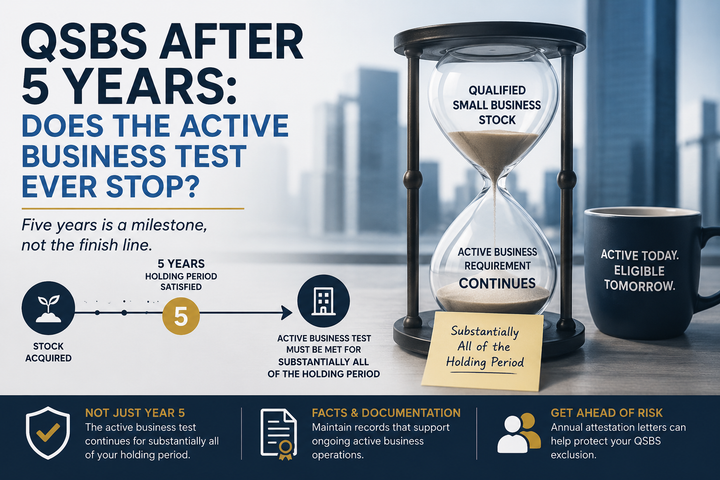
No. Reaching five years does not permanently secure QSBS. §1202(c)(2)(A) requires the corporation to meet the active-business requirements of §1202(e) and remain a C corporation during substantially all of the shareholder’s holding period for the stock — including time after year five. The applicable acquisition-date regime determines when an exclusion becomes available; it does not freeze active-business compliance.
Section 1202 lets eligible shareholders exclude capital gain on qualifying small business stock, subject to strict issuer and shareholder rules. This article answers one question: does the active-business test ever stop running?
A note on OBBBA's tiered holding periods
For qualifying stock acquired after July 4, 2025, the newer regime permits exclusion of 50%, 75%, or 100% of eligible gain after at least three, four, or five years, respectively, within the per-issuer limit. Stock acquired on or before July 4, 2025 generally requires more than five years, and older acquisition vintages have different exclusion percentages. Determine the acquisition date after applicable §1223 holding-period tacking; a recent issuance of replacement shares does not automatically put them in the newer regime.
For exclusion percentages, per-issuer limits, and how any taxable remainder is taxed, see the Complete Guide to QSBS. Reaching three, four, or five years does not end the active-business inquiry. The statutory standard is substantially all of the full holding period, not an express requirement that every day qualify without exception.
What the statute actually says
§1202(c)(2)(A) requires that the corporation meet the active business requirements of §1202(e) “during substantially all of the taxpayer’s holding period for such stock,” and that it remain a C corporation for that same period.
Section 1202(e)(1) supplies two core requirements for a qualifying period, subject to the special rules and separate restrictions discussed below:
- At least 80% (by value) of the corporation’s assets are used in the active conduct of one or more qualified trades or businesses (§1202(e)(1)(A)); and
- The corporation is an eligible corporation — a domestic C corp, not a DISC or former DISC, REIT, RIC, REMIC, or cooperative (§1202(e)(1)(B), (e)(4)).
A “qualified trade or business” is defined by exclusion in §1202(e)(3). It is any trade or business other than:
- Services in health, law, engineering, architecture, accounting, actuarial science, performing arts, consulting, athletics, financial services, or brokerage services
- Any trade or business where the principal asset is the reputation or skill of one or more of its employees
- Banking, insurance, financing, leasing, investing, or similar business
- Farming
- The production or extraction of products in §613 or §613A
- The operation of a hotel, motel, restaurant, or similar business
"Substantially all" — what does it mean?
The statute does not assign a numerical percentage to “substantially all” in §1202(c)(2)(A). Percentages borrowed from other Code provisions are not a §1202 safe harbor. Assess the facts, duration and nature of any nonqualifying period across the full holding period; do not assume that an 85%, 90% or 95% time ratio establishes eligibility.
A longer holding period does not supply a guaranteed number of years during which nonqualification is permitted. Keep a dated history of material business and asset changes and assess any gap before relying on the exclusion.
Where this actually bites
Four failure modes worth watching for:
1. Late-life pivot into a disqualified field. A SaaS company spins up a consulting arm. A medtech company starts running clinics. Over time the new line eats the asset base, and the company drops below 80% in a QTB.
This is the drift version of the problem — a company that started qualified and later tips over the 80% line. There is a separate, day-one version: a company that sells software and services from the outset may not be a qualified trade or business in the first place, depending on how those services are characterized and billed. That threshold question — the enumerated-field and reputation-or-skill screens under §1202(e)(3) — is worked through in the Complete Guide to QSBS.
2. Wind-down companies sitting on cash. §1202(e)(6) can treat certain cash and investment assets as active-business assets if they are reasonably required working capital, or are reasonably expected to be used within two years to finance R&D or increased working-capital needs. But after the corporation has existed for at least two years, no more than 50% of its assets can qualify as active by reason of this working-capital rule. Excess or stale cash — common in companies slow-walking a wind-down — can blow the test.
3. Stock-for-stock reorganizations and acquisitions. Under §1202(h)(4), an eligible §351 transaction or §368 reorganization can carry QSBS treatment into replacement stock that would not otherwise qualify, with a limitation generally tied to gain that would have been recognized at the exchange absent nonrecognition. That limitation does not apply if the replacement issuer is itself a qualified small business at the transfer. Section 351 exchanges also require the replacement issuer to own, immediately afterward, direct or indirect control of the original issuer within §368(c). Review the transaction, tacked acquisition date, gain limitation and subsequent holding separately. Neither every stock-for-stock acquisition nor every later appreciation automatically qualifies.
4. Portfolio creep and investment real estate. Section 1202(e)(5)(B) separately disqualifies a period when more than 10% of asset value in excess of liabilities consists of stock or securities in nonsubsidiary corporations, with an exception for assets described in the working-capital rule. Section 1202(e)(7) has a different standalone restriction: more than 10% of total asset value in real property not used in a qualified active business results in failure for that period. Ownership of, dealing in, or renting real property is not an active qualified business for that real-estate test. This is not merely a reduction in the 80% active-asset fraction. The two 10% restrictions use different denominators and must be checked separately.
What holders should do
If you are past year five and still holding:
- Refresh the analysis before a sale. Do not rely solely on an issuance-date letter or a year-five snapshot. The company’s QTB and asset mix can change. Start the review well before a planned closing so there is time to gather records and assess any gaps across the full holding period.
- Ask about the asset mix. Review the 80% test, working-capital treatment and its 50% cap, the nonsubsidiary-corporate-securities restriction, and the separate real-property restriction. These tests use statutory value measures; book balances or a quick look at audited financials may not establish compliance. Apply subsidiary look-through rules where relevant.
- Watch for business-line changes. If the company has acquired, divested, or pivoted, ask whether the new mix is still a QTB.
What companies should do
If you are a company with QSBS-holding shareholders:
- Track QTB status as an ongoing compliance item, not a one-time issuance event. Year-end financials are a natural checkpoint.
- Manage working capital deliberately. Section 1202(e)(6) covers both reasonably required working capital and investment assets reasonably expected to fund qualified research or increased working-capital needs within two years. The two-year expected-use condition belongs to the latter category; it is not a blanket expiration date for all operating cash. After the corporation has existed for at least two years, no more than 50% of its assets may qualify as active by reason of this paragraph. Keep contemporaneous evidence of the applicable category and use plan.
- Keep records organized. Founders and early holders will ask for documentation supporting eligibility analysis. A defined process — who supplies facts, who reviews them — avoids a scramble at exit.
Bottom line
A holding-period threshold does not permanently lock in QSBS treatment. Active-business and C-corporation status must hold during substantially all of the full holding period. Track both qualification and eligible gain through the contemplated sale.
Documentation can support an eligibility analysis; a letter does not establish or guarantee QSBS qualification, and annual letters are not a statutory requirement. If you need help assembling that analysis for holders, see QSBS attestation letters.