Personal opinion • October 3, 2026 • Updated October 7, 2026
These are my personal views, not those of my firm or its clients.
You do not have to owe Washington’s new income tax to care about the constitutional limits on it.
These elections concern who will interpret those limits—and the constitutional rules governing laws the voters pass.
I want a new Washington Supreme Court.
My endorsements
Five of the court’s nine seats are on the November 3, 2026 ballot.
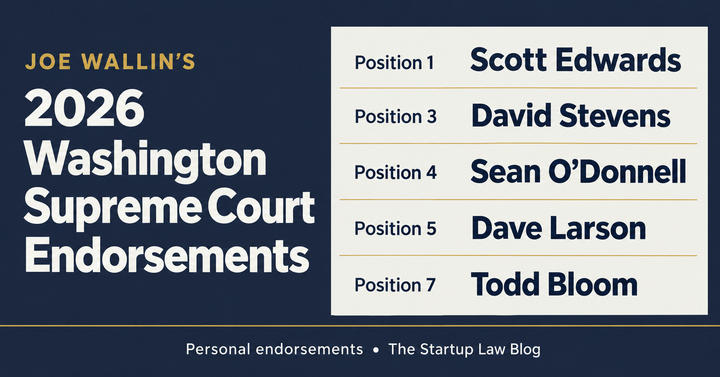
None of my five choices sits on the court today. If all five win, a majority of the justices will be new.
- Position 1 — Scott Edwards
- Position 3 — David Stevens
- Position 4 — Sean O’Donnell
- Position 5 — Dave Larson
- Position 7 — Todd Bloom
Stevens, not Stephens. David Stevens is my choice for Position 3. Chief Justice Debra Stephens is running against Todd Bloom for Position 7.
Why I want a change
Two decisions explain why: one on tax limits, one on a voter initiative.
Article VII, section 1 of our constitution requires taxes to be uniform within the same class of property. Section 2 caps property taxes at one percent of value, with exceptions such as voter-approved levies. Culliton v. Chase, 174 Wash. 363 (1933), treats income as property.
In Quinn v. State, 1 Wn.3d 453 (2023), the court upheld the capital gains tax as an excise, 7–2, in an opinion by Justice Stephens (Quinn v. State opinion). That decision did not overrule Culliton. The majority said the tax is on the sale of capital assets and only measured by the gains; in my view, as the dissent explained, it is a tax on the gains themselves (no gain, no tax), and under Culliton that makes it a property tax.
The label matters. If a tax on income is a property tax, the uniformity rule applies, and so does the one-percent limit. Culliton struck down a graduated income tax because it was not uniform. Calling the tax an excise takes it outside those limits.
Petter v. State, No. 26-2-00073-20, was filed April 9, 2026, in Klickitat County Superior Court. It challenges the constitutionality of Washington’s new income tax and is backed by the Citizen Action Defense Fund. If the case reaches the Supreme Court, the justices elected this November may help decide whether the new tax complies with these constitutional limits.
On September 17, 2026, the court decided the natural gas initiative, I-2066, 6–3. Chief Justice Stephens wrote the majority opinion (No. 104240-0). The court affirmed the superior court, applied article II, section 19 (the constitution’s single-subject requirement), and held the initiative unconstitutional in its entirety.
My objection is not that the court invalidated an initiative. Courts must invalidate unconstitutional laws, whoever enacted them. My objection is to the constitutional reasoning.
Protecting access to natural gas means addressing both whether utilities will supply it and whether people may use it in their homes and businesses. Those are connected parts of one policy. Treating different regulatory tools as different subjects gives too little weight to that common purpose.
The court also went too far by throwing out the entire initiative. The majority declined to sever. It reasoned that a court cannot tell how many voters supported each subject, so choosing which subject survives would put the court in the voters’ place (slip op. at 23 n.5, citing Lee v. State, 185 Wn.2d 608, 627 (2016)). Justice Sal Mungia’s dissent answered that sections 9, 10, and 11 and subsection 12(5) could be severed, because the remaining sections would have passed without them. I find that approach more persuasive: enforce the constitution, remove the defective provisions, and preserve the lawful policy voters enacted.
Why these candidates
Judicial candidates cannot, and should not, say how they would rule on pending cases like Petter. In the two open races, Positions 3 and 4, there is no incumbent’s record to evaluate, so I weighed experience and judicial philosophy.
Position 1 — Scott Edwards
Scott Edwards is running against Justice Colleen Melody. Justice Melody was appointed by Gov. Ferguson. This is her first election. Before joining the court, she led the Attorney General’s Civil Rights Division for 11 years. That is substantial legal experience.
She joined the September 17, 2026 majority that struck down Initiative 2066, the voter-approved natural gas measure, in its entirety. On September 3, 2026, the court split 4–4 on a motion to modify the commissioner’s ruling denying emergency relief to block the state-written "public investment impact disclosure" for Initiative 645, which would repeal the 9.9% tax on annual individual income over $1 million. She voted to deny the motion, according to the court’s order, so the commissioner’s ruling stands.
I disagree with those results. On I-645, I think voters deserve a more neutral disclosure than the state-written one.
I value Scott Edwards’s decades of experience in tax and constitutional law, particularly when the court faces fundamental questions about the limits of the state’s taxing power.
Edwards’s professional record includes representing taxpayers in the challenge to Seattle’s income tax and in the capital gains tax case before the Washington Supreme Court. That experience requires working through the text, structure, and practical operation of tax laws.
Position 3 — David Stevens
Open seat. Justice Raquel Montoya-Lewis is not seeking reelection. Judge David Stevens of the Mason County Superior Court is running against Judge Jaime Hawk of the King County Superior Court. Hawk brings public-defense and civil-rights experience, including her prior work at the ACLU of Washington.
Stevens’s career includes service as chief public defender for the Colville Confederated Tribes, a senior deputy prosecutor in Mason County, and a federal prosecutor. Having worked on both sides of criminal cases, he has had to consider both the state’s obligation to protect the public and the rights of people accused of crimes. I support that breadth of experience alongside his emphasis on judicial restraint and his view that changes to our constitution belong in the amendment process.
Position 4 — Sean O’Donnell
Open seat. Justice Charles Johnson is retiring. Judge Sean O’Donnell of the King County Superior Court is running against Judge Ian Birk of the Court of Appeals. Birk brings appellate judging experience and two decades in private practice representing individuals and families.
I support Judge O’Donnell because he has spent 13 years on the Superior Court, including service as chief criminal judge and chief family court judge. He also served as president of Washington’s Superior Court Judges’ Association, giving him experience with the needs of trial courts beyond his own courtroom. I want that experience on a court whose decisions govern what happens in trial courtrooms across Washington.
Position 5 — Dave Larson
Dave Larson, a retired Federal Way Municipal Court judge, is running against Justice Theo Angelis. Justice Angelis was appointed by Gov. Ferguson and took office in April 2026. This is his first election. His 26 years at K&L Gates included leadership of its appellate practice and substantial pro bono work. He did not participate in the I-2066 decision and was not on the court when Quinn was decided.
On the Initiative 645 ballot-disclosure fight, Angelis voted to grant the motion to modify the commissioner’s ruling denying emergency relief, according to the court’s order. I agree with that vote. Justice Angelis’s appellate experience is substantial. I still prefer Larson’s years as a trial judge and presiding judge of the Federal Way Municipal Court, and his work on court administration and judicial independence.
Larson’s record of judicial service includes the District and Municipal Court Judges Association’s Legislative and Therapeutic Courts committees and leadership of the Council on Independent Courts. I want that practical experience on the Supreme Court.
I am also voting for Larson because I want a majority of the court to be new, and that requires a change in this seat.
Position 7 — Todd Bloom
Todd Bloom is running against Chief Justice Debra Stephens. Stephens has served on the Supreme Court since 2008, following service on the Court of Appeals. Her appellate experience is a substantial qualification. My disagreement is with important decisions she has helped shape.
Chief Justice Stephens wrote the majority opinions in Quinn v. State (upholding the capital gains tax as an excise) and in the September 17, 2026 decision striking down Initiative 2066 in its entirety. On September 3, 2026, she also voted to deny the motion to modify the commissioner’s ruling on the Initiative 645 ballot disclosure, according to the court’s order.
Todd Bloom’s background as a tax attorney and CPA would bring a useful combination of legal and financial experience to a court whose decisions have substantial consequences for families and businesses.
Bloom’s campaign biography describes nearly 20 years as a FINRA arbitrator hearing financial disputes. Arbitration differs from appellate judging, but it gives him experience evaluating evidence and resolving competing claims, alongside his tax practice.
I am voting for these five candidates because I want a new majority and a fresh approach to constitutional limits. Each would have an independent duty to decide cases on the law and the record; my endorsements do not assume they would vote as a bloc.
In Positions 1, 5, and 7, a sitting justice is on the ballot. We do not owe anyone another term.
As of October 3, 2026, six of the court’s nine current justices first reached the court by appointment. In Positions 1 and 5, an appointed justice faces the voters for the first time. Appointment is not a disqualification; voters should weigh each candidate’s experience, judgment, and record.
How to vote
Read the candidates’ statements. Fill out the judicial portion of your ballot. The general election is November 3, 2026.
Related: Why I Support Initiative 645 · Initiative 645 tracker