
This post is the technical companion to our recent commentary on ESSB 6346 — the referendum ruling post and the political-context post. Those posts cover political and legislative context. This one takes the constitutional question on its own terms. The conclusion that emerges from the doctrine — not from politics — is that ESSB 6346 is a graduated tax on income, that Culliton v. Chase remains binding precedent, and that the structural arguments for upholding the tax require the Court to do something it has not yet done: overrule Culliton, extend Quinn well beyond its facts, or abandon meaningful constitutional review of state revenue measures. None of those is a "strong argument." Each is a request for the Court to change the law.
Article VII and the constitutional architecture
Two provisions of the Washington Constitution structure every income-tax case in this state. Article VII, Section 1 (as amended by Amendment 14, 1930) provides:
All taxes shall be uniform upon the same class of property within the territorial limits of the authority levying the tax and shall be levied and collected for public purposes only. The word "property" as used herein shall mean and include everything, whether tangible or intangible, subject to ownership.
Article VII, Section 2 caps the aggregate annual property tax at 1% of true and fair value.
Together, these two provisions create the constraint that has shaped Washington tax policy for almost a century. If something is a "tax on property," it must be uniform within its class and cannot exceed 1%. The only way to impose a graduated tax — or a tax over 1% — on something covered by Article VII is to characterize it as something other than a property tax.
That characterization problem is the entire ballgame.
Part I — What Culliton actually held
Culliton v. Chase, 174 Wash. 363, 25 P.2d 81 (1933), arose out of Initiative 69, a Depression-era graduated income tax that Washington voters approved in 1932. A group of taxpayers sued to enjoin enforcement. The trial court struck the tax down. The Washington Supreme Court affirmed in an en banc opinion authored by Justice Holcomb.
The holding has two operative moves.
First, income is property within the meaning of Article VII. The 1930 amendment defined property as "everything, whether tangible or intangible, subject to ownership." The Court concluded that income falls within that definition. Whatever one thinks of the underlying reasoning, the holding is now 93 years old and embedded in Washington constitutional law.
Second, because income is property, a tax on income is subject to Article VII's uniformity requirement. A graduated tax — by definition — applies different rates to different amounts of the same class of property. That is not uniform. The Court therefore struck down Initiative 69.
The Court has reaffirmed this framework at every opportunity. Jensen v. Henneford, 185 Wash. 209 (1936); Power Inc. v. Huntley, 39 Wn.2d 191 (1951); and the 2019 Court of Appeals decision in Kunath v. City of Seattle have each reapplied Culliton's income-is-property framework. The Washington Supreme Court denied review in Kunath. As recently as 2019, the Court of Appeals wrote that "Article VII, section 1 of our constitution, as interpreted by Culliton, considers income to be intangible property, so a tax on income is a tax on property. Arguments to the contrary can be resolved only by our Supreme Court."
The Supreme Court declined that invitation. Voters have rejected income-tax initiatives at the ballot ten separate times across the decades. The Legislature has not amended the Constitution. Culliton stands.
Part II — What Quinn actually held — and didn't
Quinn v. State, No. 100769-8 (Wash. 2023), upheld Washington's capital gains tax (then a flat 7%; now 9.9% on gains above $1M and 7% beneath, after a ~$278K standard deduction) in a 7-2 decision authored by Justice Debra L. Stephens, with Associate Chief Justice Charles W. Johnson and Justice Sheryl Gordon McCloud in dissent.
The State argued that the capital gains tax is an excise tax, not a property tax. The majority adopted that characterization in a single key holding: "the capital gains tax is appropriately characterized as an excise because it is levied on the sale or exchange of capital assets, not on capital assets or gains themselves." Because it is an excise, Article VII's uniformity and 1% requirements do not apply.
That framing is narrow on its own terms. The tax in Quinn attached to a discrete event — the sale or exchange of a capital asset. That event is what the Court called the taxable privilege. The majority did not hold that the Legislature could characterize anything it wanted as an excise; it held that this particular tax, structured around this particular transactional event, fit the excise category.
Three things Quinn did not do.
It did not overrule Culliton. Justice Stephens' opinion preserved the 1933 precedent on its face — distinguishing the capital gains tax from the income tax in Culliton rather than rejecting Culliton's reasoning. Income remains property under the Washington Constitution. The capital gains tax simply isn't a tax on income, in the majority's framing — it's a tax on the act of selling.
It did not address whether a more conventionally structured tax on income, untied to any discrete sale or transaction, could be similarly recharacterized.
And it did not endorse the proposition that "excise" can be applied to any tax the Legislature labels that way. The decision turned on the structural argument that capital gains taxes attach to transactions. Strip away the transaction, and Quinn's reasoning has nothing left to do.
The dissent saw this clearly. Justice Gordon McCloud's opening line — "'Capital gains' are income" — captured the position that the majority had drawn an artificial distinction to reach its result. She wrote that the majority was rewriting the tax to save it. The dissent did not carry. But it correctly identified what the majority was — and was not — doing: stretching the excise category to its outer limit, not abandoning it.
Part III — Why ESSB 6346 sits clearly outside Quinn
ESSB 6346 imposes a 9.9% tax on Washington taxable income above a $1 million standard deduction, beginning January 1, 2028. Washington taxable income is derived from federal AGI with state-specific modifications under the statute.
Compared point-by-point with the tax in Quinn, ESSB 6346 differs on every element the Quinn majority found necessary to its excise theory:
- No taxable transaction. The capital gains tax in Quinn attached to a discrete event — the sale or exchange of a long-term capital asset. ESSB 6346 attaches to the annual measurement of a taxpayer's Washington taxable income. There is no sale. There is no exchange. There is no transaction the Legislature is taxing the "privilege" of engaging in.
- The measurement base is federal AGI. The capital gains tax starts from federal net long-term capital gain — a defined category of gain associated with specific dispositions. ESSB 6346 starts from federal AGI, the comprehensive measure of income used by the federal income tax. The Legislature did not pick an obscure category that resembles an excise base. It picked the standard income-tax base used at every other level of American taxation.
- No conceivable transactional privilege. The majority in Quinn argued that selling capital assets is "the exercise of a right." That move is doctrinally awkward even for capital gains taxation, as the Quinn dissenters made clear. Extending it to ESSB 6346 would require treating earning a living in Washington as the exercise of a discrete right that can be taxed at a graduated rate. There is no precedent for that proposition in Washington law or in any other state.
- No "long line of precedent" to draw on. The Quinn majority repeatedly cited "a long line of precedent recognizing excise taxes as those levied on the exercise of rights associated with property." That line of precedent exists for transactional taxes — sales, transfers, business activities, the B&O tax. It does not exist for taxes measured by total annual income. The Legislature cannot conjure such a line by labeling the new tax an excise.
The structural conclusion is straightforward: ESSB 6346 is exactly the kind of tax Culliton prohibits. It is graduated. It is measured by income. It is not tied to any transaction. To uphold it, the Court would have to find that Quinn's narrow excise theory — already characterized by dissenting justices as a doctrinal stretch — extends to a tax that lacks every element Quinn relied on.
Part IV — What the State must actually argue
The McKenna/CADF challenge filed April 9, 2026 in Klickitat County argues that ESSB 6346 is functionally an income tax, that Culliton controls, and that the statute violates both the uniformity requirement and the 1% cap. That argument follows directly from controlling precedent.
The State's responses, examined honestly, fall into three categories — each of which is a request for the Court to change the law.
Argument 1: "Culliton was wrong and should be overruled." This is the most intellectually direct position. Scholars — most prominently Hugh Spitzer, A Washington State Income Tax — Again?, 16 U. Puget Sound L. Rev. 515 (1993) — have argued that Culliton's reliance on Aberdeen Savings & Loan v. Chase overstated what Aberdeen actually held under the Washington Constitution, a criticism litigants pressed in Quinn as well. A clean-slate court might reach a different result today. But this is an argument for overruling a 93-year precedent that has been reaffirmed at every opportunity — not for distinguishing it. It asks the Court to do what voters have refused to do ten times: amend the Constitution by judicial decision.
Argument 2: "Quinn opened the door." This is the position the bill's authors apparently expected the State to take. It asks the Court to extend Quinn's transaction-based excise theory to a tax that has no transaction. Even on a sympathetic reading, this is not an extension of Quinn — it is a replacement of Quinn's actual reasoning with something else. Quinn held that taxing the act of selling capital assets is an excise. ESSB 6346 taxes the existence of income above a threshold. Those are not analogous categories.
Argument 3: "Necessity-clause deference." The Court's decision in Heywood v. Hobbs accepted the Legislature's necessity-clause designation for purposes of the referendum question. The State will likely argue that the same deference extends to constitutional review on the merits. But Heywood decided a different question — whether a revenue measure was subject to referendum, not whether it was constitutional in substance. Extending Heywood's reasoning to merits review would effectively abandon judicial review of state revenue measures. No court should be eager to do that.
The honest summary: the State's best arguments require the Court to either overrule binding precedent, abandon Quinn's actual reasoning while keeping its result, or surrender constitutional review of revenue legislation. None of those is the kind of move courts make easily — and the plaintiffs have not asked the Court for anything except the application of existing law.
Part V — The doctrinal stakes
If Culliton falls in this case, it does not just affect ESSB 6346. It removes the constitutional constraint that has shaped Washington tax policy since 1933. The $1 million threshold becomes a legislative choice, not a constitutional floor. Subsequent legislatures can lower it — and the public record reflects an explicit intention by some of ESSB 6346's authors to test exactly that path. A future $250,000 threshold, or a $100,000 threshold, would face no different constitutional analysis than ESSB 6346 itself.
If Culliton holds, ESSB 6346 is unconstitutional in its current form. The path to a graduated income tax in Washington runs through constitutional amendment, which requires either a two-thirds legislative vote followed by ratification or a constitutional convention. That is the path the framers of the 1930 amendment built in — and the path voters have repeatedly preferred to leave undisturbed.
There is a third possibility worth naming: a narrow ruling. The Court could uphold ESSB 6346 on grounds confined to this statute, without articulating a general doctrinal framework that would survive the next round of revenue legislation. That outcome is the worst of both worlds for taxpayers and practitioners — it would resolve the immediate question without providing the doctrinal clarity needed to plan around future legislation. We should hope the Court avoids that path regardless of which side it favors.
Part VI — If Culliton Falls: What the Tax Landscape Could Look Like
Part V identifies the doctrinal stakes in the abstract. This section makes them concrete. If the Washington Supreme Court holds that income is not property for purposes of Article VII — whether by overruling Culliton, extending Quinn beyond transactions, or some other doctrinal move — the consequences reach well beyond ESSB 6346 itself. Washington's tax landscape would change in ways that practitioners and taxpayers need to think through now.
The $1 million threshold is a legislative choice, not a constitutional floor
ESSB 6346's $1 million threshold is a number the Legislature picked. There is nothing constitutionally significant about it. If the Court upholds the tax at $1 million, it will have done so on reasoning that applies equally to a $500,000 threshold, a $250,000 threshold, or lower.
The public record makes this explicit. Some of ESSB 6346's authors have described the bill as a deliberate constitutional test — an attempt to get a Supreme Court ruling that can then support a broader income tax structure. The $1 million figure was chosen to make the bill politically viable and to present the Court with a sympathetic target class. It was not chosen because it has any independent constitutional significance.
A practitioner advising clients today should not plan around a permanent $1 million floor. If Culliton falls, the floor is whatever the Legislature sets in the next session.
Washington's no-income-tax status ends
Washington is one of nine states with no broad-based individual income tax. That status has been a significant factor in the location decisions of founders, executives, and investors for decades — and an explicit selling point for Washington's startup ecosystem relative to California and Oregon.
A ruling that income is not property for Article VII purposes does not merely uphold ESSB 6346. It removes the constitutional barrier that has kept Washington in that category of states since 1933. The Legislature could, in subsequent sessions, enact a broad-base income tax without further constitutional amendment. The political constraints would remain, but the legal ones would be gone.
The migration calculus for high earners changes immediately upon such a ruling — not in 2028 when the tax takes effect, and not when a broader tax is enacted, but the moment the Court signals that the constitutional barrier is down. Taxpayers who are planning large income events on multi-year timelines need to treat a Culliton-falls ruling as a trigger for immediate residency review.
Stacking with the existing capital gains tax
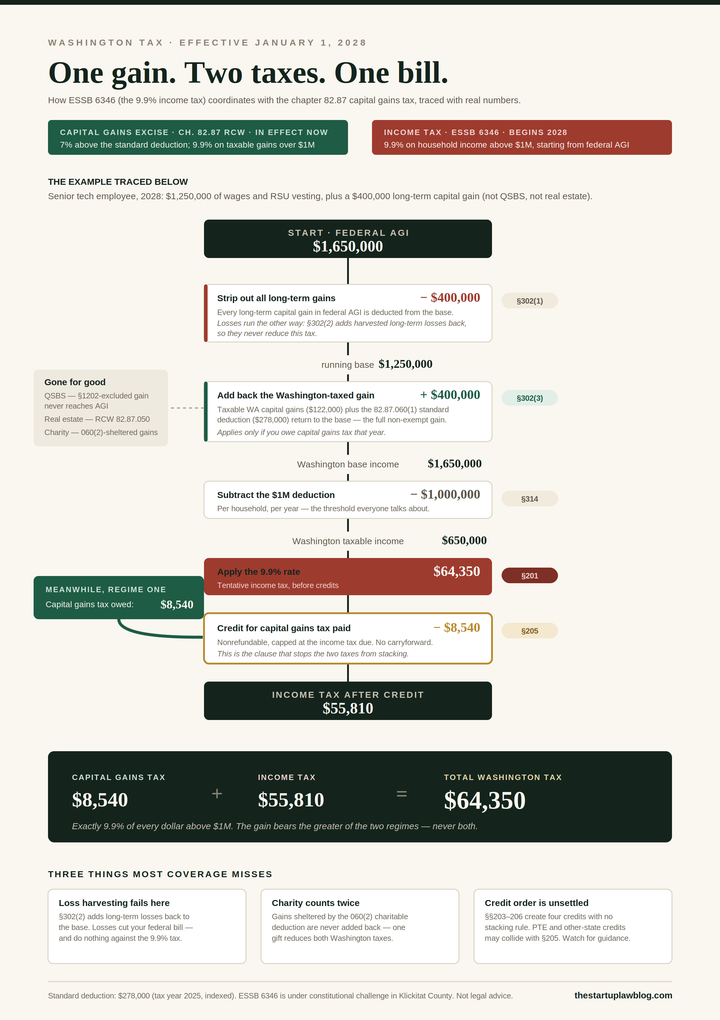
Washington already has a capital gains tax — 9.9% on gains above $1M after a ~$278K standard deduction (2025, indexed), 7% beneath — upheld in Quinn. If ESSB 6346 stands and the threshold is subsequently lowered, a Washington founder or investor realizing a significant capital gain could face the following layers of tax:
Federal long-term capital gains tax at 20% (plus the 3.8% net investment income tax for high earners) and, at the Washington level, the greater of the capital gains tax or the income tax on that gain. The two Washington taxes do not stack on the same dollar of capital gain: ESSB 6346 — through its capital gains credit (Section 205) — offsets the income tax by the capital gains tax already paid, so a given gain bears whichever of the two is larger, not the sum. On a $5 million gain, the Washington capital gains tax (tiered 7%/9.9% above the ~$278K standard deduction) runs to $438,478, and it exceeds the 9.9% income tax on that same gain — so the capital gains tax is the binding number and the combined Washington burden on the gain is roughly $438,000, before any federal obligation.
If the income-tax threshold falls to $250,000 in a future session, far more of every dollar of income is exposed to the 9.9% rate. But the two Washington taxes still would not both fall on the same dollar of capital gain — the Section 205 credit means you pay the higher of the two, not both. Where the income tax genuinely expands Washington's reach is onto income the capital gains tax never touched: wages, bonuses, interest, dividends, and business income above the threshold. That broadening of the base — not double taxation of the same gain — is the stated direction of travel of the bill's proponents.
The competitive position of the Washington startup ecosystem
Washington's attractiveness as a place to build and exit a company has rested in part on its tax profile. Founders who might otherwise locate in California have faced a meaningful differential: California's 13.3% top income tax rate versus Washington's zero. That differential has influenced not just where companies are headquartered but where founders establish residency at exit.
A Culliton-falls scenario narrows that differential substantially. If Washington enacts a broad-based income tax in the sessions following a favorable ruling, the comparison to California becomes one of rate, not existence. Washington's top rate may start lower, but the structural difference — no income tax versus income tax — disappears. Founders, investors, and the funds that back them will recalibrate.
Oregon presents a live comparison. Oregon has a 9.9% top income tax rate and has long had a more difficult time attracting the kind of capital-intensive founder activity that concentrates in the Seattle area. A Washington income tax at comparable rates would eliminate one of the primary tax-driven reasons to choose Washington over California or New York, while adding a new reason to consider Nevada, Texas, or Florida.
The narrow-ruling risk
Part V identified a third scenario: a narrow ruling that upholds ESSB 6346 without articulating a general framework. That outcome deserves special attention in the practical context because it is, in some ways, the most disruptive for planning purposes.
A narrow ruling would mean that ESSB 6346 stands, but that practitioners have no reliable basis for predicting what the next revenue measure will do. Every subsequent piece of legislation would require fresh constitutional analysis. The space between "this particular statute is valid" and "a broad income tax is valid" would be undefined. That uncertainty has its own costs — in planning complexity, in transaction risk, and in the chilling effect on investment and location decisions that persists as long as the constitutional question remains unresolved.
The best outcome for doctrinal clarity — whatever one thinks of the underlying policy question — is a ruling that squarely addresses whether income is property under Article VII and whether Culliton controls. Practitioners and taxpayers should hope the Court takes that question on its own terms, rather than resolving ESSB 6346 on narrow grounds that leave the larger question open.
Planning implications
Whichever way the case is resolved, three practical conclusions hold today.
First, the 2028 effective date is not contingent on the litigation. The statute is currently scheduled to take effect, and planning that assumes it will not is planning on a hope. The litigation is also no longer the only non-legislative track: Let's Go Washington submitted more than 511,000 signatures on July 2, 2026 for an initiative — certified by the Secretary of State on July 15, 2026 as Initiative 645 — that puts repeal of ESSB 6346, and a general income tax ban, before voters on November 3, 2026. The same discipline applies. A ballot measure that might pass is not a planning strategy either.
Second, the doctrinal stakes mean the case is unlikely to be resolved quickly. Constitutional challenges of this magnitude move through the courts on multi-year timelines. The planning window for affected taxpayers will close well before any final judgment.
Third, the doctrinal posture cuts strongly in favor of the McKenna/CADF challenge on the formal arguments. ESSB 6346 is structurally what Culliton prohibits. The State's responses each require the Court to change existing law. That is not a guarantee of victory — courts sometimes change the law — but it is the analytical baseline a careful practitioner should start from when evaluating planning options.
The right posture for an affected taxpayer is to plan around the enacted statute, track the litigation closely, and be ready to adjust if the constitutional question is resolved either way before 2028.
Washington Tax Planning Guide
If you're a founder, investor, or high earner in Washington, the planning window is open — but it won't stay open. This guide covers your options under ESSB 6346 before the tax takes effect in 2028.
Get the Guide →Have a Washington state tax planning question? Schedule a 20-minute call.