
Planning and FAQ corrections: September 14, 2026. For current litigation developments, see the I-645 tracker linked below.
Quick answer: On July 2, Let's Go Washington reported submitting 511,408 signatures for Initiative 26-645 (IP26-645), which would repeal Washington's 9.9% income tax and prohibit state and local taxes on individual income. The Secretary of State’s petition-line count was 509,365. On July 15, the Secretary of State certified the measure for the November 3, 2026 ballot, where it will appear as Initiative 645. Nothing about your planning should change today: the tax remains law, effective January 1, 2028, until voters or the courts say otherwise — and the vote lands just in time to inform, not replace, your 2027 planning decisions.
The repeal effort that couldn't proceed as a referendum is now a certified initiative. Let's Go Washington reported delivering 511,408 signatures to the Secretary of State's office in Tumwater on July 2 — the filing deadline. The Secretary of State’s table counts 509,365 petition lines accepted for checking, against a requirement of 308,911 valid signatures (eight percent of the votes cast in the last governor's race). Neither the campaign’s submitted figure nor the petition-line count is itself a count of verified valid signatures. On July 15, 2026, the Secretary of State certified the measure by 3% random sample: 12,936 accepted entries in a 15,281-entry sample (above 80% sample validity), sufficient for certification under the sampling statute.
This post is part of our Complete Guide to Washington's New Income Tax.
What IP26-645 actually does — and what it leaves alone
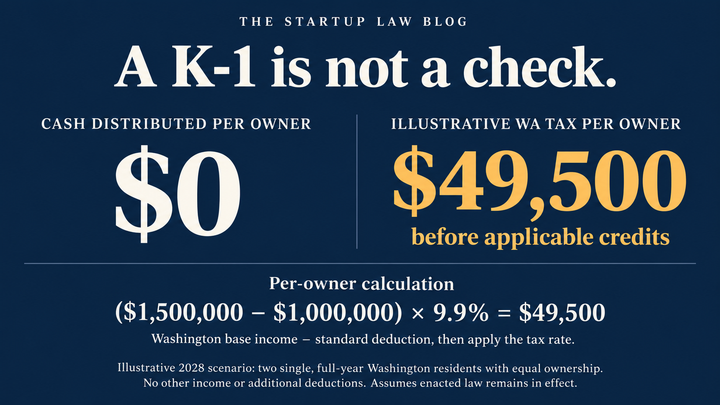
The initiative does two things. First, it repeals the 9.9% tax on income above the $1 million standard deduction enacted by ESSB 6346 before the tax ever takes effect. Second, it prohibits the state and local governments from imposing taxes on individual income or taxes measured by an individual's income — restoring the general ban that voters' 2024 measure (Initiative 2111) put in statute and that ESSB 6346 carved an exception into.
The Attorney General’s explanatory statement says the measure would preserve the non-income-tax credits, exemptions, and deductions accompanying the 2026 law. It also distinguishes the expressly repealed income tax from the measure’s broader prohibition on taxes on individual income, its receipt, or amounts measured by it. Chapter 82.87 RCW is not expressly repealed. Whether the broader prohibition would prevent collection of the capital-gains tax requires interpretation; the constitutional classification of that tax as an excise does not settle the later statute’s scope. See the official explanatory statement and our capital-gains analysis.
The timeline from here
Signature verification is complete: the Secretary of State certified the measure on July 15, 2026, and on July 23 the Attorney General filed the public investment impact disclosure — the short statement that appears on the ballot itself. It reads: "This measure would decrease funding for public K-12 education, higher education (including universities and community colleges), and human services (primarily healthcare)." That language drew two Thurston County Superior Court challenges, and only one was decided. On August 7, 2026, the court rejected Arthur West's facial constitutional challenge to the disclosure statute, found the language appropriately neutral, and denied an injunction. The sponsors' separate statutory challenge — that the disclosure is inaccurate because the measure reduces no near-term revenue — was set for hearing later the same morning and was cancelled after the earlier ruling, without a merits decision. West sought direct review in the Washington Supreme Court on August 10. On August 20, 2026, a Supreme Court commissioner denied his emergency motion for a preliminary injunction. West v. Hobbs, No. 105644-3 (Wash. Sup. Ct. Aug. 20, 2026) (Comm'r Johnston). The order decided no constitutional merits. The commissioner held that the superior court's order affirming the disclosure is final under RCW 29A.72.028 and not subject to further appellate review, applying Kreidler v. Eikenberry, 111 Wn.2d 828 (1989), and expressly left open whether the dismissal of West's declaratory judgment action is appealable of right under RAP 2.2 or discretionary under RAP 2.3, and whether the case is retained in the Supreme Court or transferred to the Court of Appeals under RAP 4.2. West's constitutional challenge to the disclosure statute survives and is unresolved on the merits. On September 3, 2026, the Washington Supreme Court denied West's motion to modify the commissioner's ruling because the participating justices divided four to four. The commissioner's denial of emergency relief therefore remained in place. The order did not decide the underlying constitutional merits. See the I-645 tracker for subsequent developments. We break down the disclosure, the $11.4 billion fiscal impact statement, and the ballot-disclosure litigation in the update to our capital gains analysis. The measure goes to voters on November 3, 2026. And if it passes, it would take effect in early December 2026 — more than a year before the tax's January 1, 2028 effective date, meaning the income tax would be repealed without ever collecting a dollar.
Why this is an initiative and not a referendum
Readers of our constitutional analysis will recall that ESSB 6346 was drafted with a necessity clause declaring the tax necessary for the support of state government — language that shields a law from referendum under the state constitution. The Secretary of State rejected Let's Go Washington's referendum filing on that basis, and the Washington Supreme Court upheld the rejection on May 4. The initiative route required more signatures and cannot suspend a law pending the vote — but because the tax doesn't take effect until 2028, suspension is beside the point. The necessity clause bought the tax nothing except a delay in the form of the question.
If it passes: durable, but not permanent
A repeal by initiative comes with a constitutional lock most commentary is missing. Under article II, section 41 of the Washington Constitution, no act approved by the voters "shall be amended or repealed by the legislature within a period of two years following such enactment" — and the exception is narrower than it is usually described. The proviso permits such an act to be amended within two years by two-thirds of all elected members of each house, subject to the governor's constitutional role. The exception does not expressly authorize legislative repeal; voters retain the power to amend or repeal the measure by direct vote. A proposal to re-enact an income tax during that period would require analysis of whether it is a permissible amendment or an impermissible repeal. After two years, ordinary legislative voting rules apply. The protection therefore limits legislative action without making the statutory ban permanent. Constitutional litigation presents a separate question, which is why the Citizen Action Defense Fund lawsuit pending in Klickitat County, with its Culliton uniformity argument, remains independently important no matter what happens on November 3.
If the initiative fails
If Initiative 645 fails, the enacted tax remains scheduled to begin January 1, 2028. Constitutional litigation would continue to matter, and the legislature could still amend or repeal the law. A failed repeal initiative would not itself enact a new law or give ESSB 6346 the two-year protection that applies to voter-approved measures. A defeat would also hand the tax's defenders a potent political fact: a direct public vote sustaining it. Washington's ballot history cuts both ways here, and anyone confidently predicting the outcome is selling something. Voters have rejected personal income tax measures in seven of eight appearances on the ballot across nine decades. But the most recent data point runs the other direction: in 2024, voters declined to repeal the capital gains tax when asked directly. Repealing a tax that applies to roughly 25,000 households — the Department of Revenue's August 2026 revision, up from the 21,000 assumed during the legislative session — is a different question than blocking a tax on everyone — and both campaigns know it.
What founders and high earners should do now
Nothing changes today. The tax is law. Plan as if it takes effect January 1, 2028, because as of this morning, it does. A certified ballot measure is not a planning strategy, any more than a pending lawsuit is.
The calendar is unusually cooperative — use it. The vote is November 3, 2026. If you plan to rely on the 30-day safe harbor, its housing conditions must be satisfied throughout 2028: no permanent place of abode in Washington, a permanent place of abode outside Washington, and no more than 30 Washington days during the year. That safe harbor is separate from an actual domicile change. If you are considering leaving Washington, identify when a genuine move would establish a new domicile, then separately review retained housing, the residency test based on a Washington abode and more than 183 days of presence, part-year allocation, and continuing Washington-source income. Selling or terminating every Washington home is not a universal requirement. Prepare the analysis now and reassess after the vote; transaction and income-recognition dates may require action earlier than year-end 2027.
Keep preparing. QSBS documentation, estate-plan coordination, and income-timing analysis remain useful. Model enacted law and a repeal scenario separately. Do not assume either that the initiative automatically eliminates the capital-gains tax or that the tax necessarily survives its broader prohibition.
Do not make irreversible moves you would regret if the tax dies. If the new income tax is your only reason for relocating, consider whether committing to a move can wait until after the November 3, 2026 vote. Existing capital gains and estate taxes, a pending sale, and personal circumstances may justify a different timetable. Reassess after the election and material court developments; a ruling may still be subject to appeal.
Frequently asked questions
Does the initiative repeal the capital gains tax too? It does not expressly repeal chapter 82.87 RCW. Its broader prohibition raises a separate question about continued collection of that tax. Calling the tax an excise does not resolve how the initiative would apply. See our analysis of the text.
Is the measure on the ballot? Yes. The Secretary of State certified it on July 15, 2026, following a 3% random sample with a reported validity rate above 80%. It will appear on the November 3, 2026 general election ballot as Initiative 645.
If the initiative passes, can the legislature just re-enact the tax? Article II, section 41 generally bars legislative amendment or repeal for two years after voter enactment. Its exception permits amendment by two-thirds of all elected members of each house, subject to the governor's constitutional role; it does not expressly authorize legislative repeal. Voters may amend or repeal the measure by direct vote during that period. After two years, ordinary legislative voting rules apply. Re-enacting a tax during the protected period would require analysis of whether the legislation is a permissible amendment or an impermissible repeal.
Should I pause my 2028 planning until the vote? Continue preparation and evaluate whether irreversible steps can wait for the vote. The 30-day safe harbor requires both housing conditions throughout 2028, but an actual domicile change is a separate route and does not universally require disposing of Washington housing. Review statutory residency, part-year rules, Washington-source income, and transaction timing before setting your deadline.
Planning around the 2028 tax while the initiative and the litigation play out? We can stress-test your sequencing — what to prepare now, what to defer until after November 3. Book a 20-minute call.
This post is for educational purposes only and is not legal or tax advice. Consult a qualified attorney about your specific situation.