
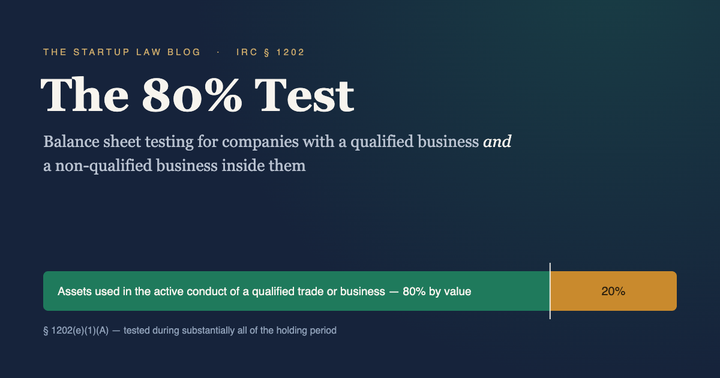
A C corporation with both qualified and nonqualified business activities must test whether at least 80% of its assets, by value, are used in qualified active businesses, alongside the separate statutory restrictions. The active-business requirements apply during substantially all of each shareholder’s holding period. Review the asset mix at issuances, at least annually, and when material changes occur. This is a recommended monitoring practice, not a statutory annual-testing safe harbor. Early review preserves evidence and planning choices; a nonqualifying period requires analysis of the full holding period rather than an automatic conclusion that the exclusion is lost.
The rule
Section 1202(c)(2)(A) requires that, during substantially all of the taxpayer's holding period, the corporation meet the "active business requirements" of Section 1202(e). Section 1202(e)(1)(A) is the operative test: at least 80 percent (by value) of the assets of the corporation must be used in the active conduct of one or more qualified trades or businesses.
Two things about that sentence deserve emphasis.
First, it is an asset test, not a revenue test. A company with 40% of its revenue coming from an excluded consulting practice can still pass if its assets are overwhelmingly deployed in the qualified side. A company with 90% qualified revenue can still fail if its balance sheet says otherwise. Revenue mix is evidence, not the answer.
Second, it is a continuous test. The statute asks about "any period," and the shareholder-level requirement runs through substantially all of the holding period. A company that qualified cleanly at its Series A can drift out of compliance as the excluded line grows, cash accumulates, or the business mix shifts — and stock issued in later rounds is tested on its own holding period. It is entirely possible to have QSBS-qualified Series A shares and disqualified Series C shares in the same company.
What counts against you
The excluded businesses are listed in Section 1202(e)(3): services in health, law, engineering, architecture, accounting, actuarial science, performing arts, consulting, athletics, financial services, or brokerage; any business whose principal asset is the reputation or skill of one or more employees; banking, insurance, financing, leasing, or investing; farming; extraction businesses; and hotels, motels, and restaurants.
On top of the 80% test, the statute imposes separate limits. Under Section 1202(e)(5)(B), the corporation fails the active-business requirements for a period when more than 10% of the value of its assets (in excess of liabilities) consists of stock or securities in non-subsidiary corporations, but assets described in the working-capital rule in Section 1202(e)(6) are expressly excepted. Apply that exception before treating invested working capital as a disqualifying portfolio holding. Separately, if more than 10% of total asset value is real property not used in the active conduct of a qualified business, the corporation fails under Section 1202(e)(7), which adds that owning, dealing in, or renting real estate is not the active conduct of a qualified business.
What counts for you
The statute is not all traps. Majority-owned subsidiaries are looked through — the parent is deemed to own its ratable share of the subsidiary's assets and conduct its ratable share of the subsidiary's activities (Section 1202(e)(5)(A)). Assets held as reasonably required working capital of a qualified business, or held for investment and reasonably expected to be deployed within two years to finance research and experimentation in a qualified business or increases in its working capital needs, count as actively used — but once the company has been in existence for at least two years, no more than 50% of its assets can qualify through the working capital rule (Section 1202(e)(6)). Start-up and research activities count as active conduct even with zero gross income (Section 1202(e)(2)). Rights to computer software producing active business software royalties count as active assets (Section 1202(e)(8)).
How to actually run the test
Section 1202(e) requires a value-based analysis, and Section 1202(c)(2)(A) does not supply a numerical safe harbor for substantially all of the holding period. Document the valuation methodology, allocation of shared assets, and relevant periods. Contemporaneous records support the factual analysis; documentation alone does not establish that the statutory requirements were met.
A workable annual process looks like this. Start with a fair-market-value balance sheet, not a GAAP or tax-basis one. The statute says "by value," and that means you must put values on assets that carry little or no basis: self-created intellectual property, customer relationships, brand, workforce in place. In most operating companies these intangibles dominate the calculation, and they are exactly the assets a book balance sheet ignores.
Then allocate every asset between the qualified and non-qualified trades or businesses. Some assets allocate cleanly — the loan book belongs to the lending arm, the product codebase belongs to the software business. Shared assets (cash, headquarters, general-purpose equipment, enterprise goodwill) require an allocation method. There is no mandated approach, so pick something defensible — relative headcount, relative revenue, relative direct costs, specific identification where possible — apply it consistently from period to period, and write down why it is reasonable.
Next, run the special rules: apply the subsidiary look-through, identify assets described in the working-capital rule in Section 1202(e)(6), and apply its 50% cap on active-use treatment once the corporation has been in existence for at least two years. Check the 10% portfolio stock and securities limit after applying its express exception for assets described in Section 1202(e)(6), and separately check the 10% real-estate limit. Those additional limits must be satisfied even when the overall 80% test is otherwise met.
Finally, compute the percentage and memorialize it — a short memo with the balance sheet, the allocation methodology, the conclusions, and the date. Repeat at every stock issuance (each round starts its own clock and its own eligibility analysis), at least annually, and whenever something material happens: an acquisition, a large financing that leaves cash undeployed, the launch or growth of a non-qualified line, a real estate purchase.
A simple asset-value example
Assume a C corporation operates a qualified software business and a separate excluded consulting business. After valuing all assets, including self-created intellectual property and goodwill, and allocating shared assets, the company has:
| Asset allocation | Fair market value |
|---|---|
| Assets used in the qualified software business | $8.5 million |
| Assets used in the excluded consulting business | $1.5 million |
| Total | $10 million |
The qualified percentage is $8.5 million ÷ $10 million = 85%. On these assumptions, the company clears the 80% asset test even if consulting produces 40% of revenue. If the qualified allocation were $7.5 million and the excluded allocation $2.5 million, it would fall to 75% and fail that test for the period.
This illustration assumes no portfolio stock or securities, no nonqualified real estate, and no assets requiring special working-capital treatment. It isolates the Section 1202(e)(1)(A) calculation; a complete review must also apply the special rules and the substantially-all holding-period requirement.
If the number is close
If the company approaches or crosses an asset-test threshold, determine when the change occurred, how long it lasted, and which shareholders’ holding periods are affected. Consider prospective changes to asset deployment or business structure with tax counsel. Restoring compliance does not erase a prior nonqualifying period, but that period does not automatically establish failure of the substantially-all requirement. There is no guaranteed cure or permissible period of noncompliance.
The stakes went up in 2025
The One Big Beautiful Bill Act changed different Section 1202 tests using different dates. The $75 million gross-assets ceiling applies to stock issued after July 4, 2025. The 50%, 75%, and 100% exclusion tiers after at least three, four, and five years, and the $15 million dollar-limit component, depend on stock acquired after that date, applying Section 1202(a)(6)(B) and Section 1223 holding-period tacking. The dollar limit is subject to prior-gain and coordination rules, and the ten-times-basis alternative remains available; the exclusion percentage applies to eligible gain within the applicable limit. The $15 million amount and $75 million ceiling are indexed beginning in 2027. These changes do not remove the ongoing active-business requirement. See Section 1202 and its effective-date notes.
This post is general information, not legal or tax advice. The application of Section 1202 to any particular company depends on its facts.