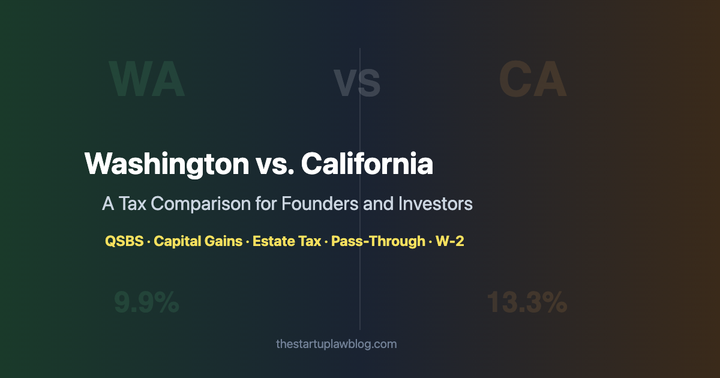
For years, the pitch was simple: move to Washington, pay no income tax. California’s 13.3% top rate made it the most expensive state in the country for founders, investors, and high earners. Washington was the obvious alternative — same time zone, strong tech ecosystem, zero income tax.
That calculus changed on March 30, 2026, when Governor Ferguson signed ESSB 6346 into law. Starting January 1, 2028, Washington imposes a 9.9% income tax on household income above $1 million. Washington is no longer a zero-tax state for high earners.
But it’s not California, either. The two systems differ in fundamental ways — on rates, on QSBS, on capital gains, on pass-through treatment, and on who actually ends up paying more. Here’s a detailed comparison.
(For an overview of ESSB 6346, see Washington’s New Income Tax: What Founders, Investors, Athletes, and High Earners Need to Know. For the full tax landscape, see Washington State Taxes.)
The Headline Rates
California: Progressive brackets from 1% to 12.3%, plus an additional 1% Mental Health Services Tax on income above $1 million. Effective top rate: 13.3%. Applies to all taxable income — wages, capital gains, business income, investment income. No preferential rate for any income type.
Washington (starting 2028): A flat 9.9% on Washington taxable income above $1 million (after modifications). Below $1 million: 0%. The $1 million standard deduction means that a Washington resident earning $999,999 owes nothing.
The gap: At the top, California is 3.4 percentage points higher. But the real difference is structural: California taxes your first dollar of income. Washington doesn’t tax anything until you cross $1 million. For someone earning $1.5 million, the effective Washington rate is about 3.3% on total income — compared to roughly 11%+ in California.
QSBS: The Biggest Single Difference
This is where the comparison gets dramatic.
California does not conform to Section 1202. If you sell qualified small business stock and exclude the gain at the federal level, California ignores the exclusion entirely and taxes the full gain at up to 13.3%. A founder who sells $10 million in QSBS pays $0 federal tax and approximately $1.33 million to California.
Washington currently protects QSBS. Under ESSB 6346, Washington base income starts with federal AGI (§101(3)). Because QSBS gain excluded under Section 1202 never enters federal AGI in the first place, it never enters the Washington tax base. A founder who sells $10 million in QSBS pays $0 federal tax and $0 to Washington.
This single difference can be worth millions of dollars on a single transaction. For a founder with $15 million in QSBS gains, the California bill is approximately $2 million. The Washington bill is zero.
There is a caveat: the Washington legislature considered QSBS add-back bills (SB 6229 and HB 2292) during the 2026 session, and they could return in future sessions. For now, QSBS is fully protected. For a deeper analysis, see Does QSBS Avoid Washington’s New 9.9% Income Tax? and our 2026 QSBS State-by-State Conformity Guide.
Capital Gains Treatment
California: Taxes capital gains as ordinary income. No preferential rate, no exemption, no distinction between short-term and long-term. The top rate on capital gains is 13.3%.
Washington: Two separate taxes apply to capital gains:
First, the Washington capital gains tax (already in effect under chapter 82.87 RCW) taxes long-term capital gains above $250,000 at 7%, with gains above $1 million taxed at 9.9%. But gains from the sale of real property held directly are exempt, and QSBS gains are excluded.
Second, the new income tax (ESSB 6346) starts with federal AGI. Long-term capital gains included in federal AGI are stripped out of Washington base income under §302, and the Washington capital gains tax amount is added back instead. This means long-term capital gains are taxed under the capital gains tax regime, not double-taxed under both systems.
Net result for a $5 million long-term capital gain (non-QSBS, non-real estate):
- California: approximately $665,000 (13.3%)
- Washington: approximately $445,500 under the capital gains tax (7% on $250K–$1M, 9.9% above $1M), plus the income tax implications on any remaining AGI items
Washington is cheaper on capital gains — but the gap is narrower than the headline rate difference suggests, because Washington’s capital gains tax applies at lower thresholds than the income tax.
Real Estate
California: Taxes gains on real property sales at full ordinary income rates (up to 13.3%).
Washington: Gains from the direct sale of real property are exempt from the capital gains tax under RCW 82.87.050. Under ESSB 6346, these gains are stripped from Washington base income via the §302 mechanism (which removes long-term capital gains and replaces them with the capital gains tax amount — and exempt gains generate no capital gains tax). Net result: direct real estate gains are largely excluded from both Washington taxes.
This is a massive advantage for real estate investors in Washington. See Are Real Estate Gains Subject to Washington’s New 9.9% Income Tax? for the full analysis, including the entity look-through rules.
W-2 Income and Compensation
For high-earning employees — senior tech executives, partners at professional firms, athletes — the comparison is more straightforward:
At $1.5 million total compensation:
- California: approximately $165,000+ in state income tax
- Washington: 9.9% × $500,000 (amount above $1M) = $49,500
At $3 million total compensation:
- California: approximately $365,000+ in state income tax
- Washington: 9.9% × $2,000,000 = $198,000
At $5 million total compensation:
- California: approximately $630,000+ in state income tax
- Washington: 9.9% × $4,000,000 = $396,000
Washington is cheaper at every income level above $1 million — but the savings narrow as income increases, because California’s progressive rate structure means the blended effective rate is lower than 13.3% on total income, while Washington’s flat 9.9% applies to every dollar above $1 million.
Stock Options and RSUs
California: Taxes ISO spread at exercise (if AMT applies), NQSO spread at exercise, and RSU value at vesting — all at ordinary income rates up to 13.3%.
Washington: Same income items flow through federal AGI into Washington base income. No AMT add-back in the statute (confirmed by reviewing §§301–308). The key difference: the $1 million standard deduction means that equity compensation events below $1 million in total household income are tax-free in Washington.
For a detailed breakdown of how Washington’s tax applies to equity comp, see How Washington’s New 9.9% Income Tax Applies to Stock Options and RSUs.
Pass-Through Business Income
California: Taxes pass-through income (K-1) at full individual rates. California does offer a pass-through entity elective tax (AB 150) at 9.3%, with a credit on the individual return. This partially addresses the federal SALT cap.
Washington: Taxes pass-through income at 9.9% above the $1 million threshold. Section 502 provides an entity-level tax election at 9.9%, creating a full federal SALT deduction (compared to California’s 9.3% entity-level rate). Washington also provides a §204 credit for B&O taxes paid on the same income.
For pass-through owners above $1 million, Washington’s entity-level election is slightly more valuable at the federal level (9.9% deductible vs. 9.3% deductible in California), but the overall state tax burden is lower because the first $1 million is exempt. See Washington’s New Income Tax and Pass-Through Business Income for the full analysis.
The Marriage Penalty
California: Uses separate brackets for married filing jointly that are double the single-filer brackets. This eliminates much (but not all) of the marriage penalty at higher income levels.
Washington: Imposes a combined $1 million standard deduction for married couples — regardless of filing status. Two unmarried individuals each get $1 million; a married couple shares one. Maximum penalty: $99,000/year. See The Marriage Penalty Explained.
This is one area where California is actually more generous than Washington. California’s doubled brackets mean that two-income couples don’t face the same cliff that Washington creates.
Estate and Gift Taxes
Neither Washington nor California imposes a gift tax — no state does anymore.
But there’s a significant difference on the estate tax side:
California: No state estate tax. Estates of California residents are subject only to the federal estate tax (with its $13.99 million exemption in 2026).
Washington: Imposes its own estate tax on estates above $2.193 million, with rates ranging from 10% to 20%. The exemption is far lower than the federal threshold, which means many estates that owe nothing to the IRS still owe Washington. For a $10 million estate, the Washington estate tax is approximately $1.1 million — a cost that doesn’t exist in California.
This is one of the most overlooked factors in the WA vs. CA comparison. A founder who moves to Washington to save on income taxes may end up paying more in estate taxes than they saved — especially if they die before a planned exit or before implementing an estate plan that moves assets out of the Washington estate. Washington’s estate tax has no portability between spouses (unlike the federal exemption), which compounds the problem for married couples.
For founders with significant wealth, the estate tax picture needs to be modeled alongside the income tax savings. The income tax advantage of Washington over California can be substantial on an annual basis, but the estate tax disadvantage is a one-time hit that can dwarf years of income tax savings if the estate is large enough.
Other Taxes That Stack
The income tax isn’t the only tax in play. Here’s the full picture:
Washington’s additional taxes:
- Capital gains tax: 7%–9.9% on long-term gains above $250K (already law)
- B&O tax: 0.471%–1.5% on gross receipts (depending on classification)
- JumpStart payroll tax (Seattle): 0.7%–2.4% on payroll above $7M
- WA Cares: 0.58% payroll tax on all wages
- No estate tax exemption portability (WA estate tax starts at $2.193M)
California’s additional taxes:
- No separate capital gains tax (taxed as ordinary income)
- No gross receipts tax comparable to B&O
- CA SDI: 1.1% on wages (employee-paid)
- No local income taxes
- Higher property tax assessment base in some cases
The stacking effect is significant. A Washington founder selling a company for $20 million in non-QSBS gains faces capital gains tax plus (potentially) income tax on other income in the same year — but the total is still substantially less than California’s 13.3% on the full gain.
The Relocation Decision
For founders and investors weighing a move, the comparison boils down to a few key questions:
Do you hold QSBS? If yes, Washington saves you millions compared to California — potentially the single largest tax benefit available. This alone can justify a move.
Is your income primarily W-2 above $1 million? Washington is cheaper, but the gap narrows at very high income levels. At $5 million in W-2 income, you save roughly $235,000 per year in Washington vs. California. That’s significant but may not justify a lifestyle change if you prefer living in California.
Do you have significant real estate gains? Washington’s exemption for direct real property sales is a major advantage. California taxes these gains at full rates.
Are you considering other no-tax states? Texas, Florida, Nevada, and Wyoming still have no income tax at all. If the goal is pure tax minimization, those states remain cheaper than Washington for high earners. Washington’s advantage is the combination of lower taxes and proximity to the Pacific Northwest tech ecosystem.
Can you actually leave California? California’s Franchise Tax Board is notoriously aggressive about auditing departing residents. A move must be genuine — change of domicile, sale of the California home, establishment of real ties in the new state. California will look at where your kids go to school, where your doctors are, where you vote, and where you spend your time. A paper move doesn’t work. (Washington has its own residency rules — see The 30-Day Rule for those details.)
The Bottom Line
Washington is no longer a tax haven. But for most founders and investors above the $1 million threshold, it remains substantially cheaper than California — especially for QSBS holders, real estate investors, and pass-through business owners. The gap is biggest on exit transactions and smallest on pure W-2 income.
The decision isn’t just about taxes, of course. California has a deeper venture capital ecosystem, better weather (for most people), and a larger talent pool in many sectors. Washington has no income tax below $1 million, protected QSBS, exempt real estate gains, and a strong tech corridor.
For now, the math still favors Washington for high earners. But the direction of travel is clear: Washington is adding taxes, not removing them. Plan accordingly.
Considering a move between California and Washington? Book a 20-minute intro call to discuss how the comparison applies to your specific situation. Also see: Washington State Taxes Guide | Income Tax Planning Guide for High Earners