
By Joe Wallin | April 9, 2026 | ~7 min read
S Corporations and Blank Check Preferred Stock: Debunking the Myth
One of the most persistent misconceptions I see among startup founders and early-stage advisors is that an S corporation cannot have blank check preferred stock authorized in its corporate charter. The answer to this question matters enormously because it shapes how founders structure their cap table, when they elect S-corp status, and whether they can deploy certain fundraising strategies without accidentally losing tax benefits.
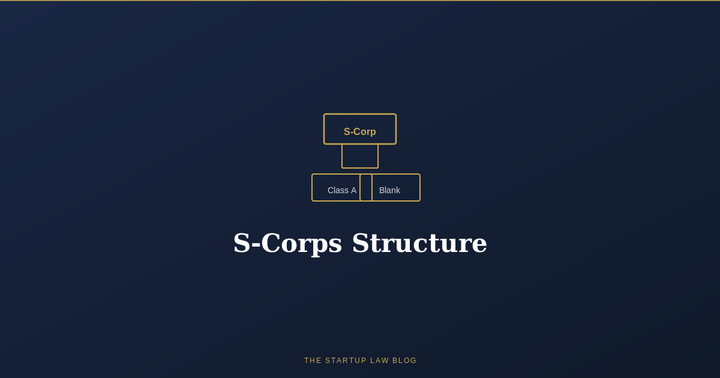
Here's the truth: S corporations can absolutely have blank check preferred stock authorized in their charter. What they cannot do is issue a second class of stock with different economic rights. That's a fundamentally different thing, and the distinction matters more than you might think.
Understanding the One-Class-of-Stock Rule
The S corporation one-class-of-stock requirement lives in Internal Revenue Code Section 1361(b)(1)(D). In plain English, it says that for a corporation to be taxed as an S corporation, it can have only one class of stock outstanding. The IRS doesn't care about authorized stock that sits in the charter gathering dust. It only cares about stock that has actually been issued.
And even then, the rule is specifically about economic rights—the rights that determine who gets paid what, and in what order. A blank check preferred stock that has been authorized but never issued, or has been authorized with no rights yet assigned, creates zero problem. A blank check authorized stock is just a placeholder. It's potential. It's future flexibility your board reserved but hasn't activated.
The one-class rule gets triggered when you issue multiple classes of stock with different economic rights. This means different distribution rights (some shares get 2x liquidation preference, others get 1x), different liquidation rights (senior preferred shares get paid before common), or participation rights that vary between classes. That's when you've created a second class of stock for tax purposes, and if you've made the S election, you've just accidentally terminated it.
Why Startups Choose S-Corp Status
Before we dive deeper into the mechanics of the one-class rule, it's worth remembering why founders consider S-corp status in the first place. An S corporation is a pass-through entity for tax purposes, which means the corporation itself pays no federal income tax. Instead, income flows through to the shareholders' personal tax returns. For profitable startups, especially those bootstrapped by founders taking salary, this can eliminate the double taxation problem: you don't pay corporate tax at the entity level, then pay personal income tax on dividends.
This is particularly valuable for Washington-based startups navigating the state's new income tax. Washington's ESSB 6346 imposes a 9.9% tax on adjusted gross income exceeding $1 million per individual (effective 2028), and the S-corp pass-through structure can help founders manage that exposure. If you operate as a C corporation and retain earnings at the entity level, you're potentially deferring but not avoiding that tax entirely. A deeper dive into this is available in my post on C Corp vs S Corp vs LLC and Washington income tax.
The Blank Check Preferred Myth Debunked
Many founders believe that the moment they put blank check preferred stock language in their articles of incorporation, they've disqualified themselves from S-corp status. This simply isn't true, and the confusion has cost some founders real tax planning opportunities.
Here's the key distinction: authorized is not the same as issued. Your charter can authorize 10 million shares of blank check preferred stock. That's pure authorization—the board has the power to set the rights and terms of those shares when and if they're issued. Until you issue those shares, and until you assign specific economic rights to them, you have one class of stock: common.
The blank check preferred becomes a tax problem only if and when the board actually issues preferred shares with economic rights that differ from common. If you authorize preferred shares, hold that authorization in reserve for a future funding round, and never issue them, your S-corp status remains intact. If you authorize preferred, then issue some shares with a 1x liquidation preference to an employee stock purchase plan (ESPP) while keeping common shares at 0.5x preference, now you've created two classes and you've broken the rule.
What Actually Violates the One-Class Rule
The IRS is precise about what triggers the second-class-of-stock problem. It's not voting rights—the Treasury Regulations explicitly state that differences in voting rights alone do not create a second class of stock. You can have voting preferred and non-voting common, or vice versa, without violating Section 1361.
What matters is economic substance. Different distribution rights among issued shares violates the rule. Different liquidation preferences among issued shares violates the rule. Call options or put options held by different shareholders that are exercisable at prices that differ from fair market value can trigger a second class problem (though there are some safe harbors here, like options issued to employees as part of compensation, or warrants issued in a legitimate financing).
The key word is issued. If your charter authorizes 5 million shares of blank check preferred with unspecified rights, and your board has issued exactly zero of those shares, you have issued one class of stock: common. The authorized-but-unissued preferred is not a second class.
Blank Check Preferred in Practice: Real Scenarios
Let's walk through how this works in the real world. You're a founder at an early-stage SaaS company. You want to elect S-corp status now to save on self-employment taxes while the business is growing. You anticipate raising a Series A in 18 to 24 months, and you know that Series A investors will almost certainly want preferred stock with economic rights—liquidation preference, participation rights, maybe anti-dilution protection.
Here's your game plan: you incorporate with articles that authorize blank check preferred stock. You issue common stock to yourselves and your co-founders. You elect S-corp status. You operate for the next two years taking an S-corp salary and distribution. When the Series A conversation becomes real, you have two paths: you can either convert to a C corporation before you issue preferred stock (which many founders do, since VC investors expect C-corp structure), or you can ask your Series A investors if they'd accept a structure where the preferred shares are issued from the blank check authorization, but with economic terms that don't violate the one-class rule (this is much rarer, and most VCs won't accept it).
Convertible notes and SAFEs offer another common scenario. You raise a convertible note that will convert into preferred stock on the next equity round. That note is not stock; it's debt. It doesn't violate the one-class rule because there's no issued stock with different economic rights. When the Series A closes and those convertibles convert into preferred, your S-corp status terminates retroactively—but that's fine, because at that point you've either already converted to a C corp or you've consciously decided to live with the S-corp termination.
When S-Corp Status Is at Risk
Let's be clear about when you actually lose S-corp status. The IRS checks whether you have one class of issued stock outstanding. If you issue preferred shares with economic rights that differ from common shares, you now have two classes of issued stock. If you've made an S election, you're done. The S election is deemed terminated as of the end of the day you issued that ineligible preferred stock. This termination is retroactive, meaning for tax purposes you've been a C corporation from the beginning of that year.
This matters because it triggers adverse tax consequences. You lose pass-through treatment. You're suddenly subject to corporate tax rates on retained earnings. Your shareholders lose the benefit of capital gains treatment on distributions (they may get ordinary income instead). If you've been taking distributions all year as an S corp based on the assumption you'd be pass-through, and then in December you accidentally become a C corp, your tax planning falls apart.
The Relief Valve: Section 1362(f)
The tax code does provide some relief for inadvertent terminations under Section 1362(f). If you unintentionally issued a second class of stock and subsequently took steps to correct it (by redeeming that ineligible stock, for example), the IRS has discretion to let you keep your S-corp election as though the termination never happened. This requires prompt action, good faith, and filing the right forms, but it's a genuine safety net if you catch the mistake quickly.
The key word is "inadvertent." If you knowingly issued preferred stock with different economic rights and didn't realize it would terminate your S election, you might qualify for relief under 1362(f). If you did it intentionally, you're out of luck.
S-Corp vs. C-Corp for Startups Raising Capital
Here's a practical reality: most venture-backed startups end up as C corporations, not S corporations. This isn't because of the one-class rule. It's because VC investors expect it, the tax code has been structured to assume it, and the path from startup to exit (IPO or acquisition) is well-worn in C-corp territory.
That said, not every startup raises venture capital. If you're bootstrapping, or raising angel checks, or planning to stay private and profitable for years, S-corp status can be genuinely valuable. The combination of a salary (subject to self-employment tax) plus distributions (not subject to self-employment tax) can save thousands annually. And if you've got blank check preferred authorized for future use but haven't issued it yet, you're preserving optionality. You're not foreclosed from the VC path—you can always convert to a C corp before the Series A closes.
For more on this entity choice, see my post on choosing between C, S, and LLC status with Washington's new income tax in mind.
Washington's Income Tax and the New Calculus
Washington's new capital gains and long-term income tax (9.9% on AGI over $1 million, effective 2028) is changing the math for some founders. If you're building a profitable company that's exiting at a substantial valuation but not necessarily going public, you may now face state income tax on the gain. Pass-through structures like S corps don't eliminate that tax—it flows through to the founder level either way. But they might help you manage the timing of when income is realized and taxed.
This is evolving territory, and the interactions between the new income tax, existing capital gains tax, and S-corp planning are still being litigated and clarified by the Department of Revenue. The smart move is to revisit your entity structure choices as these rules settle.
Practical Takeaway
You can have an S corporation with blank check preferred stock authorized in your charter. Authorized stock is not issued stock, and it doesn't violate the one-class rule. The rule only bites when you actually issue preferred shares with economic rights different from common shares. If you haven't issued that preferred yet, your S-corp status is safe. If you do issue it someday, you've knowingly terminated your election—or you've created a situation where you might qualify for relief if the termination was truly inadvertent.
This flexibility is valuable if you're trying to balance current tax savings (via the S-corp pass-through) against future fundraising optionality (by reserving preferred stock for later). Just know what you're doing and plan accordingly.
If you want to explore whether S-corp status makes sense for your particular situation, including how Washington's new income tax affects the analysis, let's talk—book a free introductory call.
Related Posts
- C Corp vs S Corp vs LLC: Choosing Entity Structure in Washington
- Where Should I Incorporate My Business?
- What Is a Startup? Defining Your Company for Legal Purposes
- Section 83(b) Elections: What Startup Founders Need to Know
- PTE Election: Pass-Through Entity Tax Explained
- SAFE Agreements: What Every Startup Founder Needs to Know