
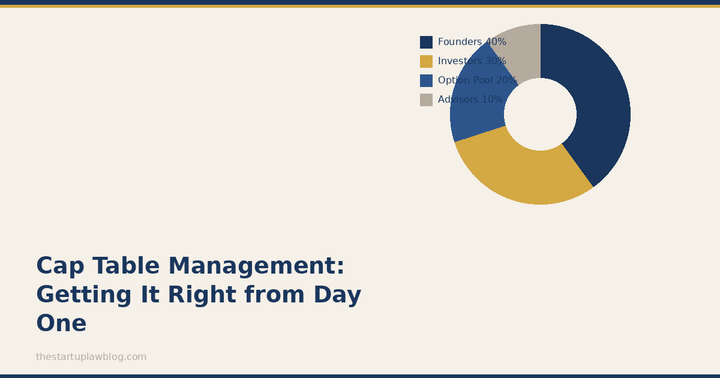
A cap table is the organized record of who owns what in your company — by holder, share class, share count, and the terms of each grant. It is not the legal source of truth; the underlying documents are. It is the working view everyone relies on, which is why it has to reconcile to those documents exactly. The misconceptions about it — what it is, what belongs on it, how much it matters — are expensive. They cost founders equity, stall financings, and complicate acquisitions.
This guide is written for founders who want to get the cap table right from day one — not because compliance is enjoyable, but because an accurate cap table is fundamental to a company that works.
What a Cap Table Is — and Isn't
A cap table answers one question: who owns what percentage of this company? Answering it carefully has more depth than it first appears.
It helps to see where the cap table sits in the chain of records. The legal source of truth is the underlying documents: stock purchase agreements, board consents authorizing each issuance, signed option grants and the option plan, SAFEs, convertible notes, and stock certificates. From those documents the company maintains a stock ledger — the running record of stock actually issued. The cap table is the analytical layer built on top of the ledger: it organizes ownership by holder, share class, share count, and terms, and extends it to what the ledger alone doesn't cover — the option pool, granted options, warrants, SAFEs and notes, and what ownership looks like fully diluted.
So the cap table is a working view, not the authority. When it disagrees with the documents, the documents win — which is exactly why it has to be reconciled back to them. It is also a living document, not a one-time snapshot: it changes as you grant options, issue stock, convert instruments, and bring on investors.
What Belongs on Your Cap Table
A cap table reflects every equity interest — not just issued stock, but options, warrants, SAFEs, and convertible notes. Many carry different terms and should be modeled separately.
Common stock is the equity founders and employees own (or will own after exercising options). It usually carries voting rights and sits last in the liquidation line — common holders are paid only after creditors and preferred. Pro-rata and participation rights are negotiated investor rights, not a default feature of common.
Preferred stock is what investors buy in priced rounds. It carries a liquidation preference (their money back first), protective provisions, and governance rights, and it is senior to common. Preferred usually votes with common on an as-converted basis, plus separate class votes on specified matters. Each round typically creates a new class — Series A, B, C — with its own terms, which is why a cap table tracks classes separately.
Options are the most demanding to track precisely. Granting an option isn't issuing stock — it's granting the right to buy stock later, valuable only if the exercise price is below what the shares are worth. Options sit in three states — granted, vested, exercised — and you need to track pool size, granted, vested, and exercised. Cap tables that treat options as if they don't count until exercised lose credibility the moment you raise money.
On the mechanics, only the board (or a comp committee) can grant options, which is why offer letters say “subject to board approval.” The grant happens on the board-approval date, and that date fixes the exercise price (the fair market value then) and the terms. One trap under the securities laws: don't have the board formally grant service-based options before the recipient has started work.
Warrants are similar to options but usually given to investors, advisors, or lenders as sweeteners — the right to buy stock at a set price within a set window. Track and model them separately; warrant exercise can move fully diluted capitalization meaningfully, and the exercise often lands at the worst moment, usually a down round.
SAFEs (Simple Agreements for Future Equity) auto-convert to preferred on your next preferred issuance. By their terms they are equity, not debt — no interest, no maturity date. The key point is priority: even before converting, a SAFE sits ahead of common. If the company is sold or wound up before a priced round, SAFE holders are generally paid before common, typically for at least their invested amount. A SAFE lives on its own ledger line from signing until conversion, so you model it in two states, pre- and post-conversion.
Convertible notes are debt with conversion terms. They typically convert to preferred at the next round, at a discount to the investor's price. If they haven't converted by maturity, the default under most notes is repayment of principal plus accrued interest — they don't simply become equity. Until conversion the note stays outstanding, tracked separately from issued equity.
Advisor equity, RSUs, and profits interests belong on the cap table too. Some are simple (advisor common stock), others less so (RSUs that vest and then carry further restrictions; LLC profits interests, whose tax treatment is its own subject). The rule is the same: if it's an equity interest or a right to one, it goes on the cap table.
Outstanding vs. Fully Diluted: The Critical Distinction
Investors think in fully diluted terms. If you aren't, you aren't seeing your company the way your future investors will.
Outstanding shares are shares issued and owned by someone right now — a snapshot of what exists today. Fully diluted shares include everything that could be issued: every option that could be exercised (vested or not), every SAFE and note that could convert, every warrant — plus the entire unallocated option pool. Fully diluted capitalization assumes maximum dilution — every conversion right exercised at once.
Investors care about fully diluted numbers because they show true economic ownership. When an investor says “we're investing at a $10 million post-money, giving us 25% fully diluted,” those words mean they're counting every potential share and assuming your option pool is fully reserved. The gap between outstanding and fully diluted is where real ownership quietly erodes — you can end up with 10% when you assumed 15%, not through any wrongdoing, just the math of financing.
A single example carries the rest of this guide. Two founders start with 4,000,000 shares each. Then they create a 1,000,000-share option pool and grant 200,000 of it to an early hire:
After creating the option pool
| Holder | Security | Shares | Fully Diluted % |
|---|---|---|---|
| Founder A | Common | 4,000,000 | 44.4% |
| Founder B | Common | 4,000,000 | 44.4% |
| Early hire | Options (granted) | 200,000 | 2.2% |
| Option pool (unallocated) | Options (reserved) | 800,000 | 8.9% |
| Total | 9,000,000 | 100% |
Outstanding is still 8,000,000 (only issued common). Fully diluted is 9,000,000. The founders sold nothing, yet their fully diluted ownership fell from 50% to 44.4% each just from creating the pool. That is the single most important habit in reading a cap table: watch the gap between outstanding and fully diluted, because that gap is your future dilution.
How a SAFE Converts — and Why You Absorb the Dilution
SAFEs and convertible notes are standard at seed. The logic is consistent; the work is modeling the pre- and post-conversion pictures.
Take founders holding 1,000,000 shares of common who raise $1,000,000 on a post-money SAFE with a $10,000,000 cap. (A SAFE may carry a cap, a discount, or both; with both, it converts at whichever price is lower for the holder.) Until the priced round, the SAFE sits on its own line with no fixed share count.
Now a Series A prices at $18.00 per share. The new investor puts in $1,000,000. The SAFE converts at its $10M cap — about $9.00 per share — because the cap beats the round price:
At the round — SAFE converts at its cap
| Holder | Security | Shares | Price/share | Ownership |
|---|---|---|---|---|
| Founders | Common | 1,000,000 | — | 85.7% |
| SAFE holder | Preferred (converted) | 111,111 | $9.00 | 9.5% |
| New investor | Preferred | 55,556 | $18.00 | 4.8% |
| Total | 1,166,667 | 100% |
Read the ownership column: the new investor and the SAFE holder wrote the same $1,000,000 check, but the SAFE holder owns roughly twice as much — because the cap let it convert at $9.00 while the round priced at $18.00. Price per share, not the size of the check, drives ownership.
A structural point worth internalizing: with a post-money SAFE (the standard since Y Combinator's 2018 rewrite), the holder's stake is locked at investment ÷ cap — here 10% — on a fully diluted basis that includes the option pool but excludes the new round's money. Because that slice is fixed, any option-pool top-up and any other SAFEs dilute you, not the holder; the holder is diluted only by the new money, which is why 10% becomes ~9.5% post-round. The name “post-money” is misleading — more dilution lands on you than it implies.
Convertible notes differ in one way that matters: they have a maturity date. If a note hasn't converted by maturity, the default under most notes is repayment of principal plus accrued interest. Parties often extend or convert by agreement, but none of that is automatic. The cap table treatment is otherwise the same: track the note separately until it converts, then model the post-conversion structure.
The Option Pool and the Pool Shuffle
The option pool is a block of shares reserved for future grants, carved out of authorized shares so you can grant equity to hires. An authorized-but-ungranted pool doesn't dilute anyone in real terms yet — real dilution happens as options are granted — but fully diluted math counts the whole authorized pool as if outstanding, so a large reserved pool lowers your ownership on paper and in any negotiation that uses fully diluted numbers.
The trap is what a Series A investor asks for, sometimes called the “pool shuffle.” Go in with an undersized pool and the investor will often ask you to expand it — to, say, 20% of post-money fully diluted — so there's room to hire. If that expansion is added to the pre-money cap table, the new shares come out of existing holders, mainly founders, while the investor's percentage stays protected.
Here it is with numbers. You close a $5,000,000 Series A at a $10,000,000 pre-money ($15,000,000 post). The investor takes 33.3%. Expand the pool from 5% to 20% of fully diluted as part of the deal, pre-money, and every one of those added points comes out of the founders:
The pool shuffle: who absorbs the new pool
| Holder | Without pool expansion | With expansion (pre-money) |
|---|---|---|
| Series A investor | 33.3% | 33.3% |
| Option pool | 5% | 20% |
| Founders + existing holders | 61.7% | 46.7% |
| Total | 100% | 100% |
The investor holds 33.3% either way. The pool jumps 15 points, and all 15 come out of the founders and existing holders. The fix isn't to refuse a pool — it's to size the pool to the hires you actually plan to make over the next 18 months, negotiate that number explicitly, and model it before you sign rather than waving it through alongside the valuation.
Pro Forma: Model Before You Sign
A pro forma cap table is a projection — what ownership looks like after a round closes, after SAFEs convert, or after options are exercised. It is how you make informed decisions before you commit to them.
Keep three views: your as-of-today cap table; a pro forma showing what the next round does (SAFE conversions, a refreshed pool, the new investor's shares); and the fully diluted view that assumes every option, warrant, and convertible converts at once. Building the pro forma is mechanical — start from today, add the investor's cash and shares at their price, expand the pool if required, show conversions and warrant exercises, then recompute everyone's percentage on the new total. A spreadsheet that shows current and projected states side by side is fine for a pre-Series A company; a tool does it automatically. Either way you need to understand the logic, because the pro forma is where you catch the surprise — the forgotten SAFE, the larger-than-expected conversion — with months to fix it instead of two weeks before closing.
The Mistakes That Recur
Most cap table problems fall into a handful of patterns, and knowing them is most of avoiding them:
- Lost early grants. An option granted to a first employee or advisor, never documented, becomes a scramble years later at Series A. Document every grant in writing from day one — board authorization plus a signed agreement — and keep the cap table matching the stock ledger.
- Wrong share counts. Internal inconsistencies between the cap table, the detailed holdings, and the ledger, usually from manual spreadsheet entry. Be religious about consistency checks, or use a tool that reconciles automatically.
- Not updating after exercises. When an option holder exercises, move the shares from “options” to “common issued.” Stale tables give investors a fully diluted number that's simply wrong.
- Mixing share classes. Every preferred round is a specific class with its own liquidation preference, voting, and anti-dilution terms. Track each class separately.
- Ignoring forfeiture. Unvested stock forfeited on departure must come off the holder's count and return to authorized-but-unissued. Show which shares are unvested.
- Mismodeling SAFEs and notes. A SAFE has no fixed share count until it converts — don't book it as issued shares, even though the post-money SAFE states it is intended to be treated as stock for tax purposes (a point that matters for QSBS holding periods); a note is debt that must still be modeled in fully diluted capitalization because it will convert. Both errors are common.
The antidote to all of them is process: document every grant, update after every corporate event, reconcile to the ledger regularly, and have someone who understands equity review the table before every round.
If any of these mistakes are already on your cap table, they get more expensive to fix with every financing. I do flat-fee formation and cap table cleanup, or book a 20-minute call to scope the problem first.
Tools vs. Spreadsheets
Should you use a tool like Carta or is Excel fine? It depends on stage and complexity, but a tool is increasingly worth it even early, because the cost is low and it prevents expensive mistakes.
A disciplined spreadsheet works for a simple structure — it's free, familiar, and fully under your control — but it's error-prone, has no built-in reconciliation or audit trail, and won't generate pro formas or model SAFE and note conversions for you. Cap table software (Carta, Pulley, Shareworks, AngelList) brings automated pro formas, conversion modeling, scenario planning, and — most valuable — a clean audit trail showing every change and who made it. For a company that has raised money or has double-digit option holders, a proper tool (typically $300–$2,000/year) is trivial against your burn and worth it. If you start in Excel, migrate as soon as you raise or cross ten option holders. What you must avoid is an unmaintained manual table that goes months without an update — that's how you end up with a mess that costs thousands to fix.
Legal Requirements: What the Law Actually Requires
The cap table sits on top of real legal requirements that founders tend to overlook until a financing or exit forces the issue.
A stock ledger. A formal record of issued shares, holder names and addresses, share counts, and issuance dates. A Delaware C-corporation (most venture-backed startups) is required to maintain one under Delaware law (8 Del. C. §§ 219, 224). It needn't be fancy — a spreadsheet is fine — but it must exist, be accurate, and reconcile to the cap table.
A transfer agent function. If you've issued shares, you either have a transfer agent or you're performing the function yourself, which most early companies do. As you grow and run employee stock plans, you may bring on a professional agent. Their records and the cap table should match exactly.
Section 12(g) of the Exchange Act. It requires SEC registration once a company has more than $10 million in total assets and either 2,000 holders of record or 500 holders who are not accredited investors — both the asset test and a holder threshold must be met, which is why it rarely bites early-stage companies but matters as you scale. One nuance founders miss: under Rule 12g5-1(a)(7), shares held by people who received them under an employee equity plan in exempt transactions are excluded from the holders-of-record count, with a safe harbor keyed to Rule 701(c). Employees who exercised options and still hold the stock generally don't count toward the threshold — no sell-back required — but non-employee holders can accumulate, so track your record-holder count.
Documented equity grants. Every option or stock grant needs a board (or committee) resolution authorizing it and a signed agreement. This is required by your option plan and protects you if anyone later claims an undocumented grant.
State rules. Equity compensation must be priced and documented properly under both federal law (IRC §409A) and state securities law. State compliance follows where your recipients live, not where you're incorporated — for example, grants to California-resident employees must satisfy California’s compensatory plan exemption (Corporations Code §25102(o)), including its notice filing.
The practical takeaway: set up your stock ledger and equity documentation correctly at the start with counsel, and maintain it. The requirements aren't onerous, but getting them wrong creates compounding problems.
Raising in the next six months? Investor diligence starts with the stock ledger and cap table. Book a 20-minute call before the term sheet, not after.
Before You Raise: What Investors Check
In a financing, your cap table becomes a central diligence artifact. Series A investors verify it against your stock ledger, option plan, board resolutions, and sometimes a transfer agent — so accuracy comes first; don't hope they won't notice a discrepancy. They want clear terms on contingent obligations (every outstanding SAFE and note, with conversion mechanics they can model), a reasonable structure (a founder group that still owns a meaningful stake, a pool sized appropriately, no odd classes or preferences), and no surprises. There's no magic founder-ownership percentage — how much you still own depends mostly on how much you raised and at what valuations, not on negotiating skill. What investors look for is that you own enough to stay motivated and that the table reflects deliberate choices rather than avoidable mistakes.
If your table is messy, clean it up before you start — not mid-process. Cleanup is unglamorous but doable: identify what you don't know, ask every holder to confirm their position, gather the original documents (option agreements, SAFEs, notes), rebuild a table that reconciles to all of it, and get board sign-off that it's accurate. It's far easier before a raise than during one.
Exit: Why It All Matters in the End
Cap table accuracy matters most at exit. In M&A, the acquirer diligences the table closely to ensure every holder is paid correctly at closing; discrepancies delay closings and occasionally kill deals, and they drive larger escrows to cover ownership disputes. In an IPO, the SEC requires detailed holdings disclosure and underwriters reconcile every position — every option that should have vested, every SAFE and note — with no tolerance for error. Both also turn on tax basis: each holder's basis comes from their original grant or purchase documentation, which the cap table ties back to. Maintain your cap table as if you might exit tomorrow, because eventually you will.
The Bottom Line
A good cap table gives you clarity about ownership, lets you model dilution, and creates a foundation for fundraising and exit. A bad one creates confusion, legal risk, and real cost to fix later. Maintaining a good one isn't complicated — it takes discipline, not advanced analysis: document every grant, update after every corporate event, reconcile to the ledger, and review before every round. Founders who treat the cap table with the rigor they give their financials negotiate better terms, attract better investors, and have smoother exits, because they understand the trade-offs and leave fewer surprises. Get it right from day one.
Ready to Build on a Solid Legal Foundation?
If you're forming a company, taking your first SAFE, or cleaning up a table before a raise, getting the equity structure right early is the cheapest it will ever be. I work with founders on exactly these decisions.
Schedule a free 20-minute call to talk through your cap table and equity structure.